"You walk, drive, bike or train in to work; you chat with your co-workers; you stress over your to-do list; you meet with your boss or underlings; you sit at your desk and stare into the screen. Before you get home, you’ve probably also eaten lunch, run errands, hit the gym or the basketball court, and perhaps visited a friend or a relative."
That's the first paragraph of an article about the problems of retirement. (What happens when you lose all that structure and stress?) But I found that description of the "typical workday" implausible. Even assuming the typical worker has a desk job, I find it hard to believe that on a typical day, a working person slots in exercise, errands, and social calls on the same day.
This narrative of busyness and stress... is that what life is really like?
You know, back in the 1950s and 60s, you would constantly read about the problem of excessive leisure time. In the modern world — with automation and so forth — people would have so much free time it would be a problem. Are we living in the solution to that problem? Who imposed that solution and how?
Showing posts with label too much drama. Show all posts
Showing posts with label too much drama. Show all posts
Saturday, March 2, 2013

Saturday, February 23, 2013
Speaking of being called to a higher law and speaking of speaking....
In the previous post, we're talking about what Jesus wrote in the sand and what he said out loud, in the New Testament story where the scribes and Pharisees present Jesus with the question of what to do with a woman who was caught in the act of adultery. In the Gospel text, we're told Jesus that wrote on the ground, but not what he wrote, and we're told that he subsequently spoke and said "Let him who is without sin among you be the first to throw a stone at her."
I'm putting up a separate post because I found the scene that sydney said he loved in the movie "The King of Kings." Made in 1927, it's a silent movie, so no one is saying anything out loud. We see what Jesus says written out on the intertitles, and we also see what he writes in the sand.
Beautiful filmmaking, particularly as the sand-words, not written in Roman letters, transform into our English words, naming the sins that the men in the crowd realize they've committed, and that's why they all turn and walk away.
That's not an accurate depiction of what happens in the biblical text though. The movie shows a mob on the verge of stoning the woman and Jesus intervenes and announces his rule about casting the first stone. Only thereafter, does he write the names of the sins in the sand. But in the Bible story, there is no angry mob with stones in hand. There are scribes and Pharisees demanding that Jesus deliver a legal opinion. Jesus bends down and writes on the ground instead of answering the question. Only after they persist does he stand up and pronounce his new rule, which causes the scribes and Pharisees to walk away — "beginning with the older ones." The movie would have you see the members of the mob acknowledging their sins and their consequent lack of qualification to cast the first stone. But the text has intellectuals trying to box Jesus in on a question of law, and Jesus getting the better of a conversation he didn't want to have in the first place.
It's not surprising that a movie plays up the visible drama, and it's also not surprising that when I — a law professor — read the text, I see something akin to a law school class. The professors try to stump the student and the student transcends their tricky game. To me, the part where Jesus bends over and writes in the sand is like what happens in a law school class when the lawprof poses a difficult hypothetical and the students bend their heads down and go through motions of writing. They don't want to answer. It's not that they're writing something magically revelatory and startling. But if the lawprof keeps pushing and calls on someone, an answer will be spoken out loud.
I guess the law-professorly interpretation of the text isn't terribly cinematic. It's no wonder the movies present an angry mob with stones in hand and Jesus miraculously knowing and changing the hearts of the sinners. (And the adulteress is an actress evincing exactly the form of sexiness that was fashionable in the year the movie was made. I love the eyeliner!)
But to me the lawprof interpretation is thrilling and dramatic. The professors think they've got the upper hand. They know the legal text and it's tough. And then the brilliant student who will soon be the greatest professor of all gets on top of the dialogue and says something they must accept as correct: If you're going to have strict rules and severe mechanisms of enforcement, you must apply them equally to everyone. This is the structural safeguard of equal protection of the laws that is the necessary component of a democratic system. If there can't be exceptions and special treatment for preferred people, legislatures will resist imposing harsh rules and painful punishments.
In this context, let me give you my favorite Justice Scalia quote, which happens to include one of the key words of Christianity: "Our salvation is the Equal Protection Clause, which requires the democratic majority to accept for themselves and their loved ones what they impose on you and me."
I'm putting up a separate post because I found the scene that sydney said he loved in the movie "The King of Kings." Made in 1927, it's a silent movie, so no one is saying anything out loud. We see what Jesus says written out on the intertitles, and we also see what he writes in the sand.
Beautiful filmmaking, particularly as the sand-words, not written in Roman letters, transform into our English words, naming the sins that the men in the crowd realize they've committed, and that's why they all turn and walk away.
That's not an accurate depiction of what happens in the biblical text though. The movie shows a mob on the verge of stoning the woman and Jesus intervenes and announces his rule about casting the first stone. Only thereafter, does he write the names of the sins in the sand. But in the Bible story, there is no angry mob with stones in hand. There are scribes and Pharisees demanding that Jesus deliver a legal opinion. Jesus bends down and writes on the ground instead of answering the question. Only after they persist does he stand up and pronounce his new rule, which causes the scribes and Pharisees to walk away — "beginning with the older ones." The movie would have you see the members of the mob acknowledging their sins and their consequent lack of qualification to cast the first stone. But the text has intellectuals trying to box Jesus in on a question of law, and Jesus getting the better of a conversation he didn't want to have in the first place.
It's not surprising that a movie plays up the visible drama, and it's also not surprising that when I — a law professor — read the text, I see something akin to a law school class. The professors try to stump the student and the student transcends their tricky game. To me, the part where Jesus bends over and writes in the sand is like what happens in a law school class when the lawprof poses a difficult hypothetical and the students bend their heads down and go through motions of writing. They don't want to answer. It's not that they're writing something magically revelatory and startling. But if the lawprof keeps pushing and calls on someone, an answer will be spoken out loud.
I guess the law-professorly interpretation of the text isn't terribly cinematic. It's no wonder the movies present an angry mob with stones in hand and Jesus miraculously knowing and changing the hearts of the sinners. (And the adulteress is an actress evincing exactly the form of sexiness that was fashionable in the year the movie was made. I love the eyeliner!)
But to me the lawprof interpretation is thrilling and dramatic. The professors think they've got the upper hand. They know the legal text and it's tough. And then the brilliant student who will soon be the greatest professor of all gets on top of the dialogue and says something they must accept as correct: If you're going to have strict rules and severe mechanisms of enforcement, you must apply them equally to everyone. This is the structural safeguard of equal protection of the laws that is the necessary component of a democratic system. If there can't be exceptions and special treatment for preferred people, legislatures will resist imposing harsh rules and painful punishments.
In this context, let me give you my favorite Justice Scalia quote, which happens to include one of the key words of Christianity: "Our salvation is the Equal Protection Clause, which requires the democratic majority to accept for themselves and their loved ones what they impose on you and me."
Thursday, December 27, 2012
Why was that prop so important to David Gregory?
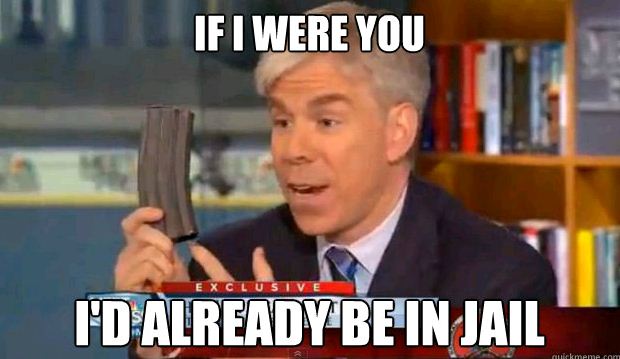
"Yeah, asking for permission is pretty damning when you ignore what you are told directly from the law enforcement authority and do it anyway."
But what it tells us is that the prop was really, really important to Gregory. Let's think about why. He knew he was going to have NRA CEO Wayne LaPierre across the table and that he'd push him with one question after another, building the pressure. Here's how that moment looked:
You hear the tension in Gregory's voice as he's about to confront LaPierre with the prop — actually 2 props: the high-capacity magazine and then the smaller one. At the point when Gregory picks up the first prop, you see his eyes dart over to the side. He doesn't have the script memorized, but the precise text is important as he displays one prop and then the other. He need the prompter.
Of course, if this prop display is supposed to be explosive, it doesn't work, because LaPierre is good at not getting agitated. Predictably good, so Gregory's routine looks silly to me. But maybe it inflamed some people in the "Meet the Press" viewership. Maybe there were lots of folks at home going "OMG that thing is huge!!"
I'm trying to think of other examples in political/policy debates when somebody whipped out a prop for dramatic effect. Especially examples where it really worked. I remember President Clinton waggling his pen. Anything else?
ADDED: I was thinking about the value of a fetus replica for a pro-lifers, and, googling, happened upon this 3D-printed replica made from an MRI image.
UPDATE: I figured it out!
Subscribe to:
Posts (Atom)