Showing posts with label Congress. Show all posts

Wednesday, November 6, 2013

Minimizing the crimes of women (in a serious case about federalism).

Here's how WaPo's Robert Barnes begins his report about a case of attempted murder:
A melodramatic love triangle begat a ham-handed revenge poisoning. That led to what one Supreme Court justice called an “unimaginable” federal prosecution of the scorned wife under a law enacted to implement a global chemical weapons treaty.
As long as the victim didn't actually die, it's just some kind of joke?

Now, there is a problem with the feds taking over this prosecution, and that should be the focus of the story about this case. But you should see how outrageous it is to diminish the criminal behavior in this gendered fashion.
Carol Anne Bond, a Pennsylvania microbiologist... ordered a rare blend of chemicals, partly off the Internet, and over the next several months tried to poison [Myrlinda] Haynes 24 times by putting them on her doorknob, car and, critically, mailbox.
Just some nutty lady's bumbling parry in a cat fight?
Federal prosecutors charged Bond with violating the 1998 Chemical Weapons Convention Implementation Act, a law based on the chemical weapons ban treaty that is signed by all but four of the world’s nations.
The problem here is not the unseriousness of attempted murder. It's that murder is traditionally left to the states, and the federal government is — at least theoretically — a government of limited, enumerated powers. With this important constitutional principle at stake, Bond is represented by the great ex-Solicitor General Paul Clement:
Clement...  said that if the law implementing the treaty “really does reach every malicious use of chemicals anywhere in the nation, as the government insists,” then it violates the “bedrock principle of our federalist system that Congress lacks a general police power to criminalize conduct” that does not have distinctly federal concern....
[Justice Elena Kagan] said the treaty gave Congress the power to pass implementing legislation. “So you have to find a constraint on the treaty power. Where does it come from?” she demanded.

Justice Sonia Sotomayor worried about the courts hamstringing efforts to deal with terrorism. 
Writing tip for Barnes: If you've already got "ham-handed," don't use "hamstringing." Too much ham.
“It would be deeply ironic that we have expended so much energy criticizing Syria, when if this court were now to declare that our joining or creating legislation to implement the treaty was unconstitutional,” she said.
Now, we're getting to the real meat of it. The government was represented by the current Solicitor General, Donald B. Verrilli Jr.
Chief Justice John G. Roberts Jr., who posed no questions to Clement, asked Verrilli if it would be possible for the president to join a treaty that gives national governments all powers and for Congress then to put in place such legislation.

When Verrilli said that would be unimaginable, Justice Anthony M. Kennedy shot back: “It also seems unimaginable that you would bring this prosecution.”

That led the conservative justices — plus Justice Stephen G. Breyer, who usually sides with the liberals — to unleash a barrage of hypotheticals of what could be prosecuted under the broad law, which covers chemicals that could harm humans or animals: a wheelbarrow full of kerosene; a poisoned potato given to a horse; the performance-enhancing drugs allegedly used by cyclist Lance Armstrong.

“Would it shock you if I told you that a few days ago my wife and I distributed toxic chemicals to a great number of children?” Alito asked Verrilli, drawing laughter from the court’s spectators. He explained that chocolate Halloween candy is “poison to dogs, so it’s a toxic chemical” under the act.

Verrilli chafed, saying, “This is serious business.”
Yes, it truly is. It's easy to see Kennedy's point: The federal government shouldn't have chosen to prosecute this case. But it did, and now what? It's easy to think: The central government needs ample power to do everything that might need to be done at a national level and it should refrain from using that power to deal with matters that are better left to the states.

But it doesn't refrain.

Monday, October 7, 2013

Which state attorneys general "were throwing away important points of law, not just for their state, but for the other 49"?

In his New York Magazine interview, Justice Scalia says that these days, when the states have cases in the Supreme Court, they send in "people who know how to conduct appellate argument." But:
In the old days, it would be the attorney general—usually an elected attorney general. And if he gets a case into the Supreme Court [pumps his fist], he’s going to argue it himself! Get the press and whatnot. Some of them were just disasters. They were throwing away important points of law, not just for their state, but for the other 49.
Who, specifically, do you think he might have been talking about there? I'll tell you who I thought of when I read that: Roger A. Tellinghuisen, the Attorney General for the state of South Dakota, whose argument in South Dakota v. Dole — the key case about Congress's power to attach conditions to spending — threw away an important point of law that could have limited the spending power. For years, when I teach that case, I've urged students to listen to that argument as a lesson in what not to do.


Tellinghuisen was only prepared to talk about the 21st Amendment as a limit on the Spending Power. There's an argument in an amicus brief from the National Conference of State Legislatures that O'Connor pushes Tellinghuisen to use, about how related the condition needs to be to the spending, and Tellinghuisen says he's "not prepared to argue that particular fine point." His case is about a condition that relates to the sale of liquor, so he's all about the amendment that preserves state legislative power in that area, as if all that matters is winning this particular case — which he didn't — and not about the doctrine that will apply to many other cases in the future.

In the 7-to-2 opinion in Dole, written by Chief Justice Rehnquist, we see that the thrown away point in a footnote (boldface added):
Our cases have not required that we define the outer bounds of the "germaneness" or "relatedness" limitation on the imposition of conditions under the spending power. Amici urge that we take this occasion to establish that a condition on federal funds is legitimate only if it relates directly to the purpose of the expenditure to which it is attached. See Brief for National Conference of State Legislatures et al. as Amici Curiae 10. Because petitioner has not sought such a restriction, see Tr. of Oral Arg. 19-21, and because we find any such limitation on conditional federal grants satisfied in this case in any event, we do not address whether conditions less directly related to the particular purpose of the expenditure might be outside the bounds of the spending power.
The Court found spending on highway construction sufficiently related to the age at which a person is allowed to buy alcohol. Dissenting, Justice O'Connor said:
When Congress appropriates money to build a highway, it is entitled to insist that the highway be a safe one. But it is not entitled to insist as a condition of the use of highway funds that the State impose or change regulations in other areas of the State's social and economic life because of an attenuated or tangential relationship to highway use or safety. Indeed, if the rule were otherwise, the Congress could effectively regulate almost any area of a State's social, political, or economic life on the theory that use of the interstate transportation system is somehow enhanced.
What an astounding missed opportunity to limit conditional spending! 

I was going to make a list titled 9 Things Justice Scalia said in his New York Magazine interview.

Most interviews with Supreme Court Justices are not even worth that. The Justices say such predictable things that I might pull out the most interesting thing or, not finding one, I skip blogging it altogether. But this interview by Jennifer Senior is so good (and long) that as I read it (before getting out of bed just now) I decided I'd pull out 9 items (the number 9 pops into my head when I'm thinking about Supreme Court Justices) and do something like:

1. He calls DVDs "CDs" (and the "CDs" in question are episodes of "Seinfeld").

2. He thinks "blurbing" on the internet is narcissistic and interferes with the process of becoming a good writer.

3. He's most proud of his opinion in Morrison v. Olson (where he's the lone dissenter in the decision that found the Independent Counsel law constitutional).

4. He thinks Congress is truly dangerous — if only it would actually use the powers it has.

5. He's not "a fan of different levels of scrutiny" in constitutional interpretation.

6. He believes in the Devil, because it's Catholic doctrine, but maybe because it's a helpful metaphor.

7. He plays poker, claims to be good at poker, but is unfamiliar with the term "tell."

8. He has friends that he knows or "very much suspect[s]" are homosexual, and doesn't like the interviewer's suggestion that — re homosexuality — he's "softened."

9. To imitate Rehnquist, he "turns his nose up theatrically, flutters his hand in dismissal."

There are more than 9 things worth treating that way...

10. You have to be very careful picking law clerks because "one dud will ruin your year."

11. His dissents have the tone they do — "breezy" and with "some thrust" — because they're written for law students and law students will read that sort of thing.

12. Back in the 80s, Supreme Court opinions were loaded with the "garbage" of legislative history (and they're not anymore, and he takes credit for that).

13. He wants the Catholic Church to be more evangelistic.

14. He blames "The Gipper" for turning the State of the Union Address into the "childish spectacle" it's become.

15. He likes Bill Bennett's radio show.

16. He won't read The Washington Post anymore because it became so "shrilly, shrilly liberal" that he can't "handle it."

17. The worst thing about the Constitution, he thinks, is that it's way too hard to amend it.

18. He "repudiate[s]" his old statement that his originalism is "fainthearted."

But I decided (at the point of finally getting out of bed) that I wanted to do a series of posts on a number of topics, taking them on individually and blogging — or blurbing — my way through and going somewhere with the idea. It's the Devil topic in particular that made me want to do that. I know there are people who are linking to this interview just to say Scalia believes in the Devil, but — is the Devil making me do this? — I feel there's a lot in his discussion of the Devil that needs to be taken apart and examined. The blog will blurb and burble.

ADDED: Here's the promised Devil post. And here's a post about a topic that isn't represented on that list of 18 things.

Friday, September 6, 2013

"Speaking crudely, football and sport are 'important'; the worship of fashion, the buying of clothes 'trivial.'"

Wrote Virginia Woolf — "it is the masculine values that prevail."

An old quote, echoed here by fashion writer Robin Givhan:
I always compare fashion to sports, and when you think about some of the issues that have come up in sports, particularly in baseball, with steroid use and all of that, you wonder, “Why is Congress having hearings and calling Barry Bonds? What does that have to do with anything?” And you realize it’s because we as a culture, or at least some people in our culture, take sports really seriously, and they believe that it represents something about who we are, about our belief in fair play, and they recognize that that has an impact on younger people. I don’t think that fashion will really change until that same sort of recognition happens. 
I agree with the proposition that sports and fashion are exactly equally important and that it's helpful to keep that in mind even as you personally feel more drawn to one than the other. I hate to think that the essence of being taken seriously is that Congress holds hearings, but I don't think Givhan is saying she wants congressional hearings into the problems of the fashion industry. The baseball hearings are evidence that sports are taken seriously, too seriously maybe.

Keep the equation of sports and fashion in mind and use it to test whether we're taking something more seriously or less seriously than we should. This is similar to the way we analyze reactions to Obama by asking what if Bush had done the same thing.

ADDED: Sports are as related to maleness as fashion is related to femaleness, and the 2 things are equally important. You can get by with 0% of your interest in sports as you do your sports/fashion allocation, but you can't get by with 0% of your interest in fashion, since you must wear clothes. Set your percents however you want other than that.

The total amount of time that is your 100% varies from person to person. I'll bet my 100% fashion/sports time is less than yours!

Thursday, September 5, 2013

"Republicans and Democrats alike feel the Syria resolution would not pass today, even after party leaders endorsed it."

Says Politico, "[b]ased on talking to the smartest members and aides we know."
House Republican staffers tell us that several key members are unsatisfied so far by the classified briefings from the administration. A top aide said the administration has failed to make a compelling case “beyond spasmodic moral outrage.”

"Nobody has really heard how this is going to either improve the situation on the ground in Syria, improve the situation for pro-democracy groups, not play into al-Qaeda’s hands, not play into Russia’s hands, not play into China’s hands,” the aide said. “Members felt the administration hasn’t made a case about how this is going to stop it from happening again. They’re putting a lot of chips on: ‘We have to do this for Israel,’ or, ‘We have to do this because it’s unacceptable.’”

Sunday, September 1, 2013

"How do you ask John Kerry to be the fall guy, go on all the Sunday morning talk shows, and try to cover up for your own leadership mistake?"

Asks Meade, in the comments to "How do you ask a man to be the [first] man to die for a mistake?" — which was yesterday's post, titled after Meade's rewrite of Kerry's famous question, " How do you ask a man to be the last man to die for a mistake?"

So, we watched the talk shows today, and in addition to Kerry, on "Meet the Press," there was Rand Paul, and just about the first thing he said was:
... I think it's a mistake to get involved in the Syrian civil war. And what I want would ask John Kerry is, he's famous for saying, "How can you ask a man to be the last one to die for a mistake?" I would ask John Kerry, "How can you ask a man to be the first one to die from a mistake?"
I'm not saying Rand reads the Althouse blog, but hi, Rand. Rand was remarkable — or seemed remarkable in contrast to Kerry, who preceded him — because he listened to the questions and appeared to think in real time and then verbalize actual answers.

Kerry filibustered, evading David Gregory's questions, such as "If Congress says no [to an attack on Syria], the president will act regardless of what Congress says?" Nonanswer: "I said that the president has the authority to act, but the Congress is going to do what's right here." Note the "I said," like he's already answered and now he's forced to repeat himself.

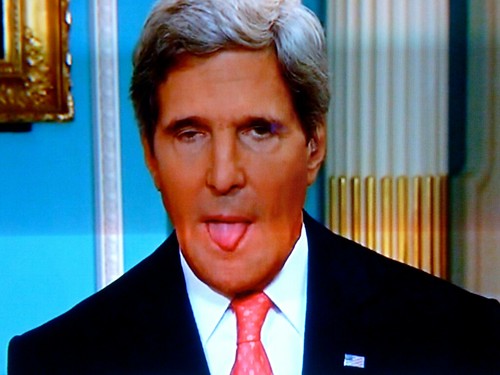
Somehow I started feeling sorry for Kerry, having to be the one to go around to all the talk shows. And he looked so weary. He looked awful, weirdly different from usual, like something wasn't right. His hair was fine. (It's a wig, right?) But his eyes were mismatched, and he kept sticking out his tongue like this:

Untitled

Is there some tongue-out disease going around this week, some virulence of chapped lips? (Cf. "21 Obnoxious Photos of Miley’s Tongue.") That particular shot was taken immediately after he said the words "the American people," which annoyed Meade so much that he backtracked to pause it so I could photograph it.

What I really want to do, now that I have the transcript, is go through and find all the ways Kerry managed to say that the President needs to go to Congress and doesn't need to go to Congress. I'll update this post and show you soon.

ADDED: Here's how Kerry avoided saying the President needed authority from Congress:
Now why go to Congress? Because the United States of America is stronger when the Congress of the United States representing the people and the President of the United States are acting together. And the president wants that strength represented in this initiative….

The issue originally was, "Should the President of the United States take action…?"… There was no decision not to do that. And the President has the right to do that…. The president then made the decision that he thought we would be stronger and the United States would act with greater moral authority and greater strength if we acted in a united way….

He believes we need to move, he's made his decision. Now it's up to the Congress of the United States to join him….

I hope and pray it will be seen as careful deliberation, as appropriate exercise of American constitutional process. The United States is strongest when the Congress speaks with the president….

[To the question: “If Congress says no, the president will act regardless of what Congress says?”] I said that the president has the authority to act, but the Congress is going to do what's right here.
I was intrigued by the phrase "American constitutional process." If the President can act on his own — and almost did — then what "constitutional process" is in seeking approval? That's the only time Kerry mentions the Constitution, and note how quickly he shifts to assertions about what makes the United States "strongest." He seems to say the Congress should go along with the President to make the country strong, but the Constitution has the safeguard of the separation of powers, and it's only because Congress operates independently that the conjunction of presidential and congressional power yields strength. Congress can't produce strength in the country by becoming compliant to the President. Though that does make the President stronger, the President is not the country.

Tuesday, June 25, 2013

Justice Ginsburg says the "equal sovereignty" principle "is capable of much mischief" and brainstorms ideas for vexatious litigation.

In her dissenting opinion in Shelby County v. Holder (PDF), she frets about all the federal laws that treat states differently from each other and could be subjected to attacks based on the majority's "fundamental principle of equal sovereignty" among the states:
See, e.g., 28 U. S. C. §3704 (no State may operate or permit a sports-related gambling scheme, unless that State con­ducted such a scheme “at any time during the period beginning January 1, 1976, and ending August 31, 1990”); 26 U. S. C. §142(l) (EPA required to locate green building project in a State meeting specified population criteria); 42 U. S. C. §3796bb (at least 50 percent of rural drug enforcement assistance funding must be allocated to States with “a population density of fifty-two or fewer persons per square mile or a State in which the largest county has fewer than one hundred and fifty thousand people, based on the decennial census of 1990 through fiscal year 1997”); §§13925, 13971 (similar population criteria for funding to combat rural domestic violence); §10136 (specifying rules applicable to Nevada’s Yucca Mountain nuclear waste site, and providing that “[n]o State, other than the State of Nevada, may receive financial assistance under this sub­section after December 22, 1987”). 
It seems to me that the "equal sovereignty" principle is an important structural safeguard in the federal legislative process, protecting us from the democratic dysfunctions of things like the "Cornhusker Kickback." This is exactly the sort of thing that ought to shake judges out of the usual deference to Congress. 

Thursday, June 20, 2013

Congress's ill-starred effort to prescribe the orthodoxy of anti-prostitution.

Today, the Supreme Court found that it violated the First Amendment for Congress to grant anti-AIDS funds only to organizations that have "a policy explicitly opposing prostitution and sex trafficking." The case is Agency for International Development v. Alliance for Open Society International, Inc. (PDF).

Chief Justice Roberts, writing for the majority, ends his opinion with what is perhaps the most lofty expression in all of the Supreme Court Reports:
We cannot improve upon what Justice Jackson wrote for the Court 70 years ago: "If there is any fixed star in our constitutional constellation, it is that no official, high or petty, can prescribe what shall be orthodox in politics, nationalism, religion, or other matters of opinion or force citizens to confess by word or act their faith therein." [West Virginia State Board of Education v. Barnette, 319 U. S. 624, 642 (1943).
Justice Scalia (who's joined by Thomas) does not appreciate the invocation of Jackson's famously fixed star. He said it was a distraction from "the elephant in the room: that the Government is not forcing anyone to say anything." Congress simply demanded that the recipients of federal funds have "an ideological commitment relevant" to the work that the government is funding. Barnette was about requiring American children to pledge allegiance to the flag. But the U.S. Constitution itself requires legislators to take an oath or affirmation of allegiance to the government, and that shows that the founders believed in "the wisdom of imposing affirmative ideological commitments prerequisite to assisting in the government’s work."

You may remember a 1991 case called Rust v. Sullivan, where the Supreme Court upheld HHS regulations that required recipients of federal health-care grants for family planning services to refrain from discussing abortion as an option. Congress was exercising its spending power, and:
That power includes the authority to impose limits on the use of such funds to ensure they are used in the manner Congress intends. Rust v. Sullivan, 500 U. S. 173, 195, n. 4 (1991) (“Congress’ power to allocate funds for public purposes includes an ancillary power to ensure that those funds are properly applied to the prescribed use.”)
In Rust, Roberts says, Congress was defining the program it funded, which was to "encourage only particular family planning methods." Even though Congress limited what they could say as they carried out the funded activity they agreed to do, it did not try to limit their speech outside of the program and it did not require them to espouse a government-prescribed anti-abortion policy.

Justice Scalia said that the government is entitled have its own viewpoints, and it can express that viewpoint by excluding recipients who believe things they don't want promoted.
If the organization Hamas—reputed to have an efficient system for delivering welfare—were excluded from a program for the distribution of U. S. food assistance, no one could reasonably object. And that would remain true if Hamas were an organization of United States citizens entitled to the protection of the Constitution. So long as the unfunded organization remains free to engage in its activities (including anti-American propaganda) “without federal assistance,” United States v. American Library Assn., Inc., 539 U. S. 194, 212 (2003) (plurality), refusing to make use of its assistance for an enterprise to which it is opposed does not abridge its speech. And the same is true when the rejected organization is not affirmatively opposed to, but merely unsupportive of, the object of the federal program, which appears to be the case here. (Respondents do not promote prostitution, but neither do they wish to oppose it.) A federal program to encourage healthy eating habits need not be administered by the American Gourmet Society, which has nothing against healthy food but does not insist upon it....
So how much do you worry about the government exploiting its immense power to channel money into controlling what people are able to say?  Just don't fall for the temptation of taking the money and you can say whatever you want — that's the Scaliaesque answer.

As the government rakes in more and more money and turns around and redistributes it with strings attached, I'd say we should worry a lot. I'm glad to see the free speech right strengthened here.

Tuesday, June 4, 2013

"I am not here as a serf or vassal. I am not begging my lords for mercy."

"I’m a born free American woman, wife, mother and citizen. And I’m telling my government that you’ve forgotten your place. It’s not your responsibility to look out for my well-being, and to monitor my speech. It’s not your right to assert an agenda. Your post, the post that you occupy, exists to preserve American liberty. You’ve sworn to perform that duty. And you have faltered."

Becky Gerritson of the Wetumpka Tea Party, testifying today before the House Ways and Means Committee about abuse by the IRS.

Friday, May 31, 2013

Should Republicans make the 2014 elections about Obama?

"'I don’t think I’d personalize it,' said John Linder, the former congressman from Georgia who ran the National Republican Congressional Committee during the late 1990s while Newt Gingrich and House Republicans were preparing an impeachment case against President Bill Clinton."
Mr. Linder said he fought and lost a battle with Mr. Gingrich over their strategy in the 1998 midterm elections, which Mr. Gingrich thought should be focused on assailing Mr. Clinton’s character.

“I didn’t want to talk about Clinton at all,” Mr. Linder recalled, saying the same logic should apply today. “Obama was not in the Justice Department. Obama was not working in the I.R.S.” His advice? “Don’t overreach,” he said.
The analogy to 1998 isn't exact. Clinton was active in doing the things that got him into impeachment trouble, but those things weren't about the political ideology that he shared with the Democrats in Congress. Voters might want Congress to go after him more aggressively, but it made sense, if you agreed with Democratic Party ideology, to regard the sex-and-lies scandal as secondary to the overall legislative agenda when deciding who should represent your district in Congress.

Obama is — or looks — passive. You've got the difficulty of attaching him to the scandals. You have to argue that he should have known more, or he must have known more than we're seeing, or he's not rigorous enough in supervising his multitudinous underlings, or he's responsible for the "climate" within which everyone understands the sorts of things they ought to do to satisfy their superiors. Voters need to be convinced to blame Obama for the things that have gone wrong. But what has gone wrong is something that is wrong with governing.

In both cases — Clinton and Obama — there's room for the argument that we need stronger supervision from Congress. But going after Clinton over sex and lying was only loosely connected to the ongoing work of government. With Obama, the most central work of government has been compromised. It's not just a matter of letting the President off the hook and moving forward to deal with the real problems that affect Americans. Regardless of how directly Obama is implicated and how much any given voter wants to blame Obama, the scandals make a strong argument for opposite-party control of Congress.

That's all I'm going to write this morning about how 2014 is different from 1998 other than to say I have not made the argument that Republicans would do well to personalize the election.

Wednesday, May 8, 2013

"House Hearing on U.S. Consulate Attack in Benghazi, Libya."

"The House Oversight and Government Reform Committee conducts a hearing with Foreign Service officers focusing on information turned over to the committee by administration whistle-blowers on the Benghazi terrorist attacks." Live streaming here — on C-Span3, beginning in a few minutes.

Wednesday, March 27, 2013

"Congress decided to reflect and honor a collective moral judgment and to express moral disapproval of homosexuality."

Justice Kagan quotes from the House of Representatives legislative history of the 1996 Defense of Marriage Act at today's oral argument. (Audio and transcript here. The quote in the title corrects a slightly garbled transcript.) There's a murmur of laughter. Here, listen. This clip includes the response from the very well-prepared Paul Clement, who's defending the federal statute.


By the way, the quote in the post title appeared in the amicus brief filed by 172 Members of the U.S. House of Representatives and 40 U.S. Senators. Here's the context, showing something of the case law that makes this a powerful argument (to anyone who accepts the precedents and is willing to consider the legislative history):
DOMA is... unlike most other Acts of Congress in another critical respect: A clearly stated purpose for its enactment was to express moral disapproval of a disfavored minority group. Many proponents repeatedly stated their intent to "honor a collective moral judgment" reflecting "moral disapproval  of homosexuality" (House Report at 15-16). Chairman Hyde explained, for example, that "most people do not approve of homosexual conduct * * * and they express their disapprobation through the law." 142 Cong. Rec. H7501 (July 12, 1996). Lead Senate sponsor Don Nickles likewise stated that "we find ourselves at the point today that this legislation is needed" because of the "erosion of values." 142 Cong. Rec. S4870 (May 8, 1996).
Those views no doubt reflect "profound and deep convictions," reflecting the "ethical and moral principles" of those who hold them. [Citation to Lawrence v. Texas]. But this Court has made clear that such "considerations do not answer the question before us." Ibid. No matter how sincerely held, such beliefs are not a constitutionally valid basis for enacting "a classification of persons undertaken for its own sake" and "den[ying] them protection across the board." [Citation to Romer v. Evans].

Saturday, March 2, 2013

Listen to the oral argument in the Voting Rights Act case.

Audio here. There's also a summary there of what the case is about, basically whether Congress has the power to continue to require some states, but not others, to get approval from the federal government before they change any election laws. The states are covered based on a formula that looks at how things were in 1972.

I was especially impressed by something Justice Breyer said at 65:42. Transcript (PDF):
If you draw a red line around the States that are in, at least some of those States have a better record than some of the States that are out. So in 1965, well, we have history. We have 200 years or perhaps of slavery. We have 80 years or so of legal segregation. We have had 41 years of this statute. And this statute has helped, a lot. So therefore Congress in 2005 looks back and says don't change horses in the middle of the stream, because we still have a ways to go.

Now the question is, is it rational to do that? And people could differ on that. And one thing to say is, of course this is aimed at States. What do you think the Civil War was about? Of course it was aimed at treating some States differently than others. And at some point that historical and practical sunset/no sunset, renew what worked type of justification runs out. And the question, I think, is has it run out now?

And now you tell me when does it run out? What is the standard for when it runs out? Never? That's something you have heard people worried about. Does it never run out? Or does it run out, but not yet?

Or do we have a clear case where at least it doesn't run out now?
That's a sharp summary to the question and it's fair, though it leans toward upholding what Congress did. I think Breyer framed his question around something Justice Scalia said earlier — which I think is what "you have heard people worried about" refers to. At 50:30 in the audio, Scalia notes that the Court generally leaves "racial questions such as this one... to Congress." But congressional support for reauthorizing the act has increased over the years, even though the need for it has lessened.
[That increased congressional support] is attributable, very likely attributable, to a phenomenon that is called perpetuation of racial entitlement. It's been written about. Whenever a society adopts racial entitlements, it is very difficult to get out of them through the normal political processes. I don't think there is anything to be gained by any Senator to vote against continuation of this act. And I am fairly confident it will be reenacted in perpetuity unless — unless a court can say it does not comport with the Constitution. You have to show, when you are treating different States differently, that there's a good reason for it.... It's -- it's a concern that this is not the kind of a question you can leave to Congress.
Scalia is saying the Court needs to act because there is a dysfunction in the political process that keeps Congress from looking rationally at the actual need for the remedy that made so much sense back in 1965. Breyer's response is: Congress is still in the middle of doing what was once badly needed, it's not obvious that the endpoint has been reached, and therefore it's not time yet for the Court to act.

Thursday, February 7, 2013

How to tell look-alike politicans apart.

There are various techniques reporters employ:
I used to make notes next to the names of members I was looking for — intentionally sloppy so they wouldn't be legible to the member as we huddled over my notebook off the floor of the House chamber — of their distinguishing characteristics. "Bald. Bald with glasses. Combover. Close-talker." And there is this classic method, offered by a former colleague on the beat: "My trick is, when you're talking to a member and you don't remember who they are, you ask at the end of the conversation — even if you couldn’t give a shit — 'And how will this affect your district?' So that way it narrows it down, and you can return to the picture book to look them up."
Several great examples of look-alikes at the link, including:


Freaky! I'd scribble the illegible note that Yoder is the one with the slightly devilish eyebrows. 

Saturday, January 26, 2013

"They would be explaining what your benefits were, then all of a sudden this embarrassed look would flash across their face like, 'Oh, sorry. I guess this doesn’t apply to you.'"

For the new gay members of Congress, "their freshman orientation sessions were a reminder of just how unequally the law treats them, since the entity that cuts their paychecks and provides benefits — the United States government — is barred from recognizing their relationships."

I wish members of Congress would have more opportunities to experience the embarrassment of having to live with the people their laws oppress. And I don't mean just things having to do with whether their colleagues are getting paid enough.

Wednesday, January 23, 2013

Hillary time!

Here. Testifying on Benghazi to the Senate Foreign Affairs Committee. 

ADDED, 8:31 A.M.: Hillary has a fairly authentic crying quality in her voice as she speaks of embracing the families of those who died in the attack. That comes just after she says in a steely voice that those who serve in countries like Libya know they are going into a dangerous place and cannot work "in a bunker." Risk comes with the territory, and Chris Stevens fully understood where he was going and what he would face.

Thursday, January 3, 2013

"As the 113th Congress takes its place in the Capitol, John Boehner has been re-elected speaker of the House..."

With 200 votes, says email, just now, from CNN.
Several conservative members of Boehner’s Republican caucus voted against him and others didn’t vote in protest of what they see as the speaker not holding a hard enough line on fiscal issues.

C-Span is sorry it wrote "Just Plain Dick" and "I Want You to Shut the F#ck Up" at the top of your screen.

"Now on C-SPAN2: Just Plain Dick" appeared on screen at 1:30 a.m. ET on January 1 as Sen. Tom Harkin (D-IA) was speaking in the Senate:


Some people thought C-SPAN had been hacked, but it was just doing its usual thing of cutting away from scheduled shows when there's action on the floor of the House or Senate. The "Now on C-SPAN2" caption referred to a scheduled show, which was a BookTV interview with Kevin Mattson about his book "Just Plain Dick: Richard Nixon’s Checkers Speech and the 'Rocking, Socking' Election of 1952."

"I Want You to Shut the F#ck Up" was another accidentally apt book title that captioned congressional blabbery.