Showing posts with label Satan. Show all posts

Wednesday, November 27, 2013

"For his senior thesis, he turned the Bill of Rights into a play. 'I made each amendment into a character...'"

"'The First Amendment is a loudmouth guy who won't shut up. The Second Amendment guy, all he wanted to talk about was his gun collection. Then the 10th Amendment, the one where they say leave the rest for the states to decide, he was a guy with no self-esteem.'"

From the Wikipedia article on David E. Kelley, the TV writer and producer (who made "Ally McBeal," "Boston Legal," and a lot of other shows). The play in question was written while he was an undergrad at Princeton. He later attended Boston University School of Law and was a lawyer before he branched out into TV writing.

How did I end up on that article, of all articles? I got there from the page on Michelle Pfeiffer (who happens to be his wife), and I was reading about her because we were talking about the movie (which I love) "The Witches of Eastwick," which we were talking about because the Susan Sarandon character in that movie is an elementary school music teacher who has some scenes with the band that are reminiscent of the school band scenes in "The Music Man." (Sarandon is inspired by the Devil, and the Music Man is a bit of a devil, a trickster palming off a fake system for kids playing musical instruments.)

And we were talking about "The Music Man" because Meade was singing "'Til There Was You" as a consequence of my asking for more examples of songs about nature seeming to express the feelings of the singer, such as "Close to You," which begins "Why do birds suddenly appear every time you walk near." I rejected "'Til There Was You" as an example of what I was looking for, since it's not a fantasy about nature, but a true statement of the singer's increased awareness of the beauty of nature. "There were birds in the sky/But I never saw them winging/No, I never saw them at all/'Til there was you."

The "Close to You" fantasy is really the same idea, expressed subjectively. The birds seem to appear because love has heightened the singer's awareness of the existence of birds, but she doesn't seem to understand, as does Marian the Librarian (the lovely Shirley Jones, whom you can cause to suddenly appear if you click on that last link, above). The "Close to You" singer (let's pick Karen Carpenter) presents herself as baffled by the phenomenon. She asks "why?" Marian/Shirley is the fully/overly rational woman, the librarian with book-learning of the existence of birds, and she too has some fantasy — the notion of never having seen birds at all before the arrival of love. She means: I never really saw them. Or perhaps: Seeing without the emotional lift of believing that the birds are about this love of mine is not really seeing.

So continue this long train of thought with me as we circle back to the Bill of Rights and talk about the infusion of human emotion into that which is not human. Do you picture the rights as human entities with feelings and motivations, and if you do — or force yourself to do it — is the 10th Amendment a guy with no self-esteem?

I am outraged at the disparagement of the character of the 10th Amendment!
The powers not delegated to the United States by the Constitution, nor prohibited by it to the States, are reserved to the States respectively, or to the people.
The man who knows the scope of the job he's been hired to do and doesn't spread himself thin taking over things that other workers have been doing for a long time — and know how to do better — isn't a sad sack. It's the guy with the inferiority complex who feels he's got to take over everything. Mr. 10th Amendment is smart and competent. He knows he's got plenty of important work that needs to be done well, he sticks to that, he has the integrity to resist seeking brownie points for doing extra work, he's not a jerk who can't trust the other workers to do things well enough, and he's not an egomaniac who thinks he's got the one right answer that must be applied to everyone regardless of the different ideas they might have and good experiments they might like to try.

I know you need a villain to pump some drama into your play, but I think in a theater piece about the Bill of Rights, the villain should be the federal government. The rights are all heroes. In my play.

Tuesday, October 29, 2013

"Cleveland State Law Profs File Unfair Labor Practice Charge Alleging That 'Satanic' $666 Merit Pay Raise Was Retaliation for Union Activities."

"Faculty were placed in four merit raise bands — $5,000, $3,000, $666, and $0 — based on scholarship and scholarly influence (40%), teaching as measured by student evaluations (40%), and service (20%).... In a memo distributed to the central administration and copied to the entire faculty, one of the eight AAUP organizers alleges that:"
[The $666 figure] is a universally understood symbol of the Antichrist or Devil — one of our culture's most violent religious images. Implicitly, but unmistakably and obviously intentionally, [the Dean] used his powers to set faculty salaries as an occasion to brand his perceived opponents as the Antichrist.
What do you think of the $666 raise?
  
pollcode.com free polls 

Sunday, October 20, 2013

"Mailer thought that God exists but is not completely in control of his creation. He needs us to help him in his struggle with the Devil."

"How can we help? By acting instinctively and taking risks, on the understanding, as Mailer liked to say, that the best move lies close to the worst. It’s no good choosing a middle path. We have to risk being damned if we hope to save God, preserve our souls for reincarnation, and avoid cancer. The guiding power in all this business is the unconscious, which Mailer thought had 'an enormous teleological sense,' and which he named 'the navigator.'"

Another extract from that subscribers-only New Yorker article by Louis Menand about Norman Mailer. That jumped out at me in part because of the recent excitement over Justice Scalia's revelation that he believes in the Devil.

Wednesday, October 16, 2013

"I come from 7 suicides, perhaps more."

Said Mariel Hemingway, who's in a new documentary called "Running From Crazy," the trailer for which I've embedded below:
The granddaughter of Ernest Hemingway, Mariel has had to contend with a lot during her life. While millions celebrate her father as one of the all-time greatest writers, Mariel has struggled with the history of mental illness in her family.
Note the headslappingly bad error in that passage, which is in USA Today, where they seem to be running from editing.


There's some New Age-y spirituality in that, but it seems to be mostly about a wholesome experience in the mountains and earnest* physical exercise. What would you do if substance abuse, depression, and suicide seemed to "curse" your family? Just to call it a "curse," which MH does, is to give it a spiritual quality, as if one — like Scalia — believed in the Devil. If you think something is engrained in your genetic structure, it might be preferable to conceive of that thing as a separate entity that you could fight.

***

That Scalia business got me to download "The Screwtape Letters," and searching for "suicide," I came up with this, as the devil Screwtape talks about how to use love to turn "an emotional, gullible man" away from God:
[F]eed him on minor poets and fifth-rate novelists of the old school until you have made him believe that ‘Love’ is both irresistible and somehow intrinsically meritorious. This belief is not much help, I grant you, in producing casual unchastity; but it is an incomparable recipe for prolonged, ‘noble’, romantic, tragic adulteries, ending, if all goes well, in murders and suicides. Failing that, it can be used to steer the patient into a useful marriage....
I love the happenstance of "novelist" appearing in that passage, but no one would put Hemingway at the 5th rate level. Even Hemingway haters. Here's a Hemingway quote:
Dying was nothing and he had no picture of it nor fear of it in his mind. But living was a field of grain blowing in the wind on the side of a hill. Living was a hawk in the sky. Living was an earthen jar of water in the dust of the threshing with the grain flailed out and the chaff blowing. Living was a horse between your legs and a carbine under one leg and a hill and a valley and a stream with trees along it and the far side of the valley and the hills beyond.
That chimes with Mariel's less-well-put thoughts on walking the hills.

***

*  No pun intended. Noticed only on proofreading.

Friday, October 11, 2013

"The Screwtape Letters" is not an egg salad sandwich.

In yesterday's Boardwalk Café, Saint Croix said:
I should have said this in the Scalia post — the devil made me not do it — but one of the interesting things about The Screwtape Letters is the insight that a devil is simply an angel with free will.

Thus if you believe in an afterlife — and an overwhelming number of people believe in an afterlife — you should acknowledge devils. They are simply angels who are in rebellion with God. Which God allows, because God believes in free will for humanity.

What a fantastic book The Screwtape Letters is.

I would pay money for Althouse to blog that book!
Pay money to get me to blog about something? That's been done... to get me to eat an egg salad sandwich. I'd written a post — back in 2005 — listing "10 things I've never done," and #2 was "Eaten egg salad, devilled eggs, or cold hard-boiled eggs" — hmm, interesting second appearance of the Devil in this post! — and somehow that led to my saying you'd have to pay me $200 to eat an egg salad sandwich, and some commenters got together and collected $200 and PayPal'd it to me, and I blogged — vlogged! — The Eating of the Egg Salad Sandwich.

But I didn't want to eat an egg salad sandwich. Reading the "Screwtape Letters" is something I would like to do. I read it years ago — and I'm old so that "years ago" in the history of Althouse is almost half a century ago — but I'd like to read it again, especially with the ability to blog it and the context of Scalia's recent remarks about it.

So I added it to my Kindle. You can add it too: here. And if you use that link, you'll be sending me a little money (without paying more). If you like this blog, you can funnel money to me by entering Amazon through the Althouse portal and buying something, anything, at some point before clicking away. But to get me to blog on specific topics, you could attempt the Egg Salad Method. That might work for some things — bloggable, vloggable things, for the right price. You could also just ask, as Saint Croix did, and it might work, if I'm interested enough. This blog is all and only about what interests me.

So I bought "The Screwtape Letters" and read a few pages last night. Here's the first thing I highlighted, and I'll put it here out of context, because you know that I like isolating sentences from their context — so sue me — for the purposes of discussion. That's what we did last winter with The Gatsby Project, which actually has one post that got the "egg salad" tag. It was the post with the "salads of harlequin designs." Remember?

I'm not saying these "Screwtape Letters" posts will only be isolated sentences in the manner of The Gatsby Project. But I am getting us started with this sentence, as the devil Screwtape advises his nephew devil on how to screw with some human being, referred to as "the patient":
"By the very act of arguing, you awake the patient’s reason; and once it is awake, who can foresee the result?"
ADDED:  I've got to put that sentence in the context of its paragraph, because as it stands, out of context, it creates the impression that the God-oriented position is the avoidance of reason and the acceptance of authority. That isn't so:
The trouble about argument is that it moves the whole struggle on to the Enemy’s own ground. 
"The Enemy" = God. This is the Devil's perspective.
He can argue too; whereas in really practical propaganda of the kind I am suggesting He has been shown for centuries to be greatly the inferior of Our Father Below. 
So there's a distinction between "argument" and "really practical propaganda." Something rates as argument — and it works better for aligning with God — and something else is the Devil's territory. That is called "really practical propaganda." When are we to think that's argument, and God has a fighting chance, and when are we to think that's just practical propaganda, and we ought to be wary?
By the very act of arguing, you awake the patient’s reason; and once it is awake, who can foresee the result? Even if a particular train of thought can be twisted so as to end in our favour, you will find that you have been strengthening in your patient the fatal habit of attending to universal issues and withdrawing his attention from the stream of immediate sense experiences. Your business is to fix his attention on the stream. Teach him to call it ‘real life’ and don’t let him ask what he means by ‘real’.
A connection is made between propaganda (which is not true argument) and living in the moment, paying attention to the stream of immediate sense experiences. And true argument is connected to turning away from daily, worldly life, and attending to universal issues.

This reminds me that blogging — I said it just above — is really paying attention the stream of immediate experiences, though this form of following the stream (and creating a stream) is abstracted from one's own bodily senses, other than the vision of text and pictures on the screen and the touch of touch-typing.

I've got to admit — I've been saying it for years — that I think living in the real world and paying attention to it is exactly what one ought to do, and I am very skeptical of the kind of people who move too quickly to abstract ideals. That puts me in the position of C.S. Lewis's devils, and it's C.S. Lewis I mistrust.

Monday, October 7, 2013

What Justice Scalia really means when he says he believes in the Devil.

About halfway her wonderful interview with Justice Scalia, after some discussion of homosexuality in legal and in Catholic doctrine, Jennifer Senior pushes the old judge to worry about how history will look back on his era of the Court. The first prompt — "Justice ­Kennedy is now the Thurgood Marshall of gay rights" — gets merely a nod. She tries again, with another non-question: "I don’t know how, by your lights, that’s going to be regarded in 50 years." He says doesn't know and he doesn't care:
Maybe the world is spinning toward a wider acceptance of homosexual rights, and here’s Scalia, standing athwart it. 
Some might hear "standing athwart" homosexual rights and get an amusingly unintentionally sexual picture of Scalia straddling gay men. But I assume it's an allusion to William F. Buckley's famous 1955 mission statement for The National Review: "It stands athwart history, yelling Stop, at a time when no one is inclined to do so, or to have much patience with those who so urge it." The topic was history, you know. And who else says "standing athwart"?

Scalia has shifted from the topic of Kennedy's legacy to his own and — declining to guess what the people of the future will think — he says: "When I’m dead and gone, I’ll either be sublimely happy or terribly unhappy."

That is, he pulls Senior back to the perhaps-more-comfortable topic of religion. She obliges, asking him if he believes in heaven and hell, which he does, and they go back and forth about who goes where, and then, as she proceeds to a new topic — "your drafting process" — he pulls her back again: "I even believe in the Devil."
You do?

Of course! Yeah, he’s a real person. Hey, c’mon, that’s standard Catholic doctrine! Every Catholic believes that.
He's already connected his Catholicism to the accession to the authority of Catholic doctrine. The devil is in the doctrine, he's Catholic, and ergo, he believes in the Devil.

Asked for evidence of the Devil lately, Scalia says:
You know, it is curious. In the Gospels, the Devil is doing all sorts of things. He’s making pigs run off cliffs, he’s possessing people and whatnot. And that doesn’t happen very much anymore....

What he’s doing now is getting people not to believe in him or in God. He’s much more successful that way.
Later, he asks Senior if she's read "The Screwtape Letters," and not having read "The Screwtape Letters" in decades, I'm not sure if he's lifting these nifty observations from C.S. Lewis or not.

Senior wants to know whether it's "terribly frightening to believe in the Devil." He says:
You’re looking at me as though I’m weird. My God! Are you so out of touch with most of America, most of which believes in the Devil? I mean, Jesus Christ believed in the Devil! It’s in the Gospels! You travel in circles that are so, so removed from mainstream America that you are appalled that anybody would believe in the Devil! Most of mankind has believed in the Devil, for all of history. Many more intelligent people than you or me have believed in the Devil.
He seems to be trying to get a reaction out of her, because she defends with: "I hope you weren’t sensing contempt from me. It wasn’t your belief that surprised me so much as how boldly you expressed it." He says:
I was offended by that. I really was.
She doesn't grasp his statement or at least what she says next indicates that she didn't. She says: "I’m sorry to have offended you," as if he was an ordinary person taking offense, when in fact, he's cracking a joke. The joke is to point at her surprise at his bold expression. It was a subtle way to say: Hey, I thought I was famous for bold expression! But he's not so bold — or so bad a comedian — as to redo a joke to drive it home. Either you get it or you don't. He moves forward. Here's where he brings up "The Screwtape Letters," which she says she's read. He says:
So, there you are. That’s a great book. 
That suggests all the interesting things he's throwing out about the Devil are ideas in or closely tracking that book he likes.
It really is, just as a study of human nature.
And there you are. He believes in the Devil not just, perhaps, because he yields to the authority of a religion of dogma and authority, but he believes in the Devil because the Devil is a literary device for exploring human nature, and how can we not believe in human nature and literature?

I was going to make a list titled 9 Things Justice Scalia said in his New York Magazine interview.

Most interviews with Supreme Court Justices are not even worth that. The Justices say such predictable things that I might pull out the most interesting thing or, not finding one, I skip blogging it altogether. But this interview by Jennifer Senior is so good (and long) that as I read it (before getting out of bed just now) I decided I'd pull out 9 items (the number 9 pops into my head when I'm thinking about Supreme Court Justices) and do something like:

1. He calls DVDs "CDs" (and the "CDs" in question are episodes of "Seinfeld").

2. He thinks "blurbing" on the internet is narcissistic and interferes with the process of becoming a good writer.

3. He's most proud of his opinion in Morrison v. Olson (where he's the lone dissenter in the decision that found the Independent Counsel law constitutional).

4. He thinks Congress is truly dangerous — if only it would actually use the powers it has.

5. He's not "a fan of different levels of scrutiny" in constitutional interpretation.

6. He believes in the Devil, because it's Catholic doctrine, but maybe because it's a helpful metaphor.

7. He plays poker, claims to be good at poker, but is unfamiliar with the term "tell."

8. He has friends that he knows or "very much suspect[s]" are homosexual, and doesn't like the interviewer's suggestion that — re homosexuality — he's "softened."

9. To imitate Rehnquist, he "turns his nose up theatrically, flutters his hand in dismissal."

There are more than 9 things worth treating that way...

10. You have to be very careful picking law clerks because "one dud will ruin your year."

11. His dissents have the tone they do — "breezy" and with "some thrust" — because they're written for law students and law students will read that sort of thing.

12. Back in the 80s, Supreme Court opinions were loaded with the "garbage" of legislative history (and they're not anymore, and he takes credit for that).

13. He wants the Catholic Church to be more evangelistic.

14. He blames "The Gipper" for turning the State of the Union Address into the "childish spectacle" it's become.

15. He likes Bill Bennett's radio show.

16. He won't read The Washington Post anymore because it became so "shrilly, shrilly liberal" that he can't "handle it."

17. The worst thing about the Constitution, he thinks, is that it's way too hard to amend it.

18. He "repudiate[s]" his old statement that his originalism is "fainthearted."

But I decided (at the point of finally getting out of bed) that I wanted to do a series of posts on a number of topics, taking them on individually and blogging — or blurbing — my way through and going somewhere with the idea. It's the Devil topic in particular that made me want to do that. I know there are people who are linking to this interview just to say Scalia believes in the Devil, but — is the Devil making me do this? — I feel there's a lot in his discussion of the Devil that needs to be taken apart and examined. The blog will blurb and burble.

ADDED: Here's the promised Devil post. And here's a post about a topic that isn't represented on that list of 18 things.

Sunday, April 14, 2013

"But since my cancer diagnosis, I’m beginning to empathize with Jesus at Gethsemane..."

"... Just as he’d gotten his life’s work going, just as he was planting the seeds of a new society, just as he was gaining followers willing to give up everything for justice and love, he found out he was probably going to die, at the age of 33...."

When has your life experience caused you to change which character you identify with in an old story?

Or is this a big sermon cliché? First, we identify with the sleeping disciples because blah blah blah but then etc. etc....

Eh. Maybe it's a big but great cliché. Let's have your examples.

I can't offhand think of any of my own, but I think of that mother in the BBC documentary we were watching last night who described her son as always identifying with the villain in the story and who gives — as her one example — Cruella De Vil. It's a power fantasy, and he doesn't seem to mind — mom says — that the character loses in the end. She probably thinks the BBC documentary viewer identifies with her, the devoted mother of a difficult child. Why would she have invited the documentarians into her home otherwise?

It's a cliché of documentaries to lure us into identifying with one character and then tempting, then forcing us to switch to another character. How else are you going to build narrative energy? And yet you invite these devils into your home. They seem so empathetic as you open up not just your house but your soul.

I said I couldn't  offhand think of any examples of my own, shifting from empathizing with one character to another. But now, in the context of that BBC documentary, I realize I do it all the time in blog posts. I get interested in one person, and I start writing, and I find — make?! — a narrative thread that ends up turning my empathy around. I'll bet there are over 1,000 examples of my doing that in this archive.

Perhaps you should turn against me. Perhaps I am the devil you've let into your house.

Sunday, March 31, 2013

"Be ye not unequally yoked together with unbelievers: for what fellowship hath righteousness with unrighteousness? and what communion hath light with darkness?"

"And what concord hath Christ with Belial? or what part hath he that believeth with an infidel? And what agreement hath the temple of God with idols? for ye are the temple of the living God; as God hath said, I will dwell in them, and walk in them; and I will be their God, and they shall be my people."

2 Corinthians 6:14-16, one reason why Puritans did not celebrate Easter. Another reason was that the celebration (as opposed to the event commemorated by the celebration) doesn't appear in the Bible.
Some Christian groups continue to reject the celebration of Easter due to perceived pagan roots and historical connections to the practices and permissions of the "Roman" Catholic Church. Other "Nonconformist" Christian groups that do still celebrate the event prefer to call it "Resurrection Sunday" or "Resurrection Day", for the same reasons as well as a rejection of secular or commercial aspects of the holiday in the 20th and 21st centuries....

Members of the Religious Society of Friends (Quakers), as part of their historic testimony against times and seasons, do not celebrate or observe Easter or any other Church holidays, believing instead that "every day is the Lord's day," and that elevation of one day above others suggests that it is acceptable to do un-Christian acts on other days....
Today is Easter, a day that is celebrated for religious reasons and, alternatively, in a completely secular fashion. It is also a day that some people do not celebrate, and the reasons for noncelebration can also be religious — even among Christians — as well as secular.

Opposition to a celebration can be based on a problem with that particular celebration — as the Puritans objected to Easter because it's not in the Bible — or on a more general objection to holidays — the belief that all of our days deserve equal celebration. That idea too can be religious. As the Quakers say "every day is the Lord's day." And that idea can be secular: the recognition of the beauty and promise in every day.

Happy Easter/Happy Day to everyone, believer and infidel, yokemates and yolkmates.

Monday, March 18, 2013

"Why does the devil in 'The Bible' look exactly like President Obama?"

This is actually an easy question to answer.

1. Mainstream video productions are not going to cast a black man as Satan. Everyone knows better than to do that. If you want to have an actor in the role of God, that's a great time to cast a black actor, e.g. Morgan Freeman. That's something that makes Americans feel good about racial progress. That's what we do here.

2. Needing an actor to play the role of Satan, the casting people working on the History Channel's "The Bible" picked Mehdi Ouzaani, a Moroccan actor. He was chosen because he's a fine actor and he looks like a person who would have lived in the region during Biblical times. Of course, he's not black. They wouldn't cast a black man as Satan!

3. Since Ouzaani isn't black, they didn't think about his resemblance to President Obama. People tend not to see cross-racial resemblance. If you were putting together a "Separated at Birth"-type book, can you think offhand of any black and white celebrities you'd pair?

4. They didn't notice, but when the film went up on television, with millions of viewers, and with particular shots showing Ouzaani's face in the shadows, some of them said "Hey, Satan looks like Obama!" That seemed funny/outrageous. It got tweeted. Soon everyone's talking about casting an Obama lookalike as Satan.

5. And that's how it happened. Or... maybe the Devil made them do it.

Wednesday, January 16, 2013

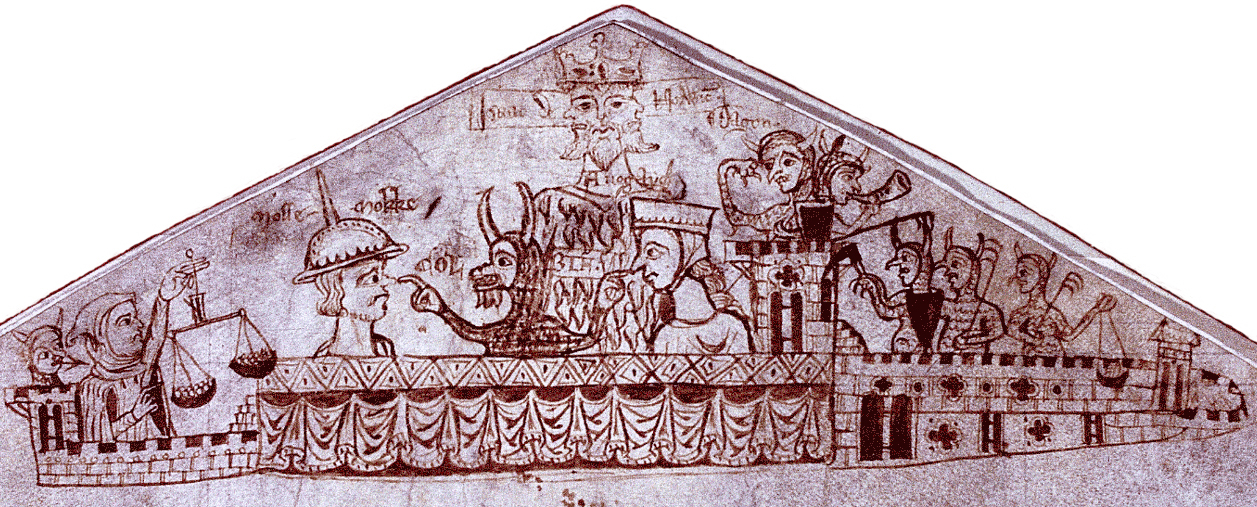
A cartoon from 1233.


I'm fascinated by the school lesson material at the U.K. National Archive site. That cartoon is from one titled "A Medieval Mystery" that asks students to "decode the dark secrets of this cartoon" and offers tips on things to look for (e.g., devils) and prompts with questions like "How has the cartoonist shown that the man and the woman are Jewish?"

Tuesday, January 15, 2013

Why are gun-death statistics inflated with gun-suicide numbers?

"I thought we had a right to die...."

Obviously, one reason is: to get bigger numbers. But I think the people that lump gun deaths together believe (or want others to believe) that guns are really dangerous. When it comes to suicide, there are 2 ways to think about the deadly effectiveness of guns: 1. For those who really want to kill themselves, guns are a sensible choice, or 2. The scary deadliness of a gun tempts weak/impulsive persons to go ahead and do something that wouldn't happen otherwise.

You can easily see that those 2 ways to think represent the mindsets that lead to libertarian or authoritarian answers to all sorts of questions. #1 would allow the individual to make his own decisions and to take care of himself, and #2 thinks the individual — call her Julia — needs to be helped and protected (even from herself).

Sorry to go all gender-y, but I'm interested in talking about suicide and attitudes about guns in the context of gender difference, because 4x as many men as women commit suicide and 56% of male suicides use firearms compared to only 30% of female suicides. Those statistics are skewed by the fact that guns are an effective method. It might be that the gender disproportion is because men choose the method that leaves fewer survivors of attempts at suicide. I note that 40% of female suicides use "poisoning" (presumably, that includes drug overdosing). What's the proportion of females attempting suicide by poisoning to females succeeding in killing themselves with poison?

If you have a fantasy of rescuing those who are in the process of committing suicide, you might think taking guns away will give you a better shot.

ADDED: It occurred to me, after the Sandy Hook murders, that blaming guns is a secular substitute for blaming the devil. People find it too challenging to figure out why a human being would do this terrible thing and they latch on to the idea that the gun made it happen. Suicide presents a similar challenge, and one way to fathom it is to say: It was the gun. Isn't it like saying the devil made him do it? The gun/the devil is a great go-to answer, freeing you from wracking your brain about the workings of the human mind.

Thursday, January 10, 2013

"I haven't been a black conservative since 1995..."

Glenn Loury talks about people he's known for 40 years who won't say hello, who won't look him in the eye because he USED TO BE a black conservative. USED TO BE! John McWhorter talks about those who think "it would be wrong to even print my name. They think of me as Satan. And that's just how it's been."


Much later in the diavlog, Loury and McWhorter weigh in on the affirmative action case that's pending in the Supreme Court. "Would you think it was a good thing if the Supreme Court outlawed racial preferences as we knew them?" McWhorter takes the "not nuanced" position that racial preferences should be proclaimed "obsolete." (Loury disagrees.)

Saturday, December 15, 2012