Showing posts with label UK. Show all posts

Wednesday, November 27, 2013

Britons asked to label the American states...

... produce results like this:


Lots more here — including more references to "Breaking Bad." And it was almost true that everyone still got Texas and California, but there's one where California is left blank, Texas is called Nevada, and Nevada is called L.A.

AND: As long as I'm at Buzzfeed, I like this list, especially #9.

Saturday, November 23, 2013

"Refusal to allow your child to attend this trip will result in a Racial Discrimination note being attached to your child’s education record..."

"...which will remain on this file throughout their school career," says a letter to parents of 8-year-olds who might consider opting them out of the National Religious Education Curriculum field trip to learn about Islam.

Among the many problems with this, it's racist to call Islam a race.

Thursday, November 14, 2013

Nudging in the U.K.: labeling stairwells in public buildings with calorie counts.

"Using a dedicated website and app, people will be able to scan 'smart signs' on stairs and track their number of calories burnt over time."
Boris Johnson, the Mayor of London, said: “Anything that gets people more active and helps tackle obesity is a good thing in my book. This initiative is a great mix of old fashioned common sense and smart technology to track and incentivise.”
Anything?

StepJockey got a £50 million government grant for that website and app. Its founder Helen Nuki says:
"The world is a gym and we aim to label it as such. It has the added benefit of cutting carbon emissions by reducing the number of lift journeys."
Ah, these Brits, always leading the way. Shakespeare wrote:
All the world's a gym,
And all the men and women merely gymrats:
They have their sidewalks and their stairwells;
And one man in his time burns many calories...

Thursday, September 26, 2013

"It was the most inconvenient and the most delightful place ever seen."

Wrote William Morris of Broadway Tower (which was built in 1799, to please the Countess of Coventry).
The Tower... certainly was absurd: the men had to bathe on the roof — when the wind didn't blow the soap away and there was water enough — and the way supplies reached us I don't quite know; but how the clean, aromatic wind blew the aches out of our tired bodies, and how good it all was!

Saturday, September 14, 2013

A monument to prolific writing and the aversion to travel.

And I thought I was prolific and averse to travel. Check out this profile of Peter Ackroyd. Excerpt:
Ackroyd writes nearly all day, nearly every day. Each morning he takes a taxi from his London home, in tony Knightsbridge, to the office he maintains in Bloomsbury, where he typically divides his workday between three books. He begins by writing and doing research for a history book, turns to a biography sometime in the afternoon and finishes the day reclining on a bed in a room adjacent to his book-lined office, writing a novel, in longhand....

In the past decade alone, he has published some two dozen books. These include four novels; a prose retelling of “The Canterbury Tales“; a magisterial “biography” of the Thames River; “London Under,” about the world beneath London’s streets; “The English Ghost,” about the national obsession with specters and spirits; a cultural history of Venice; a beautifully written series of history books for children; biographies of Chaucer, Shakespeare, Newton, J. M. W. Turner, Edgar Allan Poe and the Victorian literary oddball Wilkie Collins; and a handful of other books....

Ackroyd is a provincial and proud of it, with a hermetic lifestyle that supports his writing regimen. He hates to leave London, professing a strong dislike for the countryside (“It’s too noisy, too dangerous, I don’t trust their food”) and no interest in traveling to other cities (“I don’t understand their histories”). 
He's written multiple, massive histories of England, especially London, so he's vastly interested in history, but he's all about depth of understanding in his particular place. 
Ackroyd says that when he walks London’s streets, he will sometimes lapse into a time-travel reverie, toggling backward to envision, with crystal clarity, how a street, an intersection, looked two or three centuries before.
Those of you who argue for travel because it's broadens your mind, makes history "come alive," and foments complex understanding, please contemplate Ackroyd.

Tuesday, August 20, 2013

Juxtaposition highlights the politics of distraction.

Captured just now at Memeorandum (which auto-aggregates news and opinion pieces based on what's being written about right now by "experts and pundits, insiders and outsiders, media professionals and amateur bloggers"):


Here's "White House Had Advance Notice on Heathrow Detention," implicating the Obama administration in the British government's 9-hour detention of David Miranda, the partner of Glenn Greenwald, the most conspicuous journalist dealing with Edward Snowden.

But, look, a puppy!!! The Obamas got another dog, a girl puppy this time. Isn't she cute? She's named Sunny. Aw, doesn't that make you feel sunny? Sunny, thank you for the truth you've let me see. Sunny, thank you for the facts from A to Z. My life was torn like a windblown sand, then a rock was formed when we held hands. Sunny one so true, I love you.


David Miranda, a citizen of Brazil, was detained when he got off an airplane in the UK:
His carry-on bags were searched and, he says, police confiscated a computer, two pen drives, an external hard drive and several other electronic items, including a games console, as well [as] two newly bought watches and phones that were packaged and boxed in his stowed luggage.
The White House spokesman, Josh Earnest, asked whether "United States government [was] at all involved in this," said:
... what you’re referring to is a law enforcement action that was taken by the British government. The United States was not involved in that decision or in that action. So if you have questions about — if you have questions about that, then I would refer you to the British government.
Asked whether the U.S. government was involved, Josh Earnest — must resist remarking on his name again — substituted the issue of whether the U.S. made the decision. Then he reinserted the word "involved" and said "United States was not involved in that decision." There are the extra words "or in that action," but that doesn't answer whether the U.S. was at all involved, since the action occurred in the U.K. and was done by the police there. Earnest archly refers reporters to the British government. Go ask them.

The follow-up question — which lets him off the hook for that evasion — is "Does the U.S. feel that Miranda could have revealed information that’s useful in terms of finding Edward Snowden or pursuing its case against Snowden in any way?" And Earnest once again stresses that the Brits made the "decision" and took the action and go ask them...
Like I said, I’m not aware of any of the conversations that Mr. Miranda may have had with British law enforcement officials while he was detained, but that detention was a decision that was made by the British government and is something that if you have questions about, you should ask them.
Like I said... As in: How many times must I repeat my talking points? Now, look here....


My life was torn like windblown sand on Martha's Vineyard la la la we held hands... Sunny one so true, I love you.

Thanks, Obama, for the truth you've let us see. The facts from A to Z.

Monday, June 10, 2013

"The Government is never slow to say that Hitler was to blame for the Second World War."

"I think the Government is very frightened of taking any sort of view that might suggest we upset the Germans all over again."
"On the British Government's side at the moment what they call the non-judgmental approach seems to me that they are not willing to say outright what the historians I most respect believe, which is the First World War was not morally different from the Second World War, it was an unspeakable experience for Europe and the British people but it was for a cause worth fighting."

Wednesday, June 5, 2013

"Are women who want to join the military now more afraid of being raped by their brothers in arms than dying for their country?"

Asks Maureen Dowd, reacting to this quote from John McCain:
"Just last night a woman came to me and said her daughter wanted to join the military, and could I give my unqualified support for her doing so. I could not."
I don't think John McCain was talking about fear. I would presume that for McCain, the courage of those in the military is understood. The question is equal opportunity in one's career, and a capable, ambitious woman choosing a career path should take account of the obstacles ahead. If one line of work is notorious for hounding women for sex and even forcing it on them and that those in charge were failing to take the problem seriously, you might decide to do something else with your life.

The Dowd column goes on to discuss the legal question of how sexual assaults should be prosecuted — inside or outside the military:
Eugene Fidell, who teaches military justice at Yale Law School, told me the arguments of the brass “boiled down to an almost mystical notion of the commanders’ responsibility. Why can’t we cut the strings to the British system we inherited from George III? The British are baffled by us. They gave control over major crimes to professional prosecutors years ago. It’s an institutional structure that has outlived its utility and credibility.”
Does Fidell want us to copy the British or to stop copying the British? We're copying the old British approach and failing to change it to what the British do now. Imagine applying that legal argument across the board. Forget all the legal principles inherited from the British at the time of this country's founding and switch to what the British have devolved into over the years. I have no idea what the right answer is about prosecuting serious crimes, but I hate the general argument about giving up our legal inheritance from the British because the British themselves have tossed it out.

Dowd continues:
As Sarah Plummer, a beautiful ex-Marine who served in Iraq and says she was raped by a fellow Marine who was never prosecuted, explained to NBC News’s Jim Miklaszewski: “Having someone within your direct chain of command handling the case” is like “your brother raping you and having your dad decide the case.”
Why specify that she's "beautiful"? I get the impression it's supposed to boost her credibility. Or do you think it's a random detail? And dad deciding the case between sister and brother is a vivid and memorable analogy, but it's not completely apt. There's an issue here to be decided — how to deal with sex assaults and sexual harassment in the military — and it should be decided with sober rationality, not iffy analogies, deference to Brits, or emotional manipulation.

Monday, May 27, 2013

"The Lose the Lads' Mags campaign by UK Feminista and Object is calling on high-street retailers to immediately withdraw lads' mags..."

"... and papers featuring pornographic front covers from their stores. Each one of these stores is a workplace. Displaying these publications in workplaces, and/or requiring staff to handle them in the course of their jobs, may amount to sex discrimination and sexual harassment contrary to the Equality Act 2010. Similarly, exposing customers to these publications in the process of displaying them is capable of giving rise to breaches of the Equality Act."

More here:
"For too long supermarkets have got off the hook, stocking lads' mags in the face of widespread opposition, but this time we have the law on our side," said Kat Banyard, founder of UK Feminista. "Every shop that sells lads' mags – publications which are deeply harmful to women – are opening themselves up to legal action."...

"One woman said to us: 'Those magazines don't do women any favours, they are appalling and demeaning to women, but what can little old me do about it?' Well, employees need to know they don't need to put up with it any more."

Friday, May 24, 2013

Wednesday, May 22, 2013

"This is courage of the highest order, it sounds as if these members of the public are not soldiers, not policemen, not people whose duties demand this..."

"... they are extremely courageous people and that courage deserves to be recognised at the highest level."

As the police took 20 minutes to arrive, some women did extraordinary things.

Mrs Loyau-Kennett was a passenger on a number 53 bus which was travelling past the scene, and jumped off to check the soldier’s pulse.

“Being a cub leader I have my first aid so when I saw this guy on the floor I thought it was an accident then I saw the guy was dead and I could not feel any pulse. And then when I went up there was this black guy with a revolver and a kitchen knife, he had what looked like butcher’s tools and he had a little axe, to cut the bones, and two large knives and he said 'move off the body’.

“So I thought 'OK, I don’t know what is going on here’ and he was covered with blood. I thought I had better start talking to him before he starts attacking somebody else. I thought these people usually have a message so I said 'what do you want?’... I started to talk to him and I started to notice more weapons and the guy behind him with more weapons as well. By then, people had started to gather around. So I thought OK, I should keep him talking to me before he noticed everything around him...."
Would you jump off a bus in this situation? Would you engage an apparent murderer in conversation in the hope of distracting him from other people?

"In our land our women have to see the same. You people will never be safe. Remove your governments they don't care about you."

"You think David Cameron is going to get caught in the street when we start busting our guns you think politicians are going to die? No it's going to be the average guy, like you, and your children. So get rid of them. Tell them to bring our troops back so can all live in peace."

ADDED: "They... stood around, waving knives and a gun, asking people nearby to take pictures of them 'as if they wanted to be on TV or something.... In my opinion, they were waiting for the police to arrive to be shot by the police. That's the only thing I can think.'"

Friday, May 3, 2013

"A lot of people think [polygamy is] just about sex but... sex goes out the window after a while."

"If you don’t want your husband marrying someone else, what would happen to these single mums, then, and these divorcees? Is it fair that they just stay on the shelf? We should be looking after our community. Islam is all about community and society and we should look after our brothers and our sisters equally, otherwise it’s every man for themselves."
... Khola Hasan of Leyton’s sharia council believes that forcing mosques to register all nikahs, and thereby banning polygamy, will only make Muslims feel more persecuted. “The Muslim community in Britain already feels victimised,” she says, and it will inevitably force the practice underground, leaving women more vulnerable. She argues that, rather than banning polygamy, which she views as a “solution to many complex and difficult situations,” the practice should in fact be recognised by British law.
(Via Instapundit.)

Sunday, April 28, 2013

There was a time when people felt shame accepting a handout.

We moved beyond that, normalizing the sense of entitlement. But what if you wanted to restore that shame... some of it anyway?
Iain Duncan Smith says he “would encourage” elderly people who can well afford to pay for their their own heating bills, bus passes and television licences to return the money to the state.
ADDED: Is shame something that can be re-instilled? It's common to generate shame about something we haven't previously felt shame about — like not recycling or thinking that gay sex is shameful. But when you've got something people used to feel ashamed of, and you've convinced them not to be ashamed anymore, I think it might be close to impossible to make them feel ashamed once again. I want to talk about the nature of shame. Is it subject to resurrection? Or, once dead, does it stay dead?

When the government can turn off your household appliances....

"The National Grid is demanding that all new appliances be fitted with sensors that could shut them down when the UK’s generators struggle to meet demand for electricity. Electric ovens, air-conditioning units and washing machines will also be affected  by the proposals, which are already backed by one of the European Union’s most influential energy bodies."

Monday, April 22, 2013

"Julien Fédon, a mixed race owner of the Belvedere estate in the St. John Parish, launched a rebellion against British rule on the night of 2nd March 1795..."

"... with coordinated attacks on the towns of Grenville, La Baye and Gouyave. Fédon was clearly influenced by the ideas emerging from the French Revolution..."
... especially the Convention's abolition of slavery in 1794: he stated that he intended to make Grenada a "Black Republic just like Haiti." Fédon and his troops controlled all of Grenada except the parish of St George's, the seat of government, between March 1795 and June 1796. During those insurgent months 14,000 of Grenada's 28,000 slaves joined the revolutionary forces in order to write their own emancipation and transform themselves into "citizens"; some 7,000 of these self-liberated slaves would perish in the name of freedom. Fédon's forces were defeated by the British in late 1796, but Fédon himself was never caught and his fate is unknown.
Grenada is the next "History of" country, as we resume our alphabetical progression the the "History of" Wikipedia pages for the 206 countries of the world.


IN THE COMMENTS: bagoh20 said: "Is that outfit ever appropriate in Grenada near the equator?" And Anniella said: "That's an amazing painting, but there's a very good reason he's so bundled up," linking here.
In 1819, Charles Willson Peale headed down to Washington to paint portraits of President James Monroe, Henry Clay, and other dignitaries for exhibition in the famed Peale museum located in Independence Hall. But there was another sitter the painter wanted to snare on his trip.

"I heard of a Negro who is living in Georgetown said to be 140 years of age," Peale wrote in his diary. "He is comfortable in his Situation having Bank stock and lives in his own house."

The man was Yarrow Mamout, a free African, a Muslim who indeed held bank stock, purchased with great effort to secure a comfortable old age - after a life of abduction and bondage...
So... it's not Julien Fédon. I had my doubts, and I won't take advantage of the lame excuse — though I thought of it when I decided to use that picture — that I never actually say that's Julien Fédon. I'm glad to hear of Yarrow Mamout and I love the painting.
"Yarrow owns a house & lotts and is known by most of the Inhabitants of Georgetown & particularly by the Boys who are often teazing him which he takes in good humour," Peale confided in his diary. "The acquaintance of him often banter him about eating Bacon and drinking Whiskey - but Yarrow says it is no good to eat Hog - & drink whiskey is very bad."

Monday, March 25, 2013

How did this happen?


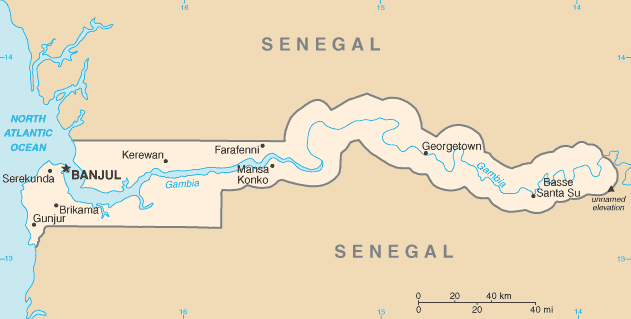
A river, a country: It's The Gambia, today's "History of" country.
In medieval times the area was dominated by the trans-Saharan trade. The reign of the Mali Empire, most renowned for the Mandinka ruler Mansa Kankan Musa, brought world wide recognition to the region due to its enormous wealth, scholarship, and civility....

As time went on the area began to suffer from continuous Moroccan and Portuguese invasion and looting. By the end of the 16th century, as the raids continued, the empire collapsed and was conquered and claimed by Portugal....

During the late 17th and throughout the 18th century, Great Britain and France constantly struggled for political and commercial supremacy in the regions of the Senegal and Gambia Rivers....

An 1889 agreement with France established the present boundaries, and the Gambia became a British Crown Colony, divided for administrative purposes into the colony (city of Banjul and the surrounding area) and the protectorate (remainder of the territory).