Showing posts with label aphorism. Show all posts

Saturday, November 23, 2013

What Rush Limbaugh is almost surely planning to say to those who are outraged at his rape analogy.

Rush Limbaugh likes to throw out things that he knows liberal media types will propagate. He knows what gets them, and he's using them to go viral. It doesn't always work out right for him, and the Sandra Fluke incident ended up hurting him, but often it creates excitement around his show and keeps his reputation relatively fresh. People love him and hate him, and that's keeps the old radio show going.

This weekend lots of the sort of people who love to hate him are raging about the analogy he used in talking about the ending of the Senate filibuster:
Let’s say, let’s take 10 people, in a room in a group. And the room is made up of six men and four women, okay? The group has a rule, that the men cannot rape the women. The group also has a rule that says any rule that will be changed must require six votes of the ten to change the rule.

Every now and then some lunatic in the group proposes to change the rule to allow women to be raped. But they never were able to get six votes for it. There were always the four women voting against it, they always found two guys, well the guy that kept proposing that women be raped kinda got tired of it. He was in the majority and he said, you know what, we’re going to change the rule. Now all we need is five."

And the women said, "You can't do that."

"Yes, we are. We're the majority, we're changing the rule." Then they vote. Can the women be raped? Well, all it would take then is half the room. You could change the rule to say three. You could change the rule say three people want it, it's gonna happen. There's no rule.
We've got Carolyn Bankoff in New York Magazine ("a vile, profoundly inappropriate rape analogy"), Amanda Marcotte ("The rape comparison is distasteful and casually misogynist"), and Politico collects the tweets:
Ana Marie Cox, a political columnist for the Guardian US, wrote that “Limbaugh using a rape analogy to explain the filibuster really takes mansplaining to a level I never imagined” — or as ChartGirl.com founder Hilary Sargent dubbed it, “rape-splaining.” Media Matters research fellow Oliver Willis tweeted that “rush limbaugh really games out how you could theoretically vote to rape women. hes just throwing it out there folks,” while fellow Media Matters colleague Todd Gregory called it “dumb, glib bullshit” that “is such a perfect encapsulation of rape culture, it should be put in a museum.” And The Huffington Post’s Elise Foley and Sabrina Siddiqui also weighed in, with Foley tweeting “Class act, that guy” in response to Siddiqui’s comment, “In today’s edition of offensive rape analogy.”
Come on. It's a trap. Don't you know your most basic famous aphorisms about democracy? "Democracy is two wolves and a lamb voting on what to have for lunch." Usually attributed, probably incorrectly, to Benjamin Franklin, it vividly drives home the problem with simple majority rule.

I'm virtually 100% certain that on his Monday show, Rush Limbaugh will laugh at his critics for their ignorance of the famous aphorism. He can easily point out that he did not minimize the seriousness of rape. In the aphorism, the lamb is killed by the wolves. His analogy substitutes rape for killing, men for wolves, and women for the lamb. Really, it's men who are getting the negative stereotype, so misogyny is exactly the wrong word. A lamb is the very symbol of innocence. And it is killed by those terrible, selfish wolves. Knowing Rush, I predict he'll pivot to a discussion of abortion: Maybe women don't realize that killing an innocent is terrible. Maybe that's why they didn't understand the workings of his analogy.

If he says all this on Monday, I won't know whether I've figured out his devious plan or if he reads my blog. If you're reading this, Rush, feel free to steal my ideas and you don't even have to say: It should have been so obvious that my analogy was built on that old wolves-and-lamb aphorism, but these idiots are blinded by their perpetual grievance. Well, I've got to say that one female saw what was clearly there, and that was the unusually perspicacious law professor blogger Ann Althouse.

ADDED: I do get why people feel antagonized when Rush — who's been taunting feminists for years — whips out a rape analogy and why they choose to exploit the occasion to attack Rush again — as feminists have done for years. I'm explaining a syndrome of baiting, taking the bait, and exulting. Rush doesn't always win, and sometimes both sides win, each in the minds of different audiences.

I know that many people think that rape should be sacrosanct in a way that murder is not, and that it cannot be used casually in jokes and metaphors and that even serious discussions of the subject require advance warnings so as not to inflict mental pain on rape survivors. We use murder as metaphor constantly in jokes and figures of speech, and murder is an even greater crime than rape. I'll bet some readers feel inclined to say: Yeah, but murder victims are dead. But that's my point: We say lightweight things about murder all the time. (And victims of attempted murder are alive, as are the loved ones of murder victims. These people are around to feel mental pain.)

ALSO: I realize that Rush's analogy deals with a more complex scenario than the old wolves-and-lamb aphorism. The wolves and lamb had only a simple democracy, with no safeguard added to protect the minority. The Senate filibuster rule was a safeguard for the minority, and Rush's point had to deal with the problem of using a simple majority to abolish the safeguard for the minority. So if you wanted to talk about lambs and wolves, you'd have to develop the story so that the lambs had believed they were protected by a system in which they could not be outvoted by the wolves, and then the wolves used their majority to change the system and then they outvoted the lambs.

Of course, in the real life of lambs and wolves, there is no system to lure the lambs into complacency, there is no pre-lunch vote, and everyone knows all along that wolves eat lambs and lambs don't eat wolves. The predator and prey are locked into place, and the wolves should never be trusted.

In the real life of men and women, all are threatened by violence, including violence to themselves and to the people they care about, and nearly all men care about at least some women. Only some men — probably quite few — want to be free to commit rape, and it's hard to imagine any man wanting all the other men to be free to get away with raping any women that they want. It's not helpful to try to think about the damned filibuster in these terms because unlike lambs and wolves — where you totally get that all the wolves want to eat all the lambs — there's no reality to the scenario.

So it is fair to say that Rush selected rape as the analogy in order to get a rise out of his usual antagonists, who responded to his call. They were seduced by his allure.

Now, in real life of the Senate, it's quite different from lambs and wolves or men and women, because the majority position switches back and forth over the years and both parties are equally eager to further their interests as they see them and equally tempted to take advantage when they have the majority. The Senate had a structural safeguard that protected the minority and it was always subject to repeal by simple majority. The rule survived because each party, when it had the majority, could picture itself back in the minority. To use a temporary majority to take away the protection of the minority was to accept a risk and to activate the predatory nature of their long-time opponents. In this setting, no one is eaten (like the lamb) and no one is raped (like the women). All survive in an endless political fight that just got nastier.

Therefore we do need some better analogies.

Saturday, November 16, 2013

"Government is not the solution to our problem. Government is the problem."

Your favorite aphorism?


Here's a take on it:


Yeah, I know. The response to that is obvious to a decently educated person, but this is an effective viral video aimed at... other people. And even if you know what's wrong with the argument in that video, it's about manipulation of opinion at an emotional level.

Saturday, October 12, 2013

"Now the moon is almost hidden/The stars are beginning to hide/The fortune-telling lady/Has even taken all her things inside."

Just an old Bob Dylan lyric that crossed my mind writing the previous post.

And here's the Jefferson Airplane song that I linked to in the second paragraph of the first post today, on the words: "You're only pretty as you feel." That link goes to a nice "extended outtake" of "Pretty As You Feel," which should remind old Baby Boomers of the pleasant languors of psychedelic rock concerts circa 1970.

By the way, it always bothered me when an artist that I liked to think of as hip and cool built a song around some old adage or platitude, especially when the saying was sung over and over and with apparent sincerity. Think of some other examples. Here's the one that hardened my hatred for this half-assed lyric-writing: "It's nature's way of telling you something's wrong."

Did Bob Dylan ever do that? I can't think of any examples, and I ask Meade — whose head is a bigger storehouse of Dylan lyrics than mine — and he can't either.

Saturday, September 28, 2013

"A tragedy is a tragedy, and at the bottom, all tragedies are stupid."

"Give me a choice and I'll take A Midsummer Night's Dream over Hamlet every time. Any fool with steady hands and a working set of lungs can build up a house of cards and then blow it down, but it takes a genius to make people laugh."

Said Stephen King. 

Then there's this super-concise, possibly perfect aphorism: "Life is a comedy to those who think, a tragedy to those who feel." That's the playwright Racine, who should be from Wisconsin, but he was French. And though that quote feels related to King's, I think it's quite different. King is talking about works of art and how hard it might be to crank them out, as he does in great volume. Racine is talking about how any given person might view life itself.

What do you think and feel? (Multiple answers allowed.)
  
pollcode.com free polls 

Monday, September 2, 2013

The list of the adultress, the unfair headline, the "orgasm of life," the twice-seen movie, the arcane logo, and the corporate cult.

I'm no fan of adultery, but "Google mistress more into sex than 'love' and kids," trashing 26-year-old Amanda Rosenberg (who's linked to Google co-founder Sergey Brin), is an awfully unfair headline.

The NY Post has gathered its information about what Ms. Rosenberg is "into" from a lightweight blog post of hers titled "The 10 Least Inspiring Sentences on This Lululemon Tote." Here's the blog post, which has a picture of the begging-to-be-mocked tote bag. #1 on the list is "1. Children are the orgasm of life." Calling that sentence "uninspiring" — I'd call it a lot worse — is not taking the position that one is not "into" kids. The blog post ends with Rosenberg identifying herself as "a misanthropic Brit who lives in San Francisco and works in Silicon Valley," and "She's currently struggling to come to terms with Californian optimism and cannot believe someone actually wrote the sentence 'children are the orgasm of life.'"

Sounds about right to me.
I was in a Lululemon store the other day — just throwing away time while waiting for my ride after seeing a movie. (I saw "Blue Jasmine" a second time, on the theory that a second viewing would inspire me to write a blog post in the style of this 9-point list I did on "Doubt." But I didn't have that experience of details bursting out and themes connecting up that I'd expected based on loving the movie the first time and getting over an hour's worth of conversation out of it. Instead the movie on second viewing turned out to be exactly what I thought I saw the first time. Knowing the story in advance, I admired the sharp storytelling, done through expert writing and editing, but I didn't uncover any cool listables.)

I didn't know I was in Lululemon, because I didn't see that word anywhere, and I looked. I saw the logo, which I had to look up just now to determine that I was, in fact, inside the store whose handbag Amanda Rosenberg mocked. At the time, seeing the logo on the sign over the door...


... I thought "Omega?" (Ω.) At the Lululemon website now, I see:
The lululemon name was chosen in a survey of 100 people from a list of 20 brand names and 20 logos. The logo is actually a stylized "A" that was made for the first letter in the name "athletically hip", a name which failed to make the grade.
So... it doesn't look like an "A," and the store's name doesn't begin with "A." Is it supposed to feel like a secret club, like you're hip (athletically) if you get the logo? Is it somehow connected the way yoga is (sort of) religion, so replacing the name with a seemingly unrelated symbol — like the fish that means Jesus — delivers the vibe that you're entering a cult? Is it connected to "I am the alpha and the omega"?

I Google "lululemon cult" and get 218,000 results. "Lululemon's Cult Culture: Get Fit or Die Trying""
Lululemon wants you to know it's "elevating the world from mediocrity to greatness" and "creating components for people to live long, healthy and fun lives." But, dig deeper, and you'll learn about Landmark Forum, the ultra-secretive, eerily cultish educational series, which Lululemon employees are "strongly encouraged" to attend. Before you're in line for Landmark, you're bombarded with Brian Tracy motivational CDs and a book club that culminates with Atlas Shrugged.
"12 Utterly Bizarre Facts About The Rise Of Lululemon, The Cult-Like Yoga Brand":
The founder is an Ayn Rand fan and the company takes its values from Atlas Shrugged....
Wilson believes the birth control pill and smoking are responsible for high divorce rates—and the existence of Lululemon itself....
"A rare look at the luon empire of Lululemon/The story of a Vancouver business that inspires cult-like devotion":
Part of the initiation and training in the company, known as “on-boarding,” involves setting your vision and goals, referred to as one unit, “vision-and-goals,” in company parlance....

“You’re a whole brain, a whole body, a wholehearted person. You should be focusing on all these things. When your life is firing on all cylinders – so when home’s working, personal’s working, career’s working, health is working – you’re going to be great at work. It’s just going to happen,” [said  said Margaret Wheeler, senior vice-president of Human Resources (“People Potential”)].
"Lululemon: A Cult, a Phenomenon or Just a Great Brand":
Lululemon promotes its brand, its community and its culture with local events, some quite large in scale. In New York this September, an event entitled, “The Gospel of Sweat” was staged at Riverside Church inviting people to “Come together to build community, engage spirituality, and celebrate fitness!”
It's just a brand. Do you want your comfy clothes made out of cotton or synthetic fibers? It all depends on how much you sweat. Sweating sounds lowly, and there's religion(ishness) to elevate things. The Gospel of Sweat. But it's not religion. It's not religion because they obviously don't care about heresy.

And because Ayn Rand was a big old atheist. What's that "A" for again?

Which reminds me...


... do not commit adultery. It will expose all your old blog posts — and all your new movie scripts — to unsympathetic reinterpretation.

Wednesday, August 21, 2013

"Even though the feminist project has been underway for decades now, plenty of people still view women doing work..."

"... especially nonservice work, in the same boggled way that you look at a dog walking on its hind legs. Is it still a dog? How can this be?"

Writes Amanda Marcotte, mangling or accidentally getting close to the famous Samuel Johnson quote:
I told him I had been that morning at a meeting of the people called Quakers, where I had heard a woman preach. Johnson: "Sir, a woman's preaching is like a dog's walking on his hind legs. It is not done well; but you are surprised to find it done at all."
It's not that anyone thinks the woman preaching ceases to be a woman or the dog walking on its hind legs ceases to be a dog. It's that people act impressed simply because it happened and fail to hold the creature to the normal standard that would apply to men. I think Johnson's quote is regarded as quite sexist, but — looking only at this quote and not the whole body of Johnson's sayings and writings — it can almost be defended. It's patronizing to mention that a woman did something as if that's remarkable. Did she do it well? If you think women are as capable as men, that should be the question. But Johnson speaks in an aphoristic form that implies that women will never be able to preach well. He did not say — or Boswell did not transcribe his saying —You say a woman preached as you might say a dog walked on his hind legs; let me know when a woman preaches well.

Wednesday, June 26, 2013

The aphorism in the abortion clinic: "Our feelings are our most genuine paths to knowledge."

Here's CNN's article "Texas filibuster on abortion bill rivets online" — about state senator Wendy Davis's effort to stop a bill that would ban abortions after the 20th week of pregnancy and the tweeting it inspired, including President Obama's "Something special is happening in Austin tonight."

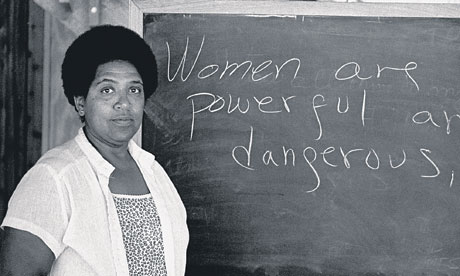
There's also a video, and I'm inspired to write about an aphorism you can see at 1:57: a shot of a room in a clinic — presumably a room where abortions are performed. The label on the door reads "Audre," and on the wall, in large capital letters, there's a quote and the name "Audre Lorde." The quote reads "Our feelings are our most genuine paths to knowledge."

Audre Lorde was a Caribbean-American writer (1934-1992) who is a source of some popular feminist aphorisms, notably "The master's tools will never dismantle the master's house." The one painted on the wall shown in the video suggests an argument about abortion that resonates with abortion rights doctrine, that the woman finds her own meaning. The Supreme Court's cases depict the woman engaging in a philosophical/theological/scientific inquiry into the significance of the entity she may choose either to nurture within or to extricate. The Lorde quote seems like a feminist paraphrase, where the mental process runs along a path of feelings.

The woman entering the room is invited into an awareness of her feelings. Feelings are the most genuine way to your decision. Perhaps the woman entering the room thinks: I don't feel this is anything like a baby or that I am murdering anyone. Or: I hear my future child begging for life. The quote — to my eye — calls you to experience your conscience, and it doesn't let you off the hook. The painted letters seem to be the only decoration in the room. It's the place to focus your eyes throughout the procedure.

I wonder what women's names appear on the other doors. Do the names take the place of room numbers and are the rooms referred to by name in an effort to give warmth to the place? You're a name not a number.

I wonder what are the other aphorisms in the other rooms. Are they all so neutral and open-ended as to the woman's right to choose?

Monday, April 1, 2013

"We do find that apologies do make apologizers feel better..."

"... but the interesting thing is that refusals to apologize also make people feel better and, in fact, in some cases it makes them feel better than an apology would have.... When you refuse to apologize, it actually makes you feel more empowered.... That power and control seems to translate into greater feelings of self-worth."

When you think of not apologizing, what are your first 2 associations? Mine were:


1. "And I'm not sorry/It's human nature...."

2. Mitt Romney's book title: "No Apology." (Looking up that link, I'm noticing that Barry Goldwater wrote a book called "With No Apologies.")

Without revealing my associations, I asked Meade for his. He spouted 2 famous aphorisms, the first of which is not about not apologizing, the second of which is the no-apologies aphorism:

1. "It is much easier to apologize than it is to get permission."

2. "Never apologize — your friends do not need it and your enemies will not believe you anyway." Actually, Google seems to think this aphorism is "Never explain — your friends do not need it and your enemies will not believe you anyway."

I enjoyed that Google search, which led me to this line from "Paths of Glory" (written by Stanley Kubrick):

Tuesday, March 26, 2013

Who was first to say that it's good if a judge "keeps easy cases easy"?

We're very familiar with the old expression "Hard cases make bad law," from which one can infer that easy cases make good law and, perhaps, an idea that judges should make an effort to keep easy cases easy.

In today's case about drug-sniffing dogs, Justice Scalia said that using a property-rights analysis (rather than discussing the expectation of privacy) "keeps easy cases easy." Justice Kagan picked up the phrase in her concurring opinion to say that using both forms of analysis "would make an 'easy cas[e] easy' twice over."

Should we credit Justice Scalia with the new aphorism "kee[p] easy cases easy"? (Note that I'm using the Kagan approach to brackets as I drop the s on "keeps.")

The only near example I found in the state and federal courts database was Mozes v. Mozes, 239 F.3d 1067 (9th Cir. 2001), in which Judge Alex Kozinski said that something "illustrates that easy cases are easy, however one analyzes them." But that's not the same as proclaiming it a virtue to keep easy cases easy, so I give the aphorism to Justice Scalia.

By the way, Scalia loves to talk about easy cases. For example, last fall:
"The death penalty? Give me a break. It's easy. Abortion? Absolutely easy. Nobody ever thought the Constitution prevented restrictions on abortion. Homosexual sodomy? Come on. For 200 years, it was criminal in every state," Scalia said at the American Enterprise Institute.
Sometimes when one lawyer says a case is easy, you want to say — as I once heard Professor Henry Monaghan say — "Yes, but which way is it easy?"

Monday, February 18, 2013

The answer to Freud's famous question "What does woman want?"

Give women what they ask for and when the demands end, the answer will be known.

ADDED: And then there's the less famous question: Why does this post have no link? If you really need a link for Freud's having said "What does woman want?" (or the alternate translations, "What do women want?"/"What does a woman want?"), feel free to Google it and get millions of search results. If you want a link for the statement, "Give women what they ask for and when the demands end, the answer will be known," that would be a link to this very post. It's my aphorism. If you want a link to what made me think about this, that's not how things work around here, where the conversation goes on and on, which is one of the many things women want. 

Sunday, January 13, 2013

"I was reckless writing about recklessness."

I say, noting that I got quoted over at Instapundit with a missing "it's" apostrophe: "he’s entirely reckless about what these laws would really mean to ordinary people, and its a recklessness that thrives in the mind of someone who...."

"Oh! It's blogging," says Meade. "It's the internet. Think how many times you've gotten it right."

"And it's more embarrassing to get the apostrophe wrong the other way," I soothe myself, referring to  putting the apostrophe in "its" when it's supposed to be out.

"It's embarrassing to be embarrassed," Meade asserts aphoristically.

"But I was criticizing recklessness at the very point when I was reckless," I brood nonetheless. "It's like the way whenever you mock a misspelling, you end up misspelling something."

I decide to write this post, which — speaking of blogging — is the antidote to embarrassment.

***

On the rooftops they dance
Valentino-type tangos
While the makeup man’s hands
Shut the eyes of the dead
Not to embarrass anyone
The sky is embarrassed
And I must be gone