Showing posts with label paraphrase. Show all posts

Wednesday, November 27, 2013

A rash of 1-star reviews for Scott Walker's book "Unintimidated."

At Amazon. Samples:

1. "Wow, this is not a book. it is a 'selfie' by Scott Walker. He has tanked Wisconsin with his corrupt leadership and this book is so poorly written, I'd give it a zero if I could. Don't waist [sic] your money on this advertisement."

2. "This book is a piece of crap written by the most self-serving narcissist to ever come down the pike. This book should be filed under fiction on the shelves....."

3. "Gah. What a terrible person. There should be a zero stars option. Good god. The man is a narcissist....."

4. "Dear dear Scooter's sad attempt to make himself feel important. Scott walkers lies and unabashed disrespect for the state of Wisconsin and the union workers is a waste of your time and money. Shouldn't he be writing a book on 'How to snake your way into Politics'?"

5. "Written by a 10th grader doing their first 'paper.' that sums up the writing style and lack of references. The introduction should have had at least 50-60 references. Non-fiction requires extensive referencing for credibility. Therefore, this book lacks credibility because it is not properly referenced. As I was reading it, I kept waiting for the hallelujah choruses to break out through my Kindle. via the writing it is abundantly clear that the author hates blue collar workers and would like to open sweat shops."

6. "Governor Walker is completely off the deep end! He wrote: 'In other words, if you're a teacher, police officer, fire fighter, snow plow driver or any other kind public servant, you're not only lazy, overpaid and corrupt, but you're also not a church goer... in fact, you're probably a damn Muslim!'--There is so much wrong with this statement I don't even know where to begin...."

Well, you might begin by Googling that quote to find out if Governor Walker really did write that. I found that quote at Uppity Wisconsin/Progressive News from the Cheddarsphere, which was humorously paraphrasing a list of "Top Ten Ways to tell if you Might be a Member of a public sector union." The list of "Top Ten Ways" really does appear in the book. It was a David-Letterman-style comic list that had appeared in The Daily Caller, and Walker tells of reading it to his "nervous" staff to "lighten the mood" during the 2011 protests.  He doesn't restate the list with a punchline — that's Uppity Wisconsin's doing. He just says: "It did the trick, putting them at ease again."

The list does include the item "4. You know by having a copy of the Holy Koran on your desk your job is 100% safe." Why is that supposed to be funny? Why does it belong with things like "2. You have a Democratic congressman’s lips permanently attached to your butt"? I mean, I see how it would belong on a list with the title "Top Ten 'Jokes' that Prove The Daily Caller Should Not Attempt Humor." But other than that.... We can see that Walker thought it was funny enough to use to cheer up the staff and to tell us about in the book, but let's not substitute the Walker-hater's paraphrase!

ADDED: There are 5-star reviews too, but more than twice as many 1-star reviews. Guess how many 4-, 3-, and 2-star reviews? Right: almost none. The current tally:
5 star: 48
4 star: 3
3 star: 1
2 star: 2
1 star: 133
I'd like to see the numbers on how many of these people actually read the book, but then, in some ways a book like this isn't designed to be read. It's designed to be an occasion for interviews about the book and articles that cherry pick excerpts from the book. I'm actually reading the book myself... in large part because I'm a writer who is looking for things to pick and excerpt.

AND: By the way, Uppity Wisconsin's post title — "Walker 'Joke': Teachers, Public Servants are Lazy, Overpaid Heathens" — inadvertently insults Muslims. Neither The Daily Caller nor Scott Walker referred to Muslims as "Heathens." That's Uppity Wisconsin's term, and it is an insult.

ALSO: The (unlinkable) OED gives as the first definition of the noun "heathen": "One who holds a religious belief which is neither Christian, Jewish, nor Muslim; a pagan." And for the adjective: "Of an individual or people: holding religious beliefs of a sort that are considered unenlightened, now esp. ones of a primitive or polytheistic nature; spec. not of the Christian, Jewish, or Muslim faiths."

From the historical quotes, my favorites:
1726 Swift Gulliver II. iii. i. 6, I was sorry to find more Mercy in a Heathen, than in a Brother Christian.
1852 H. B. Stowe Uncle Tom's Cabin II. xxviii. 139 It would certainly be a greater self-denial to receive heathen among us, than to send missionaries to them.

Sunday, November 24, 2013

University of Wisconsin-Madison Chancellor "Rebecca M. Blank was a top candidate in 2011 to lead President Barack Obama's Council of Economic Advisers, but" she said a bad word.

Redistribution!

“A commitment to economic justice necessarily implies a commitment to the redistribution of economic resources, so that the poor and the dispossessed are more fully included in the economic system,” Ms. Blank, a noted poverty researcher, wrote in 1992....

“Redistribution is a loaded word that conjures up all sorts of unfairness in people’s minds,” said William M. Daley, who was Mr. Obama’s chief of staff at the time. Republicans wield it “as a hammer” against Democrats, he said, adding, “It’s a word that, in the political world, you just don’t use.”

These days the word is particularly toxic at the White House, where it has been hidden away to make the Affordable Care Act more palatable to the public and less a target for Republicans, who have long accused Democrats of seeking “socialized medicine.” But the redistribution of wealth has always been a central feature of the law and lies at the heart of the insurance market disruptions driving political attacks this fall.
Boldface added.

The linked article is in the NYT, which does not omit the old story of Obama campaigning in 2008, running into "Joe the Plumber," and blabbing jovially about how he wanted to "spread the wealth around."

I love this sentence:
In the end, America’s political culture may have made it unrealistic to expect a smooth public reception for the law, no matter how cleverly the White House modulated Mr. Obama’s language or shaped his policy to minimize the number of losers.
Let me paraphrase that for you: Obama had to lie to get the law passed.

When we the people don't want something, in a democracy that should work to stop it. We're voters, not some agglomerated "culture" to be softened and shaped. If we didn't want it, you shouldn't have done it. It's good that cleverness and manipulation did not overcome that reality. Of course, the law got passed, because people had voted in representatives who had the grandiosity to believe they didn't need to represent us, that trickily crafted policies and rhetoric would be enough. Fortunately, those representatives were wrong, and they richly deserve all the political pain they've got to go through now.

Friday, October 18, 2013

What are law students doing to protect themselves from the horror of a law school exam that lawprofs could easily write following the advice I am giving in this post?

Do law professors realize how much law students are relying on Wikipedia for summaries and insights into the cases we are assigning? In the old days, students spent a lot of money on commercial outlines, stuff like this. I've never looked at any of those books, not as a student and not as a teacher, though over the years, I've had many students ask me to recommend one.

Back when I was a law student — I graduated in 1981 — you wouldn't want the professor to know you were the sort of person who'd need or want to use a study guide, so it always surprised me that students would ask me, and I had no answer to the question other than to be careful: These things can be out of date, they may contain errors, and you can be wasting time on a lot of detail that I am not including and missing things that I will develop in class.

The best view of what will be on the exam is what we're talking about in class, which is based on the assigned readings, so why would you put time into reading some questionable alternative material instead of reading the casebook, taking notes on that book, paying attention in class, and condensing your reading and class notes into an outline that forces you to understand precisely those things that the exam will be about?

These days, from what I've heard, students have shifted to Wikipedia, which has lots of great entries for the cases that we read.

I love Wikipedia. I think it is one of the greatest things that has happened in the history of mankind. But you've got to know what it is and what it is not. Who is writing and tweaking those articles on important Supreme Court cases? They're quite well done, but that means they are done by lawyers, law students, and law academics. These contributors offset each other and enforce Wikipedia norms of neutrality, but, of course, law folk are expert at embedding political and policy preferences in seemingly neutral material. (That's what makes the cases so hard to read and understand.)

The first time a student in my class referred openly to Wikipedia, he quoted something that was a bit off. Perhaps it described a state constitutional law provision as banning racial discrimination when what it banned was using race as factor in affirmative action. It was something that needed better editing in Wikipedia.

It immediately occurred to me that a very efficient way to write an exam in this course would be to quote the Wikipedia entry on various cases and, for each, ask whether it is inaccurate. One could pick 10 statements about 10 cases — or 20 statements about 20 case — and ask the student to pick the 3 — or 5 or 6 — that you believe to be most inaccurate and explain why.

It's fine to use Wikipedia. I love it. But you've got to know what you are dealing with.

Saturday, September 7, 2013

"It is a very strange moment for Mr. Obama..."

The NYT editorial on Obama's Syrian difficulties. It's against a military strike, I think, but in the most invisible possible way.

Let me paraphrase the 10 paragraphs:

¶1 — Obama is having trouble selling his plan to attack Syria. 

¶2 — We're right to worry that the supposedly narrow attack will turn into another big war.

¶3 — The Pentagon is planning for broader war.

¶4 — The administration has asked the Pentagon to come up with more targets — more than the 50+ targets we already have.

¶5 — Obama has been vague about what these additional targets are (but they can't be the actual chemical stockpiles, because bombing them would unloose the poison).

¶6 — Talk of launching missiles from offshore has given way to reports of sending in bombers.

¶7 — Some members of Congress want to hem Obama in but McCain openly advocates taking the side of the rebels and ousting Assad.

¶8 — Obama is supposed to be the guy that gets us out of wars, and he owes us more assurance that what is planning really is narrow.

¶9 — Putin is staring Obama down.

¶10 — The whole group of foreign leaders gave Obama the cold shoulder.

¶8 is the key paragraph. It's the one with the quote I put in the post title. It's the one where the editors get as close as they are willing to answering the question posed in the headline: "Can Mr. Obama Avoid Mission Creep?" I think their secret answer is "no," but they don't want to say that. Instead, they lay out their worries and challenge him to explain how he's going to avoid a larger war. They say "the public deserves to understand more fully what 'limited' military action actually means" as if maybe it's our comprehension problem or his failure to sufficiently elaborate.

The first paragraph references Obama's planned speech on Tuesday, so maybe the editors thought, let's give him a chance to be specific about these things. Maybe the great speech-maker can explain it all next week. What's strange — if they want to talk about strange — is that Obama hasn't delivered the big explanatory speech yet. The simplest explanation is that he can't explain, and the answer to the question "Can Mr. Obama Avoid Mission Creep?" is just: no.

***

"Mission creep" sounds — to me, anyway — like a term from the Nixon era. (There was CREEP.) But in fact, at least according to Wikipedia's "mission creep" article, the term goes back to Somalia:
The first two articles to use the term in the Washington Post were both by columnist Jim Hoagland ("Prepared for Non-Combat", April 15, 1993 and Beware 'mission creep' In Somalia, July 20, 1993). The New York Times used the term for the first time in an article by correspondent John H. Cushman, Jr. written after the October 4, 1993 firefight in the capital of Somalia, Mogadishu, in which 18 American military personnel were killed.

The U.S. and later UN Mission in Somalia (Restore Hope) would seem to be the classic example of mission creep....
Restore Hope.

***

Whatever makes you happy... whatever you want....

Wednesday, September 4, 2013

"They love my beautiful mind... I am ugly, but they’re attracted to the brains. I’m a rock star among geeks, wonks and nerds."

Said the economist, noting that his parties are great because of "fun people and beautiful girls" and "I look for 10 girls to one guy."

But you need to be more careful about your bragging, apparently, because now the Department of Buildings is coming after his giant rooftop hot tub, which he's ordered to remove, because he didn't seek approval.

Lesson: First, seek approval from the government. Then, seek approval from fun people and beautiful girls.

Paraphrase of the lesson: The government wants to be your beautiful girl.

ADDED: "10 girls to one guy" = "Surf City" x 5. 

IN THE COMMENTS: Crunchy Frog improves on my bad math:
10 girls for every guy = Surf City in binary.

"Republicans... are a bunch of dead white people. Or dying white people."

Said the college professor, secretly videoed by a student in the back row, now playing on YouTube, linked by Twitchy.

And I say: Look out all you professors. Anything you say may be taken out of context and posted on YouTube. Your hyperbole and casual humor and reenactments of the arguments of others will look quite different as the world looks over the shoulders of the captive audience you think you're talking at. The back row is no longer the back row. There are a million more rows behind that, full of people with no motive to act like they respect you.


And by the way, if you live in Wisconsin and are at least 60 years old, you have a legislature-given privilege to attend — free of tuition — classes at the University of Wisconsin.

Welcome to the future. Feel free to rant about the Panopticon wherein you find yourselves, but please at least notice you are here.

I feel like recording myself teaching and taking my own quotes out of context, as I paraphrase some argument that's made in a case, putting it in starker words to reveal problems lurking within the carefully framed language of lawyers and judges. I'd like to demonstrate how easy it would be to make me sound like a monster. (And I'm saying that partly to inoculate myself! I've got paraphrase paranoia.)

The man in the video — which I chose not to embed — is said to be a creative writing teacher. Who knows what he was up to? Maybe cranking the kids up, trying to get juices flowing. Come on, somebody, get angry. Look alive.

It's an old game. Waking up the students, but the professors need to wake up. Those students who look sleepy and blank to you all have videophones and they may be wide awake and 10 steps ahead of you.

Wednesday, August 28, 2013

The philosophy of travel... the psychology of travel...

I've been looking into the philosophy of travel, and I'm trying to get beyond the psychology of travel. It's not an easy journey, but at least I don't have to go through a metal detector and TSA patdown, and I can surround myself with >4 oz. glasses of whatever liquids I like. Here's the first substantial thing I found, a March 2000 essay by Pico Iyer: "Why we travel."

Let's see how far I can get on this leg of my journey. Iyer begins:
We travel, initially, to lose ourselves; and we travel, next, to find ourselves. We travel to open our hearts and eyes and learn more about the world than our newspapers will accommodate. We travel to bring what little we can, in our ignorance and knowledge, to those parts of the globe whose riches are differently dispersed. And we travel, in essence, to become young fools again — to slow time down and get taken in, and fall in love once more....
See? This is mostly psychology. What motivates us to go. (And I really don't believe people travel in order to spread their wealth to places that are relatively poor. Just give to charity. Or does he mean that we benefit the less fortunate by inflicting our physical presence upon them?)

Next Iyer cites an essay by George Santayana called, “The Philosophy of Travel” that stresses the work of travel.
Few of us ever forget the connection between “travel” and “travail,” and I know that I travel in large part in search of hardship — both my own, which I want to feel, and others’, which I need to see. 
I'd rather avoid hardship, but I'm sure I could find it somewhere in my own town — I could sit in on criminal trials or volunteer at the respite center — but I'd be ashamed to be satiating a personal need of mine.
Travel in that sense guides us toward a better balance of wisdom and compassion — of seeing the world clearly, and yet feeling it truly. For seeing without feeling can obviously be uncaring; while feeling without seeing can be blind.
Do you really see more clearly because you've traveled to faraway places? Have you spent much time in the worst neighborhoods of your own town? In order to travel to foreign countries, you might endure hardships of your own and you must spend a fair amount of money. These personal sacrifices of yours don't do anything for other people, and they incline you toward pleasures that will compensate, which seems to be the opposite direction from compassion. But some people do go to places where things really will be uncomfortable:
When you drive down the streets of Port-au-Prince, for example, where there is almost no paving and women relieve themselves next to mountains of trash, your notions of the Internet and a "one world order" grow usefully revised. Travel is the best way we have of rescuing the humanity of places, and saving them from abstraction and ideology.
How many of us travel to gawk at poor people? How many of those of us who might consider traveling to gawk at poor people have difficulty understanding poverty from merely reading about it? If you do travel to Port-au-Prince to see women relieve themselves next to mountains of trash, and they question why you are watching them, be sure to say, I have come here to witness this to shake myself out of my complacent abstractions and to gain wisdom. Look at that scene in your mind. It's not too abstract, is it? Aren't you ashamed of yourself?

But admit it: That's not the vacation you'd take! You might do that if it was your job — as a writer or photographer — but you're not going to spend your money to heighten your wisdom and compassion that way, are you? You're going somewhere else, somewhere you think will be amusing or uplifting, aren't you? Pico Iyer goes on to talk about less hardship-ridden trips, and he emphasizes getting outside of oneself:
On the most basic level, when I'm in Thailand, though a teetotaler who usually goes to bed at 9 p.m., I stay up till dawn in the local bars; and in Tibet, though not a real Buddhist, I spend days on end in temples, listening to the chants of sutras. I go to Iceland to visit the lunar spaces within me, and, in the uncanny quietude and emptiness of that vast and treeless world, to tap parts of myself generally obscured by chatter and routine.
Are not these all things you could achieve near home? You have lunar spaces within you, yet you need to go to Iceland to visit them? Why not sit in your room for an hour with your eyes closed, listening to classical music? Or walk to the nearest vantage point for the next sunset and gaze upon it? How much money would you save? $5,000? $10,000? Give it to charity! Now, was my prescription for your soul better or worse than Iyer's recommendation that you go to Iceland and Tibet? As for his Thailand recommendation, there's always a bar down the street. Pick a spot in the dangerous side of town.

Iyer quotes Albert Camus saying "what gives value to travel is fear." Iyer paraphrases "fear" as "disruption... (or emancipation) from circumstance, and all the habits behind which we hide." Do you accept that paraphrase? If that's the value of travel, are you really a traveler (or must you concede you're only a tourist)? Maybe you'll say you travel for disruption but not for actual fear, other than tiny first-world fears, like fear of flying, fear of having to navigate in an environment where not everything is in English, and fear of unfamiliar foods and faces. If you really are traveling for fear, are there no better ways to pursue fear, ways closer to home? In the old days people traveled for fear — fear of starving if they didn't go looking for food, fear of murderous enemies who were moving in on their home territory. That's old-school travel, and you know damned well you are not traveling like that. You're spending your extra money to take on circumscribed fear-stimulating circumstances. Why not go for a walk late at night in the bad part of your own town? Too dangerous?
And that is why many of us travel not in search of answers, but of better questions. 
And I'm blogging this essay in search of even better questions.
I, like many people, tend to ask questions of the places I visit, and relish most the ones that ask the most searching questions back of me: In Paraguay, for example, where one car in every two is stolen, and two-thirds of the goods on sale are smuggled, I have to rethink my every Californian assumption. 
Like the Californian assumption that there are parts of California that you should avoid? Forbes's list of cities with the most stolen cars is dominated, year after year, by Californian cities. Why did Iyer have these assumptions in the first place? Why does his California have such an inane meaning? If you have to go to Paraguay to disrupt that, I wonder about the quality of your mind. And yet somehow you have enough money to pay for a trip to Paraguay, to learn — what? — that life is gritty? That there is crime and poverty?
And in Thailand, where many young women give up their bodies in order to protect their families -- to become better Buddhists -- I have to question my own too-ready judgments.
You found that out by traveling to Thailand? How? That's something you learn from reading about it, not by going there, unless you yourself are a sex tourist. One answer to the Why Travel? question is: You travel to take advantage of poorer people. No one writes that in an essay. But Iyer is almost saying: Travel to see other travelers taking advantage of poorer people... because it will make you a better, wiser, more compassionate person. Why not read about problems like this and give your money to charities that try to help unfortunate people? His answer seems to be because it's about developing his mind. But shouldn't his mind already be developed past that point?

Iyer says that on return from some places — he mentions Southeast Asia — he's felt that he "was in love." Travel is a love affair. That's his metaphor. If so, staying home is monogamy, it's where the depth is, and where the thrill is too, if you have the depth yourself.
For if every true love affair can feel like a journey to a foreign country, where you can't quite speak the language, and you don't know where you're going, and you're pulled ever deeper into the inviting darkness, every trip to a foreign country can be a love affair, where you're left puzzling over who you are and whom you've fallen in love with....
Or is it more like being a stalker boyfriend of someone who does not and will never love you? Iyer makes light of what the tourist is to the people of the visited country:
We are the comic props in Japanese home-movies, the oddities in Maliese anecdotes and the fall-guys in Chinese jokes; we are the moving postcards or bizarre objets trouves that villagers in Peru will later tell their friends about. If travel is about the meeting of realities, it is no less about the mating of illusions: You give me my dreamed-of vision of Tibet, and I'll give you your wished-for California. And in truth, many of us, even (or especially) the ones who are fleeing America abroad, will get taken, willy-nilly, as symbols of the American Dream.
What happened to the love affair metaphor? That is not love. And why are you wheeling out the cheerful examples? What about the Luxor massacre (which took place 3 years before Iyer wrote this essay)? That's the most extreme exemplification of the hostility of the traveled-upon, but think of everything between that and some imagined affable Japanese person who thinks you're just a bit silly. Where's the love? A real love affair has love on both sides. The love Iyer talks about is like the love a teenager feels for a pop idol after the concert. You cannot enter that idol's life. It's an illusion. Find someone real to love. Once you get that far, Iyer's love metaphor makes the argument for staying home.

Iyer writes about many travel writers, and that's what he is too, a travel writer. That means he's not making money doing one thing, then spending some of those earnings on travel. He travels as part of making money, and the insight he gains is not merely for developing his mind — as he argues in his essay — it's for writing about the development of the mind (and festooning the inward reflection with colorful pictures of things the readers have not seen). But what about the rest of us? We could sit home reading these travel writers, who've taken on the expense and the hardship of travel, and we could develop our mind through reading and thinking and sojourning around home.

Iyer gets around to the Thoreau quote — "I have travelled a good deal in Concord" — which we were just talking about on this blog last month (on the topic of the distinction between a tourist and a traveler). Iyer throws in Emerson too: "traveling is a fool's paradise." Iyer argues by paraphrase. What Thoreau and Emerson really do is "insist on the fact that reality is our creation, and that we invent the places we see as much as we do the books that we read. What we find outside ourselves has to be inside ourselves for us to find it." Now, the sleight of hand:
So, if more and more of us have to carry our sense of home inside us, we also -- Emerson and Thoreau remind us -- have to carry with us our sense of destination. The most valuable Pacifics we explore will always be the vast expanses within us, and the most important Northwest Crossings the thresholds we cross in the heart. The virtue of finding a gilded pavilion in Kyoto is that it allows you to take back a more lasting, private Golden Temple to your office in Rockefeller Center....
Home really is superior, but somehow you need to leave home to understand that. But what if you already understand that? Then, why should you travel? And I mean why should you travel if you are not a travel writer, gathering new material?
And if travel is like love, it is, in the end, mostly because it's a heightened state of awareness, in which we are mindful, receptive, undimmed by familiarity and ready to be transformed. That is why the best trips, like the best love affairs, never really end.
The trip that never ends is home. 

Saturday, August 24, 2013

The conservatives' high ground on race is colorblindness, and they'd be fools to abandon it.

That's a general piece of advice I'd like to deliver, prompted by this specific headline, seen just now at Twitchy:
Slain World War II vet Delbert Belton honored at candlelight vigil [photos]
I know there are those who think there's a need to rebalance public opinion after the distortions that surrounded the George Zimmerman case, which skewed racial discourse in this country over the past year, but it's a terrible idea to go looking for incidents in where the killers are black and the victims are white and to exploit them in what seems like an effort to undo the distortions. I saw this happening earlier this week over the Christopher Lane murder, I labeled it "counter-Trayvonistic," which was a too-subtle way to say: Don't fight skewing with skewing in the opposite direction.

Conservatives have rested on the principle of colorblindness for a long time, and they've taken abuse for it. Look at how left liberals abuse Chief Justice Roberts for writing, "The way to stop discrimination on the basis of race is to stop discriminating on the basis of race." They consider that kind of talk naive (at best). They push the perceived sophistication of what Justice Blackmun said back in the first affirmative action case: "In order to get beyond racism, we must first take account of race. There is no other way."

Those are the 2 well-defined and socially presentable opinions in this country, and decent, sincere Americans have argued from these positions for decades. Now, we're seeing some conservatives who seem frustrated by this taking account of race that's been done on the left. They seem to think it's a good time to spotlight violence committed by black people. This is not a good idea! It's fine to mourn Shorty, but these candlelight vigils are intended to stir hearts the way hearts were stirred at the Trayvon Martin demonstrations.

Trayvon Martin — an individual human being — was used by demagogues to score points about the suffering of black people in America, but this is not a game, and it is delusion to imagine that there is a need to score points on some imagined other side. This is not a game. There is no score. And we are all on the same side.

To paraphrase the Chief Justice: The way to stop skewing public opinion based on race is to stop skewing public opinion based on race.

To stir hearts counter-Trayvonistically is to nurture feelings that white people are oppressed by black people. This alternative to colorblindness is profoundly stupid. 1. It abandons the easy to express, principled position that many people perceive as the high ground. 2. It steps into the arena of taking account of race, where the left liberals would love to take you on. And 3. It gives air to the white supremacists among us. These people have been outcasts for a long time, but they exist, perhaps not quite yet recognizing what they are.

What sparks catch fire in that candlelight vigil for Shorty?

Thursday, August 22, 2013

Bill de Blasio — with the help of Maureen Dowd and her untrustworthy tape recorder — hands Christine Quinn the gay card and she plays it...

... for all it's worth:
“I have a family. In my apartment, my wife and I, we’re a family,” she said, her voice cracking slightly. “Our 10 nieces and nephews and grand nieces and nephews, we’re a family. My father and I, Kim’s dad. we’re a family. When I took care of my mother when she was dying, that’s a family. Kim and I lost our mothers. People make personal decision, for medical reasons, all kinds of reasons, that go into why people do and don’t have children. And no one should comment about that and make it a political issue.”
Here's the background, in case you haven't been keeping up. Quinn and de Blasio are running for Mayor of NYC. Quinn is a childless lesbian. De Blasio's wife, Chirlane McCray, said something to Maureen Dowd that Dowd transcribed as a statement that Quinn is "not the kind of person I feel I can go up to and talk to about issues like taking care of children at a young age and paid sick leave."

Quinn jumped on that, de Blasio said his wife was misquoted, and Dowd's column was corrected, and the NYT revealed McCray's full quote, which came in response to Dowd's question why Quinn "was not rallying women." McCray said:
"Well, I’m a woman, and she’s not speaking to the issues that I care about, and I think a lot of women feel the same way. I don’t see her speaking to the concerns of women who have to take care of children at a young age or send them to school and after school, paid sick days, issues in the workplace — she’s not speaking to any of those issues. What can I say? And she’s not accessible, she’s not the kind of person that I feel that I can go up and talk to and have a conversation with about those things, and I suspect that other women feel the same thing that I’m feeling."
So McCray's point was that Quinn isn't speaking the right way, not that her being lesbian makes her not the kind of person who can relate to women with children. Maybe McCray was cleverly creating an occasion for people to think that, but she didn't say it.

And now, wait. I'm just now seeing Dowd's next paragraph, and it shatters the mental image I'd had of McCray:
Last spring, McCray did an interview with Essence magazine about her feelings about being a black lesbian who fell in love with a white heterosexual, back in 1991, when she worked for the New York Commission on Human Rights and wore African clothing and a nose ring and he was an aide to then-Mayor David Dinkins. With her husband, she was also interviewed by the press in December and was asked if she was no longer a lesbian, and she answered ambiguously: “I am married. I have two children. Sexuality is a fluid thing, and it’s personal. I don’t even understand the question, quite frankly.”
Whoa! Why isn't this the part of Dowd's column that's getting more attention?

Dowd goes on to talk about how Quinn has been "unable to get traction, even with women, despite talking more freely about the historical nature of her bid to become the first woman and lesbian to be mayor." Good. People shouldn't vote just to rack up another first.

NYC had a gay mayor in Ed Koch — right? He won in 1977, when his sexuality was known well enough that there were posters reading "Vote for Cuomo, Not the Homo." He said in a 1989 interview: "I happen to believe that there's nothing wrong with homosexuality. It's whatever God made you. It happens that I'm a heterosexual."

So it's great if people find Quinn boring despite her firstiness. Dowd — either craftily or bumbling — found a way to make her interesting, and Quinn is displaying some political skill, exploiting what is exploitable.

Thursday, August 15, 2013

Electrical engineering man doesn't get the poem his English major girlfriend gave him in parchment-and-calligraphy form...

... and — what the hell kind of electrical engineering guy writes to an advice columnist? — the advice columnist he writes to doesn't even know enough to tell him to watch "Hannah and Her Sisters." He's all:
It's by e.e. cummings... Sarah told me it's her favorite poem of all time. I didn't even understand the title, so I kept my mouth shut. Then she said she feels that the last line, which goes "Nobody, not even the rain, has such small hands," is the most beautiful sentence written by an American in the past 100 years. 
Aw, come on. There's an entire sequence in "Hannah and Her Sisters" — watch the 4-minute clip here —  that begins with a big white-on-black intertitle inviting laughter over the line "Nobody, not even the rain, has such small hands." This man — if he really is an electrical engineer (e.e. = electrical engineer) — instead of finding a way to laugh with this girl confesses to the advice columnist that he has "no idea what that sentence means."
I read the poem (which I had to do in front of her, which was scary) and I definitely get that it's a love poem, but if you asked me to explain a single line in it with a gun to my head, I'd be a goner.
Such violent ideation. If you're smart enough to be an electrical engineer — which, as noted above, I doubt — you should figure out how to say something like: To me, everything you say is the most beautiful sentence by an American in the past 100 years. Paraphrase it for me. I want to know why it's the most beautiful sentence to you. I want to know how you would say it.

Maybe she'll bust out laughing and say: I was just playing with you. I was thinking what would be the most ridiculous present to give to my electrical engineering guy who doesn't understand the point of being an English major. And I thought: a completely bad poem with a ridiculous line that everyone has been laughing at for years.  I'd present it to you in the most bullshit form, in calligraphy on parchment, act like it was a great present, and deadpan that that stupid line was the most beautiful line ever written in English. Oh, man, you should have seen your face.

But, no, his face was the face of a lost little boy. She realizes that her funny setup only revealed his lack of interpersonal skill and humor. If she finds out he wrote to an advice columnist — a female advice columnist — asking her — asking mommy — for help understanding the poem, she'll never be able to have sex with this man.

Back to the letter:
The thing is this was clearly a hugely meaningful gesture for Sarah to give me this poem. It means so much to her. I just didn't have the heart to tell her that it went over my head. I mumbled something about how beautiful it was and that seemed to make her happy, but I felt really bad later.
He worries that this incident ruined everything. I think it did — not because he couldn't understand the poem, but because he didn't turn the occasion of failure to understand into an interesting interaction between the two of them. She tried to make something happen, and he was too big of a coward to find out what it was. And then he went to some other lady — an authority figure — for an explanation. 

Only after writing that am I reading the advice columnist's answer — although I did do a search to see if she knew "Hannah and Her Sisters." The columnist's answer is kind of like mine, but it's more about gentleness, with the man inviting the woman to explain the poem. She was trying "to bring you into her world a bit... a loving gesture. Don't be put off by it, and trust her enough to respond with gentle honesty."

I suspect this particular man is more capable of the timid gentleness routine than of the more vigorous interplay I'd pictured, but I'm not an advice columnist.

(Link via Maggie's Farm.)

Sunday, June 30, 2013

"12-Year-Old Girl Banned From School Football Team for 'Inciting Lust.'"

Another questionable WaPo headline. Why is "inciting lust" in quotes? First, we get something the mother of girl said:
"In the meeting with the CEO of the school, I was told that the reasons behind it were... that the boys were going to start lusting after her, and have impure thoughts about her," [Paige’s mother, Cassy Blythe] said. "And that locker room talk was not appropriate for a female to hear, even though she had a separate locker room from the boys."
So even in the mother's statement there's only a reference to what the boys "were going to" do — "start lusting" — not any accusation that the girl was "inciting." But the mother is paraphrasing what the CEO said, and we don't know how diplomatically he put his references to sex. Did he say "lust" — that 7 Deadly Sins word? The school is Strong Rock Christian, so readers are invited — incited! — to think that this is old-fashioned religion.

Then, the WaPo "social reader" writer Dan Carson opines:
I’m no philosopher, but when you ban preteen girls from being around boys while wearing shoulder pads, “inciting lust” sounds like a flimsy reason. After all, the rest of the girls on school grounds are wearing skirts and polos and aren’t covered in reeking hand-me-down padding.
If it sounds like a flimsy reason, consider that the mother — who wants her daughter on the team — had a motive to state the reason in terms that would sound flimsy. Carson ought to know about the meaning slippage that occurs in restatement, because — as you see there — he's the one that came up with "inciting." Carson's use of the quotes is defensible, but really confusing. It's not a quote of what anyone else said, but quotes used to indicate paraphrasing.

Saturday, June 29, 2013

"Perhaps the biggest difference between the racers and the randonneurs was socioeconomic."

"Racing was a working-class sport — prize money was a way out of the coal mines or factories."
"You don't have the liberty to say, 'Well, the other guy deserves to win' if your living depends on it," [Jan Heine, editor of Bicycle Quarterly, a Seattle-based magazine about the history, technology and culture of biking].

Randonneuring was more of a refined hobby. "If you're doing this for fun, suddenly the distinction between winner and second becomes meaningless," says Heine.
Also:
"There was a lot of animosity in France, actually, between the tourists and the racers," Heine explains. "Because the tourists said, 'We are going in the mountains, and we are a participatory sport.' " Participatory meaning that women could ride alongside men — and people could ride basically whatever they wanted. This drove innovations in bicycle technology that today are widespread: If you've ever ridden a bike with a derailleur, thank the randonneurs.
Interesting the way the inclusiveness toward women changes things — this particular activity... and everything else. Who wins and who loses? Or... shall we say?... the inclusion of women changes the nature of the activity so that speaking in terms of winning and losing becomes inappropriate and those who play to win and triumph over losers become socially unacceptable oafs?

ADDED: I am reminded of the perennial efforts to restructure law school to suit women. Recently, in the Harvard Crimson:
Harvard Law student Jessica R. Jensen hates the Socratic method. “It’s the worst thing in the world,” she said. “It forces you to talk like a man... It made me feel really uncomfortable and incompetent at first, and it really impacted my performance in classes the first year.... You feel like you don’t know the material really well because you feel like an idiot in class.”
The worst thing in the world? Worse than coal mining or — the coal miner's alternative income source — the Tour de France?
Employed in some form across most classrooms at Harvard Law School, the Socratic method, a teaching style that relies on cold-calling, lies at the heart of the debate over gender issues and serves as a focal point for the Shatter coalition. Today, many students and faculty have raised concerns over the teaching method, saying that men are more likely to participate voluntarily in Law School classes than women....

Yet the root cause of this disparity remains contested, as professors, students, and administrators debate whether the Socratic method—the traditional form of legal pedagogy—needs to be adapted to account for gender disparities in the classroom.
Note that both calling on students and relying on volunteers is bad for women.
“Women take longer to process thoughts before they feel comfortable to say them out loud than men do,” Jensen said, adding that men feel more natural in that kind of classroom atmosphere.
I guess as long as you mean well — which is to say, you think and get others to think you're helping women — you can engage in sex stereotyping even when it's disparaging women. I know you can restate Jensen's stereotype so that it's more flattering to women — a paraphrasing skill you might want to work on. Just say that women are reflecting deeply, forming more refined ideas, and contemplating the social dynamic of the classroom —  while these brutal, competition-addicted men lunge at the first opportunity to dominate and blurt out whatever comes to mind with little concern about what others in the room think about them.
Harvard Law professor Lani C. Guinier ’71, who has authored several articles on legal pedagogy, said... “women’s reaction to law school is an important warning sign, but a warning sign that the problem will not go away simply by focusing on helping the women think more like their male counterparts”....
Inclusiveness toward women changes things.

Thursday, June 27, 2013

What accounts for this sudden and shocking spike in bigotry?

"A year and a half ago, even the president of the United States opposes gay marriage.  President Bill Clinton, a Democrat, signed DOMA into law.  Now all of a sudden, after Obama changes his mind, the whole country supports gay marriage, and those who don't are bigots."

What accounts for this sudden and shocking spike in bigotry?

It depends on what the meaning of bigotry is. (To paraphrase that humanitarian, Bill Clinton.)


But — to quote Marbury v. Madison — as quoted in the DOMA case, United States v. Windsor, "‘[i]t is emphatically the province and duty of the judicial department to say what the law is.’ ” Zivotofsky v. Clinton, 566 U. S. ___, ___ (2012) (slip op., at 7) (quoting Marbury v. Madison, 1 Cranch 137, 177 (1803))." (I know, who quotes Marbury like that? And what the hell was Zivotofsky v. Clinton? Was there some insuperable urge to bring up Bill Clinton? The Clinton in Zivotofsky was Hillary Clinton, in her Secretary of State role, and this was the case about the State Department's refusal to list Israel as the place of birth on a U.S. passport for a person born in Jerusalem.)

So if it's the Court's duty to define the terms, and opposition to same-sex marriage is defined as nothing but bigotry, then its the Court's decision in Windsor that accounts for the sudden and shocking spike in bigotry.

But let's be clear about a few things.

1. The majority opinion in Windsor did not use the word "bigotry" (or "bigot"). That word appears in Chief Justice Roberts's dissenting opinion: "At least without some more convincing evidence that the Act’s principal purpose was to codify malice, and that it furthered no legitimate government interests, I would not tar the political branches with the brush of bigotry." Justice Alito also uses the word: "Acceptance of [Windsor's] argument would cast all those who cling to traditional beliefs about the nature of marriage in the role of bigots or superstitious fools."

2.  The majority's expression is "a bare congressional desire to harm a politically unpopular group," which might sound extreme, but it appears in the case law going back to the early 70s, and it's a stock phrase used to characterize the government's interest when the Court is applying minimal scrutiny and therefore needs to say that there is no legitimate governmental interest.

3. What that "bare... desire to harm" language really means is: We don't want to have to heighten scrutiny for this discriminated-against group — they don't want responsibility for what that would mean in future cases — but we do want to be able to strike this down while staying at the minimal scrutiny level.

4. This doctrinal maneuver produces the strange impression that the Court is calling Bill Clinton and the majority of the members of the 104th Congress a bunch of bigots.

5. Now lots of traditionalists have the raw material to whine and cry about being called bigots. I doubt if that will work out very well for them, but they've been stewing in their own juice for a long time, and they're going to find it hard to stop. Unfortunately, same-sex marriage was originally presented as a conservative idea, and traditionalists could have gotten out in front of liberals on this issue if they'd listened to the original argument and predicted the future better, and now they'll have to scramble to improve their image. If they think crying about being called bigots — when, again, the majority didn't even use that word — is going to help, I just have to laugh. You took the opportunity to oppress when it was there, and now that it's gone, you want to say you are oppressed. Man up, losers. You lost. And you deserved to lose. Now, stop acting like losers. If you can. (I bet you can't!)

Wednesday, June 26, 2013

At the Wet Lettuce Café...

Untitled

... because Lem wanted a café and because I think some of you might need a break from all the legalistic argle-bargle. And it was Lem who asked "Is Argle-Bargle another way of saying bullshit?" And the answer is most definitely yes, and as you know, I'm immensely interested in the concept of paraphrasing. In other words, I want to be the Professor of Paraphrase. And by the way, did you know that the song "Fly Me To the Moon," was originally titled "In Other Words"? And that Frank Sinatra sings the line "In other words, darling, kiss me" in these other words: "In other words, baby, kiss me"? Why does "darling" seem so old fashioned? Does anyone use the endearment "darling" anymore (other than sarcastically, as in "yes, darling")?

Okay, you get the message: Talk about random stuff. Be amusing and delightful. Or something.

"Justice Scalia Used The Term ‘Argle-Bargle’ In A Scathing, Condescending DOMA Rant."

Business Insider gets to the meat of things.

Specifically, Scalia said: "As I have said, the real rationale of today’s opinion, whatever disappearing trail of its legalistic argle-bargle one chooses to follow, is that DOMA is motivated by '"bare . . . desire to harm"' couples in same-sex marriages."

I started a new tag today. No, not "argle-bargle." Paraphrase. I've become immensely interested in the concept of paraphrasing, and I'm hypervigilant about paraphrasing about paraphrasing, and I see that there. Scalia has a really cheeky way of saying "so what you're really saying is...": whatever disappearing trail of its legalistic argle-bargle one chooses to follow....

Memorize that. Use it. It's sure to annoy some people and give others a great sense of relief. For example, law students may enjoy hearing the lawprof say whatever disappearing trail of its legalistic argle-bargle Justice X chose to follow, the real rationale is...

So high-handed! So liberating!

The (unlinkable) OED traces "argle-bargle" — which means "Disputatious argument, bandying of words, wrangling" — back to 1872:
1872   A. J. Cupples Tappy's Chicks 252   During these days of ‘argle bargle’, as our smith's wife called it.
a1881   Carlyle in W. A. Knight Retrospects (1904) 15,   I have for a long time given up the argle-bargle of metaphysics.
1927   Observer 11 Dec. 15/2   Can they..stand up to a good and sufficient argle-bargle that lasts for the best part of three hours?
UPDATE: 2 days later, I actually did make a tag for argle-bargle — as the continued use of the term appealed to me — and came back to add it here.

The aphorism in the abortion clinic: "Our feelings are our most genuine paths to knowledge."

Here's CNN's article "Texas filibuster on abortion bill rivets online" — about state senator Wendy Davis's effort to stop a bill that would ban abortions after the 20th week of pregnancy and the tweeting it inspired, including President Obama's "Something special is happening in Austin tonight."

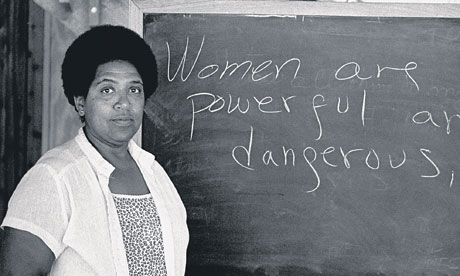
There's also a video, and I'm inspired to write about an aphorism you can see at 1:57: a shot of a room in a clinic — presumably a room where abortions are performed. The label on the door reads "Audre," and on the wall, in large capital letters, there's a quote and the name "Audre Lorde." The quote reads "Our feelings are our most genuine paths to knowledge."

Audre Lorde was a Caribbean-American writer (1934-1992) who is a source of some popular feminist aphorisms, notably "The master's tools will never dismantle the master's house." The one painted on the wall shown in the video suggests an argument about abortion that resonates with abortion rights doctrine, that the woman finds her own meaning. The Supreme Court's cases depict the woman engaging in a philosophical/theological/scientific inquiry into the significance of the entity she may choose either to nurture within or to extricate. The Lorde quote seems like a feminist paraphrase, where the mental process runs along a path of feelings.

The woman entering the room is invited into an awareness of her feelings. Feelings are the most genuine way to your decision. Perhaps the woman entering the room thinks: I don't feel this is anything like a baby or that I am murdering anyone. Or: I hear my future child begging for life. The quote — to my eye — calls you to experience your conscience, and it doesn't let you off the hook. The painted letters seem to be the only decoration in the room. It's the place to focus your eyes throughout the procedure.

I wonder what women's names appear on the other doors. Do the names take the place of room numbers and are the rooms referred to by name in an effort to give warmth to the place? You're a name not a number.

I wonder what are the other aphorisms in the other rooms. Are they all so neutral and open-ended as to the woman's right to choose?

Sunday, May 26, 2013

"This White House is so politicized that when it comes to a sort of a controversy like this, what they want to do is to get out a good story instead of getting out the real story."

David Gergen on "Face the Nation" today. (I've added italics that I hear in the audio.) Context (with my boldfacing):

BOB SCHIEFFER: David, you've seen a lot of controversies in your time in Washington. We had this IRS thing. We got the leaks investigation, all of the stuff going on. How do you think the White House has been handling it?

DAVID GERGEN (Harvard University): Not well, but I-- I do think it has to be put in context, Bob. Give them credit on one point and that is overall when you look back over the five years, this has been-- administration has been remarkably clean and-- and free of scandals and I think they do deserve credit for that. Having said that now that these events have come up, I-- I must say it's been a real surprise. We all think that the-- the Obama people do a superb job running a campaign but when it comes to running the government they can be so ham-fisted. It really sort of boggles the mind sometime. On these-- on these recent controversies, as you call them--and you know I have seen a lot of them--and they don't amount-- amount to Watergate, they don't amount to Iran-Contra. But they are important. They-- the government I think mishandled it in allowing these things to take place on the IRS front and allowing the things to take place with going after reporters. Then we came to the White House and how you communicate about this, I think-- you know, it's-- it's been a little stunning. I mean there's no-- they had to paraphrase in our world of journalism, what you need to do in the government when you got a bad set of facts on your hands you need to get them out-- you need to get the story out fast. But first you need to get it straight. And that's exactly what they haven't done. You know, they've had all these different conflicting stories and now we're into a third phase of this where we're not getting the answers. We don't know. I think right now the biggest thing they have to do: come clean. Tell us complete facts.

BOB SCHIEFFER: Michael Gerson:

MICHAEL GERSON (Washington Post): Well, I'd start by-- by reminding people that these are not second-term scandals, they're actually first-term scandals where the information on them was delayed until after the election for variety of reasons. So I don't know if that's successful or not successful in that-- in that political context. Clearly, they missed some classes in crisis management one-o-one. You're supposed to get information out before people even ask for it. You should have consistent explanations. But we need to remember two things: one of them is the Obama agenda was pretty much in trouble before the three scandals, if you look at what was going on at the time in budget negotiations, failure to pass gun control, or really overplaying their hand on-- on, you know, some other issues. So that's one thing. You know, this didn't create the problems. The second one is that messaging has limits here. You know communication-- sometimes you don't have a communications problem, sometimes you have a reality problem, okay. And we have an IRS that engaged in abuses and is stonewalling right now. And we have an attorney general that's deeply compromised and may have misled a congressional committee. I mean that's a serious set of accusations. These things are not going to be determined by what the White House--how it explains it. The facts are going to determine how this moves forward.

DAVID GERGEN: I agree with that. You know-- and my sense is-- Michael, I'll be curious about yours. My sense is that this White House is so politicized that when it comes to sort of a controversy like this what they want to do is to get out a good story instead of getting out the real story. And that that causes them problems. But if they just come with-- if they'd told us all the facts in the beginning on the IRS thing, I think they'd be in a lot less trouble right now.

BOB SCHIEFFER: Well, do you think the President has hurt himself? Have these things hurt the President?

MICHAEL GERSON: Well, we're going to see how much they hurt politically. We can't really judge right now. We-- we don't know. I think that they've hurt the President philosophically. He has a certain view of the role of government. It's a benevolent government to help the middle-class and to help people rise in-- on the ladder of opportunity. Right now-- you know I'll point out two figures. One of them, according to Pew, the reputation or trust in government is at historically low levels and the scandals contribute to that. The second one is by a recent number more than twenty-two percent-- twenty-two percent of people more than that want to keep the law want to repeal Obamacare. That's a huge gap.

DAVID GERGEN: Summing up, it's widened.

MICHAEL GERSON: Right. It has widened in-- in recent months. Now-- so I think the President-- that's a tough message to bring into a midterm election when your philosophy of government is really under question and it's just a tough thing for American liberalism. At-- at the same time the President has expanded the role and reach of government that-- that we've had a declining reputation of government in America. I think those things are at odds.

BOB SCHIEFFER: You heard Senator Coburn say he thinks that the attorney general should not be in charge of this review of the leaks and so forth. I-- I actually agree with him on that. What-- what do you think?

DAVID GERGEN: I-- I think an outside group I'm not-- I'm not sure why a special counsel is needed on-- on the question of-- of the leaks. I'm not sure that there are any criminal laws that have been violated here. It's simply been a failure to observe the guidelines that were already in place and some-- and I think an outside group to do that. Question of special counsel arises more in the IRS situation and who is actually going to get to the bottom of this? Because right now we don't-- I think-- I think Michael's right. There is this-- it's in effect a crude form of stonewalling is going on.

Wednesday, March 27, 2013

"If California provides all the substantive benefits of marriage to same-sex domestic partnerships, are you seriously arguing that... if the case before us now were from a State that doesn't provide any of those benefits to same-sex couples, this case would come out differently?"

Justice Alito asked Ted Olson in the Prop 8 oral argument yesterday. Consider the problem of trying to narrow the case by limiting it to California, where voters amended the state constitution to restrict marriage to opposite-sex couples and where they permit civil unions that give gay people access to everything but the word "marriage."

There was much talk about the perversity of imposing more severe constitutional limitations on a state that has done much — but not everything — to include gay people and to give great leeway to the states that have excluded gay people altogether.

It does make some sense. The states that resist any inclusion have preserved arguments about the function of marriage that states like California have given up by structuring civil unions to provide almost equal treatment. It's hard to articulate a legitimate interest in only withholding the name.

But if the Court wants to leave the issue of same-sex marriage to the political process, why would it attach a consequence to taking the intermediate step of creating the civil unions category? That hampers the very process it would be purporting to enable.

ADDED: Later in the argument, Justice Scalia had this colloquy with Solicitor General Verrilli (who argued against Prop 8):
GENERAL VERRILLI: We are not … taking the position that it is required throughout the country. We think that that ought to be left open for a future adjudication in other States that don't have the situation California has.

JUSTICE SCALIA: So your -- your position is only if a State allows civil unions does it become unconstitutional to forbid same-sex marriage, right?
Amusingly, at exactly this point, Verrilli’s time’s-up red light comes on and he says” “It’s on.” He could have said, “Saved by the light!” But Chief Justice Roberts tells him to go on.
GENERAL VERRILLI: … I would just take out a red pen and take the word "only" out of that sentence. When that is true, then the Equal Protection Clause forbids the exclusion of same-sex marriage, and it's an open question otherwise.
In other words, to recapture that “only” and put it in a paraphrase: He’s only arguing now that his argument is limited to states like California. If he wins this case, in the next case, when the other issue is presented, he will argue that ssm is required everywhere. Anyone can predict that. Roberts pushes:
CHIEF JUSTICE ROBERTS: You [say] it's got to happen right now in California, but you don't even have a position about whether it's required in the rest of the country.

GENERAL VERRILLI: If -- with respect to a State that allows gay couples to have children and to have families and then denies the stabilizing effect.
What state doesn’t “allow” gay couples to have children and families? I can infer that Verrilli means allow adoption by gay couples, but it’s obvious that the concern about children extends to all the states, since a gay person can be a natural parent to a child and then live with a partner who is not the child’s parents.

Roberts doesn’t pursue that but sticks with his original point. Presumably, he's building the argument that it's incoherent to strike down Prop 8 without finding a right to ssm that applies to all the states.
CHIEF JUSTICE ROBERTS: So it's got to happen right away in those States where same-sex couples have every legal right that married couples do.

GENERAL VERRILLI: Well, we think… you can wait in…

CHIEF JUSTICE ROBERTS: States where they have fewer legal rights.

GENERAL VERRILLI: What I said is it's an open question with respect to those States and the Court should wait and see what kind of a record a State could make. But in California you can't make the record to justify the exclusion….
Verrilli is saying that the state that permits adoption by gay couples can’t go back to the argument that a child is better off having both a mother and a father in the home. Does this cure the incoherence? I doubt it. It's a distinction that might be employed by a judge who looks forward to extending ssm to all the states in the next case. I don't think Roberts is one of those judges.

Sunday, January 27, 2013

"Swartz didn't face prison until feds took over case..."

"The late Internet activist was facing a stern warning from local prosecutors. But then the U.S. Attorney's office, run by Carmen Ortiz, chose to make an example of Aaron Swartz, a new report says."
The report is likely to fuel an online campaign against Ortiz... An online petition asking President Obama to remove from office Ortiz — a politically ambitious prosecutor who was talked about as Massachusetts' next governor as recently as last month.
There's a hot campaign to destroy Ortiz. Note that there's also this other case where she's accused of "bullying" a motel owner, in what she calls "strictly a law-enforcement effort to crack down on what was seen as a pattern of using the motel to further the commission of drug crimes for nearly three decades." Ortiz is considering appealing in that case, and the Boston Herald has the headline: "Ortiz to motel owner: We’re not done yet." It's not like she said we're not done yet.  That's the newspaper's paraphrase of "We are weighing our options with respect to appeal."

Is the prosecutor getting bullied? If she were to commit suicide — Swartz-style — would everyone feel ashamed of what they did to her?

No one cries for a prosecutor.

Sunday, December 30, 2012

Obama seems amenable to the NRA idea of armed guards in schools.

On today's "Meet the Press": David Gregory asked him what he thought of having "armed guards at every school in the country," adding "That's what the NRA believes. They told me last week that could work." Obama said:
You know, I am not going to prejudge the recommendations that are given to me. I am skeptical that the only answer is putting more guns in schools. And I think the vast majority of the American people are skeptical that that somehow is going to solve our problem. 
Of course, we are also skeptical that gun control is going to solve our problem. My only point here is that Obama didn't denounce the idea and treat it as crazy, which seemed to be the left/liberal spin last week after NRA CEO Wayne LaPierre made the proposal. Obama is saying that the idea deserves consideration. And to say you doubt that it's the "only answer" is to imply that it may belong in a package of items that together are the answer. In fact, later, he said: "I'm going to be putting forward a package..."

Obama went on to say that he was going to follow "the old adage of Abraham Lincoln's":
That with public opinion there's nothing you can't do and without public opinion there's very little you can get done in this town. 
That's a paraphrase. What Lincoln actually said was: "In this and like communities, public sentiment is everything. With public sentiment, nothing can fail; without it nothing can succeed. Consequently he who moulds public sentiment, goes deeper than he who enacts statutes or pronounces decisions. He makes statutes and decisions possible or impossible to be executed." I'll leave it to you to decide who's the better wordsmith.

By the way, when did Washington folk acquire the habit of tacking "in this town" onto every other sentence? And don't you think there's an interesting difference between "opinion" and "sentiment"?

Further evidence that liberals have given up on demonizing LaPierre came from Dianne Feinstein on "Fox News Sunday" today. She's going to introduce a bill banning assault weapons and magazines that hold more than 10 rounds of ammunition, and moderator Chris Wallace asked her "Why is that more effective than the NRA proposal to put armed guards in every school?" She said:
Well, in the first place, 1/3 of America's public schools does have armed guards. 
Ha! No wonder the spin has shifted. You can't call it sheer lunacy if it's happening in 1/3 of the schools already. Too bad the liberal sentiment molders didn't check the facts first. Too bad they had a hair trigger.