"... how much more bracing it is to have sweetness laced with tartness. I told them I would be very, very nice until they asked me to stop, certain that they’d get sick of saccharine and syrupy in short order. Except they didn’t. They liked it."
Says Maureen Dowd, about her 10-year-old self.
People may be bored by all niceness all the time, but they still appreciate (and maybe take advantage of) those who opt to perform perfect sweetness. One can always find amusing edge in somebody else, even keeping the very nice person around for company and for snuggles later.
Showing posts with label maureen dowd. Show all posts
Showing posts with label maureen dowd. Show all posts
Sunday, December 15, 2013

Friday, November 22, 2013
"But are men, and the age-old power structures associated with 'maleness,' permanently in decline?"
"Or do men still retain significant control over the workplace, the family and society at large, including women?" A very lively debate on the proposition: "Be it resolved, men are obsolete…"
Pro: Hanna Rosin, Maureen Dowd. Con: Caitlin Moran, Camille Paglia.
Rosin and Dowd pretty much retreat from the strong version of the proposition, and Moran and Paglia kick ass. Rosin and Dowd end up winning because they "persuaded" more people, after beginning with only 16% on their side (and ending with 44%).
Very amusing, or enraging (if you're the type to get steamed over the obvious fact that it would be considered outrageous for a bunch of men to get all hyper and cheeky over a comparable topic about the value of women).
ADDED: You might need to subscribe to watch at that link, but you can listen (which is what I did) here.
Sunday, November 3, 2013
On the occasion of the accusations of plagiarism against Rand Paul...
Let's go to the blog archives. It's nice to have a "plagiarism" tag that lets me pull out so many old conversations about plagiarism that were prompted by various things over the years. (The links are on the numbers.)
1. "The internet is changing the way students think about plagiarism... or — I would add — they way they lie about it."
2. "Confusion over sources or indifference to them can be a paradoxical strength; if we could tag the sources of all our knowledge, we would be overwhelmed with often irrelevant information."
3. "The real fault is not making it a point always to write sharp, distinctive prose. Prose like the stuff [Maureen] Dowd lifted called out for rewriting. She might not have known to think I can't use that because I didn't write it. But she should at least have thought I can't use that because it's dull."
4. "'[T]here is a big difference between being a plagiarist — at bottom, lazy or sloppy — and being a fabulist.' It's tougher to make things up than to copy, and yet it's Lehrer who's screwed himself more deeply."
5. "'To coin a phrase, in the spirit of the vice president-elect, you can't always get what you want, but you get what you need,' Alito said, an imperfect rendering of a Rolling Stones lyric. Then, he added, 'Did someone say that before?'"
6."My dear, it's called an allusion. The error isn't stealing, it's assuming people get it."
7. "Jerry Seinfeld's late-night rant about his wife's cookbook rival was no joke to the author's family."
8. "When you are discovered, I want you to claim — really sincerely — that you actually mistakenly believed that you remembered the incident as if it had happened to you. You can be all: 'I am chagrined and astonished that my mind could play such a trick on me.'"
9. "How is it possible for someone in [Fareed Zakaria's] position to make a mistake of that kind? The risk far outweighs any convenience in copying material like this. It can't be deliberate."
10. "Once you’ve been busted for making stuff up, you need to be sure that what you publish is reasonably accurate... though I suppose that passing on other people’s fabrications is arguably a modest improvement over creating his own."
11. "Should Coldplay be able to force Hoepfner to take down his accusatory video and apologize, or do we think it's a nice resolution of the controversy for Coldplay to escape unsued and for Hoepfner to have his viral video to leverage his band to whatever degree of fame it can get out of this amusing little artistic squabble?"
12. "'I think that’s the way Bob Dylan has always written songs.... It’s part of the folk process, even if you look from his first album until now.' Well, theft itself is a traditional 'process,' but it would still piss me off if someone robbed me, either with a six gun or a fountain pen. At least Dylan called an album 'Love and Theft,' and he's repeatedly presented himself as a thief in various lyrics. To have Bob Dylan steal some of your phrases and the Dylan fanatics ferret out the connection he declined to tell us about is to get publicity you never would have gotten otherwise."
13. "When you accuse a 6-year-old of plagiarism in an art contest, you'd better be ready to make a decision to disqualify her and stick to it. You've besmirched her, and you can't unbesmirch her. Oh, U.S. Fish and Wildlife Service! You idiots!"
14. Rush Limbaugh appropriates my question, without attribution.
15. "And if our good opinion of him is based mainly on his speeches, then we have reason to examine why we're supporting him. But politics is full of stock phrases, contagious memes, and brainstormed messages."
16. "Obama defends his use of a couple lines given him by his associate Duval Patrick. 'This is where we start getting into the silly season in politics.'"
17. Ch-ch-ch-changes:
Tuesday, October 15, 2013
"I'm interested in the fakeness of all those colorful photographs of the universe that we've been looking at all these years."
I said, in the course of contemplating what Maureen Dowd said about Robert Redford's hair and after reading that "There are no 'natural color' cameras aboard the Hubble and never have been. The optical cameras on board have all been digital CCD cameras, which take images as grayscale pixels." I also tweaked "the atheist Christopher Hitchens" for "burbling about 'the color and depth and majesty' of the Hubble photographs as he urges us to see the revelations of science as more awe-inspiring than the old stories told by religions." I exclaimed: "But the color is fake! The purveyors of science, like religionists, can scam us too."
Reader Gabriel Hanna emails:
Reader Gabriel Hanna emails:
To say that something is a scam [is] to say it is dishonest and done for financial gain.Now, technically, I did not say the color in the Hubble photographs is a scam. I said it was fake, and then, in a separate sentence, I stated a generality — "The purveyors of science, like religionists, can scam us too" — which is my standard warning to pay attention and be skeptical.
Astronomers, it is true, are largely taxpayer-supported, they are using the Hubble images to convince people to pay for astronomy. But the other element of a scam is dishonesty, and I do not agree that the Hubble images are dishonest — or if they are, they are no more dishonest than any photography.But I stand by my warning. The scientists do want our money, as Hanna concedes. And people like Hitchens call us to replace religion with science because science is so beautiful. If scientists, seeking dominance, punch up the beauty of their images, we must take that into account as we analyze arguments and implicit pleas for money that are based on the beauty of what they are showing us. The art photographer — processing the camera's digital file — is forthrightly guided by aesthetics. The Hubble images can be presented as artwork manipulated for aesthetic pleasure, but to the extent that they are not — as in Hitchens's argument — it is rational and scientific to catch a whiff of scam.
Light is inherently greyscale, there is no color in it. Light has only frequency. Human eyes are sensitive to three sets of frequencies, and the human brain interprets these as color. All cameras have to "fake" color in the sense that you accuse Hubble astronomers of faking color, because a machine cannot record a subjective human experience.
Hubble, like any digital camera, records numbers that correspond to frequencies of light. The colors are put into the images by the algorithm that converts the numbers to an image. In a film camera the data is collected and stored chemically and the developing process does what software does for digital cameras.
When a photographer adjusts white balance, or shoots in sepia, that is "false color" in the exact sense it is for Hubble images. We do not call that dishonest in the case of digital photography, and it is not a scam even if the photographer sells the photographs. Like digital photography, most Hubble images are boring, and for public consumption astronomers select the beautiful ones in the same way that a blogger takes hundreds of shots before she gets one good enough to post. Like digital photography, brightness and white balance of Hubble images might well be adjusted, or colors altered in the same way as shooting in sepia, but if we don't call it a scam in the one case we ought not to call it one in the other.
It is especially unfair in that Hubble extends human capabilities to non-visible wavelengths. It seems very unfair to say that honesty demands that all radio or x-ray astronomy images be rendered in flat black because humans cannot see those colors, and to do anything else is a "scam."
Saturday, October 12, 2013
"And Mr. Chandor can verify to skeptics Mr. Redford’s claim that his hair remains naturally Hubbell strawberry blond."
"His locks survived the months of sun and chlorine, with no colorist in sight," writes Maureen Dowd in that NYT article that we're already talking about in that first post of the day.
Dowd doesn't say whether she believes him, but she quotes "No one believes me" without stating her view. She has the mysterious line "Mr. Chandor can verify," but did she ask Mr. Chandor, and who can believe that Mr. Chandor watched Mr. Redford at all times? Who thinks Ronald Reagan didn't dye his hair? But it's nice of Robert Redford to keep thinking about Ronald Reagan. These slow-aging Hollywood RRs need to stick together with their age-defying secrets.
What does Hubbell refer to in "naturally Hubbell strawberry blond"? The Hubbell telescope? "There are no 'natural color' cameras aboard the Hubble and never have been. The optical cameras on board have all been digital CCD cameras, which take images as grayscale pixels." It's Hubble, not Hubbell, so it can't be that — though I'm interested in the fakeness of all those colorful photographs of the universe that we've been looking at all these years.
Here's the atheist Christopher Hitchens burbling about "the color and depth and majesty" of the Hubble photographs as he urges us to see the revelations of science as more awe-inspiring than the old stories told by religions:
But the color is fake! The purveyors of science, like religionists, can scam us too.
Now, back to the possible scam of the color of Robert Redford's hair. And I got a sudden inspiration about the meaning of Hubbell. Some character Redford played long ago? I go to his IMDB page and search. Ah! It's the name of the guy he played in "The Way We Were." Am I ashamed not to have known? Absolutely not! I'm damned proud I never saw that movie. It was back in 1973 too, when we went to see every movie we thought was supposed to be good. We knew better.
In the comments at that first post of the day, Amexpat calls bullshit on Redford:

What if God were one of us? He might go grocery shopping with Nick Nolte:

But go ahead, if you're the creative type — you don't have to be as creative as The Creator (He's so creative!) — to take that iconic Michelangelo image of God and photoshop us a post-hairdresser pic, with God's flowing tresses rejuvenated into Hubbell strawberry blond.
Here:

You could change Adam into Robert Redford. Did you know that in the movie "All Is Lost," Robert Redford's character is called only "Our Man" and that in the Bible, Adam means "man"? Anyway, the scenario here in this imagined photoshop is God and The Man at The Hairdresser. They look about ready to consult The Manicurist. While we're punching up awe-inspiring images with color, it's probably time to repaint God's pink dress. Maybe something effulgently red, gold, and green, like the colors with which a science huckster would infuse the Hubble's pixels.
“No one believes me,” Mr. Redford said. “Even my kids didn’t believe me. I keep thinking of Reagan. It’s freaking me out.”Chandor is J. C. Chandor, the director of Redford's new movie, "All Is Lost," which is a seafaring tale, hence the "sun and chlorine."
Dowd doesn't say whether she believes him, but she quotes "No one believes me" without stating her view. She has the mysterious line "Mr. Chandor can verify," but did she ask Mr. Chandor, and who can believe that Mr. Chandor watched Mr. Redford at all times? Who thinks Ronald Reagan didn't dye his hair? But it's nice of Robert Redford to keep thinking about Ronald Reagan. These slow-aging Hollywood RRs need to stick together with their age-defying secrets.
What does Hubbell refer to in "naturally Hubbell strawberry blond"? The Hubbell telescope? "There are no 'natural color' cameras aboard the Hubble and never have been. The optical cameras on board have all been digital CCD cameras, which take images as grayscale pixels." It's Hubble, not Hubbell, so it can't be that — though I'm interested in the fakeness of all those colorful photographs of the universe that we've been looking at all these years.
Here's the atheist Christopher Hitchens burbling about "the color and depth and majesty" of the Hubble photographs as he urges us to see the revelations of science as more awe-inspiring than the old stories told by religions:
But the color is fake! The purveyors of science, like religionists, can scam us too.
Now, back to the possible scam of the color of Robert Redford's hair. And I got a sudden inspiration about the meaning of Hubbell. Some character Redford played long ago? I go to his IMDB page and search. Ah! It's the name of the guy he played in "The Way We Were." Am I ashamed not to have known? Absolutely not! I'm damned proud I never saw that movie. It was back in 1973 too, when we went to see every movie we thought was supposed to be good. We knew better.
In the comments at that first post of the day, Amexpat calls bullshit on Redford:
He hasn't aged honestly or gracefully (Paul Newman did a better job at that). His hair looks ridiculous for a man his age.I note that he claims it's all natural, and the lovely redhead Maureen Dowd backs him up at least insofar as no one on set saw a hairdresser. I offer a poem parody (original here):
Who has seen the hairdresserOne of the stated themes of that post is "Where's God?" (which came up in the context of Redford's sidekick Nick Nolte, who asked the question in the context of saying you'll kill yourself trying to answer it). So I say:
Neither you nor I
But when the 77-year-old has yellow hair
The hairdresser has passed by
Where's God?But that's a joke, everyone knows that like Nick Nolte, God has gray hair:
With the hairdresser.
What if God were one of us? He might go grocery shopping with Nick Nolte:
But go ahead, if you're the creative type — you don't have to be as creative as The Creator (He's so creative!) — to take that iconic Michelangelo image of God and photoshop us a post-hairdresser pic, with God's flowing tresses rejuvenated into Hubbell strawberry blond.
Here:
You could change Adam into Robert Redford. Did you know that in the movie "All Is Lost," Robert Redford's character is called only "Our Man" and that in the Bible, Adam means "man"? Anyway, the scenario here in this imagined photoshop is God and The Man at The Hairdresser. They look about ready to consult The Manicurist. While we're punching up awe-inspiring images with color, it's probably time to repaint God's pink dress. Maybe something effulgently red, gold, and green, like the colors with which a science huckster would infuse the Hubble's pixels.
"I don’t see myself as beautiful. I was a kid who was freckle-faced, and they used to call me 'hay head.'"
Said Robert Redford, who also reports that when he was 18, studying art in Italy and France, the women there did not find him attractive.
So — if we can believe that — even the prettiest pretty boy may still fall within the shadow of the old adage "You're only pretty as you feel."
Now, after years of recognition as incredibly good-looking — he's 77 — he says:
It must say something about us that we're being presented with tales of rugged individualists far adrift from any foundation. Did we ask for that? It's what Hollywood decided, back when this fall's movies were given the go, that we'd need in the Fall of 2013. There's no reason to give much credence to Hollywood's notion of who we are right now. Hollywood thought we were the Lone Ranger and Tonto last summer, and the people said no. Perhaps the Lone Ranger isn't lone enough for our alienated psyches. He had Tonto. Where's my sidekick? the public that shunned "The Lone Ranger" might have thought. How can we identify with his loneliness when he has Johnny Depp?
Robert Redford famously had a sidekick, Paul Newman, in the 2 movies that made him seem to be even more handsome than the already-impossibly-handsome Paul Newman — "Butch Cassidy and the Sundance Kid" and "The Sting." And Redford did have another movie in the works with Newman — a movie version of Bill Bryson's "A Walk in the Woods" (my second-most-listened-to audiobook). Newman died 5 years ago, but now the news is that it will be made with the not-always-completely-cute Nick Nolte. If you know the book, you may agree with me that Nolte seems more like Bryson's "Walk in the Woods" sidekick Stephen Katz than does Paul Newman.
You might think Newman was more like Katz because he was (half) Jewish. ("Newman had no religion as an adult, but described himself as a Jew, saying, 'it's more of a challenge.'") Nolte, on the other hand, is (apparently) a man disconnected from any particular religion. ("'Where’s God?' You’re gonna kill yourself with that. You’ll never be able to answer that.")
But Bryson's Katz — despite the distinctively Jewish name — is not Jewish, as Bryson reveals in his memoir of childhood, "The Life and Times of the Thunderbolt Kid" (my most-listened-to audiobook):
So — if we can believe that — even the prettiest pretty boy may still fall within the shadow of the old adage "You're only pretty as you feel."
Now, after years of recognition as incredibly good-looking — he's 77 — he says:
"And I guess the nice thing about getting older is that you don’t have that [beauty] quite so much anymore. I never had a problem with my face on screen. I thought it is what it is, and I was turned off by actors and actresses that tried to keep themselves young."That face is the only face we get to see in his new movie — "All Is Lost" — in which he's (apparently) the only actor. I've seen the trailer. He's lost at sea. Tom Hanks is also having lonesome, though not that lonesome, trouble at sea in a big movie this fall, and Sandra Bullock is alone in a space suit, bereft even of gravity in a grave situation in "Gravity."
It must say something about us that we're being presented with tales of rugged individualists far adrift from any foundation. Did we ask for that? It's what Hollywood decided, back when this fall's movies were given the go, that we'd need in the Fall of 2013. There's no reason to give much credence to Hollywood's notion of who we are right now. Hollywood thought we were the Lone Ranger and Tonto last summer, and the people said no. Perhaps the Lone Ranger isn't lone enough for our alienated psyches. He had Tonto. Where's my sidekick? the public that shunned "The Lone Ranger" might have thought. How can we identify with his loneliness when he has Johnny Depp?
Robert Redford famously had a sidekick, Paul Newman, in the 2 movies that made him seem to be even more handsome than the already-impossibly-handsome Paul Newman — "Butch Cassidy and the Sundance Kid" and "The Sting." And Redford did have another movie in the works with Newman — a movie version of Bill Bryson's "A Walk in the Woods" (my second-most-listened-to audiobook). Newman died 5 years ago, but now the news is that it will be made with the not-always-completely-cute Nick Nolte. If you know the book, you may agree with me that Nolte seems more like Bryson's "Walk in the Woods" sidekick Stephen Katz than does Paul Newman.
You might think Newman was more like Katz because he was (half) Jewish. ("Newman had no religion as an adult, but described himself as a Jew, saying, 'it's more of a challenge.'") Nolte, on the other hand, is (apparently) a man disconnected from any particular religion. ("'Where’s God?' You’re gonna kill yourself with that. You’ll never be able to answer that.")
But Bryson's Katz — despite the distinctively Jewish name — is not Jewish, as Bryson reveals in his memoir of childhood, "The Life and Times of the Thunderbolt Kid" (my most-listened-to audiobook):
Some years ago when I came to apply a pseudonym to one of my boyhood friends, I chose the name Stephen Katz partly in honor of a Des Moines drugstore called Katz’s, which was something of a local institution in my childhood, and partly because I wanted a short name that was easy to type. Never did it occur to me that the name was Semitic. I never thought of anybody in Des Moines as being Jewish. I don’t believe anyone did. Even when they had names like Wasserstein and Liebowitz, it was always a surprise to learn they were Jewish. Des Moines wasn’t a very ethnic place.You've come to the end of this longish first-post-of-the-day, and maybe you're wondering, What are we supposed to talk about now? The issues are: beauty, aging, loneliness, sidekicks, floating adrift without foundation, the extent to which Hollywood may know who we really are, and Where's God?
Anyway, Katz wasn’t Jewish. He was Catholic.
Thursday, August 22, 2013
Bill de Blasio — with the help of Maureen Dowd and her untrustworthy tape recorder — hands Christine Quinn the gay card and she plays it...
... for all it's worth:
Quinn jumped on that, de Blasio said his wife was misquoted, and Dowd's column was corrected, and the NYT revealed McCray's full quote, which came in response to Dowd's question why Quinn "was not rallying women." McCray said:
And now, wait. I'm just now seeing Dowd's next paragraph, and it shatters the mental image I'd had of McCray:
Dowd goes on to talk about how Quinn has been "unable to get traction, even with women, despite talking more freely about the historical nature of her bid to become the first woman and lesbian to be mayor." Good. People shouldn't vote just to rack up another first.
NYC had a gay mayor in Ed Koch — right? He won in 1977, when his sexuality was known well enough that there were posters reading "Vote for Cuomo, Not the Homo." He said in a 1989 interview: "I happen to believe that there's nothing wrong with homosexuality. It's whatever God made you. It happens that I'm a heterosexual."
So it's great if people find Quinn boring despite her firstiness. Dowd — either craftily or bumbling — found a way to make her interesting, and Quinn is displaying some political skill, exploiting what is exploitable.
“I have a family. In my apartment, my wife and I, we’re a family,” she said, her voice cracking slightly. “Our 10 nieces and nephews and grand nieces and nephews, we’re a family. My father and I, Kim’s dad. we’re a family. When I took care of my mother when she was dying, that’s a family. Kim and I lost our mothers. People make personal decision, for medical reasons, all kinds of reasons, that go into why people do and don’t have children. And no one should comment about that and make it a political issue.”Here's the background, in case you haven't been keeping up. Quinn and de Blasio are running for Mayor of NYC. Quinn is a childless lesbian. De Blasio's wife, Chirlane McCray, said something to Maureen Dowd that Dowd transcribed as a statement that Quinn is "not the kind of person I feel I can go up to and talk to about issues like taking care of children at a young age and paid sick leave."
Quinn jumped on that, de Blasio said his wife was misquoted, and Dowd's column was corrected, and the NYT revealed McCray's full quote, which came in response to Dowd's question why Quinn "was not rallying women." McCray said:
"Well, I’m a woman, and she’s not speaking to the issues that I care about, and I think a lot of women feel the same way. I don’t see her speaking to the concerns of women who have to take care of children at a young age or send them to school and after school, paid sick days, issues in the workplace — she’s not speaking to any of those issues. What can I say? And she’s not accessible, she’s not the kind of person that I feel that I can go up and talk to and have a conversation with about those things, and I suspect that other women feel the same thing that I’m feeling."So McCray's point was that Quinn isn't speaking the right way, not that her being lesbian makes her not the kind of person who can relate to women with children. Maybe McCray was cleverly creating an occasion for people to think that, but she didn't say it.
And now, wait. I'm just now seeing Dowd's next paragraph, and it shatters the mental image I'd had of McCray:
Last spring, McCray did an interview with Essence magazine about her feelings about being a black lesbian who fell in love with a white heterosexual, back in 1991, when she worked for the New York Commission on Human Rights and wore African clothing and a nose ring and he was an aide to then-Mayor David Dinkins. With her husband, she was also interviewed by the press in December and was asked if she was no longer a lesbian, and she answered ambiguously: “I am married. I have two children. Sexuality is a fluid thing, and it’s personal. I don’t even understand the question, quite frankly.”Whoa! Why isn't this the part of Dowd's column that's getting more attention?
Dowd goes on to talk about how Quinn has been "unable to get traction, even with women, despite talking more freely about the historical nature of her bid to become the first woman and lesbian to be mayor." Good. People shouldn't vote just to rack up another first.
NYC had a gay mayor in Ed Koch — right? He won in 1977, when his sexuality was known well enough that there were posters reading "Vote for Cuomo, Not the Homo." He said in a 1989 interview: "I happen to believe that there's nothing wrong with homosexuality. It's whatever God made you. It happens that I'm a heterosexual."
So it's great if people find Quinn boring despite her firstiness. Dowd — either craftily or bumbling — found a way to make her interesting, and Quinn is displaying some political skill, exploiting what is exploitable.
Sunday, June 16, 2013
Reemerging twinges of lust for our old boyfriend, Bill Clinton.
That's the post title I've written for this quotation of the first 2 sentences and the last 2 sentences of Maureen Dowd's new column. Read with me, and then let's talk about it:
1. The phrase "leading from behind" has always seemed funny to people. If you're behind, you're not in front, so how is that leading? Those who like Obama think it's clever/intriguing. Those who are literal-minded — and notice imagery — focus on the word "behind."
2. To take "leading from behind" and then put Barack behind Bill is to demand that we picture the 2 men in a physical position and — particularly with the amusing phrasing and because we're talking about Bill Clinton — to experience the sexual innuendo.
3. Said innuendo is violently intensified by the phrase: "shoved into action by the past and perhaps future occupant of his bedroom."
4. If Barack is behind Bill, then how did Bill shove Barack? Maureen is not fully in control of her imagery.
5. Got to give Maureen points for the poetic proximity of the verbs "dither" and "slaughter."
6. The dithering is Barack's. The (unlinkable) OED says "dither" originally meant, in dialect, "to tremble, quake, quiver, thrill."
7. "Pallid" means " Lacking depth or intensity of colour; faint or feeble in colour; spec. (of the face) wan, pale...." That's quite something, saying that history will remember The First Black President, Barack Obama, as pale-faced!
8. Barack is pallid compared to Bill. Maureen is taunting Boyfriend Barack: He's not as manly as Boyfriend Bill, who might just get to be her boyfriend again.
9. Pallid interregnum. "Pallid" is a poetic word, and Maureen is doing various poetic turns. I know what "interregnum" means, but I also hear near-puns, and we've got leading from behind and shoving in the bedroom and 2 boyfriends, one of whom is portrayed as subordinate.
10. And that brings us to "vacuum," an empty space. One might say a hole, which you know Bill Clinton feels compelled to fill.
Not only is President Obama leading from behind, now he’s leading from behind Bill Clinton.If you want to talk about what's actually going on in Syria and what the United States ought to do about it, please go to the earlier post on the subject. This new post is for talking about those 4 Maureen Dowd sentences. I'll start off the conversation with a list of 10 things.
After dithering for two years over what to do about the slaughter in Syria, the president was finally shoved into action by the past and perhaps future occupant of his bedroom....
The less Obama leads, the more likely it is that history will see him as a pallid interregnum between two chaotic Clinton eras.
Nature abhors a vacuum. And so does Bill Clinton.
1. The phrase "leading from behind" has always seemed funny to people. If you're behind, you're not in front, so how is that leading? Those who like Obama think it's clever/intriguing. Those who are literal-minded — and notice imagery — focus on the word "behind."
2. To take "leading from behind" and then put Barack behind Bill is to demand that we picture the 2 men in a physical position and — particularly with the amusing phrasing and because we're talking about Bill Clinton — to experience the sexual innuendo.
3. Said innuendo is violently intensified by the phrase: "shoved into action by the past and perhaps future occupant of his bedroom."
4. If Barack is behind Bill, then how did Bill shove Barack? Maureen is not fully in control of her imagery.
5. Got to give Maureen points for the poetic proximity of the verbs "dither" and "slaughter."
6. The dithering is Barack's. The (unlinkable) OED says "dither" originally meant, in dialect, "to tremble, quake, quiver, thrill."
7. "Pallid" means " Lacking depth or intensity of colour; faint or feeble in colour; spec. (of the face) wan, pale...." That's quite something, saying that history will remember The First Black President, Barack Obama, as pale-faced!
8. Barack is pallid compared to Bill. Maureen is taunting Boyfriend Barack: He's not as manly as Boyfriend Bill, who might just get to be her boyfriend again.
9. Pallid interregnum. "Pallid" is a poetic word, and Maureen is doing various poetic turns. I know what "interregnum" means, but I also hear near-puns, and we've got leading from behind and shoving in the bedroom and 2 boyfriends, one of whom is portrayed as subordinate.
10. And that brings us to "vacuum," an empty space. One might say a hole, which you know Bill Clinton feels compelled to fill.
Saturday, May 25, 2013
Sunday, May 19, 2013
For the birds.
The phrase "for the birds" — originally, "strictly for the birds" (I guess the strictures broke down over time) — is defined by the (unlinkable) Oxford English Dictionary to mean "trivial, worthless; appealing only to gullible people." This isn't such an old expression, according to the OED, which finds its first print appearance in J. D. Salinger's "Catcher in the Rye," published in 1951: "‘Since 1888 we have been moulding boys into splendid, clear-thinking young men.’ Strictly for the birds."
But the 1957 book "American Speech" tells us about its use in speech, which goes back to 1942:
This is especially amazing to me this morning as I'm pursuing a bird theme this morning, but I'd gone off-theme in the previous post to talk about Maureen Dowd's column and encountered the expression "sad sack" and learned for the first time that it's a short version of the WWII military slang "sad sack of shit."
How many more common expressions have a hidden shit theme dating back to World War II? If I encounter another one this morning by accident, it's going to feel cosmic. And don't tell me "cosmic" WWII slang for Coincidence Of Shit Metaphors In Combat.
But the 1957 book "American Speech" tells us about its use in speech, which goes back to 1942:
In 1942, when I entered the U.S. Army..the disparaging term that's for the birds was in common use among officers and enlisted men... The metaphor alludes to birds eating droppings from horses and cattle.So "for the birds" is a way of saying "shit"!
This is especially amazing to me this morning as I'm pursuing a bird theme this morning, but I'd gone off-theme in the previous post to talk about Maureen Dowd's column and encountered the expression "sad sack" and learned for the first time that it's a short version of the WWII military slang "sad sack of shit."
How many more common expressions have a hidden shit theme dating back to World War II? If I encounter another one this morning by accident, it's going to feel cosmic. And don't tell me "cosmic" WWII slang for Coincidence Of Shit Metaphors In Combat.
"The onetime messiah seems like a sad sack, trying to bounce back from a blistering array of sins that are not even his fault."
Obama's in trouble, and Maureen Dowd is trying to help. I think. But lamely describing lameness? What's the solution?
Is "try candid" a solution? It's very funny to say "try candid." Try. See if it works, because that other thing you've been doing hasn't worked. Candid is another means to an end, to be tried after dissembling has failed. Try it. For what end? Obviously not for its own sake or you wouldn't say try. The end must be partisan gain. Or... no, partisan gain is that terrible end sought by Republicans. Democrats are about solving the country’s problems.
How much attention does Maureen Dowd pay to her writing? I suspect that she giddily spins out colorful sentences. She's got a knack. But then she doesn't look at them critically. For example, that sentence I put in the post title:
But Sad Sack has a military connotation to some of us who remember the old comic book character:
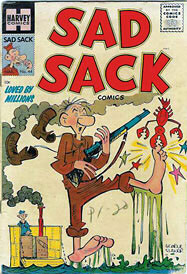
Sad Sack was "an otherwise unnamed, lowly private experiencing some of the absurdities and humiliations of military life. The title was a euphemistic shortening of the military slang 'sad sack of shit,' common during WWII."
I doubt if Dowd meant to associate Obama with a sack of shit, but she asks us to picture this sack bouncing. Bouncing back from an array of sins. So the sins are arrayed in military formation — perhaps in the sun, with second-degree sunburns — and the sack of shit (which was once a messiah) is trying to bounce, as if bouncing is a good response to an organized military attack.
Seems like a sad sack, trying to bounce back... I take it that's an accidental rhyme, just one morelump dingleberry of evidence that Dowd doesn't look critically at her writing, but it's possible, considering her reference to Obama's statement that "he dreams of 'going Bulworth,' a reference to the Warren Beatty movie in which a depressed and fading Democratic senator from California starts rapping, speaking with politically incorrect candor and dating Halle Berry." Seems like a sad sack, trying to bounce back... that could be a line in a rap. But no, it's an unintentional rhyme. Just as throwing Halle Berry into that riff about Bulworth unintentionally imputes an adultery component to Obama's Dreams From Warren Beatty.

The president should try candid; wistful and petulant aren’t getting him anywhere. The Republicans who are putting partisan gain above solving the country’s problems deserve a smackdown.Oh, please. That deserve-a-smackdown sentence is typical of what Obama's been saying for months. It's the very "wistful and petulant" that's not "getting him anywhere." And saying that a smackdown is deserved is perfectly passive. There's no solution there.
Is "try candid" a solution? It's very funny to say "try candid." Try. See if it works, because that other thing you've been doing hasn't worked. Candid is another means to an end, to be tried after dissembling has failed. Try it. For what end? Obviously not for its own sake or you wouldn't say try. The end must be partisan gain. Or... no, partisan gain is that terrible end sought by Republicans. Democrats are about solving the country’s problems.
How much attention does Maureen Dowd pay to her writing? I suspect that she giddily spins out colorful sentences. She's got a knack. But then she doesn't look at them critically. For example, that sentence I put in the post title:
The onetime messiah seems like a sad sack, trying to bounce back from a blistering array of sins that are not even his fault.Speaking of a blistering array... that's quite an array of images. And what's a blistering array? It's like the rays of the sun got into array and caused a second-degree sunburn. But the oldest meaning of the word "array" is military — soldiers lined up for battle. It's not really anything that sins do.
But Sad Sack has a military connotation to some of us who remember the old comic book character:
Sad Sack was "an otherwise unnamed, lowly private experiencing some of the absurdities and humiliations of military life. The title was a euphemistic shortening of the military slang 'sad sack of shit,' common during WWII."
I doubt if Dowd meant to associate Obama with a sack of shit, but she asks us to picture this sack bouncing. Bouncing back from an array of sins. So the sins are arrayed in military formation — perhaps in the sun, with second-degree sunburns — and the sack of shit (which was once a messiah) is trying to bounce, as if bouncing is a good response to an organized military attack.
Seems like a sad sack, trying to bounce back... I take it that's an accidental rhyme, just one more
Wednesday, May 1, 2013
Obama's performance in the Theater of the Ineffectual President.
It's not "my job... to somehow get [Congress] to behave," said Obama at yesterday's news conference, quoted by Maureen Dowd, who says:
2. Why would this Hollywood-in-Washington adoration make him deferential to some other historical figure, one who had to accomplish great things to achieve his high place in history? Quite the opposite! It should make Obama feel that it's always been enough for him simply to be Obama, the screen onto which a nation projects its hopes and dreams. Why should Obama "absorb lessons" from the movie about "Lincoln"? Obama created his own mode of arriving at greatness, and it's not much like Lincoln's at all.
3. A "community organizer" doesn't really "organize" a community, but even if one does, Congress isn't like the communities Obama supposedly organized. The idea that Obama could "organize" Congress is silly. Congress has its own organization, and it's full of powerful individuals who are currently actively pursuing political goals, not a bunch of citizens going about their private lives who might be induced to back some political project run by somebody else.
4. Yesterday's performance at the press conference was — I would presume — theater. It was the Theater of the Ineffectual President. It was not the Theater of the Lame Duck. (Dowd's piece is titled "Bottoms Up, Lame Duck." The "Bottoms Up" refers to her suggestion that Obama "have a drink with Mitch McConnell.") Obama likes to say he'll never face another election, but he's facing the 2014 elections. His performance yesterday was — I presume — a scene in the script for winning the midterms. I can't accomplish anything without Congress. Congress is the problem. He needs his Congress. Will we not give this beautiful man — upon whom we've projected our hopes and dreams — the Congress that will bring his presidency to a successful end? He is the central character in this movie "Obama" that we've all got to sit through. If we stay in character as members of the audience — passively taking in whatever we see on the screen — we'll merge our desires with the main character in the big spectacle. Identification with the protagonist. In the scene that ran yesterday, we saw our protagonist suffering his doubts and his weaknesses. He is beset with adversaries. Oh, no!
5. So, now we can see that Obama is doing his "job," as described by Maureen Dowd: "to somehow get this dunderheaded Congress, which is mind-bendingly awful, to do the stuff he wants them to do." Somehow. I'm telling you how I think he's going about getting Congress — Congress 2015 — to do the stuff he wants them to do. Keep sitting on your bottom as he leads from behind. Or: Bottoms up! And I don't mean drinking. I mean, get your ass out of your theater seat and stop watching the "Obama" movie. The lameness is not in our President but in ourselves.
Actually, it is his job to get them to behave. The job of the former community organizer and self-styled uniter is to somehow get this dunderheaded Congress, which is mind-bendingly awful, to do the stuff he wants them to do. It’s called leadership.1. It's silly to think that because Obama played the role of himself (playing Day-Lewis playing himself) that Obama is all about Lincoln. It made Obama look like he's about Obama, and putting Obama on the same level as Lincoln, with the mock-historical grandeur and the direction by Steven Spielberg, seems likely only to inflate Obama's egocentrism.
He still thinks he’ll do his thing from the balcony and everyone else will follow along below. That’s not how it works.
How can the president star in a White House Correspondents’ Association dinner satirical film pretending to be Daniel Day-Lewis playing Barack Obama in Steven Spielberg’s movie “Obama,” and not have absorbed the lessons of “Lincoln”?
2. Why would this Hollywood-in-Washington adoration make him deferential to some other historical figure, one who had to accomplish great things to achieve his high place in history? Quite the opposite! It should make Obama feel that it's always been enough for him simply to be Obama, the screen onto which a nation projects its hopes and dreams. Why should Obama "absorb lessons" from the movie about "Lincoln"? Obama created his own mode of arriving at greatness, and it's not much like Lincoln's at all.
3. A "community organizer" doesn't really "organize" a community, but even if one does, Congress isn't like the communities Obama supposedly organized. The idea that Obama could "organize" Congress is silly. Congress has its own organization, and it's full of powerful individuals who are currently actively pursuing political goals, not a bunch of citizens going about their private lives who might be induced to back some political project run by somebody else.
4. Yesterday's performance at the press conference was — I would presume — theater. It was the Theater of the Ineffectual President. It was not the Theater of the Lame Duck. (Dowd's piece is titled "Bottoms Up, Lame Duck." The "Bottoms Up" refers to her suggestion that Obama "have a drink with Mitch McConnell.") Obama likes to say he'll never face another election, but he's facing the 2014 elections. His performance yesterday was — I presume — a scene in the script for winning the midterms. I can't accomplish anything without Congress. Congress is the problem. He needs his Congress. Will we not give this beautiful man — upon whom we've projected our hopes and dreams — the Congress that will bring his presidency to a successful end? He is the central character in this movie "Obama" that we've all got to sit through. If we stay in character as members of the audience — passively taking in whatever we see on the screen — we'll merge our desires with the main character in the big spectacle. Identification with the protagonist. In the scene that ran yesterday, we saw our protagonist suffering his doubts and his weaknesses. He is beset with adversaries. Oh, no!
5. So, now we can see that Obama is doing his "job," as described by Maureen Dowd: "to somehow get this dunderheaded Congress, which is mind-bendingly awful, to do the stuff he wants them to do." Somehow. I'm telling you how I think he's going about getting Congress — Congress 2015 — to do the stuff he wants them to do. Keep sitting on your bottom as he leads from behind. Or: Bottoms up! And I don't mean drinking. I mean, get your ass out of your theater seat and stop watching the "Obama" movie. The lameness is not in our President but in ourselves.
Sunday, April 21, 2013
"Obama hates selling. He thinks people should just accept the right thing to do."
Says Maureen Dowd, who thinks that Obama "doesn’t know how to work the system" and "doesn’t want to learn, or to even hire some clever people who can tell him how to do it or do it for him." He's just too good to be good.
Dowd says Obama should have left "the high road," put on "brass knuckles," and clobbered North Dakota Democratic Senator Heidi Heitkamp with these lines: “Heidi, you’re brand new and you’re going to have a long career. You work with us, we’ll work with you. Public opinion is moving fast on this issue. The reason you get a six-year term is so you can have the guts to make tough votes. This is a totally defensible bill back home. It’s about background checks, nothing to do with access to guns. Heidi, you’re a mother. Think of those little kids dying in schoolrooms.”
Heidi, you’re a mother. Think of those little kids dying in schoolrooms. Give me a break! A powerful female politician would find that incredibly patronizing. I don't believe Dowd really thinks that's what a President would say in a private conversation with a female Senator. That's just pap for NYT readers.
Dowd began with something that sounded slightly tough: "Heidi, you’re brand new and you’re going to have a long career. You work with us, we’ll work with you." Why not make it actually tough? You’re brand new and you’re not going to have much of a career if you don't work with us. But Dowd — even while recommending violence-against-women-y brass knuckles — can't bring herself to invent truly bullying lines for Obama. And then she switches to the same policy arguments Obama used publicly. Finally, Dowd dribbles to such a soft landing that it's inadvertently sexist.
I presume Heitkamp figured out on her own what would play in North Dakota.
Sunday, April 7, 2013
The sex and the presidency analogy.
"Running for president is like sex... No one ever did it once and forgot about it," says James Carville, talking to Maureen Dowd, who inserts a few paragraphs — for decency's sake? — before getting to this additional Carville quote:
Going back into my own old "likeable enough" posts, I find this 2010 link to Instapundit:
"[Hillary]’s gone to hell and back trying to be president. She’s paid her dues, to say the least. The old cliché is that Democrats fall in love and Republicans fall in line. But now Republicans want a lot of people to run and they want to fall in love. And Democrats don’t want to fight; they just want to get behind Hillary and go on from there."What's with all this love and sex analogizing? I hear in it echoes of Barack Obama's crushing "You're likeable enough, Hillary."
Going back into my own old "likeable enough" posts, I find this 2010 link to Instapundit:
ELIZABETH WURTZEL: “I suppose I should confess: I like Sarah Palin. I like her because she is such a problem for all these political men, Republicans and Democrats alike, with their polls, and their Walter Dean Burnham theories of transformative elections, and their economy this and their values that–and here comes Palin, and logic just doesn’t apply. . . . The Democrats are total morons for not finding their own hot mama before the Republicans did so first, or maybe I should have left off the qualifiers and called it straight: the Democrats are just plain morons, at least where women are concerned.”Politics is like sex, and people want to fall in love, but it gets complicated when it's women in politics. Think about sex/don't think about sex. A paradox. A quandary.
... But the very essence of old-line Democratic feminism is to reject feminine appeal. It’s Bella Abzug and Hillary Clinton as role models.
Sunday, February 17, 2013
Tony Kushner thinks it's fine for a movie to "manipulate a small detail in the service of a greater historical truth."
"History doesn’t always organize itself according to the rules of drama. It’s ridiculous. It’s like saying that Lincoln didn’t have green socks, he had blue socks."
The green/blue sock equivalent ridiculousness in Kushner's screenplay was having Connecticut vote against the abolition of slavery when in fact it voted for.
The green/blue sock equivalent ridiculousness in Kushner's screenplay was having Connecticut vote against the abolition of slavery when in fact it voted for.
Subscribe to:
Posts (Atom)