Showing posts with label Nixon. Show all posts

Sunday, November 17, 2013

Bob Woodward seems so mealymouthed, but he might be a genius at saying everything, anything, and nothing.

Today, on Fox News Sunday, George Will took a staunch position about Obama's IYLYPYCKYP fix:
And I do think this is a constitutional scandal. Suppose the next Republican president and there will be another Republican president, comes into the press room someday and says, "You know, I really think the capital gains tax does not serve the national interest, so we're just, as an act of executive discretion, going to quit enforcing that for a few years."

That's not the rule of law.
Bob Woodward broke in and said something — in the slow, strangely over-restrained manner he has — that made me laugh out loud:

It is in a way, but as you know, there is a strong other side on that. And we're at the moment here where people have to make decisions and this is an implementation issue. And the pre -- I think people are going to give him discretion.
On re-listen, I laughed again. And then the third time, I said: "Actually, he's right"... if you understand what he's saying.

Now, trying to write this post, I'm not sure whether "It is in a way" meant "In a way, it is the rule of law" or "In a way, it is not the rule of law." When I laughed, I assumed the latter, the "is" being an affirmation of what Will had said, so Will's "not" was implied in Woodward's "is." I laughed because Will had been so firm, and Woodward seemed to agree, but with the weaseling "in a way." Then he added an acknowledgement of the "other side," which he called "strong."

And I'm not sure whether the "strong other side" was meant to oppose the statement that what Obama did is consistent with the rule of law or to oppose the statement that it is not the rule of law. You'd think reading the remainder of what Woodward said would clear that up, but as I read those next 2 sentences, I'm not sure whether they are meant to articulate the "strong other side" or whether he's moved on to another point.

Woodward might be brushing off the legal question and saying, whatever you and I might be able to say about the law, it doesn't much matter because the "people are going to give him discretion." That is: Obama is going to get away with it.

Or he might have meant to explain the legal issue: The question is whether the President is executing the law, and there's plenty of room for discretion in a President's decisionmaking about the scope of what is involved in implementing a particular statute, and most people, faced with Obama's implicit assertion that he's only executing the law, not writing new law, will see him as acting within the range of his discretion.

Or he might have been channeling the sort of legal attitude that says the rule of law is what you can get away with.  Another way to say that is:

Tuesday, October 29, 2013

"How the Alger Hiss Case Explains the Tea Party."

By Cass Sunstein.
Most of those who have carefully studied the case, and who have explored evidence emerging long after the trial itself, have concluded that [Whittaker] Chambers was telling the truth and that Hiss did indeed perjure himself....

Chambers’ broader charge -- that liberalism was a species of socialism, “inching its ice cap over the nation” -- polarized the nation. His attack on the patriotism of the Ivy League elite reflected an important strand in American culture, and it helped to initiate suspicions that persist to this day.
Rush Limbaugh was just talking about Alger Hiss last month:
The Democrat Party and the left of the day loved Alger Hiss, and they hated Nixon for exposing him.  To this day, Nixon is hated for having exposed -- successfully exposed -- Alger Hiss as a communist spy working in the State Department.  He was at the high levels, and Nixon got him, and they hated Nixon for it....

Friday, October 4, 2013

Today, at the University of Wisconsin—Madison, the law school presents a lecture by John Dean about Watergate, criminal law, and ethics.

That's later this afternoon. Meanwhile, here's a local media interview with Dean that engages him in some of the issues of the day. The interviewer Paul Fanlund invites Dean to attack today's Republicans with the prompt: "You wrote that book a few years ago and focused on politicians such as then-Vice President Cheney. But now the GOP looks ever more radical."

Dean says that 30% of Americans have a "personality trait" that some social psychologist he's talked to labels "authoritarianism," and that's now "the dominant force" driving Republican politics, which is why he and his friends — Dean lives in Beverly Hills — aren't Republicans anymore and also why Republicans are stuck with only 30% of the electorate. But Dean wonders "if the authoritarian people will ever get up to the 51 percent number because that would make a very different United States."

Unsuprisingly, Fanlund doesn't follow up with any questions about whether authoritarianism ever manifests itself in Democratic Party politics or whether some people with the authoritarian personality trait ever feel drawn into the hopes and dreams of left-liberal projects.

Fanlund's next question is a model of fawning and imprecision, the very opposite of what I'd want from a journalist: "You’ve done so much scholarship and have your first-hand experience. What do you think the future holds?"

Dean has just about nothing to say, so Fanlund proceeds to the topic of Wisconsin: "Last year I wrote about your assessment of Scott Walker, our governor, as a classic authoritarian personality." How did I miss that analysis? Dean says Walker is "so strikingly Nixonian that I cannot (turn away) out of fascination."
It’s kind of like the moth to the candle, I keep an eye on him. And I am likely to see pigs flying before he’s president.
So Walker is like Nixon, but somehow it's impossible for him to become President. Dean's not making a whole lot of sense in this phone interview, and Fanlund prompts him again: "Because of how Walker’s personality would play out with a national electorate?"

Dean picks up the cue:
Exactly. The country is not ready for him unless he skews far to the middle from where he is....
Isn't that easier than pigs flying? Dean blathers about moderation, and Fanlund offers some more help: "What struck us in Wisconsin, as much as anything, is how Walker, unlike governors I’ve known for three decades, made it clear from the start that he wasn’t interested in representing all of us, only those who elected him. Are you surprised?"

This is a telephone interview, and Dean is phoning it in. From Beverly Hills. And guess what? He is surprised. Frankly, he's surprised, but maybe he shouldn't be so surprised, because, after all, Joe McCarthy... blah blah... "maybe there are still people that kind of politics appeals to".... you know, the kind of people with that authoritarianism personality trait. Maybe they're still around out there somewhere in Wisconsin. Not Madison, of course, where it's worth flying in from Beverly Hills to speak to people who can't possibly be authoritarian.

Saturday, September 7, 2013

"It is a very strange moment for Mr. Obama..."

The NYT editorial on Obama's Syrian difficulties. It's against a military strike, I think, but in the most invisible possible way.

Let me paraphrase the 10 paragraphs:

¶1 — Obama is having trouble selling his plan to attack Syria. 

¶2 — We're right to worry that the supposedly narrow attack will turn into another big war.

¶3 — The Pentagon is planning for broader war.

¶4 — The administration has asked the Pentagon to come up with more targets — more than the 50+ targets we already have.

¶5 — Obama has been vague about what these additional targets are (but they can't be the actual chemical stockpiles, because bombing them would unloose the poison).

¶6 — Talk of launching missiles from offshore has given way to reports of sending in bombers.

¶7 — Some members of Congress want to hem Obama in but McCain openly advocates taking the side of the rebels and ousting Assad.

¶8 — Obama is supposed to be the guy that gets us out of wars, and he owes us more assurance that what is planning really is narrow.

¶9 — Putin is staring Obama down.

¶10 — The whole group of foreign leaders gave Obama the cold shoulder.

¶8 is the key paragraph. It's the one with the quote I put in the post title. It's the one where the editors get as close as they are willing to answering the question posed in the headline: "Can Mr. Obama Avoid Mission Creep?" I think their secret answer is "no," but they don't want to say that. Instead, they lay out their worries and challenge him to explain how he's going to avoid a larger war. They say "the public deserves to understand more fully what 'limited' military action actually means" as if maybe it's our comprehension problem or his failure to sufficiently elaborate.

The first paragraph references Obama's planned speech on Tuesday, so maybe the editors thought, let's give him a chance to be specific about these things. Maybe the great speech-maker can explain it all next week. What's strange — if they want to talk about strange — is that Obama hasn't delivered the big explanatory speech yet. The simplest explanation is that he can't explain, and the answer to the question "Can Mr. Obama Avoid Mission Creep?" is just: no.

***

"Mission creep" sounds — to me, anyway — like a term from the Nixon era. (There was CREEP.) But in fact, at least according to Wikipedia's "mission creep" article, the term goes back to Somalia:
The first two articles to use the term in the Washington Post were both by columnist Jim Hoagland ("Prepared for Non-Combat", April 15, 1993 and Beware 'mission creep' In Somalia, July 20, 1993). The New York Times used the term for the first time in an article by correspondent John H. Cushman, Jr. written after the October 4, 1993 firefight in the capital of Somalia, Mogadishu, in which 18 American military personnel were killed.

The U.S. and later UN Mission in Somalia (Restore Hope) would seem to be the classic example of mission creep....
Restore Hope.

***

Whatever makes you happy... whatever you want....

Sunday, September 1, 2013

Goodbye to David Frost.

Dead of a heart attack, which happened last night on board the Queen Elizabeth. He was 74.

You might think first of his interviews with Richard Nixon...


... but I remember him from the early 60s comedy show — a precursor to "The Daily Show" — "That Was the Week That Was."

Monday, May 13, 2013

Nixon goes to China.

It's Christopher Nixon Cox, the grandson of Richard Nixon.
The 34-year-old investment banker was joined by his Andrea Castimatidis - the daughter of supermarket billionaire and New York City mayoral hopeful John Castimatidis - who stood out in a plunging red dress to match her husband's tie.
"His Andrea Castimatidis"? How many other guys get an Andrea Castimatidis? Are the other Andrea Castimatidises that the nongrandsons-of-Presidents get also daughters of billionaires who want to be mayors? And do they all look that weird?

Do all these couples stand hand-almost-in-hand and pose with the image of Chairman Mao between their 2 heads?

ADDED: So, the missing word in the linked Daily Mail article is "wife." The strange looking pair is actually a marital unit. Here's the NYT "vows" article on the occasion of their wedding. 
Throughout the summer of 2008, Ms. Catsimatidis and Mr. Cox kept seeing each other at political events. “We’d have these great conversations,” Mr. Cox said. “We think about a lot of things the same way.”

The more she saw him, the more she, too, became impressed. And as she did, their 11-year age difference seemed to melt away. But she did not always see him as a potential boyfriend. “I was always drawn to him,” she said. “But it didn’t cross my mind until a whole bunch of my friends said, ‘You should date him.’ ”...

“We knew from the beginning we wanted to marry each other,” Mr. Cox said. “We believe in love at first sight.”
And love at first girlfriends saying "You should date him." But why did they say that? She wasn't even 18 when she met him. She didn't think of him as a potential boyfriend. And her strict father had never permitted her to date. Now billionaire dad is running for mayor and the couple is in China posing around the same monuments once posed around by Pat and Dick Nixon.

"We know a lot about President Obama, and I think the idea that he would want the IRS used for retribution — we have no evidence of any such thing."

Says Carl Bernstein, declaring that the Obama administration's IRS scandal is not Watergate. 
"In the Nixon White House, we heard the president of the United States on tape saying 'Use the IRS to get back on our enemies."
The link goes to Politico, which doesn't close the quotation marks around "Use the IRS to get back on our enemies," and doesn't link to specific Nixon quotes found on the Watergate tapes. It's strange to put quotes around that if it's not a quote. Here's the Wikipedia article "Nixon's Enemies List," which doesn't quote any Nixon remarks. It does have the truly shocking John Dean memo that asks "how we can use the available federal machinery to screw our political enemies." Politico needs to close the quotation marks and link to the quote or take away the quotes and add some material about how Nixon never said that and perhaps Bernstein — the wheeled-out old authority on Watergate — meant to say John Dean when he said Nixon.

Now, as to we have any evidence that Obama would want the IRS used for retribution, Obama once joked about using the machinery of the IRS against his enemies:
At his Arizona State University commencement speech [in May 2009], Mr. Obama noted that ASU had refused to grant him an honorary degree, citing his lack of experience, and the controversy this had caused. He then demonstrated ASU's point by remarking, "I really thought this was much ado about nothing, but I do think we all learned an important lesson. I learned never again to pick another team over the Sun Devils in my NCAA brackets. . . . President [Michael] Crowe and the Board of Regents will soon learn all about being audited by the IRS."

Sunday, May 12, 2013

What did the President know and when did he know it?

An old question. It springs to mind upon reading today's news:
Senior Internal Revenue Service officials knew agents were targeting tea party groups as early as 2011, according to a draft of an inspector general's report obtained by The Associated Press that seemingly contradicts public statements by the IRS commissioner.
Over at the Isthmus forum — a Madison, Wisconsin site, where lefties try to cocoon — a regular commenter who uses the pseudonym Henry Vilas had said: "Sounds like an over-zealot functionary in a local office. While such partisan use of the IRS should be condemned, it's not like a presidential enemies list." And when confronted with the news that senior IRS officials knew, he said: "So did Obama sic the IRS on them, like Nixon did with his enemies list?"

Our own Meade followed the link to the Wikipedia article "Nixon's Enemies List," actually read it, and wrote:
Obamaphiles should hope so:
"On December 20, 1973, the Congressional Joint Committee on Internal Revenue Taxation concluded that people on the 'Enemies' list had not been subjected to an unusual number of tax audits."

Friday, May 10, 2013

"I kid you not: The IRS just released a statement on its improper harassment of conservative groups in the run-up to the 2012 election including the words: 'mistakes were made.'"

Says Instapundit, under the heading "It just gets worse."

I see that "Mistakes were made" has its own Wikipedia page:
The New York Times has called the phrase a "classic Washington linguistic construct." Political consultant William Schneider suggested that this usage be referred to as the "past exonerative" tense, and commentator William Safire has defined the phrase as "[a] passive-evasive way of acknowledging error while distancing the speaker from responsibility for it." While perhaps most famous in politics, the phrase has also been used in business, sports, and entertainment.
The phrase is most associated with Richard Nixon and his press secretary Ron Ziegler:

U.S. President Richard Nixon used the phrase several times in reference to wrongdoings by his own electoral organization and presidential administration.

On May 1, 1973, White House Press Secretary Ron Ziegler stated "I would apologize to the Post, and I would apologize to Mr. Woodward and Mr. Bernstein" (referring to Bob Woodward and Carl Bernstein of The Washington Post). He continued, "We would all have to say that mistakes were made in terms of comments. I was overenthusiastic in my comments about the Post, particularly if you look at them in the context of developments that have taken place." The previous day, White House counsel John Dean and Nixon aides John Ehrlichman and H.R. Haldeman had resigned, as the Watergate scandal progressed.
But it's not as though the association with Nixon has worked over the years to warn off other politicians. As you can see at the Wikipedia page, President Reagan used it in 1987 (about Iran-Contra, President Clinton used it in 1997 (about Democratic Party fundraising scandals. Senator McCain used it in 2005 (about the Iraq war). There are more items on the list, including — I love Wikipedia —today's statement by the IRS.

Under the "see also" heading:
List of political catch phrases
Non-apology apology
Non-denial denial
Spin (public relations)
IN THE COMMENTS: Erich said: "Calls to mind the classic Matt Groening cartoon."

Saturday, April 13, 2013

"Shell Shocked: My Life with the Turtles, Flo and Eddie, and Frank Zappa, etc."

Wow! Howard Kaylan has a book that just came out today. Stumbled over it, looking for other things.

Not in Kindle, for some reason, but here's an excerpt that was in Rolling Stone:
I was snorting coke on Abraham Lincoln's desk in the White House. Yes, that Abraham Lincoln and that White House. A bunch of hairy peacenik dopers from California though we were, it seems that Tricia Nixon, daughter of Tricky Dick himself, was a fan of the Turtles and had requested our presence. Our first instinct: you've got to be kidding! No way in hell!

Yet here we were, our noses vacuuming lines off the surface of Honest Abe's very own workspace.
Oh, all the drugs that have been taken at the White House over the years! Someone should collect all that on one webpage... including the 100% uncut speculation. 

Wednesday, April 10, 2013

When things fall into the wrong hands.

From Bob Woodward and Scott Armstrong's "The Brethren," the 1979 book about the the Supreme Court (in the 1969 Term through the 1975 Term). This vignette takes place after the oral argument in the Watergate tapes case (United States v. Nixon) at page 374:
The clerks turned to humor to kill time as they waited to learn what was going on. One of Powell’s clerks, disturbed by his boss’s memo the day before, drafted a phony opinion and gave it very limited circulation to the clerks’ dining room. “We believe the principle of executive privilege is important…. This case is different from all others that will come before the Court. The Court should be guided by a solicitous concern for the effective discharge of the President’s duties and the dignity of his high office.

“However, we’re deciding this case differently, because Nixon is a crook and somebody ought to throw the son of a bitch in jail.”

Marshall laughed heartily when his clerks showed him a copy. The copies were destroyed for fear that one might fall into the wrong hands.

Sunday, March 17, 2013

"McCain jokingly wiped his face, pretending to wipe off moss."

Moss can't be wiped off, and it's not — like the metaphorical egg — only on the face.

In fact, the standard term is mossback:
A reactionary; one who furiously resists progress of any kind.

The word is derived from a sea creature so ancient that it has moss or seaweed growing on its back. During the Civil War it was used to describe those who fled to the swamps and forests to evade the draft; in the 1870s the word was given a political meaning as a Northern counterpart to a Southern "Bourbon (i.e., conservative) Democrat."

Emporia Gazette editor William Allen White, in his famed "What's the Matter with Kansas?" editorial in 1896, thundered: "We have an old moss-back Jacksonian who snorts and howls because there is a bathtub in the State House; we are running that old jay for Governor."
Old jay, eh? Was he wacko? Back to the discussion of mossback (which is from the greatly missed William Safire).
Pennsylvania Congressman J.C. Sibley drew a typical word picture in 1900: "Primitive man lived in caverns, clothed himself with skins, and ate his meat raw, sitting on his haunches, and there has never occurred a change for the higher and better forms of life without arousing the hostility of some old mossback, conservative hunker[s], who will prate of those fairer and better days of old, when their grandfathers swung by their tails from the limbs of the trees."
Wacko monkeys.
Will Rogers told defeated Democratic candidate Al Smith in 1929: "taken out from under the influence of a lot of these old Mossbacks, you are a pretty progressive fellow, Al, and with you and this fellow Roosevelt as a kind of nucleus, I think we can, with the help of some Progressive young Democratic governors and senators and congressmen, make this thing into a Party, instead of a Memory."
Make this thing into a Party, instead of a Memory... a good phrase for Republicans to think about today.
The word was relatively dormant during the thirties and early forties, but President Harry Truman gave it new life in the 1948 campaign. In the Far West he charged that the Republican party's domination by "eastern mossbacks" would stifle the economy of the West. Throughout the country, he denounced the Republican chairmen of the Senate and House committees as "a bunch of mossbacks."

One of the lines that best describes a mossback was leveled at House Speaker "Uncle Joe" Cannon: "If he had been present at Creation, he would have voted for Chaos."...

In 1992 President George H.W. Bush complained that he had extended a "hand of friendship" to Congress at the start of his presidency "and these old mossbacks bit it off." Long Island's Newsday reported a year later that "Clinton joined... Richard Nixon in toasting [Strom] Thurmond's inspiring 90-year journey from racist Democratic segregationist to mossback Republican obstructionist."
The Oxford English dictionary has the old Civil War meaning first, then "A slow, rustic, or old-fashioned person; one attached to antiquated ideas; (hence) an extreme conservative; a reactionary. In early use often denoting farmers of the southern and western States of the United States (see quot. 1888)." Examples:
[1850   H. C. Lewis Odd Leaves from Louisiana Swamp Doctor 181   Here you sit, like a knot in a tree, with the moss commencing to grow on your back.]...
1885   Boston (Mass.) Jrnl. 5 Mar. 2/3   Everybody rejoices over the passage of the bill... We say everybody—we except a few intense mossbacks, who were known during the war as copperheads.
1888   America 18 Oct. 16   Mossback..seems to have originated in the swamps of North Carolina, where a particular class of the poor whites were said to have lived among the cypress until the moss had grown on their backs.
1924   J. Buchan Three Hostages i. 10,   I was becoming such a mossback that I had almost stopped reading the papers.

Saturday, March 16, 2013

LBJ wanted to show up at the 1968 Democratic Convention and ask for the nomination.

Newly declassified tapes reveal. This plan arose during the convention, while the big "whole world is watching" protests raged.
[LBJ] planned to leave Texas and fly into Chicago. He would then enter the convention and announce he was putting his name forward as a candidate for a second term....

[Chicago Mayor Richard] Daley assured him enough delegates would support his nomination but the plan was shelved after the Secret Service warned the president they could not guarantee his safety.
Also at that link, LBJ "orders the Nixon campaign to be placed under FBI surveillance and demands to know if Nixon is personally involved" in some dealings involving Vietnam peace talks.

Thursday, February 28, 2013

"Strains credulity to think that ice releases thousands of illegals..."

"... and no one there ran it up the food chain. Not even a 'heads up?' Hmmm."

The old buzzword "deniability" popped into my head.

ME (out loud): "Deniability. Who do you associate with that word."

MEADE: "Nixon."

ME (having Googled, reading from Wikipedia): "Kennedy. 'Plausible deniability is a term coined by the CIA during the Kennedy administration to describe the withholding of information from senior officials in order to protect them from repercussions in the event that illegal or unpopular activities by the CIA became public knowledge.'"

I love Wikipedia. I love that there's a whole long article on the topic "plausible deniability." The name Nixon comes up — in a list of 6 "major flaws" in the "doctrine." The Nixon-related flaw is:
It rarely worked when invoked; the denials made were rarely plausible and were generally seen through by both the media and the populace. One aspect of the Watergate crisis is the repeated failure of the doctrine of plausible deniability, which the administration repeatedly attempted to use to stop the scandal affecting President Richard Nixon and his aides.
Also at the article, under the heading "other examples":
The Murder of Thomas Becket

King Henry II of England is often said to have stated of Archbishop of Canterbury Thomas Becket, "Who will rid me of this meddlesome priest?" Becket was indeed murdered, although the king denied that his plea was to be taken in such a way.
We don't live in a monarchy, and efforts to insulate a U.S. President from criticism should fail and will fail if we haven't lost track of our role as citizens.

(And, as noted a few posts ago, these Washington writers are nauseatingly dependent on clichés. The food chain, heads up. "Food chain" isn't even the right cliché. Perino meant the chain of command. That other chain. Django Unchained. Chain of Fools. Chains, my baby's got me locked up in chains. Workers of the world unite. You have nothing to lose but your chains. Ball and chain. A chain is only as strong as its weakest link. Chain smoking. Hey, I'm only yanking your chain.)

Saturday, February 2, 2013

Obama, skeet-shooting last August.

The photographic evidence — responding to skepticism — uploaded at the presidential Flickr page today:

P080412PS-0464

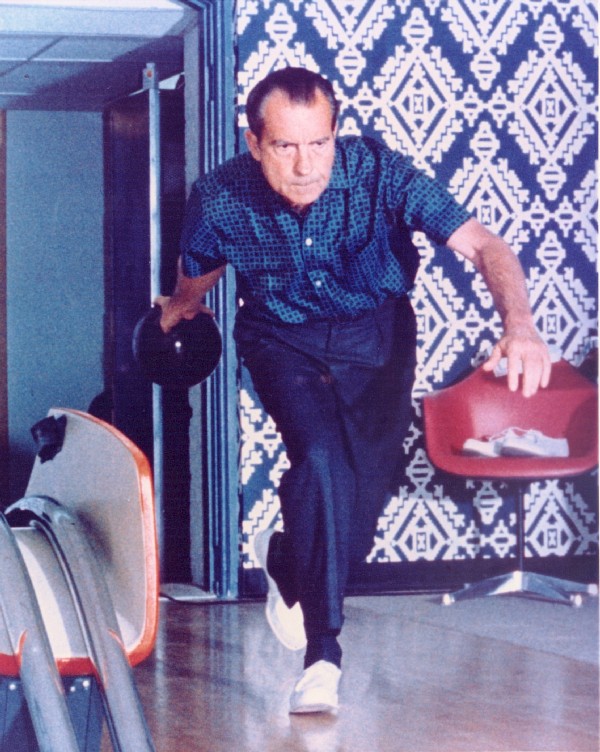
IN THE COMMENTS: mccullough said: "Cool picture. I want a poster of it to put next to my poster of Nixon bowling."


ADDED: White House coins the term "skeeters" to make fun of people don't believe Obama goes skeet shooting all the time at Camp David.

Tuesday, January 22, 2013

Linda Greenhouse and Reva Siegel "say one of the things that really politicized the abortion issue was the efforts of those working to re-elect President Richard Nixon in 1972."

"His aides, including future Republican presidential candidate Patrick Buchanan, wanted to lure Northern Catholic voters, who had traditionally voted Democratic, over to the Republican Party."
Nixon "was strongly advised by his strategists ... to make a play for a Northern urban Catholic Democratic vote," says Greenhouse. "A kind of Northern strategy that mirrored the Southern strategy."

In fact, up until then, top Republicans tended to be more in favor of abortion rights than Democrats, including, for much of his first term, Nixon himself....

So, taking his aides' advice, Nixon switched sides on abortion, even reversing an earlier relaxation of an abortion ban in military facilities.

Wednesday, January 9, 2013

How should we celebrate the 100th birthday of Richard M. Nixon?

It's today.

Ideas:

1. Tell us your favorite thing about Richard Nixon. (It's his birthday. No need to trot out all the usual hatred.)

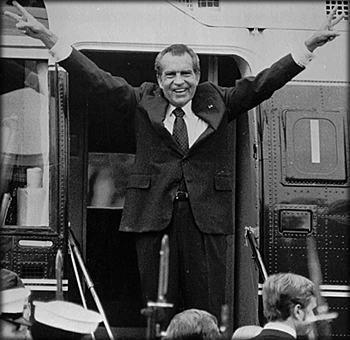
2. When you encounter someone today, instead of saying "hi," do that 2-arms-raised-with-V-for-victory-fingers gesture.


3. For lunch: Ketchup on your cottage cheese.

4. Work Nixon phrases into conversations, e.g. "the lift of a driving dream."

5. When you put on your coat, call attention to the fact that it's a "cloth coat," as if that's remarkable, as if anyone would ever expect anyone these days to have a fur. If people look at you funny, double down by calling it "a respectable Republican cloth coat." If somebody gets the jump on you and calls their coat a "cloth coat" first, show that you get it by saying, "As I always say, you'd look good in anything."

6. At some point today, when you're with someone who never kneels to pray, insist that they get down on their knees and pray with you.

7. Wearing a dark suit and wingtips, take a walk on the beach.

8. Secretly record all your conversations. (Or is everyone already doing that?)

9. If anyone happens to say "pardon me," say: "Pursuant to the pardon power conferred upon me by Article II, Section II, I grant a full, free, and absolute pardon unto you for all offenses."

10. When you leave a room, turn to anyone who remains in it — or even to an empty room — and proclaim: "I leave you gentlemen now. But as I leave you I want you to know, you won't have [your name] to kick around any more."

11. This is special for lawprofs and other law folk. If anyone mentions Rehnquist, act like they got the name wrong, and faux-correct them with "Renchburg."

12. From Ron in the comments: Play ping pong. Watch Dr. StrangeKissinger. Just for the hell of it say, "Sock it to me?" Just for today call your closest friend "Spiro." Play Checkers.

13. If you find yourself in the kitchen with somebody, strike up a debate and at some point, start needling them about being a Communist.

Monday, December 31, 2012

What's Happening to Hillary? Only a clod would say the clot is a plot!

Here are Senators Lindsey Graham and Dianne Feinstein, interviewed by Chris Wallace (yesterday, on "Fox News Sunday"):
WALLACE: Senator Graham, how important is it for Secretary of State Clinton to testify under oath before she leaves office about the Benghazi terror attack?...

GRAHAM: Absolutely essential that she'd testify....

WALLACE: Some of your Republican colleagues say they are prepared to hold off the confirmation of John Kerry as secretary of state, until Secretary Clinton testifies as secretary, before she leaves office.

GRAHAM: That's going to happen. I've been told by Senator Kerry he wants that approach also. He needs to hear what she says so he can make comments about, I agree with her/I don't agree with her. It makes sense to have her go first.

WALLACE: Do you agree with that, Senator Feinstein, that she needs to testify first, as an -- and have you been assured she will testify, though it has been 3 1/2 months since Benghazi and she still has never really answered questions, about Benghazi, her role before, during, after the attack? Do you have reason to believe she'll testify as secretary?

FEINSTEIN: She has said she will and I believe she will. You know, she's had a very real accident and she's recovering from it, and, she will be back. I gather, her first day, of work may well be next week. So, I think that's good news.
With all that assurance that Hillary Clinton would testify, later that day, we heard the news that Hillary Clinton had entered the hospital with a blood clot. We weren't told the site of said blood clot. Was it her brain (recently concussed)? Was it her leg (where she had a blood clot back in 1998)? The former is a big deal, the latter, not so much. Why not specify the site, since it make such a big difference, medically? Oh, but we're told we must not display any skepticism, any hint of suspicion that the SOS is trying to avoid having to testify about Benghazi. The woman is ill. Only a clod would say a clot was a plot.

Here's medical expert Kent Sepkowitz:
Unlike the relatively bland “concussion after fainting” pronouncement from earlier this month, this terse press release from her spokesman smells a little fishy. First it is odd that we are not told where the clot is—usually the clot, referred to as thrombophlebitis, occurs in the leg, a condition suffered by former president Richard Nixon after leaving the White House. 
Maybe you can remember — if not, guess! — how sensitive we were to Nixon's phlebitis, which conveniently flared up in the midst of Watergate. Ha! That bastard thinks he can get our sympathy. Pathetic! (That's what I said at the time.)
The clot [in the leg] can be uncomfortable but is only dangerous and even life threatening if it breaks free and travels downstream into the lung—a pulmonary embolus, in medical parlance.... Given that Clinton already has had this condition and those who have had one episode have a predilection to recurrence, the lack of a reminder of the 1998 clot from her press people seems a strange oversight.

Another problem with the “concussion then clot” story is this—the concussion, if indeed it came after a faint, should not directly predispose Clinton to a clot....

Alternatively, is it possible that the clot in question is one in the lining of the brain that can form after head trauma.... But anticoagulation is never given to persons with clots around the brain. They are either watched without intervention or surgically evacuated. So this possible explanation is out.

We are left with a story that is not easy to connect up with sparse information from the inside crowd, who could easily deflate speculation with two or three more measly facts. The National Enquirer has already declared Clinton to be suffering from a brain tumor, linking her observed weight gain, possibly from treatment for the putative cancer, and not-exactly-explained need to leave Obama’s Cabinet to the grim diagnosis. Such a story no longer seems to me as implausible as it did after the faint and concussion reports.
The suppression of informationthe site of the clot — suggests 2 radically different theories: 1. fakery/exaggeration to evade testimony, or 2. something horribly serious. I read Sepkowitz to exclude the middle ground.

UPDATE: Email from CNN says: "Secretary of State Hillary Clinton has a blood clot between her brain and skull behind her right ear, her doctors said." This seems to be the option that Sepkowitz excluded because "anticoagulation is never given to persons with clots around the brain." If that's correct, then something is still, to use Sepkowitz's word, fishy.

UPDATE 2: Here's the Washington Post, on January 1st, noting the site of the clot and saying "The conventional treatment is an anticoagulant drug for at least six months." So that directly contradictions Sepkowitz's statement that "anticoagulation is never given to persons with clots around the brain."

AND: I've got a bit more to say here

Wednesday, December 19, 2012

Republicans used to stress "law and order," and Democrats — sounding more educated and compassionate — said we needed to look at the "root causes" of crime.

Back in, say, the Nixon era, we Nixon-hating types used "law-and-order" as an adjective expressing contempt. We might say, for example, "Governor Reagan is a law-and-order idiot."

Remember when Nixon caught flak for saying — about Charles Manson — "Here is a man who was guilty, directly or indirectly, of eight murders without reason.... Here is a man, yet, who, as far as the news media coverage was concerned, appeared to be rather a glamorous figure..."?

Nowadays, everyone's for law and order. The disagreement is only over the nature of the order. The Democrats don't react to mass murder with pleas to understand mental illness, economic strains, and cultural malaise anymore. They offer tougher laws (in the form of gun control).

Meanwhile, the mentally ill live on the streets or — once they've acted out — are incapacitated in prisons, and one hears very little concern about it from Democrats.