Showing posts with label things not believed. Show all posts

Friday, October 18, 2013

"Even When the GOP Loses, It Wins/Think the Senate deal is a resounding defeat for Republicans? Think again."

 That is the headline of an editorial in The Nation.
[I]n the war of ideas, the Senate deal is but a stalemate, one made almost entirely on conservative terms. The GOP now goes into budget talks with sequestration as the new baseline, primed to demand longer-term cuts in Medicare, Medicaid and Social Security. And they still hold the gun of a US default to the nation’s head in the next debt ceiling showdown.

Surrender? Any more “victories” like this and Democrats will end up paying tribute into the GOP’s coffers.
I'm surprised to read this, because I thought what I was observing — to the extent that I did not avert my eyes — was the liberal media doing the Democratic Party's work of declaring victory.* I'm interested in seeing The Nation peel off from that strategy. It's all propaganda of one kind or another, but the strategies of propaganda interest me. It's boring when they all do the same thing, which is the  main reason I had my own personal shutdown during the shutdown.

Key line: "The GOP may be bearing the brunt of the public’s rage, but anger is also directed at Washington and government generally." The Democratic Party and its supporters in the media mostly had the strategy of blaming the GOP. Get people mad and then: Be mad at those guys. But stirring up anger is a problem:

1. There are a lot of people like me who turn away and refuse to listen when someone is directing us to be angry. Those ugly people over there are going to solve their problem whether I monitor their argument or not.

2. Then you have the kind of people who actually do take direction to the point where they become inflamed with anger. Do these hotheaded folks pay attention to the details of why these nasty people as opposed to those nasty people were more responsible for the thing they were induced to feel angry about?

Examine that key line again: "The GOP may be bearing the brunt of the public’s rage, but anger is also directed at Washington and government generally." There are 2 clauses, and if the second clause is the stronger proposition — which is likely — then the GOP came out ahead.
_______________________________

* Yesterday, I almost ended my personal shutdown to do a post based on the old saying "Declare victory and get out." Do you know the origin of that phrase?

During the Vietnam war, [U.S. Senator from Vermont George] Aiken is widely believed to have suggested that the U.S. should declare victory and bring the troops home. Actually, what he said was that "the United States could well declare unilaterally ... that we have 'won' in the sense that our armed forces are in control of most of the field and no potential enemy is in a position to establish its authority over South Vietnam," and that such a declaration "would herald the resumption of political warfare as the dominant theme in Vietnam." He added: "It may be a far-fetched proposal, but nothing else has worked."
Anyone who knows what happened when we got out of Vietnam should be skeptical of propaganda in the form of declaring victory. Frankly, I'm surprised anyone attempts the "declare victory and get out" type of statement. In my book, it's on the list of things not to say, right after "I am not a crook."

Saturday, October 5, 2013

"'What happened today was not credible,' were the stunned and wooden words of Tom Clancy..."

A line on page 4 of the Martin Amis book "The Second Plane/September 11: Terror and Boredom," which I began rereading last night.

Tom Clancy died last Tuesday, and I did not blog about it, because I don't blog every obituary and because I've never read (or felt motivated to read) a Tom Clancy book. It doesn't mean anything — of course, I'm not superstitious — that I'd never taken an interest in Clancy and then I run into his name on the second page of the first essay in a book I happened to take down from the shelf for no apparent reason — was it on Tuesday?

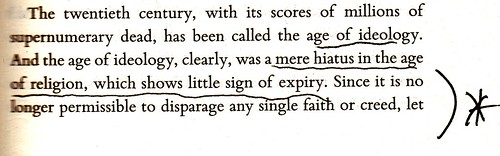
I took the book off the shelf and immediately saw something I'd written inside the back cover. I didn't remember getting this idea, but I could recognize it as my own thinking and knew that something in the book had inspired me to think that. Because my graphomania extends to marginalia — as the first post on this blog attests — I'm able to find the place in the text that inspired the back-of-the-book notes.

First, I'll show you the Amis text (with my marginalia). It's on pages 13 and 14:

scrapbook 5_0001
scrapbook 5_0002

Now, I'll let you read my notes:

scrapbook 5_0004

Tuesday, March 26, 2013

"What precisely is the way in which allowing gay couples to marry would interfere with the vision of marriage as procreation of children that allowing sterile couples of different sexes to marry would not?"

A perceptive question by Justice Breyer at today's oral argument in the Prop 8 case, asked of Charles J. Cooper, who had framed the state's interest in terms of "responsible procreation." It's certainly true that same-sex couples and opposite-sex couples are different in that only sex between a man and a woman can result in children, but what's the harm in letting some couples who can't reproduce get married?

Cooper says:
The concern is that redefining marriage as a genderless institution will sever its abiding connection to its historic traditional procreative purposes, and it will refocus, refocus the purpose of marriage and the definition of marriage away from the raising of children and to the emotional needs and desires of adults, of adult couples….
Justice Kagan presses him: What about older heterosexual couples over the age of 55? Their sexual intercourse isn't going to produce children. Letting them marry when they can't procreate ought to present the same problem of centering marriage on adult "needs and desires" instead of on children.

Cooper says:
[S]ociety's interest in responsible procreation isn't just with respect to the procreative capacities of the couple itself. The marital norm, which imposes the obligations of fidelity and monogamy... advances the interests in responsible procreation by making it more likely that neither party, including the fertile party to that...
The fertile party? Yes: The man can still reproduce, just not with this woman.
The marital norm... [is] designed... to make it less likely that either party to that — to that marriage will engage in irresponsible procreative conduct outside of that marriage.... That's... the marital norm. Society has an interest in seeing a 55-year-old couple that is -- just as it has an interest of seeing any heterosexual couple that intends to engage in a prolonged period of cohabitation to reserve that until they have made a marital commitment.... So that, should that union produce any offspring, it would be more likely that that child or children will be raised by the mother and father who brought them into the world.
Got that? In this view, marriage is about children and not adult desire because it is a device to rein in male desire, to keep men from fathering children they aren't going to raise. It's not that marriage can keep that bad thing from happening. It just makes it less likely, because the marriage norm is fidelity.

Obviously, fornication and adultery go on despite this marriage norm, and it's hard to see why letting gay people marry would mess up the norm. I'm trying to picture this man at the heart of Cooper's vision of society: He's true to his wife, because he's gotten the message that's the norm, but if some gay people can marry, then he's going to start cheating, knocking up some other woman, and it's because of this guy that gay people can be excluded from marriage?

What a nutty set of things we're asked to believe! Who the hell is this stereotypical married man, constrained by what other people are forbidden to do? And why should his ridiculous, tenuous connection to norms carry the day? And how can obsessing over what makes him tick work to keep marriage focused on the raising of children and not on the emotional needs and desires of adults? It seems to be all about the needs and desires of adults — really ridiculous heterosexual male adults.

Who are these people?!

Tuesday, February 26, 2013

"As a movie lover, she was honored to present the award and celebrate the artists who inspire us all — especially our young people."

After Michelle Obama got criticized for horning in on the Oscars, her communications director issues that as a response.

I loathe that kind of PR — so saccharine and insincere. Look at all the assertions crammed into that sentence. 1. MO is a movie lover. 2. MO was honored. 3. MO was honored as a movie lover. 4. MO presented the award in order to celebrate the artists. 5. Hollywood movie people are artists. 6. Artists do art for the purpose of inspiring everybody. 7. Hollywood movies are made for the purpose of inspiring people. 8. Hollywood movies actually succeeding in inspiring all of us. 9. Young people are especially inspired by movies.

It's such an inane load of nonsense that it seems low and peevish of me to point out so many distinct elements. It was only ever intended to waft over you as a vague fog of a feeling that something appropriately lofty and bland has been said. That's the only relevant meaning.

Oh, wait. Look at this. Something else is being said. We have here a professor of women’s history from Ohio University who has delved into the study of First Ladies. This comes not from the PR department but from academia. Professor Katherine Jellison says: "I get the feeling that she is for the first time maybe really relaxing and enjoying her celebrityhood."

For the first time in my adult lifetime, I’m really proud of my celebrityhood...

Thursday, January 17, 2013

"The toothbrush moustache (also called Hitler moustache, Charlie Chaplin moustache, 1/3 moustache, philtrum moustache, the postage stamp, or soul (mou)stache)..."

"... is a moustache, shaved at the edges, except for three to five centimeters above the centre of the lip. The sides of the moustache are vertical rather than tapered."

I found this Wikipedia article — "Toothbrush moustache" — last night after asserting that Hitler adopted the Hilter mustache to emulate Charlie Chaplin. The topic came up in connection with the array of photographs — Obama/Hitler/Stalin — that we're talking about in the previous post. Meade didn't believe me, and my belief — even if it's wrong — is at least common enough that I could easily do the research. (A couple weeks ago, the roles were reversed: Meade asserted a misconception common enough to have a Snopes article declaring it false.)

So, according to Wikipedia, the toothbrush mustache "originally became popular in America in the late 19th century."
It was a neat, uniform, low-maintenance style that echoed the standardization and uniformity brought on by industrialization, in contrast to the more flamboyant moustaches typical of the 19th century such as the Imperial, Walrus, Handlebar, Horseshoe, Pencil and Fantastico moustaches.
Brought on by industrialization? Is that some stray unsupported — Marxist? — opinion that needs editing out of Wikipedia? There is a citation. It's to a 2007 Vanity Fair article by Rich Cohen called "Becoming Adolf" ("Hitler's Toothbrush mustache is one of the most powerful symbols of the last century, an inch of hair that represents infinite evil. The author had his reasons for deciding to wear one.") All Cohen says is that the toothbrush mustache was "a bit of modern efficiency," replacing the old style mustache, which paralleled the way "the old, monarchical world... was about to be crushed by the rising tide of assembly-line America."

There's a big sidetrack here about whether the taste for the modern — clean lines, low ornamentation — corresponds to a loss of individuality inherent in assembly line production. And we've got to get back to the question at hand: whether Hitler adopted the mustache to look like Chaplin. But I must take this sidetrack long enough to say that in the 1940 movie "The Great Dictator," when Chaplin exploits his resemblance to Hitler by playing a Hitler character and a Jewish man who looks like him, he concludes with a big speech that is mostly about overcoming, not fascism, but machines.
[M]achinery that gives abundance has left us in want.... More than machinery we need humanity.... Don't give yourselves to these unnatural men, machine men, with machine minds and machine hearts. You are not machines....
(I've read Chaplin's Autobiography, and it is full of fretting about modern machines. (And in the movie "Modern Times," the Chaplin character goes nuts doing assembly line work and then gets caught up inside a big machine.))

Now, back to the question: Did Hitler try to look like Chaplin? I'm sticking with the Rich Cohen article, because the writing is better than Wikipedia's generic style.
Ron Rosenbaum, perhaps the only historian to give the mustache its proper due, fixes its appearance with confidence. "It was Chaplin's first, before Hitler's," he writes in an essay from The Secret Parts of Fortune. "Chaplin adopted a little black crepe blot beneath the nose for his Mack Sennett silent comedies after 1915, Hitler didn't adopt his until late 1919...."
But, Cohen says, there's some conflicting material. Someone who served with Hitler in WWI wrote an essay saying he cut a bigger mustache down so it would fit under the gas mask. And then there's Hitler's sister-in-law Bridget.
Bridget Hitler was Irish and lived in Liverpool, where, according to the memoir, the young Adolf spent a lost winter. 
I'm reading this out loud and Meade shouts "The Fifth Beatle!" — which suggests a fantastico idea for a photoshop using this iconic early Beatles pic, adding Hitler, and dabbing the Fab Four with little black smudges across the philtrum. I continue with the dubious tale of Bridget Hitler:
Bridget (or whoever) says she often bickered with her brother-in-law. Because he was disagreeable, but mostly because she could not stand his unruly 'stache. In one of the great inadvertent summaries of historical character, she writes that in this, as in everything, he went too far.
The year in question was 1912–13. So we're currently observing the 100th anniversary of the mustache, if Bridget Hitler — not the gas mask or Chaplin — inspired distinctive shaving.  But we do know that...
[Hitler] was wearing the Toothbrush at the first Nazi meetings, when there were just a few people in a room full of empty chairs. One day, an early financial supporter of the Nazi Party advised Hitler to grow out his mustache. He did this delicately but firmly, in the manner of a man trying to protect an investment. The mustache made the Nazi look freakish. Hitler was advised to grow it at least "to the end of the lips." Hitler was a vain man, and you can almost feel him bristle. Here's what Hitler said: "If it is not the fashion now, it will be later because I wear it."
The exact opposite became true: It can never be in fashion, because he wore it. You can't even indulge a love of Chaplin, because as Rich Cohen puts is: "If you dress like Chaplin, you run the risk of being mistaken for Hitler, as, if you dress like Evel Knievel, as I do when it rains, you run the risk of being mistaken for Elvis."
Ron Rosenbaum argues that the presence of Chaplin's 'stache on Hitler's face encouraged Western leaders to underestimate the Führer. "Chaplin's mustache became a lens through which to look at Hitler," he writes. "A glass in which Hitler became merely Chaplinesque: a figure to be mocked more than feared, a comic villain whose pretensions would collapse of his own disproportionate weight like the Little Tramp collapsing on his cane. Someone to be ridiculed rather than resisted."
So, it can't be ascertained whether Hitler first shaved his mustache down because of Chaplin, but the resemblance to Chaplin certainly mattered. I think it's more likely that Hitler was not trying to look like Chaplin — even if it's true that Hitler — like most people — loved Chaplin. First: Why would a political leader choose to look like a clown? Even if it helped him to have some people not take him seriously, he needed to be taken seriously to acquire power. Second: The toothbrush mustache was a big fashion in Germany early enough that the New York Times published an item in 1907: "'Toothbrush' Mustache/German Women Resent Its Usurpation of the 'Kaiserbart.'"
"Man is naturally very ugly," [wrote one German woman.] "The only natural adornment he ever had was his mustache, and that he is now ruthlessly mutilating. Instead of the peaceful hirsute ornament of the past he is marring his face with a lot of bristles."
Peaceful! An interesting association. To bristle is — I'm quoting the OED — "to display temper or indignation, to 'show fight.'" Imagine blaming the mustache. But that is how some people like to think. It's not the human being, but the inanimate thing that is the source of evil. Cohen lampoons that kind of thinking:
... I had seen Richard Dawkins, the author of The God Delusion, interviewed by Bill O'Reilly, who, citing Stalin and Hitler, said he thought atheists, because of their lack of restraining faith, were more susceptible to evil. To which Dawkins (in essence) replied: both Stalin and Hitler wore mustaches — do we therefore think the mustache was the cause of their behavior? I experienced this as an epiphany: By Jove! I said to myself. It was the mustache!