Showing posts with label Picasso. Show all posts

Wednesday, June 19, 2013

60 years ago today, the Rosenbergs were executed.

Here's the NYT article that appeared on the 50th anniversary of the execution.
The available evidence now suggests to historians that Julius Rosenberg did in fact spy for the Soviet Union. The evidence against Ethel Rosenberg, however, is considered flimsy at best. But whatever they may have done, it is far from evident that they had handed Moscow the key to its first atomic bomb, as charged at the time.

The couple remain a special case. The United States has had many spies over the last 50 years, including some believed to have done great harm to American interests. Not one was put to death.
Here's the Wikipedia page:
The Rosenbergs were the only two American civilians to be executed for espionage-related activity during the Cold War. In imposing the death penalty, [Judge Irving] Kaufman noted that he held them responsible not only for espionage but also for the deaths of the Korean War:
“I consider your crime worse than murder...
I believe your conduct in putting into the hands of the Russians the A-Bomb years before our best scientists predicted Russia would perfect the bomb has already caused, in my opinion, the Communist aggression in Korea, with the resultant casualties exceeding 50,000 and who knows but that millions more of innocent people may pay the price of your treason. Indeed, by your betrayal you undoubtedly have altered the course of history to the disadvantage of our country. No one can say that we do not live in a constant state of tension. We have evidence of your treachery all around us every day for the civilian defense activities throughout the nation are aimed at preparing us for an atom bomb attack.”
Commenting on the sentence given to them, Julius Rosenberg claimed the case is a political frame-up.
“This death sentence is not surprising. It had to be. There had to be a Rosenberg case, because there had to be an intensification of the hysteria in America to make the Korean War acceptable to the American people. There had to be hysteria and a fear sent through America in order to get increased war budgets. And there had to be a dagger thrust in the heart of the left to tell them that you are no longer gonna get five years for a Smith Act prosecution or one year for contempt of court, but we’re gonna kill ya! ”...
Marxist Nobel Prize-winning existentialist philosopher and writer Jean-Paul Sartre called the trial "a legal lynching which smears with blood a whole nation. By killing the Rosenbergs, you have quite simply tried to halt the progress of science by human sacrifice. Magic, witch-hunts, autos-da-fé, sacrifices – we are here getting to the point: your country is sick with fear ... you are afraid of the shadow of your own bomb." Others, including non-Communists such as Jean Cocteau, Albert Einstein and Nobel-Prize-winning physical chemist Harold Urey, as well as Communists or left-leaning artists such as Nelson Algren, Bertolt Brecht, Dashiell Hammett, Frida Kahlo and Diego Rivera, protested the position of the American government in what the French termed America's Dreyfus affair. In May 1951, Pablo Picasso wrote for the communist French newspaper L’Humanité, "The hours count. The minutes count. Do not let this crime against humanity take place." The all-black labor union International Longshoremen’s Association Local 968 stopped working for a day in protest. Cinema artists such as Fritz Lang registered their protest. Pope Pius XII appealed to President Dwight D. Eisenhower to spare the couple, but Eisenhower refused on February 11, 1953, and all other appeals were also unsuccessful.

Senator Daniel Patrick Moynihan, vice-chairman of the Senate Select Committee on Intelligence, investigated how much the Soviet spy ring helped the USSR to build their bomb. In 1945, Moynihan found, physicist Hans Bethe estimated that the Soviets would be able to build their own bomb in five years. “Thanks to information provided by their agents,” Moynihan concluded in his book Secrecy, they did it in four. That was the edge that espionage gave them: one year.”

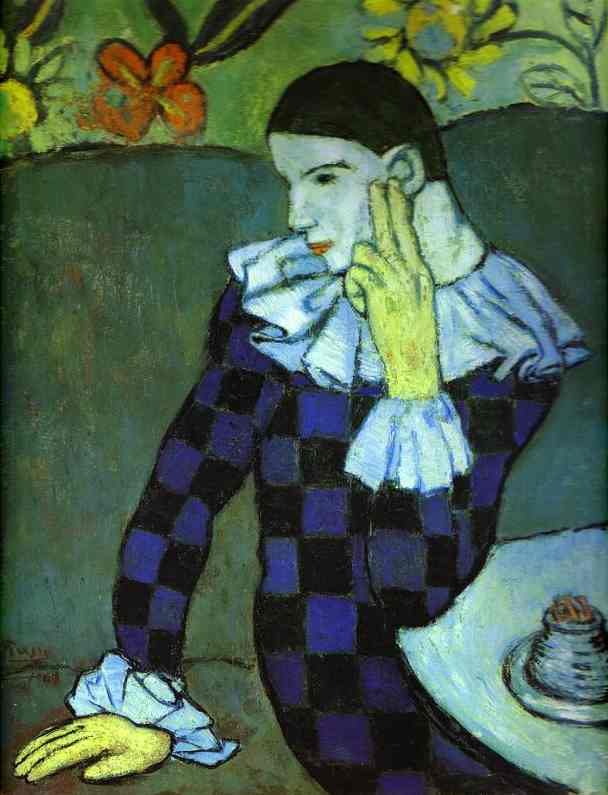
Monday, January 14, 2013

"Must you always be out in that ghastly clown suit, running around annoying people?"

Says Pretty Alice to the Harlequin in Harlan Ellison's "Repent Harlequin!' Said The Ticktockman," which I read on the urging of commenter Icepick because of the way it reflected on the recent news stories about Aaron Swartz, David Gregory, and the Boston ban on drinking games.

I downloaded this Orson Scott Card collection — "Masterpieces: The Best Science Fiction of the 20th Century" — which included "Repent Harlequin," because I wanted to understand this harlequin/ticktockman distinction, and lo and behold here's the harlequin — actually, what do you expect? he's a harlequin — wearing a clown suit, when just 5 days ago, the bloggism of the day was clown suits. We were pimping clown suits.


It's weird how these themes seem to coagulate on their own.


IN THE COMMENTS: Astro said points out that my Picasso clown isn't a harlequin. I need to be better about specifying the Commedia dell'arte characters. Here's a Picasso harlequin (on the right):

Tuesday, December 11, 2012

2 passages read recently on what makes an artist.

I've been rereading Tom Wolfe's "The Painted Word" in Kindle the last couple days, and I ran across a great passage that shed light on something in that collection of essays I keep pushing, David Rakoff's "Half Empty."

First, Rakoff:
An artist is something you are, not something you do.

I first encountered this Seussian syllogism in a used-book store, where I spent an extra thirty minutes fake-browsing just so I might continue to eavesdrop on the cashier, who was expounding to his friend about Johnny Got His Gun, Dalton Trumbo’s classic antiwar novel. The cashier had a theory about the book’s protagonist, Johnny, wounded and blinded and amputated to such an extent that, while sentient, he was little more than an unresponsive trunk of meat with a rich inner life.
“So I asked myself: If this guy was Picasso, would he have been any less of an artist or less of a genius just because he couldn’t paint? And my thinking is no, he wouldn’t.” I lacked the bravery to challenge him more openly than a muttered “Oh, brother” from the stacks, choosing instead to ridicule and sell him out years later, here in print. But it’s the same reasoning: indolence as proof positive of prodigious gifts. You can arguably invent Cubism and be the very embodiment of Modernism if you get a kick out of that sort of thing. But you hardly need to, Armless Picasso. Artists are artists whether they produce or not. None of it requires much more than hanging out. 
And hanging out can be marvelous. But hanging out does not make one an artist. A secondhand wardrobe does not make one an artist. Neither do a hair-trigger temper, melancholic nature, propensity for tears, hating your parents, nor even HIV—I hate to say it—none of these make one an artist. They can help, but just as being gay does not make one witty (you can suck a mile of cock, as my friend Sarah Thyre puts it, it still won’t make you Oscar Wilde, believe me), the only thing that makes one an artist is making art. And that requires the precise opposite of hanging out; a deeply lonely and unglamorous task of tolerating oneself long enough to push something out.
Here's Wolfe:
The Conceptualists liked to propound the following question: Suppose the greatest artist in the history of the world, impoverished and unknown at the time, had been sitting at a table in the old Automat at Union Square, cadging some free water and hoping to cop a leftover crust of toasted corn muffin or a few abandoned translucent chartreuse waxed beans or some other item of that amazing range of Yellow Food the Automat went in for— and suddenly he got the inspiration for the greatest work of art in the history of the world. Possessing not even so much as a pencil or a burnt match, he dipped his forefinger into the glass of water and began recording this greatest of all inspirations, this high point in the history of man as a sentient being, on a paper napkin, with New York tap water as his paint. In a matter of seconds, of course, the water had diffused through the paper and the grand design vanished, whereupon the greatest artist in the history of the world slumped to the table and died of a broken heart, and the manager came over, and he thought that here was nothing more than a dead wino with a wet napkin. Now, the question is: Would that have been the greatest work of art in the history of the world or not? The Conceptualists would answer: Of course, it was. It’s not permanence and materials, all that Winsor & Newton paint and other crap, that are at the heart of art, but two things only: Genius and the process of creation! Later they decided that Genius might as well take a walk, too.