Showing posts with label Spain. Show all posts
Showing posts with label Spain. Show all posts
Monday, December 16, 2013

Tuesday, December 3, 2013
"Monkey Jesus priest hit with sex and fraud charges."
A sidebar teaser for the news from Spain that "The priest of a small Spanish village which rose to international fame after a local woman in 2012 'restored' a fresco of Jesus Christ has been arrested for alleged sexual abuse and the embezzlement of €210,000 ($285,000)."
Is there a connection between these charges and the "Ecce Homo" restoration that amused the world back in 2012? The priest's lawyer says absolutely not, but the restoration brought tourists to the little town of of Borja, and you have to pay €1 ($1.30) to get into the church. That makes a tempting pot of money.
Oh, noooooo!

A little old lady mucks up a portrait of Jesus and life was never the same in the little Spanish town of Borja.
It needs to be a movie, don't you think?
Is there a connection between these charges and the "Ecce Homo" restoration that amused the world back in 2012? The priest's lawyer says absolutely not, but the restoration brought tourists to the little town of of Borja, and you have to pay €1 ($1.30) to get into the church. That makes a tempting pot of money.
Oh, noooooo!

A little old lady mucks up a portrait of Jesus and life was never the same in the little Spanish town of Borja.
It needs to be a movie, don't you think?
Thursday, November 7, 2013
"Top 10 signs you've gone native in Spain."
"You've gone all touchy-feely...."
You've started yelling at waiters....
You've lost all political correctness....
You've stopped being so polite. Countless blank stares have made you realize that being excessively apologetic or thankful doesn't get you places in Spain. So no more "muchas gracias" (thank you very much) or "lo siento" (sorry) unless you really, really mean it.....
Tuesday, October 15, 2013
The yellow-duct-tape beam-of-light.

"'Fos' is the name of the first ephemeral installation by Eleni Karpatsi, Susana Piquer and Julio Calvo, a multidisciplinary team based in Madrid and Barcelona. Using yellow duct tape, paint, found furniture and pineapples, the team created a brilliant visual illusion that simulates a beam of light coming from the lamp above the door of a vegan restaurant in Madrid. The name 'Fos' means 'light' in the Greek language, and 'melted' in Catalan."
More here.
Thursday, September 26, 2013
Visualizing the completion of Barcelona's Sagrada Familia cathedral, which was begun in 1882.
The end of the construction is projected for 2026, and this 90-second video shows what will be done. I said "wow" out loud at 0:58:
Friday, August 30, 2013
#13 is not like the other photos that won the Red Bull Illume Photo Contest 2013.
The photographer's explanation of his photograph:
I was in Barcelona for a week shooting the local BMX scene. Barcelona is definitely one of the most interesting BMX Meccas in the world, with many street spots where you can ride all day. After a hard day of searching for different spots, I shot this picture where an old man was angry with one of the local riders (Nil Soler), thinking that what he was doing was a bad thing for the city. He doesn't understand it's only BMX! After this mishap, which is usual in Barcelona lately, we continued our search for new images, new spots and new sensations.From the comments:
The man in #13 is of course right. All this stunting should be limited to locations not in nature and not on other people's property including public space and infrastructure.Yeah, look at photo #3 and think of Mario Richard. Or — what the hell? — continue your search for new images, new spots, and new sensations.
And despite the prettiness of some photos all this Red Bull crazy acting stuff is dangerous and people die in attempts to please Red Bull in commisioned shoots. So don't give away your photos for a tray of Red Bull or for nothing but a name quote. Nobody reads these but yourself.
Tuesday, June 4, 2013
Friday, March 8, 2013
"As the Inca Civil War raged, in 1531 the Spanish landed in Ecuador."
"Led by Francisco Pizarro, the conquistadors learned that the conflict and disease were destroying the empire."

... Pizarro sent an embassy, led by Hernando de Soto with 15 horsemen and an interpreter; shortly thereafter he sent 20 more horsemen led by his brother Hernando Pizarro as reinforcements in case of an Inca attack. Atahualpa was in awe of these men dressed in full clothing, with long beards and riding horses (an animal he had never seen). In town Pizzaro set a trap for the Inca and the Battle of Cajamarca began....In Ecuador, today's "History of" country.
During the next year Pizzaro held Atahualpa for ransom. The Incas filled the Ransom Room with gold and silver awaiting a release that would never happen. On August 29, 1533 Atahualpa was garroted.

Sunday, March 3, 2013
"Christopher Columbus reached the island of Hispaniola on his first voyage, in December 1492."
"On Columbus second voyage in 1493 the colony and Santo Domingo became the new capital, and remains the oldest continuously inhabited European city in the Americas."
Hundreds of thousands Tainos living on the island were enslaved to work in gold mines. As a consequence of oppression, forced labor, hunger, disease, and mass killings, by 1535, only 60,000 were still alive. In 1501, the Spanish monarchs, Ferdinand I and Isabella, first granted permission to the colonists of the Caribbean to import African slaves, which began arriving to the island in 1503. These African importees have had the most dominant racial influence, and their rich and ancient culture has had an influence second only to that of Europe on the political and cultural character of the modern Dominican Republic.The Dominican Republic is today's "History of" country. (In the "History of" project, we're going through the 206 countries of the world in alphabetical order and reading their "History of" page in Wikipedia.)
Friday, February 22, 2013
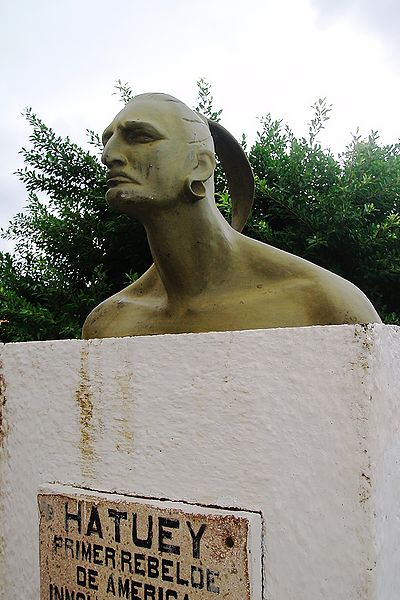
"In 1511, Diego Velázquez de Cuéllar set out from Hispaniola to form the first Spanish settlement in Cuba..."
"... with orders from Spain to conquer the island. The settlement was at Baracoa, but the new settlers were to be greeted with stiff resistance from the local Taíno population. The Taínos were initially organized by cacique (chieftain) Hatuey, who had himself relocated from Hispaniola to escape the brutalities of Spanish rule on that island. After a prolonged guerrilla campaign, Hatuey and successive chieftains were captured and burnt alive, and within three years the Spanish had gained control of the island. In 1514, a settlement was founded in what was to become Havana."
In Cuba, today's "History of" country.

In Cuba, today's "History of" country.
Saturday, February 16, 2013
"Costa Rica was described as 'the poorest and most miserable Spanish colony in all America' by a Spanish governor in 1719."
This occurred because Costa Rica was all the way south in the Captaincy General of Guatemala and forbidden to trade with the Viceroyalty of New Granada (to its south), and it lacked gold and silver and an indigenous population to do forced labor. In the long run — if I am to believe the presentation on the Wikipedia "History of Costa Rica" page — this all worked out for the best:
... Costa Rica was by and large unappreciated and overlooked by the Spanish Crown and left to develop on its own. The small landowners' relative poverty, the lack of a large indigenous labor force, the population's ethnic and linguistic homogeneity, and Costa Rica's isolation from the Spanish colonial centers in Mexico and the Andes all contributed to the development of an autonomous and individualistic agrarian society. Even the Governor had to farm his own crops and tend to his own garden due to the poverty that he lived in. An egalitarian tradition also arose. Costa Rica became a "rural democracy" with no oppressed mestizo or indigenous class.(In the "History of" project on this blog, we're going through the Wikipedia "History of" pages for all the 206 countries in the world, in alphabetical order.)
Thursday, February 7, 2013
"The name Patagonia comes from the word patagón used by Magellan to describe the native people whom his expedition thought to be giants."
Saturday, January 5, 2013
"In the mountains of the Pyrenees/There's an independent state/Its population five thousand souls/And I think they're simply great..."
"One hundred and seventy square miles big/And it's awf'lly dear to me/Spends less than five dollars on armaments/And this I've got to see."
So wrote Malvina Reynolds, with that kooky, lefty patronizing attitude you probably know better from her greatest hit, "Little Boxes." Remember that one, criticizing people for going to school, then getting jobs, forming families, and living in suburban developments where the houses are "all made out of ticky tacky and they all look just the same"? Really, what was that lady complaining about? The song quoted in the title is about a country that she read in the newspaper — back in the 60s — had a defense budget of $4.90. She took off on a lyrical flight of fancy that had no inkling of what was really going on with this country. She just used that $4.90 business as a jumping off point for hating on the United States:
Andorra is today's "History of" country, as we proceed through the list of the 206 countries in the world. It's very tiny, 181 square miles. But look where it is:
View Larger Map
How did that happen?
So wrote Malvina Reynolds, with that kooky, lefty patronizing attitude you probably know better from her greatest hit, "Little Boxes." Remember that one, criticizing people for going to school, then getting jobs, forming families, and living in suburban developments where the houses are "all made out of ticky tacky and they all look just the same"? Really, what was that lady complaining about? The song quoted in the title is about a country that she read in the newspaper — back in the 60s — had a defense budget of $4.90. She took off on a lyrical flight of fancy that had no inkling of what was really going on with this country. She just used that $4.90 business as a jumping off point for hating on the United States:
I wandered down by the PentagonWhat did she know of Andorra? What do you know?
This newspaper clipping in hand
I said, "I want to see everyone
In McNamara’s band."
I said, "Look what they did in Andorra,
They put us all to shame.
The least is first, the biggest is last,
Let’s get there just the same."
Andorra is today's "History of" country, as we proceed through the list of the 206 countries in the world. It's very tiny, 181 square miles. But look where it is:
View Larger Map
How did that happen?
Andorra is the last independent survivor of the Marca Hispanica, the buffer states created by Charlemagne to keep the Islamic Moors from advancing into Christian France.This isn't Malvina's cute little child of a place that doesn't know war. It owes its existence to a French strategic defense.
Tradition holds that Charlemagne granted a charter to the Andorran people in return for their fighting the Moors. In the 9th century, Charlemagne's grandson, Charles the Bald, named the Count of Urgell as overlord of Andorra. A descendant of the count later gave the lands to the Diocese of Urgell, headed by Bishop of Urgell.4 hams!
In the 11th century, fearing military action by neighboring lords, the bishop placed himself under the protection of the Lord of Caboet, a Catalan nobleman. Later, the Count of Foix became heir to the Lord of Caboet through marriage, and a dispute arose between the French Count and the Catalan bishop over Andorra..
In 1278, the conflict was resolved by the signing of a pareage (pariatges).... The pareage, a feudal institution recognizing the principle of equality of rights shared by two rulers.... In return, Andorra pays an annual tribute or questia to the co-rulers consisting of four hams, forty loaves of bread, and some wine.
In 1793, the French revolutionary government refused the traditional Andorran tribute as smacking of feudalism and renounced its suzerainty, despite the wish of the Andorrans to enjoy French protection and avoid being under exclusively Spanish influence....
During World War II, Andorra remained neutral and was an important smuggling route from Spain into France. The French Resistance used Andorra as part of their route to get downed airmen out of France....
In 1958, Andorra declared peace with Germany, having been forgotten on the Treaty of Versailles that ended World War I and, the conflict being extended by the lack of a peace treaty, remaining legally at war.
Friday, January 4, 2013
"I don’t know whether this world has a meaning that transcends it."
"But I know that I cannot know that meaning and that it is impossible for me just now to know it."

Today, the "History of" project brings us to...
Algeria, where human beings have lived for at least 1.8 million years. There are prehistoric rock paintings in the Tassili n'Ajjer range. Like this:

The indigenous people have been called Berbers since 4000 BC, and they have been joined over the years by invaders of the Phoenician, Roman, Vandal, Byzantine, Arab, Turkish, and French kind.

Today, the "History of" project brings us to...
Algeria, where human beings have lived for at least 1.8 million years. There are prehistoric rock paintings in the Tassili n'Ajjer range. Like this:

The indigenous people have been called Berbers since 4000 BC, and they have been joined over the years by invaders of the Phoenician, Roman, Vandal, Byzantine, Arab, Turkish, and French kind.
Berber territory was annexed by the Roman Empire in AD 24. Increases in urbanization and in the area under cultivation during Roman rule caused wholesale dislocations of Berber society, and Berber opposition to the Roman presence was nearly constant....Colonization by the French began in 1830.
Christianity arrived in the 2nd century AD. By the end of the 4th century, the settled areas had become Christianized, and some Berber tribes had converted en masse....
The 8th and 11th centuries AD, brought Islam and the Arabic language....
In the central Maghrib, the Abdalwadid founded a dynasty at Tlemcen in Algeria. For more than 300 years, until the region came under Ottoman suzerainty in the 16th century, the Zayanids kept a tenuous hold in the central Maghrib. Many coastal cities asserted their autonomy as municipal republics governed by merchant oligarchies, tribal chieftains from the surrounding countryside, or the privateers who operated out of their ports. Nonetheless, Tlemcen, the “pearl of the Maghrib,” prospered as a commercial center.
The final triumph of the 700-year Christian reconquest of Spain was marked by the fall of Granada in 1492. Christian Spain imposed its influence on the Maghrib coast by constructing fortified outposts and collecting tribute. But Spain never sought to extend its North African conquests much beyond a few modest enclaves. Privateering was an age-old practice in the Mediterranean, and North African rulers engaged in it increasingly in the late 16th and early 17th centuries because it was so lucrative. Algeria became the privateering city-state par excellence.....
Algeria and surrounding areas, collectively known as the Barbary States, were responsible for piracy in the Mediterranean Sea, as well as the enslaving of Christians, actions which brought them into the First and Second Barbary War with the United States of America.
Viewed by the Europeans with condescension at best and contempt at worst, the Algerians endured 132 years of colonial subjugation. From 1856, native Muslims and Jews were viewed as French subjects, but not French citizens.Abdelaziz Bouteflika became president in 1999 and "concentrated on restoring security and stability." He remains president to this day.
However, in 1865, Napoleon III allowed them to apply for full French citizenship, a measure that few took, since it involved renouncing the right to be governed by sharia law in personal matters, and was considered a kind of apostasy; in 1870, French citizenship was made automatic for Jewish natives, a move which largely angered the Muslims, who began to consider the Jews as the accomplices of the colonial power. Nonetheless, this period saw progress in health, some infrastructures, and the overall expansion of the economy of Algeria, as well as the formation of new social classes, which, after exposure to ideas of equality and political liberty, would help propel the country to independence. During the years of French domination, the struggles to survive, to co-exist, to gain equality, and to achieve independence shaped a large part of the Algerian national identity....
A new generation of Islamic leadership emerged in Algeria at the time of World War I and grew to maturity during the 1920s and 1930s. Various groups were formed in opposition to French rule....
The Algerian War of Independence (1954–1962), brutal and long, was the most recent major turning point in the country's history. Although often fratricidal, it ultimately united Algerians and seared the value of independence and the philosophy of anticolonialism into the national consciousness....
Between 350,000 and 1 million Algerians are estimated to have died during the war, and more than 2 million, out of a total Muslim population of 9 or 10 million, were made into refugees or forcibly relocated into government-controlled camps. Much of the countryside and agriculture was devastated, along with the modern economy, which had been dominated by urban European settlers (the pied-noirs). French sources estimated that at least 70,000 Muslim civilians were killed or abducted and presumed killed, by the [Front de Libération Nationale] during the Algerian War. Citizens of European ethnicity... and Jews were also subjected to ethnic cleansing. These nearly one million people of mostly French descent were forced to flee the country at independence due to the unbridgeable rifts opened by the civil war and threats from units of the victorious FLN; along with them fled Algerians of Jewish descent and those Muslim Algerians who had supported a French Algeria (harkis). 30-150,000 pro-French Muslims were also allegedly killed in Algeria by FLN in post-war reprisals....
On 19 June 1965, Houari Boumédienne deposed Ahmed Ben Bella in a military coup d'état that was both swift and bloodless....
Boumédienne’s death on December 27, 1978 set off a struggle within the FLN to choose a successor....
After the violent 1988 October Riots, a new constitution was adopted in 1989 that allowed the formation of political associations other than the FLN....
Among the scores of parties that sprang up under the new constitution, the militant Islamic Salvation Front (FIS) was the most successful....
In 1996 a referendum introduced changes to the constitution, enhancing presidential powers and banning Islamist parties.

Subscribe to:
Posts (Atom)