Showing posts with label law and emotion. Show all posts

Sunday, October 20, 2013

"I had some dim intuitive feeling that what was wrong with all journalism is that the reporter tended to be objective and that that was one of the great lies of all time."

Said Norman Mailer, quoted in this subscribers-only article by Louis Menand in The New Yorker. As Menand puts it, Mailer "made the way in which events are reported part of what is reported."

ADDED: You could say something similar about law: I had some dim intuitive feeling that what was wrong with all judicial opinions is that the judge tended to be objective and that that was one of the great lies of all time. But what then? No judge can switch to writing the judicial equivalent of New Journalism.

(20 years ago, I tried to write about this problem, here (PDF) — with some quotes from Mailer's "Executioner's Song.")

AND: From that link, above, on New Journalism, which goes to Wikipedia:
How and when the term New Journalism began to refer to a genre is not clear....

But wherever and whenever the term arose, there is evidence of some literary experimentation in the early 1960s, as when Norman Mailer broke away from fiction to write Superman Comes to the Supermarket. A report of John F. Kennedy's nomination that year, the piece established a precedent which Mailer would later build on in his 1968 convention coverage (Miami and the Siege of Chicago) and in other nonfiction as well.
And here, you can read the full text of "Superman Comes to the Supermarket" (at the Esquire website, Esquire having once been a monumentally important magazine). It begins:
For once let us try to think about a political convention without losing ourselves in housing projects of fact and issue. Politics has its virtues, all too many of them -- it would not rank with baseball as a topic of conversation if it did not satisfy a great many things -- but one can suspect that its secret appeal is close to nicotine. Smoking cigarettes insulates one from one’s life, one does not feel as much, often happily so, and politics quarantines one from history; most of the people who nourish themselves in the political life are in the game not to make history but to be diverted from the history which is being made.
Convenient sidebar chez Esquire: 


Are we doomed? Did you go to my link and read the sentences that followed those 3 mindbendingly interesting sentences that began "Superman Comes to the Supermarket," or did you go over to click through to the explanation of why Miss Johansson in the sexiest woman alive (or what a "brutally frank" 98-year-old woman might say about sex)?

Thursday, October 10, 2013

"This bill is bad for Mukwonago taxpayers, bad for the Republican Party and its reputation for having a race problem, bad for Scott Walker if he aspires to the national stage..."

"... but most importantly this bill is bad for children. You will be doing a favor to everyone including Mukwonago and your own Republican Party if you let this horribly racist legislation die a peaceful death in committee."

Try to think of what the bill in question could be. It's pending in the Wisconsin legislature. It's not the bill discussed in the previous post, which was about creating a new basis for lawsuit. This one is actually about repealing an existing basis for lawsuits. Here's another quote about the bill:
“There’s an elephant in the room that needs to be addressed directly. The elephant in the room is white Republican racism... Some have called [this bill] the ‘most racist legislation of the current generation.... That could be the kiss of death for a politician having national aspirations...” 
The politician with national aspirations is Scott Walker. What is this law that would put the stink of racism on Scott Walker and wreck his career?
Under the current law, a school district must prove that its mascot or nickname is not offensive if someone files a complaint. But the new bill stipulates that any complaints would have to include a petition signed by 10 percent of the district’s student population saying the logo or mascot is offensive, shifting the burden of proof to those filing the complaint.
“That’s like if an employee of the Ho-Chunk nation felt they were sexually harassed and had to get 10 percent of the other employees to agree (with them),” Greendeer said. “That’s absurd.”

Jennifer Kammerud, DPI’s legislative liaison, said Nass’ bill takes away the complaint process. “It is setting a level of discrimination into state statute,” Kammerud said. “You have to have your feelings validated by having 10 percent of your community agreeing with you.”

Saturday, September 7, 2013

"So I see the genius of our Constitution, and of our society, is how much more embracive we have become than we were at the beginning."

Said Justice Ruth Bader Ginsburg, embracing a word I can't remember ever noticing before and a constitutional theory I've seen 1,000s of times.

"Embracive" is listed in the OED. It means, first, "Given to or fond of embracing; embracing demonstratively," but this is a "nonce-use." The quote, from 1855, from Thackeray, is "Not less kind..though less expansive and embracive, was Madame de Montcontour to my wife." The second meaning, going back to 1897, is "Embracing or tending to embrace all." Examples:
1897 Academy 18 Sept. (Fiction Suppl.) 70/1 ‘George Du Maurier in three volumes’ would be a fair embracive title....

1902 Edinb. Rev. Oct. 357 Important deities have been omitted from this brief catalogue, which is much more representative than embracive....
I take it Ginsburg is deploying the word to mean inclusive, perhaps with more love/empathy/enthusiasm.

Sunday, June 30, 2013

"Secret-court judges upset at portrayal of ‘collaboration’ with government."

You wouldn't think federal judges, especially those working on secret things, would go public with their emotions, especially their emotions about how they themselves are portrayed, but that's the headline at WaPo. From the article:
“In my view, that draft report contains major omissions, and some inaccuracies, regarding the actions I took as Presiding Judge of the FISC and my interactions with Executive Branch officials,” [U.S. District Judge Colleen Kollar-Kotelly, the former chief judge of the Foreign Intelligence Surveillance Court,] said in a statement to The Post...
Draft report = this 2009 document by the NSA inspector general, which was leaked recently by Edward Snowden.  (Note that the judge isn't really talking about her emotional "upset." News articles about judges tend to present them as a bundle of emotions, I guess because newspaper editors imagine us readers to click where our emotions lead us.)
Kollar-Kotelly disputed the NSA report’s suggestion of a fairly high level of coordination between the court and the NSA and Justice in 2004 to re-create certain authorities under the Foreign Intelligence Surveillance Act, the 1978 law that created the court in response to abuses of domestic surveillance in the 1960s and 1970s.

“That is incorrect,” she said. “I participated in a process of adjudication, not ‘coordination’ with the executive branch. The discussions I had with executive branch officials were in most respects typical of how I and other district court judges entertain applications for criminal wiretaps under Title III, where issues are discussed ex parte.”
Ex parte = no one participating as an opposing, adversarial party.

Wednesday, June 26, 2013

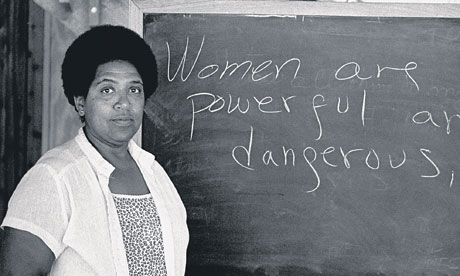
The aphorism in the abortion clinic: "Our feelings are our most genuine paths to knowledge."

Here's CNN's article "Texas filibuster on abortion bill rivets online" — about state senator Wendy Davis's effort to stop a bill that would ban abortions after the 20th week of pregnancy and the tweeting it inspired, including President Obama's "Something special is happening in Austin tonight."

There's also a video, and I'm inspired to write about an aphorism you can see at 1:57: a shot of a room in a clinic — presumably a room where abortions are performed. The label on the door reads "Audre," and on the wall, in large capital letters, there's a quote and the name "Audre Lorde." The quote reads "Our feelings are our most genuine paths to knowledge."

Audre Lorde was a Caribbean-American writer (1934-1992) who is a source of some popular feminist aphorisms, notably "The master's tools will never dismantle the master's house." The one painted on the wall shown in the video suggests an argument about abortion that resonates with abortion rights doctrine, that the woman finds her own meaning. The Supreme Court's cases depict the woman engaging in a philosophical/theological/scientific inquiry into the significance of the entity she may choose either to nurture within or to extricate. The Lorde quote seems like a feminist paraphrase, where the mental process runs along a path of feelings.

The woman entering the room is invited into an awareness of her feelings. Feelings are the most genuine way to your decision. Perhaps the woman entering the room thinks: I don't feel this is anything like a baby or that I am murdering anyone. Or: I hear my future child begging for life. The quote — to my eye — calls you to experience your conscience, and it doesn't let you off the hook. The painted letters seem to be the only decoration in the room. It's the place to focus your eyes throughout the procedure.

I wonder what women's names appear on the other doors. Do the names take the place of room numbers and are the rooms referred to by name in an effort to give warmth to the place? You're a name not a number.

I wonder what are the other aphorisms in the other rooms. Are they all so neutral and open-ended as to the woman's right to choose?

Thursday, June 6, 2013

"The National Security Agency’s seizure and surveillance of virtually all of Verizon’s phone customers is an astounding assault on the Constitution."

Says Senator Rand Paul in a press release, received just now in the email:
After revelations that the Internal Revenue Service targeted political dissidents and the Department of Justice seized reporters’ phone records, it would appear that this Administration has now sunk to a new low.

When Sen. Mike Lee and I offered an amendment that would attach Fourth Amendment protections to the Foreign Intelligence Surveillance Act last year, it was defeated, and FISA was passed by an overwhelming majority of the Senate. At the time, Senate Majority Leader Harry Reid remarked that FISA was “necessary to protect us from the evil in this world.”

The Bill of Rights was designed to protect us from evil, too, particularly that which always correlates with concentrated government power, and particularly Executive power. If the President and Congress would obey the Fourth Amendment we all swore to uphold, this new shocking revelation that the government is now spying on citizens’ phone data en masse would never have happened.
I don't know why you'd need to "attach Fourth Amendment protections" to a statute. I'll just observe that Senator Paul is a very active participant in the debate about what rights are. So is President Obama (and so was President Bush in his time). I think the legal questions are complicated, but if people do not find these things "astounding" and "shocking," the President is likely to win. 

UPDATE: Another press release from Paul: "Sen. Rand Paul today announced he will introduce the Fourth Amendment Restoration Act of 2013, which ensures the Constitutional protections of the Fourth Amendment are not violated by any government entity."

“The revelation that the NSA has secretly seized the call records of millions of Americans, without probable cause, represents an outrageous abuse of power and a violation of the Fourth Amendment to the Constitution. I have long argued that Congress must do more to restrict the Executive’s expansive law enforcement powers to seize private records of law-abiding Americans that are held by a third-party,” Sen. Paul said. “When the Senate rushed through a last-minute extension of the FISA Amendments Act late last year, I insisted on a vote on my amendment (SA 3436) to require stronger protections on business records and prohibiting the kind of data-mining this case has revealed. Just last month, I introduced S.1037, the Fourth Amendment Preservation and Protection Act, which would provide exactly the kind of protections that, if enacted, could have prevented these abuses and stopped these increasingly frequent violations of every American’s constitutional rights.

“The bill restores our Constitutional rights and declares that the Fourth Amendment shall not be construed to allow any agency of the United States government to search the phone records of Americans without a warrant based on probable cause.” 

Monday, December 24, 2012

David Gregory, neatly tweaked...

... by Drudge (in Christmas colors):


The links are: "Did David Gregory Violate DC Gun Law On National TV?" and "Mocks NRA Chief for Proposing Armed Guards; Sends Kids to High-Security School..."

And here's the transcript for the whole interview. We watched it. Gregory was all heated up, eager to extract his sound bites from LaPierre, in the typical style of recent gun control debates I've seen, like this one between Bob Wright and Jacob Sullum. The one who wants gun control cranks up the emotion, and the gun control opponent stolidly stands his ground.

It's like they intended to make an implicit argument, premised on the question: This is what a human being is like; do you want people to have guns? The gun control advocate models the answer "no" (because people run on emotion and might do unpredictable, regrettable things). The gun control opponent models the answer "yes" (because people are stable and rational).

It's all about control: Do you think people are self-controlled or is government control needed? And now, I see this post is about to bust loose into a much more general set of observations about politics, and I don't want to do that. This is a blog post, the first of the day, and it needs to come to an end. So let me leave you with 3 brief bonus observations:

1. David Gregory was not appearing on "Meet the Press" as a gun control advocate. He's the moderator... some sort of "journalist."

2. If a new federal gun control program includes a buy-back of some newly banned "assault" weapons, it will be like Cash for Clunkers. I hated Cash for Clunkers.

3. The post-Newtown gun control advocates have been emphasizing the gun, rather than the person, on the theory that a person may have murderous impulses but if he doesn't have a gun, he won't be able to do as much damage. But in real life, if you had someone in you midst who was bent on murder, you would not think: Well, at least he doesn't have a gun. If he goes off, what's the worst he can do, maybe 4 or 5 kids, max?

Monday, December 17, 2012

"The founding fathers never envisioned the damage that could be done by a 24-hour news cycle."

"The media incentivizes killers by giving them attention, and they put innocent people in danger."
Clearly, we cannot sit by and hope this situation will improve. How many more deaths will it take before someone does something?

I know what you're thinking: Free societies are inherently messy. And what about the First Amendment?

I'm not suggesting we completely abolish the media. But perhaps we should curtail it. Isn't it time for some common sense media control?
It's time for a conversation and perhaps a commission... about common sense control....