Showing posts with label empathy. Show all posts

Monday, December 9, 2013

Juan Williams thinks he's defending Obamacare by observing that it has no effect on him and the other members of the Sunday talk show pundit panel.

This is the sort of thing that a Republican would be pilloried for saying. It was yesterday's "Fox News Sunday," and the moderator Chris Wallace had just read a question tweeted by some guy named Skip. The question was "other than hope, what substantive argument do the ACA, Affordable Care Act, supporters have that the law will work as intended?" Juan Williams threw out a big word storm, but one line jumped out at me, and I will boldface it:
Well, Skip, I think you're deserving a straight answer. There's such a snowstorm of partisan politics around the ObamaCare thing right now. 
When I wrote "big word storm," above, I'd forgotten that he'd said "such a snowstorm." Normally, I'd rewrite to eliminate a clumsy repetition, but I'm leaving this one for effect.  And I'm also amused by that first sentence. To say that Skip is "deserving" of "a straight answer" is not to promise you're about to give one. I'm reminded of the way we used to laugh when Nixon said "let me make one thing perfectly clear." And I'm reminded of the way Obama et al. keep blaming others for hearing promises when, technically, there were none.

All Williams said is that Skip deserves — or, oddly, is deserving — a straight answer. He never said he was going to give Skip a straight answer, and if Skip somehow gets the impression that a straight answer is forthcoming, well, then Skip ought to sharpen his critical listening skills. And when Williams said "There's such a snowstorm," he did not say: And I'm here to guide you through the storm, Skip. The passive voice preserves the possibility that Williams himself is part of the snowstorm. Why wouldn't he be?

Back to the text:
So I'd say the number one thing I would say is....
What a locution! Why not just say what you have to say? When you say that you're going to say what you would say, it sounds as though you are dissembling.
... just look at this week. A million people went to the website as it was working. So there's obviously an appetite, a real need. 
A need?! People are required to buy insurance. The need is to comply with government force. How is that evidence of appetite? (I picture a parent saying "You're going to eat it and you're going to like it.")
30 million people uninsured. Millions more inadequately insured who can avoid bankruptcy and illnesses as a result. Number two, I think it the reason [sic] I think this is going to work is it doesn't disrupt the market for most people. Nobody on this panel is going to have their health care affected, impacted, by what's taking place. 
There it is! He looks around at George Will and Brit Hume and the AP's Julie Pace and says, hey, we're all doing fine. So what's the big deal? People like us aren't hurting! 

ADDED: Williams shouldn't get away with that callousness. Where's the empathy? And now I want to take a shot at George Will. Just before Williams got his question, Will said something that also struck me as distanced and out of touch in a way that maintains the aversion many people have to conservatives:
The education of this president is a protracted and often amusing process as it was this week. 
Oh? You were amused? Is that what this is, entertainment for you, old man, as you sit back and — whatever you do — puff on your pipe and sip your Scotch? Real people are really struggling with this. It's not funny.
As he continues to alight upon the obvious with a sense of profound and original discovery. He's alighting on what is obvious to governors. This is really why we should have governors more often than senators as president. The president is saying the trouble with big government is it's so darn big. And like a lot of big organisms, dinosaurs spring to mind. It has a simple nervous system. It's erratic, it's governed by inertia. And it's hard to move. This from a man who's devoted his life to increasing the power of government as an instrument to the redistribution of income because government is wiser than markets. And it's, as I say, highly amusing.
There are some great points in there, but why does he have to begin and end with his own amusement? I understand the temptation to sit back and find amusement in the foibles of humanity, but it's not very attractive. If people are struggling, you might want to shut up about how funny it seems to you, that is, if you want to win favor with those people and not, you know, enrage them.

Yesterday, we were looking at an article in USA Today about how healthcare.gov was incorrectly putting people into Medicaid and depriving them of the chance to buy the insurance they're supposed to buy. A commenter, David, snarking "Customer service, government style," quoted the line:
"If the Medicaid determination is wrong, consumers should file an appeal with the federal marketplace, says Department of Health and Human Services spokeswoman Joanne Peters, but she says she does not have an estimate on how long that would take."
And I said:
So people who thought they'd get the subsidy — which seemed sort of friendly like a low tax rate in a system of progressive taxation — find themselves shunted into welfare, which has to feel insulting or at least surprising, and then if they realize they aren't supposed to be there, how do they get to the subsidy they actually deserve?

This is causing so many people to feel so much anguish. I can't imagine how upset I would be trying to get this straightened out or even trying to understand if something is wrong.

And that's with no health problems. What if you had to deal with this while hurting from a physical (or mental) problem and on top of the actual malady, you had to worry about losing the ability to pay for your treatments?

There is so much suffering here. I assume it's a huge snowballing mass of problems that we are only seeing the very beginning of.

I think the Republican message should be: How dare you create such an uncontrollable machinery of suffering? How could you be so arrogant and reckless? And how dare you hide the damage that you knew was coming? What are you still hiding?
I wrote that before listening to George Will, and then when I heard him, I thought: No! That's exactly what conservatives should not say! This is the time to show empathy — if you can scrape it together somehow — to forefront the suffering, and George Will is passively chuckling over how amusing it is to see Obama stumbling and bumbling. Republicans are doomed to lose over and over again if they can't at least look like they care about people. They seem to care so little that they don't even notice how much it shows.

Wednesday, October 30, 2013

"I am as frustrated and angry as anyone," claims Kathleen Sebelius, apologizing... stalling for time...

"You deserve better. I apologize. I am accountable to you for fixing these problems, and I’m committed to earning your confidence back by fixing the site.”

In the Washington Post account, it says: "She pledged that the glitches are 'fixable.'"

Did she say "glitches"? I'd like to know, because I think they need to move on to a new word. "Glitches" is so 3 weeks ago. It was intended, back then, in the early days of HealthCare.gov, to calm us... to palliate... and it just doesn't work that way any more.

Also old and increasingly intolerable: politicians claiming to be as or more emotional that the people they are hurting.

At least Sebelius toned it down a step from Obama's "no one is madder than me." It's possible to step it up and present oneself as the angriest person. Even Obama did not go there. He merely said no one is madder. So maybe some people are equally mad. Sebelius's rhetoric seems milder, but in fact, it too is a claim of matching the level of anger of the most angry person.

I know it's the old empathy routine, but I have no empathy for them and their empathy routine. For one thing, these people are actually pretty calm, and given the amount of time they had leading up to the opening of the website, it's not believable that they approached their task with great energy and passion. It seems to me that the timeline was set for political reasons, to skirt the 2012 elections and to make good-seeming things hit at the point when it would help most for the 2014 elections.

For another thing, would you really want the angriest person in the world working on your incredibly complicated technical problems? I know most people don't experience the images in language as concretely as I do, but in my mind, when the President of the United States says there is no one madder than he is, I picture a total lunatic in the White House.


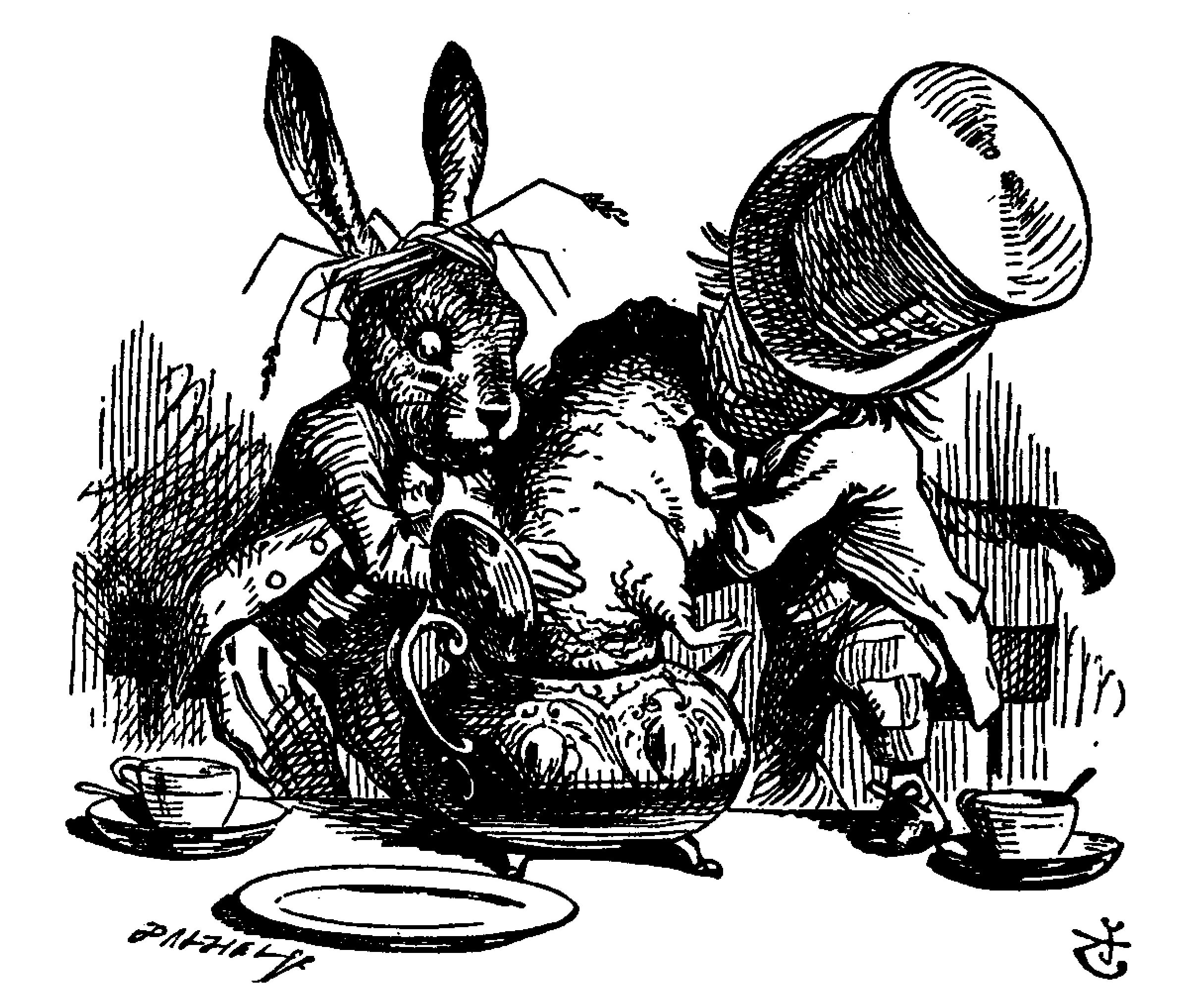
Okay, now, you can pull Kathleen's head out of the teapot. She's joined the fellowship of politicos who assure us they're at the top level of madness.

Hey! Teapot. Nice image:
"But I don't want to go among mad people," Alice remarked....

Alice had not gone much farther before she came in sight of the house...
The White House....
... it was so large a house that she did not like to go near till she had nibbled some more of the left-hand bit of mushroom.
Yeah, we're calling that "the blue pill." Obama said you're going to need it.
There was a table set out under a tree in front of the house, and the March Hare and the Hatter were having tea at it; a Dormouse was sitting between them, fast asleep....

"Take some more tea," the March Hare said to Alice, very earnestly.

"I've had nothing yet," Alice replied in an offended tone, "so I can't take more."

"You mean you can't take less," said the Hatter; "it's very easy to take more than nothing."...

"At any rate, I'll never go there again!" said Alice, as she picked her way through the wood. "It's the stupidest tea-party I ever was at in all my life!"
So... find a better tea party.

Wednesday, October 9, 2013

Fending off the genderistic nonsense about Janet Yellen.

"For years, the Federal Reserve has been led by men who had a scientistic view of monetary policy. These men – including Paul Volcker, Alan Greenspan, and Ben Bernanke... – viewed the job of running the country's economy as if they were dealing with chemical reactions or physics experiments," writes Kevin Roose, in a New York Magazine piece titled "Welcome to the Humanist Federal Reserve, Led By Janet Yellen."
[Janet Yellen] looks at the economy not just as a series of charts and figures, but as a moving, breathing organism, a collection of millions of people who are struggling to make their lives better today than they were yesterday.
Roose — who refrains from saying he attributes Yellen's difference to her gender difference — cites a Yellen speech at an AFL-CIO-sponsored conference that he says is "a remarkable look at the empathy she brings to policy-making." Empathy... visualizing the economy as a moving, breathing organism....
She... speaks about unemployment not just as an economic problem, but as a humanitarian crisis....

No matter what else it does, we know a Yellen-led Fed would use the tools of monetary policy to help millions of struggling Americans get back on their feet. And it's just one of the reasons I'm thrilled with the Yellen nomination.
This feels like gender-based claptrap to me, and I'm reeling in feelings from the furthest reaches of my female nervous system. Why wouldn't any bank official speaking at an AFL-CIO-sponsored conference include verbiage about the struggles of ordinary workers?

By the way, what is a "scientistic view"? Is it that way that men perceive? Wikipedia defines "scientism" as "a term used, often pejoratively, to refer to belief in the universal applicability of the scientific method and approach, and the view that empirical science constitutes the most authoritative worldview or most valuable part of human learning to the exclusion of other viewpoints."

Roose slathers Yellen in praise, but he's rolling out the usual stereotypes. Ironically, he's not female, and yet he's displaying some "woman's way of knowing" to arrive at a belief that Yellen will help people because she feels and cares. This reminds me of the murmurings about "empathy" and "heart" that burbled from Obama when he nominated Sonia Sotomayor for the Supreme Court. She resisted the concept:
I can only explain what I think judges should do, which is judges can't rely on what's in their heart.... The job of a judge is to apply the law. And so it's not the heart that compels conclusions in cases. It's the law. The judge applies the law to the facts before that judge.
I'll bet Yellen fends off the genderistic nonsense in just about exactly the same way.

Wednesday, September 18, 2013

Trashing contempt for women with contempt for men.

I tried to read this WaPo column by Alexandria Petri called "Why Bustle.com doesn’t work for women." It's about how the male founder of a website for women has "ample contempt for the very market he was aiming at." I think Petri, aiming for the market he has contempt for, aims contempt at him. But she quickly dives into generic contempt for men, on the theory that men don't read "books," and by "books," Petri means novels, and somehow the general failure of men generally to read novels feeds back into the topic of why Bryan Goldberg's Bustle sucks.

Excerpt:
Reading is one of the few sure-fire ways to become better at being human. So it’s a problem when anyone doesn’t do it — and an especial problem recently, when boys are increasingly slipping behind, at least compared to their female counterparts.
As of 2009, boys lagged 39 points behind girls, according to the Programme for International Student Assessment. One of the suggested reasons that boys aren’t reading is that unlike girls, who are somehow fonts of empathy capable of leaping from one perspective to another at a single bound, reading books from male or female perspectives with equal vigor and ease, boys can only be summoned to respond to the stories of other boys.
Who suggested this reason? No one's name is stuck to that stereotype, it's just a "suggested reason." Boys can't read because "books" are those fictional stories told from a perspective that can only be understood if one possesses empathy and that's something boys lack or Goldberg lacks or who the hell knows? It's just a theory out there, not a theory Petri herself admits to embracing as she wanders about trying to aim at that man who takes aim at women.

Saturday, September 7, 2013

"So I see the genius of our Constitution, and of our society, is how much more embracive we have become than we were at the beginning."

Said Justice Ruth Bader Ginsburg, embracing a word I can't remember ever noticing before and a constitutional theory I've seen 1,000s of times.

"Embracive" is listed in the OED. It means, first, "Given to or fond of embracing; embracing demonstratively," but this is a "nonce-use." The quote, from 1855, from Thackeray, is "Not less kind..though less expansive and embracive, was Madame de Montcontour to my wife." The second meaning, going back to 1897, is "Embracing or tending to embrace all." Examples:
1897 Academy 18 Sept. (Fiction Suppl.) 70/1 ‘George Du Maurier in three volumes’ would be a fair embracive title....

1902 Edinb. Rev. Oct. 357 Important deities have been omitted from this brief catalogue, which is much more representative than embracive....
I take it Ginsburg is deploying the word to mean inclusive, perhaps with more love/empathy/enthusiasm.

Thursday, September 5, 2013

The good liberals of Madison struggling with the "good" homeless and the "bad" homeless.

On Tuesday, the city council anguished over one block of our Capitol Square:
"(P)eople are scared to death to go there," said Maria Milsted, who runs a property management company with her husband at 106 W. Mifflin St. "We are frightened to go into our own place of work."

In her speech, Milsted distinguished between the "good homeless," — those who are seeking jobs and a place to live — and "the takers" who she believes are seeking handouts and have no intention of behaving civilly....
The mayor, Paul Soglin, the longtime Madison lefty and former UW student radical blamed the world beyond Madison for dumping its undesirables here:
"Statements that some of us have made about Madison being a drop-off point (of homeless people) for other units of government is now getting fairly well-documented," Soglin said.

He also alleged that other cities are driving homeless people into the city of Madison, and vowed that Madison would "drive them right back!"
So xenophobic. Whatever happened to empathy and compassion? We're ready now to see the downtrodden as "takers" and reprobates... when they congregate in a prime residential area and freak out the real estate folk?

You know, one of the nicest condo buildings I've ever seen is on that block. It's terrible if the bad homeless people are hurting real estate values. But if you're not freaked out by a few street people, it might be a good time to put in an offer on one of the places currently on the market. Like that 2-bedroom penthouse, priced at $2,200,000, now down to $1,995,000.

Friday, August 23, 2013

"Antoinette Tuff Had Empathy for the Georgia School Gunman. We Can Learn a Lot From Her."

Writes Dahlia Lithwick.
In her first interview after the standoff, Tuff mentions that in the initial terrible moments she thought about a sermon series on “anchoring” that her pastor had been preaching, and it helped her to see that Hill was bereaved and in pain, and she was praying for him. I don’t know anything about anchoring, but I know I want to learn. Tuff’s compassion and her ability to see herself in her assailant (and him in her) might be as useful a way to think about school violence as any other I’ve seen. In the course of a few days, Tuff proved that the national debate doesn’t have to be about “bad” guys and “tough” guys (or even just “guys” at all). This doesn’t have to be about lose-lose split-second decisions or the simplification of complicated situations for political gain. She shows that this debate is about ongoing, years-in-the-making problems: isolation and loneliness, medical failures, depression, and the allure of being a copycat in a culture that celebrates violence. She shows that polarizing debates about bad guys and good guys in the heat of battle are both fatuous and pointless.
Much more here, with details about the hour-long interview Anderson Cooper did with Tuff last night. I highly recommend that. You'll see that Tuff is very strongly grounded in religion — more than Lithwick seems to want to talk about. I don't think religion is essential to developing the kind of skill that Tuff displayed, but it is most certainly Tuff's own understanding of why she was able to do what she did, as she continually returned to statements like "God gives us a purpose in life" and "God has a way of showing you what's really in you."

Monday, August 19, 2013

"Rand Paul is... strongly against abortion rights, which many libertarians disagree with."

"What is the libertarian position on abortion?"
I don't think there is a libertarian position on abortion. There was a study done by a graduate student at UCLA that found that about two-thirds of people you would identify as libertarian are pro-choice. From a philosophical perspective, libertarians generally believe the appropriate role of government is to protect life, liberty, and property. The question is, is forbidding abortion a way of protecting life, or should it be viewed as a restriction of liberty? There's a plausible libertarian case on both sides. People who are consciously libertarian are more respectful of the other position on abortion, in my experience, than most pro-lifers and pro-choicers. I do not think there is an official position.
From an interesting Atlantic interview — via Instapundit — titled "America's Libertarian Moment" ("A longtime libertarian policy wonk talks about whether the philosophy can save the GOP -- and why he still doesn't think Rand Paul can win the presidency"). Via Instapundit, who says: "Rand Paul doesn’t have to be elected President to change the direction of the country."

I like libertarians when they back off from stark ideology, which really is not presentable to the American people, who require a closer approximation to something that feels like humanity. It's fascinating to watch Rand Paul supply the performance in the role of Libertarian that Americans can watch.

Tuesday, June 25, 2013

Why did all 3 female Supreme Court Justices vote on the side of the father...

... in a case where the single mother — with no financial support from the biological father — chose to go forward with her pregnancy and chose adoptive parents, parents who were with her in the delivery room? The father gave up his parental rights via text message before the baby was born, and the child — a little girl — lived with those adoptive parents for 2 years before the state court gave her to the father. The only reason the father had an argument for taking the child was the Indian Child Welfare Act of 1978, a federal law intended to protect Indian families from public and private welfare agencies that Congress decided had been too aggressive. The Supreme Court majority — which included the one male liberal Justice (Breyer) — interpreted the statute not to apply in a situation where the biological father had never had custody of the child. Here is a mother who happened to have been impregnated by a man who is a member of an Indian tribe. Why was it appealing to the female Justices to allow this man to intrude on the mother's choice to give the baby up for adoption?

Here's the text of the case, Adoptive Couple v. Baby Girl.

The child is 1.2% Cherokee.


Consider that the states have traditionally handled family law, and Congress's power arises from the Commerce Clause.

Did Justice Alito roll his eyes while Justice Ginsburg was speaking?

Garrett Epps and Dana Milbank think so.

Milbank says "Alito visibly mocked his colleague":
Ginsburg, the second woman to serve on the high court, was making her argument about how the majority opinion made it easier for sexual harassment to occur in the workplace when Alito, seated immediately to Ginsburg’s left, shook his head from side to side in disagreement, rolled his eyes and looked at the ceiling.
Epps:
... Alito pursed his lips, rolled his eyes to the ceiling, and shook his head "no." He looked for all the world like Sean Penn as Jeff Spicoli in Fast Times at Ridgemont High, signaling to the homies his contempt for Ray Walston as the bothersome history teacher, Mr. Hand. 
I don't trust the descriptions of Epps and Milbank. Maybe we could get some more discussion of the meaning of Alito's head — from some observers who like him. And then I could calculate the truth from there. But what would be better would be  cameras in the Supreme Court chambers. This is a new argument for cameras in the Supreme Court — to protect Samuel Alito from calumny.

Amusingly, Epps begins his little article with:
I suspect that the cause of cameras in the Supreme Court suffered a blow on Monday. I am glad the nation did not see first-hand Justice Samuel Alito's display of rudeness to his senior colleague, Justice Ruth Bader Ginsburg.  Because Alito's mini-tantrum was silent, it will not be recorded in transcript or audio; but it was clear to all with eyes, and brought gasps from more than one person in the audience.
It wasn't clear to me, and I have eyes.

Nice of Epps to want to protect me and the rest of Americans who didn't make it into the courtroom that day, but I prefer to be free to look things and form my own opinion, not to get second-hand descriptions from partisans and polemicists.

And by the way, the notion that female Justices command stronger displays of decorum than male Justices is sexist. Show some real respect.

AND: Do I detect anti-Italian prejudice? Alito is too visibly expressive. He's like a movie character with an Italian name (Spicoli)? The rule is your face should be a mask? WASP-style?

ALSO: Remember the words of one of the world's greatest Italian-Americans:


MOREOVER: Want to bet that if emotions played across the visage of Sonia Sotomayor while Alito or Scalia were articulating some nugget of conservatism that media's Epps and Milbanks would tell us that this — this! — was the empathy Obama said was essential to judging?

AND: A new post highlighting comments about what's wrong with likening Alito to Spicoli.

Sunday, June 2, 2013

Humanizing the IRS.

This latest effort at extending the outrage at the IRS scandal is — in my opinion — backfiring.

These nameless, faceless bureaucrats are subjected to inane activities that look like something from "The Office." It doesn't look like profligate spending. It looks like sad and misguided morale-boosting.

Don't make me empathize with the taxman, you hapless scandalmongers!

What am I doing?! Simultaneously empathizing with the taxman and the scandalmongers?

Finding everyone here far too human, I will return to the mountaintop retreat I call Cruel Neutrality.

Sunday, March 31, 2013

"The idea that having a capacity for empathy, for expressing and understanding emotion, is part of being a normal male..."

"... is fundamentally contemporary and a way of asking that men learn a traditionally feminine virtue. When men were in an unquestioned position of control in the economy — when the bedrock of the nuclear family was a single male wage, a flow of income largely unavailable to women — there was less force compelling men to make themselves attractive mates through understanding the feelings of others and expressing affection. The Asperger’s population is 90 percent male; it’s likely that one reason Asperger’s got 'discovered' and then 'boomed' is that the rest of us have been slowly revising our expectations of men."

Benjamin Nugent, "American Nerd: The Story of My People." (Kindle Locations 1840-1845).

Friday, March 22, 2013

Rush smells a Rose.

I was just listening to the podcast of Monday's Rush Limbaugh show. A long segment called "The Mommy Wars" ends like this:
RUSH:  Here's Charlie Rose.  And listen to Charlie.  He had to wrap up the interview with the women on his show today with Gayle King, and they were talking about the new feminism.  Here's what Charlie Rose said that men have to do.

ROSE:  It is incumbent on men to appreciate more and to do more and have the same responsibilities that women do.

RUSH:  I just sit here, my mouth just falls open.  Will you play that again?  It is up to men to understand more, to do more, to explain more, to say more, to feel more, to touch more, to be more, to be fully respected and understood so that women will go to bed with us, is what he means.

ROSE:  It is incumbent on men to appreciate more and to do more and have the same responsibilities that women do.

RUSH: Appreciate more and to do more and understand the absolute hell women's lives are, because if we don't, we'll never get 'em in the sack.  Yes, dear, yes dear, yes dear, yes dear, can we go to bed now?

Friday, January 11, 2013

"Academics Struggle With Managing E-Mail."

Did you just curse out loud? Or are you actually sympathetic with the arduous life of academics?

Meanwhile, Robert Fisk is having trouble with his email. Remember when we used to "fisk" things — when the name "fisk" was a verb like "bork"? I don't see fisking anymore. Did that go out of style on the internet? Am I the first one to notice (and to miss it)? Back in the olden days of blog, we used to cut and paste a whole article and intersperse commentary to produce a long blog post alternating between indented quotes from the fisking victim and unindented attacks from the blogger. If that did indeed go out of style, I'd say it's because it's too easy to do. It's lazy. It could be done really well, but how do readers know this is going to be good? They see the tell-tale signs of fisking — that alternating indenting and unindenting — and they don't bother. The blogger is lazy and the reader is lazy, and suddenly, nothing happens.

Anyway, Fisk's problem with email is a bit more sympathetic than the plight of academics who've simply allowed too many messages to pile up in their in-boxes.
The Islamist cut-throats you sympathise with would gladly slash your pencil neck from ear to ear just because you won’t bow to their bloodthirsty pedophile [sic] prophet.
I think the "[sic]" is there because that's not how you spell "pedophile" in England. Fisk wants something to be done about the scourge of invective. Fisk isn't "sure that anonymous emails kill," but:
Just before Christmas, an Irish minister of state, Shane McEntee, committed suicide after receiving a swath of online hate-mail.
(Will suicides ever be held responsible for the murders they commit?)
Now in the old days, when someone stuffed something abusive in your letter box, you’d be round the cop-shop in no time, brandishing green-ink letters in the face of the station sergeant. Threatening behaviour, at the least. But now, merely to complain about this sort of incendiary material marks you as the oddball....
The cop-shop? Brandishing green-ink letters? I'm sorry, this is all very British. I hope Mr. Fisk survives his terrible struggle with the mail. The academics? The need to quit whining and find the delete key.

Saturday, December 15, 2012

"Adam Lanza has been a weird kid since we were 5 years old... As horrible as this was, I can't say I am surprised... Burn in hell, Adam."

A tweet from a neighbor. And:
Nancy Lanza, 54, whom Adam murdered inside the home the two shared, reportedly had worked at Sandy Hook Elementary School. But more recently, she was taking care of her son.

“She needed to be home with Adam,” the family insider said.
I'm seeing a lot of post-Newtown proposals for more gun control — and resistance to these proposals. It's not surprising that each new massacre becomes an occasion to restate positions on gun control, with redoubled enthusiasm.

But why isn't there more talk about institutionalizing the mentally ill? Adam Lanza's mother needed to be home with him? What 20-year-old needs pervasive supervision from his mother? I suspect the mother, who is now dead, had very serious problems of her own. I can't understand her keeping those 3 weapons — pictured at the link — in the home along with a 20-year-old man who — in her view — required her stay-at-home motherhood.

We're so sympathetic to children, and now we're distracted by our sympathy for the dead children, but what about all the deeply troubled young people? Why are we so sympathetic to them up until the point where they act? Or... I mean... why does our sympathy toward the mentally ill take the form of regarding them as socially awkward and weird and leaving them alone?

ADDED: Why did Adam, after killing his mother, travel to the school where she worked? Shouldn't some suspicion fall on the mother? She looks like a victim, but could she and her son have been operating together? News reports say the guns were "apparently" hers, and Adam was buzzed past security at the school because the principal "recognized him as the son of a colleague." If she was a "colleague" and had such a troubled son, why hadn't she conveyed this information to them? If she was staying home from work to deal with his problems, why didn't they know it? What were her issues with them?

UPDATE: Now, the word is that Adam was not buzzed in.

UPDATE 2: The NYT publishes an article about what a "big, big gun fan" Nancy Lanza was.

UPDATE 3: WaPo on Nancy Lanza, who doesn't seem to have worked at the school her son targeted. There was a lot of inaccurate reporting on this incident! My suspicion at "ADDED," above, was largely premised on Adam's going to her workplace. Wouldn't she have been the one with hostility toward that particular place? It wasn't his school. Was her hostility conveyed to him somehow? But if it wasn't her workplace, those questions don't arise. Mysteries remain about what went on between these 2 individuals, and it would be helpful to know whether the mother might have done something to protect the rest of us from her dangerous son. That she failed even to protect herself does not close that door of inquiry.

Tuesday, December 4, 2012

"Jovan Belcher’s grieving teammates on the Kansas City Chiefs refused to blame guns for his horrifying murder-suicide."

So begins an article at The Daily News. Interesting construction "his... murder-suicide." Normally, when you say "his murder," the possessive pronoun refers to the murder victim, not the murder." "[H]is horrifying murder-suicide" seems to strain to hide Belcher's agency in killing 2 human beings. One senses that The Daily News would like to do the very thing the teammates aren't doing: blame the guns.
"If you have daughters, you should (have a gun),” Chiefs defensive lineman Shaun Smith said Monday. “You have to protect yourself. You work so hard to get to where you at, I'll be damned if I’ll just let someone take it from me.”
If you acquire wealth, you become a theft target!
Linebacker Brandon Siler, who had Thanksgiving dinner with Belcher, also had no problems with guns.

“Well, a majority of people own one, especially in the places where they're legal. Most of the time they're for self defense or sport,” he said.
Speaking of self-defense and looking at the picture at the link, showing the huge size difference between Belcher and the woman he killed, even if your concern is domestic violence, why would you blame guns? There are any number of ways he could have killed her. A gun would have been the one way she could have defended herself.

And, by the way, I'm not swallowing the story that Belcher traveled from the murder scene — his home — to the football facility for the purpose of thanking his employers for giving him "a chance" in life. That's management's story, and it works as PR. It essentially requests that we sympathize with the murderer. I invite you into a thought experiment: Why else might Belcher have relocated?

With a theory of my own, I asked Meade that question yesterday, and he said something that hadn't occurred to me. Belcher shot his Kasandra Perkins in front of his mother. He had an audience. And he sought out an audience —  head coach Romeo Crennel and general manager Scott Pioli — for the suicide. He chose spectators for his self-killing. Having horrified his mother, he went for new spectator-victims, individuals most likely to suffer to see him die. If he thanked them, he was saying you've invested your work and your trust in me and now watch me destroy that.

My theory was different. After the murder, Belcher thought: What do I do now? How can I get out of this? He went to management in the hope that they could bail him out somehow. He was in a terrible jam. Come on, enfold me, protect me. You've got all those ingenious defensive plays on the field, do something for me now. Protect your investment in me. You've done so much for me already. You've given me a chance in life, and a chance is what I really need now. You pulled me up out of nothing. If anyone can help me now it's you.