"... a Rousseau-esque gesture that was crucial to the age of Aquarius, a time when long-established norms of behavior collapsed and made public life a clearer expression of formerly unspeakable private desires. By contrast, the shaven and crew-cut athlete suggests a martial fury that is joyless—a grim, self-denying efficiency that may work in war but is exactly the opposite of the essence of baseball, which, for all its competitive ardor, is playtime...."
Just be careful that beard doesn't obstruct anybody.
(Wow, in the GIF at that second link, Middlebrooks looks like he's dancing The Worm.)
ADDED: "Immediately after we got off the field into our locker room, we congratulated Jim and said, 'Great call.' It's out of the ordinary, but when it happens, and it's the World Series, you expect to get it right."
Showing posts with label dancing. Show all posts
Showing posts with label dancing. Show all posts
Sunday, October 27, 2013

Thursday, October 17, 2013
Great shakes.
The previous post talks about the 1960s dance called "the shake," which The Supremes were instructed to do with their "buttocks under" rather than "protruding." I wanted to see some video of what this old dance really looked like, a search that was complicated by the YouTube era meme the Harlem Shake... not to be confused with the actual dance called the Harlem Shake, which goes back to 1981 and is also not the 1960s shake I'm looking for.
I amend my search to "1960s dance the shake," and I get this old TV commercial:
Both Meade and I felt a big nostalgic twinge of recognition at the point where the pyramid-shaped packets of powder are dumped out of the plastic shaker.
And speaking of pyramids, the inventor of the dance the Harlem Shake, Al B says:
So... finally, here's The Supremes, singing and dancing "The Shake" on the British TV show "Ready Steady Go" in 1965. That's kind of bad. This is much better, also on "Ready Steady Go." The year is 1966:
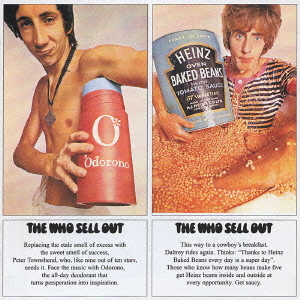
BONUS: The Who do a Great Shakes commercial. But those of us who followed The Who back then — I was a member of The Who Fan Club before they released their first album in the U.S. — know that The Who sold out early. It looked like this:

I amend my search to "1960s dance the shake," and I get this old TV commercial:
Both Meade and I felt a big nostalgic twinge of recognition at the point where the pyramid-shaped packets of powder are dumped out of the plastic shaker.
And speaking of pyramids, the inventor of the dance the Harlem Shake, Al B says:
It's a drunken shake anyway, it's an alcoholic shake, but it's fantastic, everybody loves it and everybody appreciates it. And it's glowing with glory. And it's respected. But if we could mystify it, and become historian, about this Egyptian jazz... Pharaohs invented this thing, with spears, and hats, and gowns. And so, it becomes a subject of being communicative to the system and to realization. If you get my drift.... It was a drunken dance, you know, from the mummies, in the tombs. That's what the mummies used to do. They was all wrapped up and taped up. So they couldn't really move, all they could do was shake...Yes, but how about the 1960s dance? I see "'Shake!!' - RJ & The Del Guapos - (60's dances)," but the dancers are obviously doing the twist and the pony, so this is not an authoritative depiction. And here's a video with the Sam Cooke song "Shake" — "a new dance that's going around" — but, again, somebody just threw together clips of 60s people dancing a jumble of 60s dances. But I did immensely enjoy the appearance of the word "shake" clipped from the Great Shakes TV commercial!
So... finally, here's The Supremes, singing and dancing "The Shake" on the British TV show "Ready Steady Go" in 1965. That's kind of bad. This is much better, also on "Ready Steady Go." The year is 1966:
BONUS: The Who do a Great Shakes commercial. But those of us who followed The Who back then — I was a member of The Who Fan Club before they released their first album in the U.S. — know that The Who sold out early. It looked like this:
The woman who taught the Motown stars to behave in a manner that read as "class."
It's Maxine Powell, who died on Monday at the age of 98.
Maybe you're thinking: Why aren't there any Maxine Powells around anymore to class up the pop stars of today? But there must be. They're simply classing them up to suit the taste of our time, which is to say putting them somewhere near the edge of what is acceptable to the big majority. More is acceptable today because of what went on in those earlier years. Dancing the shake at all — rolling the buttocks — was near the edge of acceptability in the 1960s. So that Powells' modification — smile when you roll those buttocks — shaped how people felt about such things and was part of a process that got us where we find ourselves today.
The NYT obituary — at the link — doesn't mention the topic of race (other than to say that Powell founded a finishing and modeling school "which placed the first black models" (was it only for black women?)). But it's hard to ignore that Motown succeeded in making black performers popular with white Americans, who might not have liked them so much if they hadn't been remade in the way Powell taught. What does it say about American racism? It was Powell's idea of what white people wanted and didn't want.
It worked, so who can say what would have happened if some other approach had been used?
“Mrs. Powell was always a lady of grace, elegance and style, and we did our best to emulate her,” Martha Reeves, the former lead singer of Martha and the Vandellas, said in a telephone interview on Tuesday. “I don’t think I would have been successful at all without her training.... Every asset of my personality has been by her influence... Even to the end, she was making sure that I was standing with posture and exuberant grace.”She scolded the Supremes about how they were dancing the shake. “You are protruding the buttocks... Whenever you do a naughty step like the shake, add some class to it. Instead of shaking and acting tough, you should roll your buttocks under and keep smiling all the time.” She showed them how to do it and: "They were shocked that I could do it and at how much better it looked my way."
Maybe you're thinking: Why aren't there any Maxine Powells around anymore to class up the pop stars of today? But there must be. They're simply classing them up to suit the taste of our time, which is to say putting them somewhere near the edge of what is acceptable to the big majority. More is acceptable today because of what went on in those earlier years. Dancing the shake at all — rolling the buttocks — was near the edge of acceptability in the 1960s. So that Powells' modification — smile when you roll those buttocks — shaped how people felt about such things and was part of a process that got us where we find ourselves today.
The NYT obituary — at the link — doesn't mention the topic of race (other than to say that Powell founded a finishing and modeling school "which placed the first black models" (was it only for black women?)). But it's hard to ignore that Motown succeeded in making black performers popular with white Americans, who might not have liked them so much if they hadn't been remade in the way Powell taught. What does it say about American racism? It was Powell's idea of what white people wanted and didn't want.
It worked, so who can say what would have happened if some other approach had been used?
Wednesday, October 2, 2013
I quit, because my boss only cared about quantity, not quality, and now this video has 8,532,328 views in 4 days.
Videographer dances her parting words to her boss, Via Metafilter, where people don't all appreciate the humor of her going after virality when she resented the boss's pursuit of virality. And:
Here's the above-referenced response from the company.
(Actually, the whole thing seems like a "subversive"-type ad for the company. Is it really that cute? And what's Kanye West going to do about it?)
ADDED: I've removed the embedded video, partly out of respect for Kanye West, but also because I've become convinced of what I was previously merely skeptical was the case: This is viral advertising.
I don't get it. I love a viral video as much as the next person, but neither the original nor the response was amusing or cute or interesting. She didn't do anything fantastically rebellious, or dish dirt, or anything. She just danced around the office a little -- we've all done that.There's also the problem of appropriating someone else's music. And someone complains about her title for the video — "An Interpretive Dance For My Boss Set To Kanye West's Gone" — when "that is not interpretive dance/that is just bopping around."
Here's the above-referenced response from the company.
(Actually, the whole thing seems like a "subversive"-type ad for the company. Is it really that cute? And what's Kanye West going to do about it?)
ADDED: I've removed the embedded video, partly out of respect for Kanye West, but also because I've become convinced of what I was previously merely skeptical was the case: This is viral advertising.
Saturday, September 28, 2013
"Arguendo" — a play with the text lifted from a Supreme Court oral argument about free speech and nude dancing.
At the Public Theater until the end of October. From a review in NY Magazine by Scott Brown (presumably not the political dreamboat Scott Brown)(links added by me):
From the NY Post review of the play:
HuffPo has a lawprof's cogitations. It's Michael Meltsner, who uses Barnes in his teaching of oral advocacy (and who wrote a book called "Race, Rape, and Injustice: Documenting and Challenging Death Penalty Cases in the Civil Rights Era").
I hope you like the link I did — up there in the first indented block of text — on "briefs of all sorts go flying." That was the most literally apt image from a Google search on "flying underpants." But something urges me to show you this too:

What is Sting saying via flight-themed underpants? The eloquence of his expression escapes the banks of chaos in my mind.
In 80 dizzy minutes of towering, tottering legalese, hilariously atrocious wigs and highly athletic swivel-chair-ballet, five performer-creators... do the seemingly impossible: They make the Rehnquist Court feel as intellectually rigorous as The Muppet Show. (And I mean that flatteringly, with respect to The Muppet Show.)...That review could use a rewrite. Maximum sexual innuendo or children's puppet show analogy: Pick one.
Guided by conceiver-director John Collins and aided by the endlessly creative video projections... the ensemble teases out the muffled passions and inarticulable absurdities throbbing beneath the intellectual chessmatch of [Barnes v. Glen Theatre Inc.]—is this an obscenity case? Is dance really “expression”? “Why do they call this place a ‘bookstore’?”—and crystallize the justices as characters without resorting to direct caricature.... The black-robed sages literally circle Indiana Attorney General Uhl (played by Williams and Knight) and respondent attorney Ennis (Iveson), swooping down like vultures one minute, creeping up like Skeksis the next, depending on the line of attack.... The whole nature of expression is called into question in the uninhibited finale, where briefs of all sorts go flying.... The show’s ultimate thrust is a bit of a feint, but the legal term “arguendo” translates colloquially to “for the sake of argument,” not “to conclude definitively and forcefully.”... [A]s a friend of mine used to say, “to reach a conclusion is to limit the potential of argument.”
From the NY Post review of the play:
Since the case revolves the issue of defining nude dancing as a means of communication, Collins seems to extend the discussion to the idea of theater itself. Can you turn any document into a play, even a law case? Can actors jumping and yelling seemingly randomly qualify as a show, and does nudity make that much of a difference?He takes takes off his underpants to nail the argument.
Lo and behold, [the actor playing the lawyer for the strip club] strips to a golden thong, black socks and dress shoes. Then he takes off the thong.
HuffPo has a lawprof's cogitations. It's Michael Meltsner, who uses Barnes in his teaching of oral advocacy (and who wrote a book called "Race, Rape, and Injustice: Documenting and Challenging Death Penalty Cases in the Civil Rights Era").
Alas, while the production presents the legal arguments of two knowledgeable advocates, it is replete with jargon and enough insider's free expression law that even many lawyers in the audience were grabbing smart phones to do some instant Googling. Collins has chosen neither to dignify the ideas expressed by the lawyers nor use them as a take off point for a serious exploration of a culture that debates at the highest levels the constitutional value of public nudity before consenting adults.Ooh. Ow.
That would all by perfectly ok if the result was really funny but too often the text has been saddled by distracting black robbed justices swivel chairing around the stage, enough voices overriding voices to suggest a confusing Tower of Babel in what for all its faults is a process that in the real world aims at clarity and a chaotic display of less than beautiful frontal nudity.
I hope you like the link I did — up there in the first indented block of text — on "briefs of all sorts go flying." That was the most literally apt image from a Google search on "flying underpants." But something urges me to show you this too:
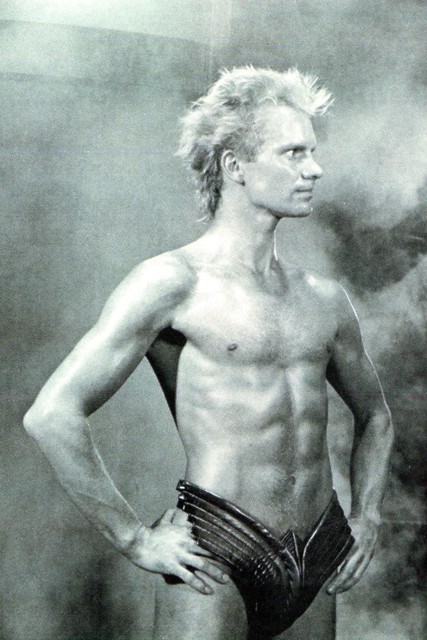
What is Sting saying via flight-themed underpants? The eloquence of his expression escapes the banks of chaos in my mind.
Poets, priests and politiciansAnd lawyers and judges...
Have words to thank for their positionsWhen words tie you up and rape you, say it with — or without — underpants. Sing a song. Sting a thong.
Words that scream for your submission
And no one's jamming their transmission
'Cos when their eloquence escapes you
Their logic ties you up and rapes you
Sunday, September 1, 2013
So you want to get started working in the TV news business?
Prepared to be required to do things like this:
Via Adam at ALOTT2MO, who somehow thinks the women are being "objectified" in a manner that the men are not.
ADDED: Am I the only one who hears "Blurred Lines" and thinks of "Working in the Coal Mine"? Here it is by Lee Dorsey (doing a strange promo for the Brits):
And here's the later Devo version.
Lee Dorsey is best known for the great oldie "Ya Ya." Here's Petula Clark in 1962 updating the song by singing it in French and dancing the twist:
Everything is always recycling: Those newsfolk in that "Blurred News" promo do the twist at least some of the time.
Via Adam at ALOTT2MO, who somehow thinks the women are being "objectified" in a manner that the men are not.
ADDED: Am I the only one who hears "Blurred Lines" and thinks of "Working in the Coal Mine"? Here it is by Lee Dorsey (doing a strange promo for the Brits):
And here's the later Devo version.
Lee Dorsey is best known for the great oldie "Ya Ya." Here's Petula Clark in 1962 updating the song by singing it in French and dancing the twist:
Everything is always recycling: Those newsfolk in that "Blurred News" promo do the twist at least some of the time.
Sunday, June 2, 2013
Humanizing the IRS.
This latest effort at extending the outrage at the IRS scandal is — in my opinion — backfiring.
These nameless, faceless bureaucrats are subjected to inane activities that look like something from "The Office." It doesn't look like profligate spending. It looks like sad and misguided morale-boosting.
Don't make me empathize with the taxman, you hapless scandalmongers!
What am I doing?! Simultaneously empathizing with the taxman and the scandalmongers?
Finding everyone here far too human, I will return to the mountaintop retreat I call Cruel Neutrality.
These nameless, faceless bureaucrats are subjected to inane activities that look like something from "The Office." It doesn't look like profligate spending. It looks like sad and misguided morale-boosting.
Don't make me empathize with the taxman, you hapless scandalmongers!
What am I doing?! Simultaneously empathizing with the taxman and the scandalmongers?
Finding everyone here far too human, I will return to the mountaintop retreat I call Cruel Neutrality.
Wednesday, May 29, 2013
Today is the 100th anniversary of the performance of Stravinsky's "The Rite of Spring" that caused a riot.
Or so the story goes.

The Rite and the riot become entangled in memory making this event, as he puts it, "some kind of gate to modernism, to the 20th Century."He = Esteban Buch, director of studies at the School of Advanced Studies in Social Science in Paris.
There had been some noise two weeks earlier at the premiere of Debussy's ballet, Jeux, and critics had heaped abuse on Vaslav Nijinsky's choreography. Now Nijinsky had choreographed the Rite of Spring - rumoured to be the last word in Russian primitivism or modernist chic, depending who you believed. So part of the audience may well have been predisposed to be outraged.Picture yourself, 100 years ago, losing your composure over this:
"There was an existing tremor in the air against Nijinsky before any curtain went up," says Stephen Walsh, professor of music at Cardiff University. Others say the trouble began with the start of the overture and its strangled bassoon melody, and other strange sounds never before conjured from an orchestra.
Igor Stravinsky, for his part, said the storm only really broke after the overture, "when the curtain opened on the group of knock-kneed and long-braided Lolitas jumping up and down".

Sunday, May 26, 2013
"Trunk."
The word "trunk" has come up — by chance — in 2 posts today.
1. "The plus-size 'bikini'": "Note that the caption refers to the bottoms as 'trunks,' a word that strikes me as way too masculine (perhaps because I associate it with elephant appendages)."
2. "'The Giving Tree' — 'Remember that book...": "In his childhood, the boy enjoys playing with the tree, climbing her trunk, swinging from her branches, and eating her apples. However, as time passes the tree becomes mean, jealous, and stingy...."
When things like that happen around here, it's de rigueur to consult the (unlinkable) Oxford English Dictionary. The first meaning, going back to 1490, is "The main part of something as distinguished from its appendages," which explains how we talk about trees.
Anyway, the elephant's trunk is the 15th meaning for "trunk," and there's no explanation for why the appendage gets the word that originally meant the main part.

... until they didn't....

As for the elephant's trunk, the 15th meaning of "trunk," I'm thinking the word for the main part became the word for the appendage as way to express the awesome size of the appendage. It might have been a comical figure of speech at one time, the way a man's very large phallus might be called his "third leg."
1. "The plus-size 'bikini'": "Note that the caption refers to the bottoms as 'trunks,' a word that strikes me as way too masculine (perhaps because I associate it with elephant appendages)."
2. "'The Giving Tree' — 'Remember that book...": "In his childhood, the boy enjoys playing with the tree, climbing her trunk, swinging from her branches, and eating her apples. However, as time passes the tree becomes mean, jealous, and stingy...."
When things like that happen around here, it's de rigueur to consult the (unlinkable) Oxford English Dictionary. The first meaning, going back to 1490, is "The main part of something as distinguished from its appendages," which explains how we talk about trees.
1490 Caxton tr. Eneydos iv. 17 Eneas..hewe the troncke of a tree oute of the whiche yssued bloode.That leads to a figurative use, for example:
a1616 Shakespeare Measure for Measure (1623) iii. i. 70 You consenting too't, Would barke your honor from that trunke you beare, And leaue you naked.The second meaning is: "The human body, or that of an animal, without the head, or esp. without the head and limbs, or considered apart from these..."
a1616 Shakespeare Henry VI, Pt. 2 (1623) iv. ix. 84 There [will I] cut off thy most vngracious head;..Leauing thy trunke for Crowes to feed vpon.So how do we get to the elephant's trunk, which seems to have it backwards, with the word referring to the appendage and not the main part? And what about those swimming trunks? There's the "trunk" that is a large piece of luggage, and I see that usage seems to have come from the fact that trunks were once made out of tree trunks. Another word for that sort of trunk is "chest," which seems to take us back to the human torso sort of trunk. A puzzle!
Anyway, the elephant's trunk is the 15th meaning for "trunk," and there's no explanation for why the appendage gets the word that originally meant the main part.
1589 R. Baker in R. Hakluyt Princ. Navigations i. 138 The Elephant..With water fils his troonke right hie and blowes it on the rest.And we need to scroll down to meaning #17 to get to the pants category, first with "trunk-hose," and then "trunks" to mean "Short breeches of silk or other thin material; in theatrical use, often worn over tights...."
1613 S. Purchas Pilgrimage 816 There was another strange creature in Nicaragua..like a blacke Hogge, with..a short truncke or snowt like an Elephant....
1836 Dickens Pickwick Papers (1837) xv. 152 The appearance of Mr. Snodgrass in blue satin trunks and cloak, white silk tights and shoes, and Grecian helmet.And finally, "orig. U.S. Short tight-fitting drawers worn by swimmers and athletes."
1883 Pall Mall Gaz. 26 July 7/1 Captain Webb attempted his perilous feat of swimming the Niagara Rapids... He wore a pair of silk trunks....With little help from the OED, I'm going to leap to the supposition that meaning #17 is an example of metonymy — where a word referring to one thing is used to refer to a related thing, like "dish" for the food on the dish. The trunk is in the garment and the garment gets called by the thing it contains. That wouldn't explain why we say "trunks" in the plural, which is like "pants," which we can easily tell is plural because pants have 2 legs. (Calling pant legs "legs" is clearly metonymy.) Oddly, trunks, unlike pants, lack legs, but I think if we go back to the first #17 usage and see "trunk-hose," we get a clue for where "trunks," plural, came from. It was a one-piece garment, the tights, and the term got transferred to those puffy panties that covered up the dancer's bulges...
1894 Ralph in Harper's Mag. Aug. 341 Nude bathing will not be permitted... The use of tights or ‘trunks’ will not be allowed.

... until they didn't....

As for the elephant's trunk, the 15th meaning of "trunk," I'm thinking the word for the main part became the word for the appendage as way to express the awesome size of the appendage. It might have been a comical figure of speech at one time, the way a man's very large phallus might be called his "third leg."
Monday, May 6, 2013

Monday, April 15, 2013
2 choices: "step aside" or "step the f*** up and show the world how Madison..."
"... has consistently earned our spot in the top five party schools while continuing to excel academically."
University of Wisconsin students have been protesting for a long time. Is this too not an issue of freedom?
University of Wisconsin students have been protesting for a long time. Is this too not an issue of freedom?
"We still have rights; we have a house on Mifflin... Long live Mifflin."Should they not fight for their right to party... especially on Mifflin Street? The history:
The Mifflin Street Block Party began in 1969 as a street protest, which involved dancing in protest against the Vietnam War. Its original date, May 3, was set to coincide with the one-year anniversary of the French student rebellion. Anti-war sentiments had accelerated in Madison since the 1967 Dow Chemical protest in which thousands of students occupied and were violently expelled from Ingraham Hall. The original event arose as part of a continuing conflict between students and police in the "Miffland" area, centered on Mifflin Street. Police refused to allow permission for the street dance and when they entered the area in response to a noise complaint, a confrontation ensued that lasted three nights and spread into the surrounding student areas. Students threw stones at the police and constructed barricades to defend themselves. The police responded with tear gas and billy clubs. At the end, 70 people were injured and more than 100 arrested, including future and current mayor, Paul Soglin.
Friday, March 22, 2013
Wednesday, March 20, 2013
"Bolshoi ballet was 'giant brothel' claims former dancer."
"Anastasia Volochkova... fired from the Bolshoi in 2003 for being too heavy... made the allegations...."
"Ten years ago, when I was dancing at the theatre, I repeatedly received such propositions to share the beds of oligarchs.
"The girls were forced to go along to grand dinners and given advance warning that afterwards they would be expected to go to bed and have sex," she alleged.
"When the girls asked: 'What happens if we refuse?', they were told that they would not go on tour or even perform at the Bolshoi theatre. Can you imagine?"
Saturday, March 16, 2013
Saturday, March 9, 2013
"I could dance all f***ing day."
This is a nice trend. Young people finding very old grandmas adorable.
Friday, March 1, 2013
"Aviation danger probe after EVERY passenger on flight leaps in the air at the same time..."
"... at 30,000ft for Harlem Shake flash mob."
"You have a weight and balance issue because that many people moving around in an aircraft, you could have the plane potentially losing control and its very, very dangerous...."...
‘I don't see there being any reason why this should cause any trouble. We asked the staff and they said it was safe,’..."
Saturday, February 16, 2013
"In 1959 Fred Astaire hired renowned makeup artist John Chambers to work on his television special, Another Evening with Fred Astaire."
"The assignment? Turn Fred Astaire into Alfred E. Neuman. The results were predictably strange."
As they say... The past is a foreign country: they do things differently there.
I can't imagine such a long dance routine on network TV, even with a visual gag. I can't imagine a visual gag going on and on like that. People must have been so much more patient back then. Or much more in love with the idea of themselves as appreciating elevated culture. And yet it was not so elevated, what with the Alfred E. Neuman gag.
And that deadly modern dance. The woman swanning around while men in tuxedos behaved as if they were a single entity and that entity was a pulsating sexual organ. And all in such exquisite taste! Then Neuman/Astaire performs alone, lasts longer than all the rest of them, but in the end, he too loses his erection.
Moral: The ugliest guy might be the best performer.
Did I get that right?
As they say... The past is a foreign country: they do things differently there.
I can't imagine such a long dance routine on network TV, even with a visual gag. I can't imagine a visual gag going on and on like that. People must have been so much more patient back then. Or much more in love with the idea of themselves as appreciating elevated culture. And yet it was not so elevated, what with the Alfred E. Neuman gag.
And that deadly modern dance. The woman swanning around while men in tuxedos behaved as if they were a single entity and that entity was a pulsating sexual organ. And all in such exquisite taste! Then Neuman/Astaire performs alone, lasts longer than all the rest of them, but in the end, he too loses his erection.
Moral: The ugliest guy might be the best performer.
Did I get that right?
Saturday, January 26, 2013
"Buy yourself a shotgun"... maybe not a real shotgun, maybe something metaphorical.
So, yeah, there's Jimi Hendrix, on TV in 1965. Can you even hear him? I want to concentrate on Buddy & Stacy. I'm surprised they got away with dancing like that on television:
Those were different times.
Those were different times.
Friday, January 25, 2013
I was so tired when I wrote last night's "Gatsby" post.
It was a real struggle with that sentence:
I'll leave you to untangle the strands of colored lights that festoon the Christmas tree sentence, because I need to get back to what people said about yesterday's sentence. I must say I laughed out loud when McTriumph said:
And now, it's your turn to dance. Dance all night in the comments, backward in eternal graceless circles, tortuously, fashionably, individualistically.
There was dancing now on the canvas in the garden; old men pushing young girls backward in eternal graceless circles, superior couples holding each other tortuously, fashionably, and keeping in the corners — and a great number of single girls dancing individualistically or relieving the orchestra for a moment of the burden of the banjo or the traps.You might say I wrestled with that sentence. The commenters — whom I read this morning, after I conked out and slept for 10 hours — helped me make the connection to wrestling. Terry said: "The key phrase, I think, is 'on the canvas.'" That affects how you think of the men pushing the young girls, the gracelessness, and the tortuously. Dancing is like wrestling here. In the "Gatsby" project, we look into one sentence, in isolation, but I just looked back into the text to get a better picture of that canvas, which I took to be a way to transform lawn into dance floor. I get to this sentence:
At least once a fortnight a corps of caterers came down with several hundred feet of canvas and enough colored lights to make a Christmas tree of Gatsby’s enormous garden.So let that be today's sentence. Lots of Cs: corps, caterers came, canvas, colored, Christmas. Christmas replacing the garden evokes the New Testament supplanting the Old. From the Garden of Eden to the salvation of Christ. By the way, that is the sentence just before the "crowded hams" sentence that made me angry 3 days ago.
I'll leave you to untangle the strands of colored lights that festoon the Christmas tree sentence, because I need to get back to what people said about yesterday's sentence. I must say I laughed out loud when McTriumph said:
Professor Ann, your first thought was musicians using the girls as instruments? You should write a novel, "Fifty Shades of Banjo."And then betamax3000 introduced Naked Andy Kaufman Robot. Betamax has done this "naked robot" routine before, but the Andy Kaufman iteration blew my mind, because I was still admiring Terry's wrestling insight, with men wrestling/dancing with woman, and then to bring up Andy Kaufman — when Kaufman not only had a comic act that was about wrestling with women, but he had a routine that consisted of taking the stage and reading, in its entirety, "The Great Gatsby." But it's not as if betamax3000 just said, "Hey, this is so Andy Kaufman — the wrestling and 'The Great Gatsby.'" No, betamax did a series of comments that twisted the "Gatsby" text into things that would be said by the Naked Andy Kaufman Robot:
I have pushed many women gracelessly backwards on canvas. It has been both tortuous and fashionable, leaping high from the corners of the ring onto the contestant below: in that moment there is Truth, Sweat and Cheers. Many people assume the urge to wrestle women is sexual. As a wrestler of women I can definitively say that this is untrue. Mostly. In the main it is about the defining moment of being Superior, of recognition of the Pinner and the Pinnee.
A few moments on Etiquette.And:
A sportsman never uses the Banjo or the Traps on a female wrestler. While he is allowed to use the Piledriver it is not to be done from a height greater than a women's modest skirt: below the knees only, gentlemen.
Danny DeVito did not understand. He would ask "Andy, why don't you stop wrestling women?" and I would reply "Danny, why don't you stop being so short and disheveled?"
Shirt tucked or not, in the ring Danny would've been able to stand as tall as his Courage would allow him to be, but -- sadly --he did not understand.
Tony Danza would argue "I'm a boxer. What would be so different if I boxed women?"
I could only shake my head. He did not comprehend the difference between wrestling and fighting. A punch is anger, but only through grappling do we experience the common ground between the sexes: the canvas ring is where the true colors are painted, like a woman's red nails or a man's 1969 orange Camaro.
I once wrestled a woman who smelled of avocado. In the midst of our grappling a moment was frozen as that scent overpowered my senses, psychically and spiritually. Was the avocado Fear or Power? How could I pin this woman down, this woman who smelled of avocado? How could I keep her soul and buttocks confined beneath me when the Avocado was everywhere? In the end I won the match, but the avocado defeated me on a far grander level.
Every woman has the Avocado inside her -- this, a true wrestler knows -- knows and respects...
The first time I wrestled a woman was practically a religious experience. At the end I laid on the canvas pinned, defeated and euphoric: through my bell-rung eyes I saw God through the rafters wink at me. I do not remember her name but I remember the look of Victory in her eyes and how I peed a little.And:
Women have soft elbows. When you are elbowed in the solar plexus by a woman it is different than a man's elbow: there is Understanding. There is Forgiveness.And:
When pinned between a woman's headstrong knees a man has no choice but to understand: it is the Silent Conversation, and the chafing will heal.And:
To repeat: wrestling a woman is not sexual. Excitement is for the Soul and the Arms and the Thighs, not the Loins. To have an erection in the ring is to give the Devil a Handle.There's more, but enough of the quoting of the Naked Andy Kaufman Robot. Let's turn to the wonderful commenter Chip Ahoy, crisply quipping:
Later, following the death of Gatz, the same canvas was turned over to modern dance.I remember that modern dance GIF. It was back in 2009, when I wrote about "Lawrence Halprin... 'the tribal elder of American landscape architecture'" whose wife was a dancer who, he said, "could not be contained by a rectangle," so he built her a dance deck that was the "odd, improvised shape" you see in the photo. Back then Chip Ahoy said:
But that didn't last. The dancers, bored of dancing set off in pairs to the beach, to break up and pair off again and break up and pair off.
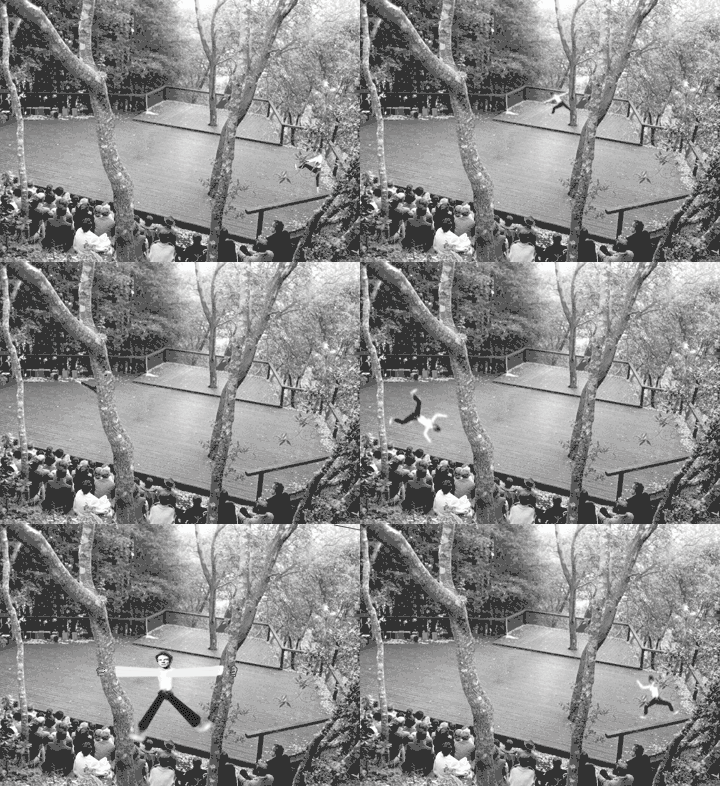


I too knew that my wife could not be contained on a rectangular deck for she is uncontainable, so I improvised with an deck area that could be danced on several levels. The outer levels tilt so that anything placed on them slide off toward the center, and built with portals that promise escape but all lead circuitously back to the main dance area, rather like a hamster habitat. I rounded the edges and varied the angles for nature has few straight lines and fewer right angles and my wife is nature personified, and that made the whole deck railing more difficult, you see, which I then electrified because I knew she would make several attempts at an over-the-rail vault. The deck areas are also surrounded by a moat that I populated with piranhas that I feed regularly by dropping in a steak so they're veritably trained to converge en mass, along with back up electric eels and those really gross blood-sucking slugs, all to discourage wandering beyond the safety of boundaries I set forth with my architecture. The deck itself is fitted with sprinklers at its farthermost points that spray a mist with power hose force to warn the little sylph-like dancing scamp whenever her dance gives the appearance of breaking loose or she nears the end of her retractible chain.And then Chip proceeded to animate a dancer for the odd, improvised dance deck.
And now, it's your turn to dance. Dance all night in the comments, backward in eternal graceless circles, tortuously, fashionably, individualistically.
Let's dance like it's 1958 in Idaho.
That's nice and slow. I think you can all learn that, and I think it would be nice if kids today learned that dance, maybe in gym class. I think it would help them in many ways. And feel free to dress like that, even unironically.
I found that because YouTube suggested it after I watched this 1965 clip from the TV show "Hollywood a Go-Go" with Del Shannon singing "Runaway" and the "Hollywood a Go-Go" go go dancers were dancing around him doing some dance that represented running away, even though their forward motion only took them in a circle so they never got away. It's faster and more frenetic dancing, but I think you might be able to figure out the moves, even though we never get to see the feet.
Seemingly bridging the time gap between the first and second video — and also suggested by YouTube — here's Little Eva singing about the brand-new dance "The Loco-Motion." I say "seemingly" because it looks early 60s and the "Runaway" dance looks later 60s, but in fact, both clips are from 1965. A lot of old and new intersected in 1965. Personally, I was 14 years old, and I was rooting for progress. I watched "Hollywood a Go-Go" and "Shindig" (the show Little Eva's on), and I tuned in hoping to see British invasion stuff like The Kinks or folk rock stuff like The Byrds. I would have regarded Del Shannon as an intrusion from the pre-Beatles era. "Runaway" was a hit in 1961. It was one of the singles we played at slumber parties when we were children.
"The Loco-Motion" was a hit in 1962. Little Eva — Eva Narcissus Boyd — was a maid who also worked as a babysitter for Carole King and Gerry Goffin: "It is often claimed that Goffin and King were amused by Boyd's individual dancing style, so they wrote 'The Loco-Motion' for her" — but maybe that's not true. Little Eva doesn't look too interested in dancing in that "Shindig" clip. The notorious song "He Hit Me (It Felt Like A Kiss)" was based on what Little Eva told Carole King about her relationship with her boyfriend. That song was originally recorded by The Crystals — produced by the not-yet-a-murderer Phil Spector — and in recent years, it's been covered by Courtney Love and Grizzly Bear — with some unknown degree of irony.
Subscribe to:
Posts (Atom)