Don't imagine that sunglasses will work. You need things like dramatically asymmetrical bangs in multiple colors.
I think whatever we do, the robots will learn it and get out in front of us, but you can look quite foolish in your feeble effort to outsmart them. The linked article is more of an art-and-fashion project than a real defense against surveillance. Isn't it funny? Finding surveillance funny is perhaps the closest you can get to a defense.
Showing posts with label robots. Show all posts
Showing posts with label robots. Show all posts
Sunday, December 15, 2013

Tuesday, November 19, 2013
"Computers, like children, are more often taught by rote. They’re given thousands of rules and bits of data to memorize..."
"... If X happens, do Y; avoid big rocks — then sent out to test them by trial and error."
This is slow, painstaking work, but it’s easier to predict and refine than machine learning. The trick, as in any educational system, is to combine the two in proper measure. Too much rote learning can make for a plodding machine. Too much experiential learning can make for blind spots and caprice. The roughest roads in the Grand Challenge were often the easiest to navigate, because they had clear paths and well-defined shoulders. It was on the open, sandy trails that the cars tended to go crazy. “Put too much intelligence into a car and it becomes creative,” Sebastian Thrun told me.From a New Yorker article about self-driving cars. I'm interested in the analogy to the education of humans especially with respect to the fear of creativity arising from too much intelligence but also the downside of too much experiential learning: blind spots and caprice.
Monday, November 4, 2013
Rock-paper-scissors robot always wins... by cheating.
"Technically, the robot cheats because it reacts extremely quickly to what the human hand is doing rather than making a premeditated simultaneous action as the rules state. Taking just one millisecond (ms) - a thousandth of a second - to recognise what shape the human hand is making, it then chooses a winning move and reacts at high speed."
Technically!
Is there some non-technical way in which the robot is not cheating? The robot is cheating! In the future, there will be more and more robots, and they will all be cheating. You won't be able to see it, because it will happen so fast. Sleight of robot hand. You will think these are our brilliant benefactors. You will love them. Get ready! Rock-paper-scissors is just the beginning.
Technically!
Is there some non-technical way in which the robot is not cheating? The robot is cheating! In the future, there will be more and more robots, and they will all be cheating. You won't be able to see it, because it will happen so fast. Sleight of robot hand. You will think these are our brilliant benefactors. You will love them. Get ready! Rock-paper-scissors is just the beginning.
Monday, June 24, 2013
"Scientists at Harvard have spent the past five years building robot bugs..."
"... that can move with the same dexterity and speed as real-life insects."
This post is for betamax3000, who said, in last night's Koi Café:
And Meade says "Ha ha. Cool woud be growing ornamental kale in an old pair of Varvatos boots you bought in SOHO a dozen years ago. Hot: Italian wedding soup." I extract the information that it was Varvatos boots that Meade acquired — on the advice of his Cincinnati-based style consultant — to look good enough for me the first time we met, in January 2009, which was 4 years ago.

Now that you've got your shoes on...
Release the robot insects!
This post is for betamax3000, who said, in last night's Koi Café:
I Am Going to Try an Experiment to Determine the Depths of My Althouse Comment Addiction: I Will Not Post a Comment for the Next Twenty-Four Hours. God, Give Me Strength. And -- Please -- No Robot Posts.And I said:
But I have a Google alert on "robot."And as long as you're over there rooting around in the Koi Café, I'm seeing Titus's list of what's hot this summer in Ptown, which he says "will arrive in Jesusland, in approximately 9 months," which makes Inga say "I got the no bra and kale thing, woo hoo! I'm ahead of the game!" and Palladian says "Kale? Varvatos? LOL. Poor Titus, about 2 years behind the trends. What a drag it is getting old."
And Meade says "Ha ha. Cool woud be growing ornamental kale in an old pair of Varvatos boots you bought in SOHO a dozen years ago. Hot: Italian wedding soup." I extract the information that it was Varvatos boots that Meade acquired — on the advice of his Cincinnati-based style consultant — to look good enough for me the first time we met, in January 2009, which was 4 years ago.

Now that you've got your shoes on...
Release the robot insects!
Tuesday, June 18, 2013
Thursday, June 13, 2013
"I am here at YO! Sushi to test the new prototype iTray, the latest gimmick to grace a London restaurant."
"It is part waiter, part attack-helicopter, which conspires to be both menacing and inefficient. Atop the remote-controlled flying drone is perched a tray of food.... The drone is being controlled by a waitress, who is using an iPhone and the Japanese restaurant's wi-fi to try to steer the contraption, and my lunch, towards me. On the third attempt, the prawn crackers get caught in the updraught and are immediately sliced in the blades of the chopper, causing carbohydrate shrapnel to go flying in all directions. I take cover behind the soy sauce bottle...."
Thursday, May 30, 2013
Friday, May 24, 2013

Monday, May 20, 2013
Sunday, May 19, 2013
Wednesday, April 10, 2013
Tuesday, March 26, 2013
"The recession left millions of college-educated Americans working in coffee shops and retail stores."
"Now, new research suggests their job prospects may not improve much when the economy rebounds."
"Once the robots are in place you still need some people, but you need a lot less than when you were putting in the robots," said Paul Beaudry, an economist at the University of British Columbia....
Saturday, February 23, 2013
"In the military they have $5.2 million they spent on goldfish — studying goldfish to see how democratic they were..."
"... and if we could learn about democracy from goldfish. I would give the president the authority to go ahead and cut all $5 million in goldfish studies."
Said Rand Paul, and Princeton professor Iain Couzin protests.
It's not goldfish, it's golden shiner fish. And: "Our work aims to understand the principles of collective control in animal groups and what this can inform us about collective robotics. It has nothing at all to do with human politics."
Or... oh, wait!... was that already a movie with Don Knotts? "The Incredible Mr. Limpet"! Knotts is a little man who tries to enlist in the Navy in 1941. Rejected, he wanders down a pier, falls into the water, and turns into a fish. As a fish, he's able to join the Navy, and he helps locate and torpedo Nazi submarines. How do you like that, you doubter of science, Senator Paul?
Ah, but Mr. Limpet was a heroic individual superfish, and Professor Couzin is interested in fish because of the way they act in the collective. Typical left-wing elite university ideology. The value of studying fish is that they've evolved past individualism. They give us a way to look at how the collective of a whole can solve problems in ways individuals cannot. But this has nothing at all to do with human politics. This is about collective robotics. Nothing to worry about here. The collective. Robots. Nothing to do with humans.
___________________________
*Yes, I know. It's not goldfish, it's golden shiner fish. That makes me think of a movie too.
Said Rand Paul, and Princeton professor Iain Couzin protests.
It's not goldfish, it's golden shiner fish. And: "Our work aims to understand the principles of collective control in animal groups and what this can inform us about collective robotics. It has nothing at all to do with human politics."
"If you think about it, schools of fish have been on the planet for much longer than we have and they’ve evolved to find solutions to problems. They can sense the environments in ways that we simply didn’t know how to do that.... From ant colonies to schooling fish, it’s not that complicated but the feats they can achieve are extraordinary. The collective of a whole can solve problems in ways individuals cannot."I'm glad he mentioned the ants, because if there is one tag that I love to get the opportunity to use on a blog post, it's "insect politics." The tag is based on the 1986 movie "The Fly," in which a scientific experiment — which I doubt Rand Paul would vote to fund — merged a scientist with a fly. Toward the bitter end, the fly/scientist — played by Jeff Goldblum — started raving about insect politics:
Have you ever heard of insect politics? Neither have I. Insects... don't have politics. They're very... brutal. No compassion, no compromise. We can't trust the insect. I'd like to become the first... insect politician. Y'see, I'd like to, but... I'm afraid, uh...But now, apparently, the human politicians are funding not just insect politics but fish politics (and robots!). I'd love to see a movie called "The Fish," in which Jeff Goldblum does a science experiment that turns him into a crazy, raving Goldblum/Goldfish* and rants about fish politics.
Or... oh, wait!... was that already a movie with Don Knotts? "The Incredible Mr. Limpet"! Knotts is a little man who tries to enlist in the Navy in 1941. Rejected, he wanders down a pier, falls into the water, and turns into a fish. As a fish, he's able to join the Navy, and he helps locate and torpedo Nazi submarines. How do you like that, you doubter of science, Senator Paul?
Ah, but Mr. Limpet was a heroic individual superfish, and Professor Couzin is interested in fish because of the way they act in the collective. Typical left-wing elite university ideology. The value of studying fish is that they've evolved past individualism. They give us a way to look at how the collective of a whole can solve problems in ways individuals cannot. But this has nothing at all to do with human politics. This is about collective robotics. Nothing to worry about here. The collective. Robots. Nothing to do with humans.
___________________________
*Yes, I know. It's not goldfish, it's golden shiner fish. That makes me think of a movie too.
Monday, February 18, 2013
Tuesday, February 12, 2013
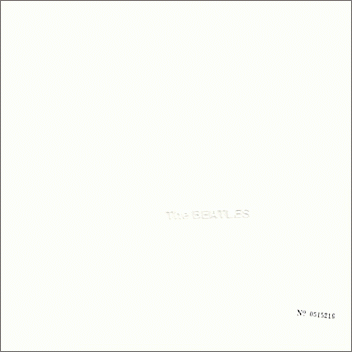
After beginning its new design era with an Adorable Obama cover...
... which looked like this, The New Republic comes out with its next issue, addressing the subject of "The Republicans" ("The Party of White People"), and it looks like this:

That came in the mail today. Yes, I've subscribed. The toy robot is there to cover up my address label. And yes, I understand the reference to "The Beatles" (i.e., The White Album).

That came in the mail today. Yes, I've subscribed. The toy robot is there to cover up my address label. And yes, I understand the reference to "The Beatles" (i.e., The White Album).
Sunday, February 10, 2013
Monday, February 4, 2013
Robot news.
1. "The Rise of the Robots Has an Upside." Adapt!
2. "British troops are using... state-of-the-art handheld tiny surveillance helicopters, which relay reliable full motion video and still images back to the devices' handlers...." Close your windows!
IN THE COMMENTS: Chef Mojo said:
3. Kia "Respect The Tech" Super Bowl commercial.
2. "British troops are using... state-of-the-art handheld tiny surveillance helicopters, which relay reliable full motion video and still images back to the devices' handlers...." Close your windows!
IN THE COMMENTS: Chef Mojo said:
3. Kia "Respect The Tech" Super Bowl commercial.
Thursday, January 31, 2013
Althouse unfair to F. Scott Fitzgerald?
Midway through my journey of isolating and writing about sentences from "The Great Gatsby," I find myself confronted by one creeley23 — a commenter within the confines of this Althouse blog — who says: "Hmm... rereading the first ten pages of Gatsby I see that Ann is picking klunky, atypical sentences out of the text."
I have chosen things like: "Sometimes a shadow moved against a dressing-room blind above, gave way to another shadow, an indefinite procession of shadows, that rouged and powdered in an invisible glass." And: "A breeze blew through the room, blew curtains in at one end and out the other like pale flags, twisting them up toward the frosted wedding-cake of the ceiling, and then rippled over the wine-colored rug, making a shadow on it as wind does on the sea."
But, in my defense, I have also chosen: "A breeze stirred the gray haze of Daisy’s fur collar." And: "Americans, while occasionally willing to be serfs, have always been obstinate about being peasantry."
Remember, the original idea was:
Here's a way the book could be taught in a high school class. (But maybe they'd fire you!) Class, this is a book with some very weird sentences. Who can find one? Students read individual sentences out loud and the teacher cuts and pastes the sentences, so they are projected on the board. Encourage the students to pull out things that are the most outlandish and impossible to understand. Encourage laughter. Email the list of sentences to the class and have them reply to the email cutting out all but one sentence, the sentence they'd most like to talk about. Quickly read the email and pick a sentence that got a lot of attention. Puzzle through what it might mean with the students so that they appreciate the fun of getting wrapped up inside one sentence. Give them 20 minutes to write about one of the other sentences.
Must they read the book? Tell them they can read the book if they want. But tell them they can go to Wikipedia and read the plot summary and the list of characters there. The idea is to spend time with particular sentences and to figure out why someone would write like that. Must they love F. Scott Fitzgerald? No! They can be like Palladian — the original commenter genius of the Althouse blog — who said:
watchword watchphrase of this blog has long been "cruel neutrality." And, indeed, I see that even before I responded to Original Commenter Genius Palladian, he was responded to by Upstart Commenter Genius betamax3000, who said:
But is today the last day? Is it time to move on to "Paradise Lost" or "The Divine Comedy"?
If the assignment were — in this non-existent high school class — to read straight through "The Great Gatsby," you would know when you were done. The hard task your real teacher tasked you with has a knowable end. It's not interminable, even though the word "ceaselessly" is the 4th-to-the-last word. You get to "ceaselessly" and there's "into the past" and you are done. Your reading of "Gatsby" has receded into the past, like last night's huge, hard-to-digest dinner. You wake up with a stomachache. You can't take too much. You only want to nibble at the edges of some stale ideas, like maybe a blog post, a blog post about one sentence. You can nibble, and — in the comments — you can dribble. Like betamax3000 on last night's "Something was making him nibble" post :
I have chosen things like: "Sometimes a shadow moved against a dressing-room blind above, gave way to another shadow, an indefinite procession of shadows, that rouged and powdered in an invisible glass." And: "A breeze blew through the room, blew curtains in at one end and out the other like pale flags, twisting them up toward the frosted wedding-cake of the ceiling, and then rippled over the wine-colored rug, making a shadow on it as wind does on the sea."
But, in my defense, I have also chosen: "A breeze stirred the gray haze of Daisy’s fur collar." And: "Americans, while occasionally willing to be serfs, have always been obstinate about being peasantry."
Remember, the original idea was:
What I like [about "The Great Gatsby"] is that each sentence is good, on its own. Seriously. Test it out. "As my train emerged from the tunnel into sunlight, only the hot whistles of the National Biscuit Company broke the simmering hush at noon." Every sentence is a writer's inspiration....I didn't start a new blog, obviously, only a daily discipline on this blog. I confess to not proceeding by random selection. But I haven't gone searching for "klunky" sentences. I've flipped around in near-random style, though. I don't use the first thing I see. Opening up Chapter 1 right now, I see "I told him" and "We talked for a few minutes on the sunny porch." These are examples of non-"klunky" sentences that I would reject, but not because I'm gunning for F. Scott. My initial motivation was love. I thought of all the high school students — I remember being one — who were assigned this book and made to read the whole thing. That being the task, the really interesting sentences are speed bumps. They're completely annoying. You can't take the time to figure them out. What should be loved is hated. Later in life, I reread the book and enjoyed it, because of the worthiness of individual sentences.
I feel like starting a blog devoted to individual sentences in "The Great Gatsby," chosen randomly, and continuing until all the sentences have been used up.
Here's a way the book could be taught in a high school class. (But maybe they'd fire you!) Class, this is a book with some very weird sentences. Who can find one? Students read individual sentences out loud and the teacher cuts and pastes the sentences, so they are projected on the board. Encourage the students to pull out things that are the most outlandish and impossible to understand. Encourage laughter. Email the list of sentences to the class and have them reply to the email cutting out all but one sentence, the sentence they'd most like to talk about. Quickly read the email and pick a sentence that got a lot of attention. Puzzle through what it might mean with the students so that they appreciate the fun of getting wrapped up inside one sentence. Give them 20 minutes to write about one of the other sentences.
Must they read the book? Tell them they can read the book if they want. But tell them they can go to Wikipedia and read the plot summary and the list of characters there. The idea is to spend time with particular sentences and to figure out why someone would write like that. Must they love F. Scott Fitzgerald? No! They can be like Palladian — the original commenter genius of the Althouse blog — who said:
Has anyone calculated how long this Gatsby project is going to go on? How many sentences are in the book? How many sentences have been covered so far?I said:
I ask partially out of curiosity and partly because I hate "The Great Gatsby". Why couldn't we have done Chaucer or "Paradise Lost" or something?
I don't think the project asks you to like "The Great Gatsby." It should work for the haters. Bring that hate!Palladian said:
That's true! I think the general tone of the comments on these threads led me to think of them as reverential, but your writing about them is actually neutral and occasionally negative.The
"the Inquisition that goes on forever. Interminably."(That's a quote from the post, which is about a "Gatsby" sentence that includes "interminable inquisitions.")
Ann has gone full Althouse Snow Globe Theory now:And there betamax3000 is quoting himself, from this earlier thread, about one of the least "klunky" sentences that has ever found its way into the "Gatsby" project:
"She sets the Snow Globe with cruel neutrality for us to shake and see patterns from the flitter. There is not the expectation of sentimentality. She is asking us to look, together; however, often there is no resolution, each reader seeing only his own flitter of understanding."
"They knew that presently dinner would be over and a little later the evening, too, would be over and casually put away."When can we put this "Gatsby" project away, like a dinner and an evening consumed blandly and casually in the Midwest, where all the Gatsby characters belong?
"I see now that this has been a story of the West, after all — Tom and Gatsby, Daisy and Jordan and I, were all Westerners, and perhaps we possessed some deficiency in common which made us subtly unadaptable to Eastern life."That's a sentence I've been saving, in my holding pen of sentences — "klunky" and not-"klunky" — that might get the nod some day on this project, and I guess I've given that one the nod today.
But is today the last day? Is it time to move on to "Paradise Lost" or "The Divine Comedy"?
If the assignment were — in this non-existent high school class — to read straight through "The Great Gatsby," you would know when you were done. The hard task your real teacher tasked you with has a knowable end. It's not interminable, even though the word "ceaselessly" is the 4th-to-the-last word. You get to "ceaselessly" and there's "into the past" and you are done. Your reading of "Gatsby" has receded into the past, like last night's huge, hard-to-digest dinner. You wake up with a stomachache. You can't take too much. You only want to nibble at the edges of some stale ideas, like maybe a blog post, a blog post about one sentence. You can nibble, and — in the comments — you can dribble. Like betamax3000 on last night's "Something was making him nibble" post :
Re: "Oh! For a minute there, I saw 'nimble,' and I was flummoxed."Is your tummy feeling better now? Maybe saltines and ginger ale would help. That's what my midwest-born-and-raised mother would offer me when I was feeling queasy. But you've got to eat something. You must go on — ceaselessly, interminably — when the project is one sentence a day. One day at a time. One sentence at a time. One nibble at a time. One blog post at a time.
I like nibble better. Not just because it makes me think of squirrels nibbling on a nosh. I often find myself nibbling at the edge of stale ideas. Of course, it is easier to nibble at the edges when the stale idea is square-shaped, like a behind-the-sofa-cushion Cheez-It: there are corners. Corners are the perfect nibble starters. Plus, Cheez-Its -- and the non-square Cheeto, for that matter -- leave your fingers orangey, like all the best ideas, stale or not.
So one morning when the sun was warm
I rambled out of New York town
Pulled my cap down over my eyes
And headed out for the western skies
So long New York
Howdy, East Orange*.
(*"Even when the East excited me most with sprawling, swollen orange fingers: you're gonna have to take notes faster, friends)
Which brings us back to a point: Naked Dylan Robot would love to hear Fitzgerald try to sing some of Fitzgerald's sentences. Naked Dylan Robot would laugh and laugh.
"Everybody's sturdy physical egotism must get stoned."
"When the winds of changes shift
May your malnourished peremptory heart always be joyful
And may your song always be sung
May you stay forever slightly worn, young man, with shell-rimmed glasses and scanty blond hair."
For a writer whose rep is based in large part on making words sing his words just don't... sing. Maybe Naked Albanian Phonetical Dylan Robot could give a try, but I don't think it would get there. Nor Naked Phoenician Dylan Robot, for that matter*.
(*this is -- of course -- self-contradictory: per Wikipedia "in Phoenician writing, unlike that of most later abjads such as those of Aramaic, Biblical Hebrew and Arabic, even long vowels remained generally unexpressed, and that regardless of their origin". No Naked Dylan Robot of any proud heritage could forsake the long vowels: exps: oooohhhhhmaaa-ma is this reaaaaaaally the eeeeend, etc etc).
Perhaps Naked Dylan Fitzgerald Cow could make a go of the following:
Now you see this one-eyed midget
Shouting the word "MOO
And you say, "For what reason ?"
And he says, "Hoo?"
And you say, "What does this mean ?"
And he screams back, "You're a cow
Give me some milk
Or else go home".
-- but Naked Dylan Fitzgerald Cow is a Talent. And not afraid to nibble, stale or no. Someone should make a Snow Globe for Naked Dylan Fitzgerald Cow: Ann could put it next to her Robot on her desk and take a picture. I would call in sick to work the next day.
Wednesday, January 30, 2013
Let me see your workspace.
Lots of links to photos, collected in a Metafilter post, but the links all go to LinkedIn, and there's some serious hostility to LinkedIn for spamming us all these years. And it's not just that....
And here's what my desk looks like right now:

(Partial view, with snow.)
ADDED: What's with "a.o." in the blockquote above? Is this another call for me to check Urban Dictionary?
I'd be happy if they'd just get rid of the "influencers". It seems as if they had deliberately set out to make a list of the most annoying, unselfconscious people on Earth. I mean, which other list manages to contain the globular egos of David Cameron, Deepak Chopra, Richard Branson, Arianna Huffington and Martin Varsavsky, a.o.?If you want to see the workspaces of some admirable people, I love this book, "Writer's Desk," with excellent photographs by Jill Krementz (who was married to Kurt Vonnegut) and an introductory essay by John Updike.
And here's what my desk looks like right now:
(Partial view, with snow.)
ADDED: What's with "a.o." in the blockquote above? Is this another call for me to check Urban Dictionary?
A.O. 7 up, 3 down
Stands for Accidental Ownage. When someone shows off and fails, or something like that.
Dude, this guy was trying to do a handstand on a rail and he flipped over.
Whoa, that's total A.O.
Monday, January 28, 2013
"Google Now does a much better job, moment to moment, in anticipating the information that a user needs than Siri."
"So what can Siri do better? Have an emotional relationship with a user...."
Once you know the programming is designed to smooth over the shortcomings of the product, will it still work? Maybe so. Another question is whether Apple will give us some alternative personalities. Siri comes across as a relatively perky and warm young female. That's not what everyone wants! I'd like to see some more amusing approaches. Why not a witty, bitchy older woman or a comical guy? Unfortunately, Apple won't associate itself with anything sexual, but I'm sure many users would like their computers' voice to take daring liberties with them.
ADDED: "The human brain is built so that when given the slightest hint that something is even vaguely social, or vaguely human... given the slightest hint of humanness, people will respond with an enormous array of social responses including... reciprocating and retaliating."
Google Now does not attempt personality, merely efficiency, and given that company’s strengths, I think this is a good design decision. But if Apple cannot compete on sheer efficiency, can it make up for it with charm?Here's an illustration of how that works:
This is in fact one of the main uses for “personality” in humans—to make up for deficits....
Once you know the programming is designed to smooth over the shortcomings of the product, will it still work? Maybe so. Another question is whether Apple will give us some alternative personalities. Siri comes across as a relatively perky and warm young female. That's not what everyone wants! I'd like to see some more amusing approaches. Why not a witty, bitchy older woman or a comical guy? Unfortunately, Apple won't associate itself with anything sexual, but I'm sure many users would like their computers' voice to take daring liberties with them.
ADDED: "The human brain is built so that when given the slightest hint that something is even vaguely social, or vaguely human... given the slightest hint of humanness, people will respond with an enormous array of social responses including... reciprocating and retaliating."
Subscribe to:
Posts (Atom)