"... and inspires conversation about how everything is connected – shore birds, me, you, the sea, fog and much more."
What is the Google barge project?
A surprint environment??
Showing posts with label Google. Show all posts
Showing posts with label Google. Show all posts
Friday, November 8, 2013

Wednesday, October 30, 2013
"why do i hate the sound of a dog cleaning itself?"
A search that brought someone to my blog this morning. What makes a person ask that question? You find a licking sound disgusting, but that's not the end of it. You ask why. That could be the beginning of some young person's serious intellectual exploration of human psychology. Or it could be just the next random thing that was just interesting enough to somebody who already had his fingers on the keyboard to do a little Google search.
By the way, the blog post of mine that came up in this Google search is quite helpful, giving you a key word: misphonia.
Bonus: Dog tongue pic, by Meade:

By the way, the blog post of mine that came up in this Google search is quite helpful, giving you a key word: misphonia.
Bonus: Dog tongue pic, by Meade:
Saturday, September 28, 2013
Googling in the theater.
Remember when Pee Wee Herman got arrested for masturbating in a movie theater? That was long ago. It must have been before home video, because why go to a theater to masturbate? Exposure? The thrill of potential discovery? A need for just the right degree of intimacy with others? Because once pornography is subject only to boring disapproval from bland people, one must look for another way to feel that you're doing something titillatingly wrong?
But today, the transgression is Googling in the theater. Googling, long ago, could have been a slang term for masturbating. (Are you googling again?!) But those days are past. Googling is research, and research in the theater is a subversive activity.
From Professor Meltsner's essay about the play "Arguendo," discussed in the previous post:
While others went off to pee or to sip a glass of wine, I stayed put and read. (To be honest, I wasn't doing research on the internet. Reception was bad where we were in the woods, and I have a Shakespeare app on my iPhone.)
More from Meltsner's essay:
I'm Googling and searching in the text of "Rosencrantz and Guildenstern," looking for "meaning." Literally. I'm searching on the word "meaning" to get some snappy way to bring this post in for a landing.
Aha! Guildenstern is talking about "the meaning of order" and how if we "happened to discover, or even suspect, that our spontaneity was part of their order, we'd know we be lost." He refers to the Chinese philosopher who "dreamed he was a butterfly, and from that moment he was never quite sure that he was not a butterfly dreaming it was a Chinese philosopher." There's a pause and then Rosencrantz jumps up and shouts "Fire!"
Well, that's convenient for bringing this post in for a landing — a joke about a Supreme Court text about shouting fire in a crowded theater. Here, let me Google that for you.
Guildenstern says "Where?" and Rosencrantz says: "It's all right — I'm demonstrating the misuse of free speech. To prove it exists." He looks at us, the audience, and obviously we are sitting there, unreacting, the suspension of disbelief having secured our disbelief in the possibility of a fire. Rosencrantz says: "Not a move. They should burn to death in their shoes."
But today, the transgression is Googling in the theater. Googling, long ago, could have been a slang term for masturbating. (Are you googling again?!) But those days are past. Googling is research, and research in the theater is a subversive activity.
From Professor Meltsner's essay about the play "Arguendo," discussed in the previous post:
[The play] is replete with jargon and enough insider's free expression law that even many lawyers in the audience were grabbing smart phones to do some instant Googling.Do they Google during the performance or wait until intermission? It happens that I was using my iPhone during intermissions at a play last night. We saw "Rosencrantz and Guildenstern Are Dead" at the American Players Theatre, and since we hadn't taken the opportunity the theatre offers this summer to freshen up our knowledge of "Hamlet," there were passages of "Hamlet" I wanted to read to go along with "Rosencrantz and Guildenstern," which is a play that has 2 minor characters from "Hamlet" dealing with their situation in that larger story that they witness only in fragments.
While others went off to pee or to sip a glass of wine, I stayed put and read. (To be honest, I wasn't doing research on the internet. Reception was bad where we were in the woods, and I have a Shakespeare app on my iPhone.)
More from Meltsner's essay:
What did I expect from a play based not so much on the story of an important law case but on the particularized verbal event that is a Court argument in such a case? Plainly the Company wasn't interested in turning out teaching materials for those like me who train advocates but, then, Collins was advised by all-star legal journalist Emily Bazelon and law professor and Broadway producer Nicholas Rosenkranz...There's a name: Rosenkranz. Pure coincidence that I should trip over that this morning. No meaning.
I'm Googling and searching in the text of "Rosencrantz and Guildenstern," looking for "meaning." Literally. I'm searching on the word "meaning" to get some snappy way to bring this post in for a landing.
Aha! Guildenstern is talking about "the meaning of order" and how if we "happened to discover, or even suspect, that our spontaneity was part of their order, we'd know we be lost." He refers to the Chinese philosopher who "dreamed he was a butterfly, and from that moment he was never quite sure that he was not a butterfly dreaming it was a Chinese philosopher." There's a pause and then Rosencrantz jumps up and shouts "Fire!"
Well, that's convenient for bringing this post in for a landing — a joke about a Supreme Court text about shouting fire in a crowded theater. Here, let me Google that for you.
Guildenstern says "Where?" and Rosencrantz says: "It's all right — I'm demonstrating the misuse of free speech. To prove it exists." He looks at us, the audience, and obviously we are sitting there, unreacting, the suspension of disbelief having secured our disbelief in the possibility of a fire. Rosencrantz says: "Not a move. They should burn to death in their shoes."
Monday, September 9, 2013
A new Van Gogh. Declared "100 percent genuine" now.
Back in 1908 it was declared a fake and stuck up in an attic.
Hey, if it's really a Van Gogh — from the "mature" period, no less — why wouldn't it be something you'd hang in full view even if you believed it was fake?
Let's contemplate the importance of authenticity. But don't start — as I tried — by Googling that phrase. You'll get bullshit about personal relationships, not art. I wanted bullshit about art.
Being who you really are. That seems like an old-fashioned subject. Something we talked about in the 60s, right?
This topic of personal authenticity took me back to "The Above Ground Sound" of Jake Holmes, specifically "Genuine, Imitation Life" (audio at link):

What's going on here? Caption: "Jim Connell, Jake Holmes and Joan Rivers when they worked as the team: 'Jim, Jake & Joan.'"
Holmes also wrote the song "Dazed and Confused" (recorded by Led Zeppelin) and many famous advertising jingles, notably "Be a Pepper" and "Be all that you can be." This is blowing my mind. Just that the same guy urged us to "Be all that you can be" (in the Army) and to "Be a Pepper." I'll bet the Army kicked you out back then if they found out you were a Pepper. That's weird. But that he also wrote "Dazed and Confused." And worked with Joan Rivers (and looked like he looked working with Joan Rivers).
Now, I'm questioning the authenticity of that Wikipedia article. But here's a 2010 NYT article about Holmes suing Led Zeppelin for copyright infringement.
Anyway, back to Van Gogh. Think that's a real Van Gogh?
ADDED: I found — on YouTube, not in my attic — some Jim, Jake & Joan (from a 1964 movie called "Once Upon A Coffee House"):
Hey, if it's really a Van Gogh — from the "mature" period, no less — why wouldn't it be something you'd hang in full view even if you believed it was fake?
Let's contemplate the importance of authenticity. But don't start — as I tried — by Googling that phrase. You'll get bullshit about personal relationships, not art. I wanted bullshit about art.
Being who you really are. That seems like an old-fashioned subject. Something we talked about in the 60s, right?
This topic of personal authenticity took me back to "The Above Ground Sound" of Jake Holmes, specifically "Genuine, Imitation Life" (audio at link):
Chameleons changing colors,That was not a joke, but 100% genuine in 1967. Or... I'm reading the Jake Holmes article at Wikipedia and I'm now not sure that it wasn't a joke. Was he making fun of serious folksingers, making fun of authenticity? A picture from that article raises questions:
While a crocodile cries.
People rubbing elbows,
But never touching eyes.
Taking off their masks,
Revealing still another guise.
Genuine, imitation life.

What's going on here? Caption: "Jim Connell, Jake Holmes and Joan Rivers when they worked as the team: 'Jim, Jake & Joan.'"
Holmes also wrote the song "Dazed and Confused" (recorded by Led Zeppelin) and many famous advertising jingles, notably "Be a Pepper" and "Be all that you can be." This is blowing my mind. Just that the same guy urged us to "Be all that you can be" (in the Army) and to "Be a Pepper." I'll bet the Army kicked you out back then if they found out you were a Pepper. That's weird. But that he also wrote "Dazed and Confused." And worked with Joan Rivers (and looked like he looked working with Joan Rivers).
Now, I'm questioning the authenticity of that Wikipedia article. But here's a 2010 NYT article about Holmes suing Led Zeppelin for copyright infringement.
Anyway, back to Van Gogh. Think that's a real Van Gogh?
ADDED: I found — on YouTube, not in my attic — some Jim, Jake & Joan (from a 1964 movie called "Once Upon A Coffee House"):
Thursday, August 22, 2013
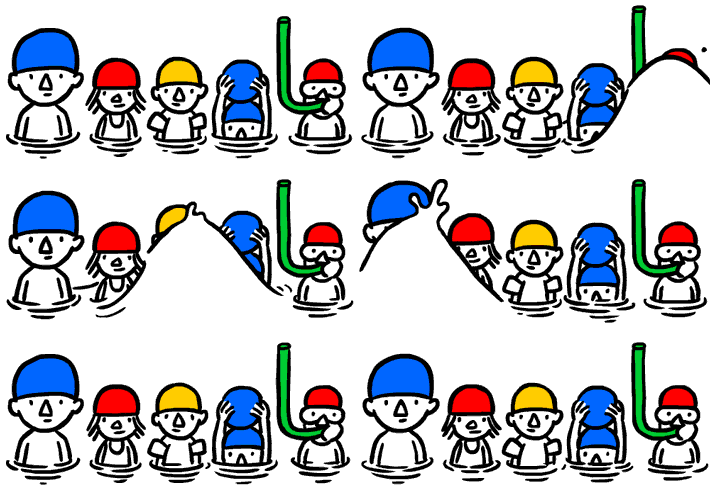
My favorite Google Doodle ever.
Monday, July 1, 2013
"Google Reader dies today. Here’s why I’m not replacing it."
Says Ezra Klein:
There’s nothing wrong with RSS feeds, or with Twitter. But they both bias my information diet in the same ways: Toward quick reads rather than long ones, toward writers and outlets I know rather than ones I don’t, toward blogs rather than other kinds of articles, and toward information I curated rather than information that someone else curated.Thanks for the confession.
Those biases are dangerous for me. After all, my job is to keep coming up with new and interesting things things to report and write about. The more I read the same things over and over, and the more I read the same things that other writers read, the worse I’ll be at my job.
Friday, June 21, 2013

Saturday, June 15, 2013
Google to bring WiFi via balloons.
Project Loon.
IN THE COMMENTS: elkh1 said:
IN THE COMMENTS: elkh1 said:
Better to snoop you including those of you who don't use Google.EDH said:
"It is balloon!!!... Well, not just stand there, sound evil spirit alarm!"
Tuesday, June 11, 2013
"'They quite literally can watch your ideas form as you type,' the then-anonymous Snowden told reporters as his leaks first emerged."
"Well, so can Google. And Facebook. And most companies’ internal networks. Creepy? You bet. Calamitous? Not so clear."
Daniel Ellsberg says Snowden is a “hero.” Let me suggest a different prism through which to view that term. Somewhere in the intelligence community is another 29-year-old computer whiz whose name we’ll never know. That person joined the government after 9/11 because she felt inspired to serve the nation in its hour of need. For years she’s sweated to perfect programs that can sort through epic reams of data to identify potential threats. Some Americans are alive today because of her work.
As one security analyst put it this week, to find a needle in a haystack, you need the haystack. If we’re going to romanticize a young nerd in the intelligence world, my Unknown Coder trumps the celebrity waiting in Hong Kong for Diane Sawyer’s call any day.
Sunday, June 9, 2013
"Speech and publication mean something very different from what the US founding fathers meant. It’s a very laddish argument..."
"... which is not to say that women may not also support it: but the fact that Facebook relies on it means they are not listening to women and to an alternative perspective that women may put. That’s the real issue here. Facebook needs to start listening to women. No joke."
You lose control of your writings once you hand them over to a 3d party like Facebook or Google... and not just because the government can get to it. What if Facebook decided to delete everything The Women found misogynist? What if Google decided to delete all the blogs that it deemed hurtful to women... or to the Democratic Party?
Here's that discussion I had back in 2011 with Bob Wright about whether "free speech" means anything outside of the individual's interaction with government.
You lose control of your writings once you hand them over to a 3d party like Facebook or Google... and not just because the government can get to it. What if Facebook decided to delete everything The Women found misogynist? What if Google decided to delete all the blogs that it deemed hurtful to women... or to the Democratic Party?
***
Here's that discussion I had back in 2011 with Bob Wright about whether "free speech" means anything outside of the individual's interaction with government.
Friday, June 7, 2013
Google's official blog: "What the ...?"
"You may be aware of press reports alleging that Internet companies have joined a secret U.S. government program called PRISM to give the National Security Agency direct access to our servers...."
AND: Here's Mark Zuckerman's official response at Facebook:
First, we have not joined any program that would give the U.S. government—or any other government—direct access to our servers. Indeed, the U.S. government does not have direct access or a “back door” to the information stored in our data centers. We had not heard of a program called PRISM until yesterday....Hey! They sound like Obama... found out when they heard about it in the news, just like you....
AND: Here's Mark Zuckerman's official response at Facebook:
Facebook is not and has never been part of any program to give the US or any other government direct access to our servers. We have never received a blanket request or court order from any government agency asking for information or metadata in bulk, like the one Verizon reportedly received. And if we did, we would fight it aggressively. We hadn't even heard of PRISM before yesterday.I was contemplating the possibility that PRISM is a fake, a decoy of some kind, but I see that government officials — in the opinion of the NYT — have admitted it exists:
Government officials defended the two surveillance initiatives as authorized under law, known to Congress and necessary to guard the country against terrorist threats...
In confirming its existence, officials said that the program, called Prism, is authorized under a foreign intelligence law that was recently renewed by Congress....
Monday, May 27, 2013
"When you’re in public, you’re in public. What happens in public, is the very definition of it."
"I don’t want you telling me that I can’t take pictures in public without your permission."
Jeff Jarvis, quoted in an article about the intrusions of Google Glass.
1. The word "kodak" — with a lower-case k — is used repeatedly in place of the word "camera," and the word "camera" appears once, toward the end, and only after "photographing machines." Less attention was paid back then, it seems, to the interest in preserving the trademark in brand names. (The loss of "aspirin" and "heroin" as Bayer trademarks came after WWI.)
2. The word "fiends," used repeatedly, connotes evil and addiction. From the same time period, the OED quotes: "The autograph-fiend; the cyclist-fiend; the interviewer-fiend; the newsboy-fiend; the organ-fiend" (1896), "‘A dope fiend’... A victim of the opium habit" (1896).
3. The word "promiscuous" fits with the nature of the perceived harm: women are victims. The article refers to "married men" wanting to bring lawsuits against the photographers. One man is said to have consulted a lawyer about whether "an assault could be charged" if the photograph is taken "against the will." But how sexual is the word "promiscuous"? The etymology connected it to "mixed up," and the oldest meaning is, according to the OED: "Done or applied with no regard for method, order, etc.; random, indiscriminate, unsystematic." The OED has some great quotes for the specifically sexual meaning that seems so central to us today:
Jeff Jarvis, quoted in an article about the intrusions of Google Glass.
Mr. Jarvis said we’ve been through a similar ruckus about cameras in public before, in the 1890s when Kodak cameras started to appear in parks and on city streets.Interesting things about that old NYT article:
The New York Times addressed people’s concerns at the time in an article in August 1899, about a group of camera users, the so-called Kodak fiends, who snapped pictures of women with their new cameras.
“About the cottage colony there is a decided rebellion against the promiscuous use of photographing machines,” The Times wrote from Newport, R.I. “Threats are being made against any one who continues to use cameras as freely.” In another article, a woman pulled a knife on a man who tried to take her picture, “demolishing” the camera before going on her way.
1. The word "kodak" — with a lower-case k — is used repeatedly in place of the word "camera," and the word "camera" appears once, toward the end, and only after "photographing machines." Less attention was paid back then, it seems, to the interest in preserving the trademark in brand names. (The loss of "aspirin" and "heroin" as Bayer trademarks came after WWI.)
2. The word "fiends," used repeatedly, connotes evil and addiction. From the same time period, the OED quotes: "The autograph-fiend; the cyclist-fiend; the interviewer-fiend; the newsboy-fiend; the organ-fiend" (1896), "‘A dope fiend’... A victim of the opium habit" (1896).
3. The word "promiscuous" fits with the nature of the perceived harm: women are victims. The article refers to "married men" wanting to bring lawsuits against the photographers. One man is said to have consulted a lawyer about whether "an assault could be charged" if the photograph is taken "against the will." But how sexual is the word "promiscuous"? The etymology connected it to "mixed up," and the oldest meaning is, according to the OED: "Done or applied with no regard for method, order, etc.; random, indiscriminate, unsystematic." The OED has some great quotes for the specifically sexual meaning that seems so central to us today:
1804 S. T. Coleridge Coll. Lett. (1956) II. 1119 He is..addicted to almost promiscuous Intercourse with women of all Classes.
1879 Harlequin Prince Cherrytop 29 Better frig, howe'er the mind it shocks, Than from promiscuous fucking catch the pox....
1924 C. Connolly Let. Dec. in Romantic Friendship (1975) 32, I am not promiscuous but I can't be loyal to an icicle....
1978 S. Herzel in P. Moore Man, Woman, & Priesthood viii. 119 It is precisely because men can compartmentalize that they are more easily promiscuous than women.
Thursday, May 9, 2013
GeoGuessr.
"1. Look around the random Google Street View and try to figure out where you are. 2. Click the world map to guess!"
A great game... really teaches you how wrong you can be. (Note: You can zoom in on the map (and the street view).)
A great game... really teaches you how wrong you can be. (Note: You can zoom in on the map (and the street view).)
Saturday, May 4, 2013
"White Men Wearing Google Glass."
A tumblr page, linked at the WSJ article called "Google Glass: An Etiquette Guide."
The photos presumably suggest the need for an etiquette guide. I'm guessing these things things will — like cell phones — seem annoying/inappropriate until enough people have them and the people who get them before that are the kind of people who sort of like being annoying/inappropriate.
The photos presumably suggest the need for an etiquette guide. I'm guessing these things things will — like cell phones — seem annoying/inappropriate until enough people have them and the people who get them before that are the kind of people who sort of like being annoying/inappropriate.
Tuesday, April 30, 2013
"As corporate rather than government actors, the Deciders aren’t formally bound by the First Amendment."
"But to protect the best qualities of the Internet, they need to summon the First Amendment principle that the only speech that can be banned is that which threatens to provoke imminent violence, an ideal articulated by Justice Louis Brandeis in 1927. It’s time, in other words, for some American free-speech imperialism if the Web is to remain open and free in twenty-first century."
This is a big subject for me, something I've argued with Bob Wright about, notably in this March 2011 post: "The Bob Wright/Ann Althouse email exchange about what free speech means in the context of saying Roger Ailes needs to kick Glenn Beck off Fox News."
ADDED: Here's a clip from March 2011:
This is a big subject for me, something I've argued with Bob Wright about, notably in this March 2011 post: "The Bob Wright/Ann Althouse email exchange about what free speech means in the context of saying Roger Ailes needs to kick Glenn Beck off Fox News."
ADDED: Here's a clip from March 2011:
Saturday, April 27, 2013
"Before he became the anti-junk-food mayor of New York City, Michael Bloomberg was a pioneer in the corporate provision of junk food."
"For decades, Bloomberg has made available to employees—at no charge—the entire contents of a convenience store. What started as coffee, chips, and cookies (snacks, not meals), quickly expanded to things that were like meals (fresh fruit, cereal and oatmeal for breakfast, cans of tuna fish, soup, and noodle packets for lunch)."
Writes Daniel Gross, in part of an argument that the IRS shouldn't add the value of food provided to employees to their taxable income. This food is "an instrument of social control."
Notice that this issue heated up because of the high quality of the food in Silicon Valley workplaces:
I've changed the topic, and I'd like to go on in this vein (duct?). Bodily fluids are a bit of a theme on the blog today, and the language of saliva is truly interesting. Drool and slaver. Did you know that drool is derived from drivel? And slaver and slobber are basically the same word. Drool and slobber — the words with the letter o — convey a childishness or mental incompetence, while the o-less drivel and slaver seem better for criticizing a competent adult who's wasting our time or is dangerously greedy.
So if you don't like the direction this post has taken, call itdrool, slobber, slaver, drivel.
Writes Daniel Gross, in part of an argument that the IRS shouldn't add the value of food provided to employees to their taxable income. This food is "an instrument of social control."
Companies use people’s basic needs and desire to consume calories as a way of channeling their efforts toward the greater corporate good.Does that really make food different from money, which is also used to energize and appease workers? One difference is that people eat different amounts of food and some — such as vegetarians — eat less expensive items. How would you calculate the value of the free food?
Notice that this issue heated up because of the high quality of the food in Silicon Valley workplaces:
A Gourmet magazine article last year raved about the "mouthwatering free food" at Google's headquarters in Mountain View, Calif. The article cited dishes such as porcini-encrusted grass-fed beef and noted that nearly half the produce was organic....By the way, how did "mouth-watering" ever come to be a standard way to describe something appetizing? It's an internally inconsistent word. It's not "mouth-watering" to picture a mouth watering. It's stomach-turning. Looking at the (unlinkable) OED, I see the word originally described the person who was slavering:
Facebook's headquarters in nearby Menlo Park, Calif., has two main cafes, plus a barbecue shack, a pizza shop, a burrito bar, and a 50s-style burger joint. Recent menu options at Facebook's Café Epic, which dishes up free food from morning until night, included spicy she-crab soup and grilled steak with chimichurri sauce.
1779 H. Downman Lucius Junius Brutus v. iv. 124 Conscientious, babbling, sniveling, Mouth-watering knaves, who envy every man The dainty morsel they can't eat themselves.In the early use as a description of the object of the drooler's desire, there is a connotation of disgust and disapproval: "1900 Speakers 3 Jan. 338/2 The White Star shareholders have made a most mouth-watering bargain."
1845 R. Ford Hand-bk. Travellers in Spain I. i. 67 The mouth-watering bystanders sigh, as they see and smell the rich freight steaming away from them.
I've changed the topic, and I'd like to go on in this vein (duct?). Bodily fluids are a bit of a theme on the blog today, and the language of saliva is truly interesting. Drool and slaver. Did you know that drool is derived from drivel? And slaver and slobber are basically the same word. Drool and slobber — the words with the letter o — convey a childishness or mental incompetence, while the o-less drivel and slaver seem better for criticizing a competent adult who's wasting our time or is dangerously greedy.
So if you don't like the direction this post has taken, call it
1852 J. S. Blackie On Stud. Lang. 2 As it begins with dreams, so it must end in drivel.Ah, that reminds me. We were talking about the government. The mouth-watering government.
Monday, April 22, 2013
Earth Day.
The Google doodle is charming.
What are you doing for Earth Day?
Me, I'm waking up pre-dawn, making a cup of coffee, and watching the sun rise through the larger window that is my picture window which is partly blocked by the smaller window that is my computer screen, and I'm blogging about the happenstance that what the window to the larger world displays is a story about an oak tree as the window to my smaller world looks out onto an oak tree.

Our oak tree, which I hope will stay upright for many more years, is very old, but nowhere nearly as old as the oldest oak in Wales, which got blown down last Wednesday night:
What are you doing for Earth Day?
Me, I'm waking up pre-dawn, making a cup of coffee, and watching the sun rise through the larger window that is my picture window which is partly blocked by the smaller window that is my computer screen, and I'm blogging about the happenstance that what the window to the larger world displays is a story about an oak tree as the window to my smaller world looks out onto an oak tree.
Our oak tree, which I hope will stay upright for many more years, is very old, but nowhere nearly as old as the oldest oak in Wales, which got blown down last Wednesday night:
The oldest oak in Wales – and probably one of the oldest oak trees in northern Europe – has grown in the Ceiriog Valley near Chirk, north Wales, since 802 and measured 12.9m in girth. Legend states that the Welsh prince Owain Gwynedd rallied his army under the tree in 1157, before defeating the English King Henry ll at the nearby battle of Crogen, and that the tree was spared when Henry had his men cut down the Ceiriog woods in 1165.
Sunday, March 31, 2013
"15 People Who Think Google Is Honoring Hugo Chávez."
"Hugo Chávez was the socialist president of Venezuela; Cesar Chavez was a labor leader and civil rights activist. See the difference?"
ADDED: "But to a small minority of conservatives thumping away at their keyboards on Easter Sunday it was something more sinister. It was a slight on Jesus. Worse still, it was a slight on Jesus directed by the White House, and in particular Barack Obama, America's Kenyan-born Muslim leader, probably."
ADDED: "But to a small minority of conservatives thumping away at their keyboards on Easter Sunday it was something more sinister. It was a slight on Jesus. Worse still, it was a slight on Jesus directed by the White House, and in particular Barack Obama, America's Kenyan-born Muslim leader, probably."
Saturday, March 30, 2013
Monday, March 25, 2013
"Would You Rather Have Google Glass or a Smart Watch?"
"When you think of the world five years from now, do you picture the masses wearing smart eyewear or Dick Tracy-style smart watches?"
I see the problem with Google Glass — it will probably make most people look stupid and even if you happen to be someone who might look cool, people won't give you credit for looking cool because they'll feel that you're intruding on them in ways they don't even quite understand. Are you streaming me to the whole world? Are you finding out things that will be used to take advantage of me? That is, either you'll either make yourself look stupid or you'll make other people feel that you're making them look stupid. Must we all self-defensively gear up? And what's to stop people from snatching those things right off your face? Not only will they attract the traditional thief, they may provoke drunks and other hotheads to grab them and break them, the way bullies in old movies used to swipe the nerd's glasses and stomp on them.
But a Smart Watch... what's the point? I used to wear a watch, but I stopped when I got a cell phone which was fully capable of informing me of the time. I carry the phone in a pocket or a handbag, and what's my motivation to strap it to my wrist? I realize that's what people with pocket watches must have said when the original wristwatches came out.
And, now that I think of it, I have engaged in some activities — e.g., running — where I've rigged a less-than-perfect way to bring the iPhone along. (I've carried it in my hand, stuck it inside a sports-bra, and bought a little "waist pack" gizmo.) And I've been in situations — e.g., paddleboarding — where I needed some waterproof container, didn't have one, then bought something that was clumsy, ugly, and hard to use. And when I go swimming, I'm forced to leave the phone in the car/hotel room or I've got to hide it under a towel and then worry that someone will steal it. So, okay, the Smart Watch would be pretty useful, especially if it's cheap, comfortable, waterproof, and doesn't make you a theft target. Make it not work if someone else has it (and inform the thief community).
So I'm voting: Smart Watch.
I see the problem with Google Glass — it will probably make most people look stupid and even if you happen to be someone who might look cool, people won't give you credit for looking cool because they'll feel that you're intruding on them in ways they don't even quite understand. Are you streaming me to the whole world? Are you finding out things that will be used to take advantage of me? That is, either you'll either make yourself look stupid or you'll make other people feel that you're making them look stupid. Must we all self-defensively gear up? And what's to stop people from snatching those things right off your face? Not only will they attract the traditional thief, they may provoke drunks and other hotheads to grab them and break them, the way bullies in old movies used to swipe the nerd's glasses and stomp on them.
But a Smart Watch... what's the point? I used to wear a watch, but I stopped when I got a cell phone which was fully capable of informing me of the time. I carry the phone in a pocket or a handbag, and what's my motivation to strap it to my wrist? I realize that's what people with pocket watches must have said when the original wristwatches came out.
And, now that I think of it, I have engaged in some activities — e.g., running — where I've rigged a less-than-perfect way to bring the iPhone along. (I've carried it in my hand, stuck it inside a sports-bra, and bought a little "waist pack" gizmo.) And I've been in situations — e.g., paddleboarding — where I needed some waterproof container, didn't have one, then bought something that was clumsy, ugly, and hard to use. And when I go swimming, I'm forced to leave the phone in the car/hotel room or I've got to hide it under a towel and then worry that someone will steal it. So, okay, the Smart Watch would be pretty useful, especially if it's cheap, comfortable, waterproof, and doesn't make you a theft target. Make it not work if someone else has it (and inform the thief community).
So I'm voting: Smart Watch.
Subscribe to:
Posts (Atom)