It is an uncomfortable position for many members of the creative classes to be in. “We are the Obama people,” said Camille Sweeney, a New York writer and member of the Authors Guild. Her insurance is being canceled, and she is dismayed that neither her pediatrician nor her general practitioner appears to be on the exchange plans. What to do has become a hot topic on Facebook and at dinner parties frequented by her fellow writers and artists.Isn't that cute? For it, but what is it? Dear, sweet, oh-so-creative Camille the Writer, seemingly flipping the old Groucho Marx lyric:
“I’m for it,” she said. “But what is the reality of it?”
Showing posts with label stupid. Show all posts
Showing posts with label stupid. Show all posts
Friday, December 13, 2013
"Many in New York’s professional and cultural elite have long supported President Obama’s health care plan."
"But now, to their surprise, thousands of writers, opera singers, music teachers, photographers, doctors, lawyers and others are learning that their health insurance plans are being canceled and they may have to pay more to get comparable coverage, if they can find it."

Taking a ridiculous racial issue and making it more ridiculous.
For some reason — ratings? — Megyn Kelly was on Fox News arguing with some lady who thought Santa Claus should no longer be depicted as a white man. Sorry, I'm not going to figure out the whole context of that proposal, but at some point Kelly emitted the following quote:
So here comes Jonathan Merritt in The Atlantic, turning that nugget o' Fox into something that Atlantic readers might find tasty. Hey, everybody, some idiot on Fox News said something stupid.
What's the error? Merritt informs us that Jesus, being a first-century Jew, probably had dark skin. Jews are not white? One ceases to be white if one's skin is sufficiently dark? It may be silly to use the term "white" to label people by race, but white is a big category, and it includes a pretty broad spectrum of skin colors, such as, for example, the "white Hispanic" George Zimmerman. Maybe we should call Jesus a "white Semitic" to heighten the awareness of the subcategories of whiteness. Is that what Jonathan Merritt requires to avoid falling into "serious error"? Megyn Kelly was arguing for less racialism, and Merritt is arguing for more.
Merritt also casually implies that the TSA engages in racial profiling of those who look Semitic. It's a scurrilous charge, but, hey, it's a joke.
Merritt continues:
And we're subjected to the usual tripe about light and darkness — which correspond so strongly to the deeply emotional experience of day and night — being about skin color. Ever consider that Jesus looks the way he does in old paintings because the painter used models in his home town? That would mean the painter wasn't focused on race at all. But why not go with the idea that all those old painters were racists who lightened Jesus up to make him look like a better class of person? What's the point? And what the hell does it have to do with Megyn Kelly?
Merritt goes on to say:
"Just because it makes you feel uncomfortable doesn't mean it has to change," Kelly said. "Jesus was a white man, too. It's like we have, he's a historical figure that's a verifiable fact, as is Santa, I just want kids to know that. How do you revise it in the middle of the legacy in the story and change Santa from white to black?"Well, that's silly, perhaps, but she's got a guest on the show who needs to be prodded with questions. And the assertion that Santa is a historical figure is jocose for adults, a sop for the kids. The question is simply the usual conservative appeal to tradition: Why change anything? There's a reference to the reason for the change: It makes some people "uncomfortable." Is that a good enough reason for changing something we've done for a long time? This is the same way you could bandy about the question whether the Washington Redskins ought to change their name. It's standard fare for the Fox News crowd.
So here comes Jonathan Merritt in The Atlantic, turning that nugget o' Fox into something that Atlantic readers might find tasty. Hey, everybody, some idiot on Fox News said something stupid.
Setting aside the ridiculousness of creating rigidly racial depictions of a fictitious character that does not actually exist—sorry, kids—like Santa, Kelly has made a more serious error about Jesus. The scholarly consensus is actually that Jesus was, like most first-century Jews, probably a dark-skinned man. If he were taking the red-eye flight from San Francisco to New York today, Jesus might be profiled for additional security screening by TSA.Kelly didn't demand "rigidly racial depictions." She was challenging her guest's attempt to turn the usual image of Santa into a racial problem. It's the guest who's yearning to impose the racial template. What's the "serious error" about Santa that Kelly is supposed to have made? None! But she made a "more serious error about Jesus," and I guess any error is a more serious error than no error.
What's the error? Merritt informs us that Jesus, being a first-century Jew, probably had dark skin. Jews are not white? One ceases to be white if one's skin is sufficiently dark? It may be silly to use the term "white" to label people by race, but white is a big category, and it includes a pretty broad spectrum of skin colors, such as, for example, the "white Hispanic" George Zimmerman. Maybe we should call Jesus a "white Semitic" to heighten the awareness of the subcategories of whiteness. Is that what Jonathan Merritt requires to avoid falling into "serious error"? Megyn Kelly was arguing for less racialism, and Merritt is arguing for more.
Merritt also casually implies that the TSA engages in racial profiling of those who look Semitic. It's a scurrilous charge, but, hey, it's a joke.
Merritt continues:
The myth of a white Jesus is one with deep roots throughout Christian history. As early as the Middle Ages and particularly during the Renaissance, popular Western artists depicted Jesus as a white man, often with blue eyes and blondish hair.Yeah, but Megyn Kelly didn't say Jesus had blond hair and blue eyes. Merritt's line is more erroneous, wafting the notion that white people must have light coloring. I'd say there are a lot more white people with dark eyes and dark hair than with blue eyes and blond (or "blondish") hair. So this is a completely screwy attack on Megyn Kelly, and it's actually pretty offensive to go out of your way to say that persons of Semitic ancestry are not white. Why go where Nazis have gone? What's the attraction? Because it's just so important to portray Fox News folk as idiots?
Perhaps fueled by some Biblical verses correlating lightness with purity and righteousness and darkness with sin and evil, these images sought to craft a sterile Son of God....Now, you are way outside of anything having to do with Megyn Kelly. This sounds like some lesson from a fourth-rate racial studies course. And by the way, Merritt, that writing is terrible. The subject of your sentence is "images," and images don't seek to do anything. Images are inanimate objects. And how do you "craft" Jesus? Human beings do the seeking and crafting. And the images are crafted. The images are of Jesus. A person might craft a sterile image of Jesus. But an image can't craft — or even seek to craft — a sterile Jesus.
And we're subjected to the usual tripe about light and darkness — which correspond so strongly to the deeply emotional experience of day and night — being about skin color. Ever consider that Jesus looks the way he does in old paintings because the painter used models in his home town? That would mean the painter wasn't focused on race at all. But why not go with the idea that all those old painters were racists who lightened Jesus up to make him look like a better class of person? What's the point? And what the hell does it have to do with Megyn Kelly?
Merritt goes on to say:
In Martin Luther King Jr.’s “Advice for Living” column for Ebony in 1957, the civil-rights leader was asked, “Why did God make Jesus white, when the majority of peoples in the world are non-white?” King replied, “The color of Jesus’ skin is of little or no consequence” because what made Jesus exceptional “His willingness to surrender His will to God’s will.” His point, as historian Edward Blum has noted, is that Jesus transcends race.Yes, Martin Luther King said some great things about getting past race. So could we? Here's what Merritt says next:
Those warnings hold just as true for believers today.What warnings? How is Jesus transcends race a warning? One could construct a warning: We'd better transcend race or terrible things will happen. But Merritt won't transcend race:
Within the church, eschewing a Jesus who looks more like a Scandinavian supermodel than the sinless Son of God in the scriptures is critical to maintaining a faith in which all can give praise to one who became like them in an effort to save them from sins like racism and prejudice.Only Merritt brought up the Scandinavian supermodel version of Jesus, but, yeah, it's critical to eschew making Jesus look like this. But who does that? If it's really so important to have the right colors to encourage everyone to identify, then a dark-haired, dark-eyed Caucasian is one of the best choices. But Martin Luther King said race is of little or no consequence, and Merritt said we were supposed to heed his warnings.

It's important for Christians who want to expand the church, too, in allowing the creation of communities that are able to worship a Jesus who builds bridges rather than barriers. And it is essential to enabling those who bear the name of Christ to look forward to that day when, according to the book of Revelation, those “from every nation, tribe, people, and language” can worship God together.He just cannot let it go. Megyn Kelly must be stupid. Fox News must suck. Jesus can wait and Martin Luther King's dream will need to be deferred for however long it takes to kick that right-wing news blonde around one more time over less than nothing.
Until that day arrives, though, can someone please tell Megyn Kelly that Jesus is not white?
Friday, November 29, 2013
Artist seems to think he invented the image of a woman with snakes for hair, accuses Damien Hirst of plagiarism for depicting Rihanna as Medusa.
"It's always fun to take a pop at Hirst, but... the charge against Hirst is not plagiarism – it is sheer artistic ordinariness."
Neither he nor [Jim] Starr have added anything original to the image of Medusa. The GQ cover is as insipid as some late Victorian mythic erotica. Compared with the great Medusas of the classical and baroque ages, Rihanna with snaky hair is just plain dull.
Saturday, November 23, 2013
What Rush Limbaugh is almost surely planning to say to those who are outraged at his rape analogy.
Rush Limbaugh likes to throw out things that he knows liberal media types will propagate. He knows what gets them, and he's using them to go viral. It doesn't always work out right for him, and the Sandra Fluke incident ended up hurting him, but often it creates excitement around his show and keeps his reputation relatively fresh. People love him and hate him, and that's keeps the old radio show going.
This weekend lots of the sort of people who love to hate him are raging about the analogy he used in talking about the ending of the Senate filibuster:
I'm virtually 100% certain that on his Monday show, Rush Limbaugh will laugh at his critics for their ignorance of the famous aphorism. He can easily point out that he did not minimize the seriousness of rape. In the aphorism, the lamb is killed by the wolves. His analogy substitutes rape for killing, men for wolves, and women for the lamb. Really, it's men who are getting the negative stereotype, so misogyny is exactly the wrong word. A lamb is the very symbol of innocence. And it is killed by those terrible, selfish wolves. Knowing Rush, I predict he'll pivot to a discussion of abortion: Maybe women don't realize that killing an innocent is terrible. Maybe that's why they didn't understand the workings of his analogy.
If he says all this on Monday, I won't know whether I've figured out his devious plan or if he reads my blog. If you're reading this, Rush, feel free to steal my ideas and you don't even have to say: It should have been so obvious that my analogy was built on that old wolves-and-lamb aphorism, but these idiots are blinded by their perpetual grievance. Well, I've got to say that one female saw what was clearly there, and that was the unusually perspicacious law professor blogger Ann Althouse.
ADDED: I do get why people feel antagonized when Rush — who's been taunting feminists for years — whips out a rape analogy and why they choose to exploit the occasion to attack Rush again — as feminists have done for years. I'm explaining a syndrome of baiting, taking the bait, and exulting. Rush doesn't always win, and sometimes both sides win, each in the minds of different audiences.
I know that many people think that rape should be sacrosanct in a way that murder is not, and that it cannot be used casually in jokes and metaphors and that even serious discussions of the subject require advance warnings so as not to inflict mental pain on rape survivors. We use murder as metaphor constantly in jokes and figures of speech, and murder is an even greater crime than rape. I'll bet some readers feel inclined to say: Yeah, but murder victims are dead. But that's my point: We say lightweight things about murder all the time. (And victims of attempted murder are alive, as are the loved ones of murder victims. These people are around to feel mental pain.)
ALSO: I realize that Rush's analogy deals with a more complex scenario than the old wolves-and-lamb aphorism. The wolves and lamb had only a simple democracy, with no safeguard added to protect the minority. The Senate filibuster rule was a safeguard for the minority, and Rush's point had to deal with the problem of using a simple majority to abolish the safeguard for the minority. So if you wanted to talk about lambs and wolves, you'd have to develop the story so that the lambs had believed they were protected by a system in which they could not be outvoted by the wolves, and then the wolves used their majority to change the system and then they outvoted the lambs.
Of course, in the real life of lambs and wolves, there is no system to lure the lambs into complacency, there is no pre-lunch vote, and everyone knows all along that wolves eat lambs and lambs don't eat wolves. The predator and prey are locked into place, and the wolves should never be trusted.
In the real life of men and women, all are threatened by violence, including violence to themselves and to the people they care about, and nearly all men care about at least some women. Only some men — probably quite few — want to be free to commit rape, and it's hard to imagine any man wanting all the other men to be free to get away with raping any women that they want. It's not helpful to try to think about the damned filibuster in these terms because unlike lambs and wolves — where you totally get that all the wolves want to eat all the lambs — there's no reality to the scenario.
So it is fair to say that Rush selected rape as the analogy in order to get a rise out of his usual antagonists, who responded to his call. They were seduced by his allure.
Now, in real life of the Senate, it's quite different from lambs and wolves or men and women, because the majority position switches back and forth over the years and both parties are equally eager to further their interests as they see them and equally tempted to take advantage when they have the majority. The Senate had a structural safeguard that protected the minority and it was always subject to repeal by simple majority. The rule survived because each party, when it had the majority, could picture itself back in the minority. To use a temporary majority to take away the protection of the minority was to accept a risk and to activate the predatory nature of their long-time opponents. In this setting, no one is eaten (like the lamb) and no one is raped (like the women). All survive in an endless political fight that just got nastier.
Therefore we do need some better analogies.
This weekend lots of the sort of people who love to hate him are raging about the analogy he used in talking about the ending of the Senate filibuster:
Let’s say, let’s take 10 people, in a room in a group. And the room is made up of six men and four women, okay? The group has a rule, that the men cannot rape the women. The group also has a rule that says any rule that will be changed must require six votes of the ten to change the rule.We've got Carolyn Bankoff in New York Magazine ("a vile, profoundly inappropriate rape analogy"), Amanda Marcotte ("The rape comparison is distasteful and casually misogynist"), and Politico collects the tweets:
Every now and then some lunatic in the group proposes to change the rule to allow women to be raped. But they never were able to get six votes for it. There were always the four women voting against it, they always found two guys, well the guy that kept proposing that women be raped kinda got tired of it. He was in the majority and he said, you know what, we’re going to change the rule. Now all we need is five."
And the women said, "You can't do that."
"Yes, we are. We're the majority, we're changing the rule." Then they vote. Can the women be raped? Well, all it would take then is half the room. You could change the rule to say three. You could change the rule say three people want it, it's gonna happen. There's no rule.
Ana Marie Cox, a political columnist for the Guardian US, wrote that “Limbaugh using a rape analogy to explain the filibuster really takes mansplaining to a level I never imagined” — or as ChartGirl.com founder Hilary Sargent dubbed it, “rape-splaining.” Media Matters research fellow Oliver Willis tweeted that “rush limbaugh really games out how you could theoretically vote to rape women. hes just throwing it out there folks,” while fellow Media Matters colleague Todd Gregory called it “dumb, glib bullshit” that “is such a perfect encapsulation of rape culture, it should be put in a museum.” And The Huffington Post’s Elise Foley and Sabrina Siddiqui also weighed in, with Foley tweeting “Class act, that guy” in response to Siddiqui’s comment, “In today’s edition of offensive rape analogy.”Come on. It's a trap. Don't you know your most basic famous aphorisms about democracy? "Democracy is two wolves and a lamb voting on what to have for lunch." Usually attributed, probably incorrectly, to Benjamin Franklin, it vividly drives home the problem with simple majority rule.
I'm virtually 100% certain that on his Monday show, Rush Limbaugh will laugh at his critics for their ignorance of the famous aphorism. He can easily point out that he did not minimize the seriousness of rape. In the aphorism, the lamb is killed by the wolves. His analogy substitutes rape for killing, men for wolves, and women for the lamb. Really, it's men who are getting the negative stereotype, so misogyny is exactly the wrong word. A lamb is the very symbol of innocence. And it is killed by those terrible, selfish wolves. Knowing Rush, I predict he'll pivot to a discussion of abortion: Maybe women don't realize that killing an innocent is terrible. Maybe that's why they didn't understand the workings of his analogy.
If he says all this on Monday, I won't know whether I've figured out his devious plan or if he reads my blog. If you're reading this, Rush, feel free to steal my ideas and you don't even have to say: It should have been so obvious that my analogy was built on that old wolves-and-lamb aphorism, but these idiots are blinded by their perpetual grievance. Well, I've got to say that one female saw what was clearly there, and that was the unusually perspicacious law professor blogger Ann Althouse.
ADDED: I do get why people feel antagonized when Rush — who's been taunting feminists for years — whips out a rape analogy and why they choose to exploit the occasion to attack Rush again — as feminists have done for years. I'm explaining a syndrome of baiting, taking the bait, and exulting. Rush doesn't always win, and sometimes both sides win, each in the minds of different audiences.
I know that many people think that rape should be sacrosanct in a way that murder is not, and that it cannot be used casually in jokes and metaphors and that even serious discussions of the subject require advance warnings so as not to inflict mental pain on rape survivors. We use murder as metaphor constantly in jokes and figures of speech, and murder is an even greater crime than rape. I'll bet some readers feel inclined to say: Yeah, but murder victims are dead. But that's my point: We say lightweight things about murder all the time. (And victims of attempted murder are alive, as are the loved ones of murder victims. These people are around to feel mental pain.)
ALSO: I realize that Rush's analogy deals with a more complex scenario than the old wolves-and-lamb aphorism. The wolves and lamb had only a simple democracy, with no safeguard added to protect the minority. The Senate filibuster rule was a safeguard for the minority, and Rush's point had to deal with the problem of using a simple majority to abolish the safeguard for the minority. So if you wanted to talk about lambs and wolves, you'd have to develop the story so that the lambs had believed they were protected by a system in which they could not be outvoted by the wolves, and then the wolves used their majority to change the system and then they outvoted the lambs.
Of course, in the real life of lambs and wolves, there is no system to lure the lambs into complacency, there is no pre-lunch vote, and everyone knows all along that wolves eat lambs and lambs don't eat wolves. The predator and prey are locked into place, and the wolves should never be trusted.
In the real life of men and women, all are threatened by violence, including violence to themselves and to the people they care about, and nearly all men care about at least some women. Only some men — probably quite few — want to be free to commit rape, and it's hard to imagine any man wanting all the other men to be free to get away with raping any women that they want. It's not helpful to try to think about the damned filibuster in these terms because unlike lambs and wolves — where you totally get that all the wolves want to eat all the lambs — there's no reality to the scenario.
So it is fair to say that Rush selected rape as the analogy in order to get a rise out of his usual antagonists, who responded to his call. They were seduced by his allure.
Now, in real life of the Senate, it's quite different from lambs and wolves or men and women, because the majority position switches back and forth over the years and both parties are equally eager to further their interests as they see them and equally tempted to take advantage when they have the majority. The Senate had a structural safeguard that protected the minority and it was always subject to repeal by simple majority. The rule survived because each party, when it had the majority, could picture itself back in the minority. To use a temporary majority to take away the protection of the minority was to accept a risk and to activate the predatory nature of their long-time opponents. In this setting, no one is eaten (like the lamb) and no one is raped (like the women). All survive in an endless political fight that just got nastier.
Therefore we do need some better analogies.
Tuesday, November 19, 2013
"Nicholas Mevoli on Sunday upon surfacing from a record attempt. He died a short time later."
Photo caption.
“Water is acceptance of the unknown, of demons, of emotions, of letting go and allowing yourself to flow freely with it,” Mr. Mevoli wrote in a blog post in June. “Come to the water willing to be consumed by it but also have confidence that your ability will bring you back.”Confidence... but there is a rapture of the deep, nitrogen narcosis, which "may have prompted Mr. Mevoli to disregard symptoms of danger and suddenly renew his quest to dive deeper."
He paused and seemed to turn back toward the surface at 68 meters, or 223 feet, but then turned around and proceeded to dive deeper.
Wednesday, November 6, 2013
Wisconsin couple was down to "eight pieces of bread, nine 15-ounce bottles of water, half a jar of that jelly and then eight packets of oatmeal."
So they wrote goodbye letters to friends and family — out there stranded in the snow, because they'd driven onto the Beartooth Highway, where "their GPS led" them, even though it's closed from October to April, because of the weather.
Tuesday, October 29, 2013
The news from Madison, Wisconsin — as told in 3 headlines.
The Times of Israel: "Wisconsin man accused of beating Hebrew-speakers."
The Huffington Post: "Dumb American Accidentally Assaults Wrong Ethnic Group: Police Report."
Global Grind: "So This Happened: American Assaults 2 Hebrew-Speaking Men He Believed Were Speaking Spanish."
The Huffington Post: "Dumb American Accidentally Assaults Wrong Ethnic Group: Police Report."
Global Grind: "So This Happened: American Assaults 2 Hebrew-Speaking Men He Believed Were Speaking Spanish."
Tuesday, October 22, 2013
Obama's "There’s no sugarcoating it" was — we now know — a sugarcoating.
WaPo reports:
Let's remember this particular delusion: that a machine already in motion is easier to fix than one that you keep on the ground until you know it works (or at least until you don't know that it doesn't work!).
Yesterday, Obama said: "There’s no sugarcoating it: The Web site is too slow; people have been getting stuck during the application process."
He was sugarcoating when he said that. "There’s no sugarcoating it" was — we now see — manifestly a lie in the form of the classic lie: "I am not a liar."
Days before the launch of President Obama’s online health insurance marketplace, government officials and contractors tested a key part of the Web site to see whether it could handle tens of thousands of consumers at the same time. It crashed after a simulation in which just a few hundred people tried to log on simultaneously.What else have they plowed ahead even though they knew it wouldn't work?
Despite the failed test, federal health officials plowed ahead.
Let's remember this particular delusion: that a machine already in motion is easier to fix than one that you keep on the ground until you know it works (or at least until you don't know that it doesn't work!).
Yesterday, Obama said: "There’s no sugarcoating it: The Web site is too slow; people have been getting stuck during the application process."
He was sugarcoating when he said that. "There’s no sugarcoating it" was — we now see — manifestly a lie in the form of the classic lie: "I am not a liar."
Monday, October 21, 2013
"Facebook is allowing videos showing people being decapitated to be posted and shared on its site once again."
"The social network had placed a temporary ban on the material in May following complaints that the clips could cause long-term psychological damage."
The US firm now believes its users should be free to watch and condemn, but not celebrate, such videos.How are they controlling how people react to what they see?
Facebook's terms and conditions now state that it will remove photos or videos that "glorify violence" in addition to other banned material, including a woman's "fully exposed breast."Idiocy.
Saturday, October 12, 2013
When does someone who's selling services as a "psychic" deserve to be prosecuted for committing a crime?
In NYC, the government prosecuted a fortune teller — Sylvia Mitchell, 39 — who worked in some storefront in Greenwich Village. The jury convicted her and she could be sentenced to as much as 15 years in prison. The charges were larceny and a scheme to defraud.
Here's the classic U.S. Supreme Court case on when unbelievable beliefs can form the basis for a criminal prosecution for fraud: United States v. Ballard. The majority opinion — written by William O. Douglas — says the question needs to be whether the criminal defendant actually believed his own bullshit. (The defendants were faith healers.)
During a weeklong trial, prosecutors portrayed Ms. Mitchell as a clever swindler who preyed on distraught people, promising them that she could alleviate their troubles through prayer and meditation to remove what she called “negative energy” and rectify problems that arose from their “past lives.”In my book, this is entertainment and unconventional psychological therapy. Let the buyer beware. Who's dumb enough to actually believe this? Should the government endeavor to protect everyone who succumbs to the temptation to blow a few bucks on a fortune teller? But this was a case where there were a couple victims who somehow had enough money to make their losses nontrivial. One woman gave Mitchell $27,000 in what was portrayed as an "exercise in letting go of money." Another put $18,000 in a jar as a way to relieve herself of "negative energy."
Both women admitted on the stand under cross-examination that they were deeply skeptical of Ms. Mitchell’s techniques, but paid her anyway, suggesting that they were never tricked into thinking the psychic had the power to better their lives, [Mitchell's lawyer] said.In Stupid World, no one can hear facts screaming.
But an assistant district attorney, James Bergamo, described Ms. Mitchell as an expert at discovering people’s vulnerabilities and scaring them into handing over their cash. It mattered little, he argued in his summation, if Ms. Mitchell’s clients believed what she said about their past lives or negative spirits: the important fact was that they believed she would return their money. “The facts scream scam,” he said.
Here's the classic U.S. Supreme Court case on when unbelievable beliefs can form the basis for a criminal prosecution for fraud: United States v. Ballard. The majority opinion — written by William O. Douglas — says the question needs to be whether the criminal defendant actually believed his own bullshit. (The defendants were faith healers.)
Men may believe what they cannot prove. They may not be put to the proof of their religious doctrines or beliefs. Religious experiences which are as real as life to some may be incomprehensible to others. Yet the fact that they may be beyond the ken of mortals does not mean that they can be made suspect before the law. Many take their gospel from the New Testament. But it would hardly be supposed that they could be tried before a jury charged with the duty of determining whether those teachings contained false representations. The miracles of the New Testament, the Divinity of Christ, life after death, the power of prayer are deep in the religious convictions of many. If one could be sent to jail because a jury in a hostile environment found those teachings false, little indeed would be left of religious freedom. The Fathers of the Constitution were not unaware of the varied and extreme views of religious sects, of the violence of disagreement among them, and of the lack of any one religious creed on which all men would agree. They fashioned a charter of government which envisaged the widest possible toleration of conflicting views. Man's relation to his God was made no concern of the state. He was granted the right to worship as he pleased and to answer to no man for the verity of his religious views. The religious views espoused by respondents might seem incredible, if not preposterous, to most people. But if those doctrines are subject to trial before a jury charged with finding their truth or falsity, then the same can be done with the religious beliefs of any sect. When the triers of fact undertake that task, they enter a forbidden domain.Justice Jackson, dissenting, thought it was wrong even to ask whether the defendant believes his own purported beliefs. I'm wracking my brain for a judicial opinion I love more than what Jackson says here, and I can't think of one, so let me give you the whole thing, replete with my boldface and commentary:
I should say the defendants have done just that for which they are indicted. If I might agree to their conviction without creating a precedent, I cheerfully would do so. I can see in their teachings nothing but humbug, untainted by any trace of truth. But that does not dispose of the constitutional question whether misrepresentation of religious experience or belief is prosecutable; it rather emphasizes the danger of such prosecutions.Jackson confesses to the temptation to jump to what feels like the right outcome in this case, but he pulls back into the proper judicial role of following rules that should apply across the board.
The Ballard family claimed miraculous communication with the spirit world and supernatural power to heal the sick. They were brought to trial for mail fraud on an indictment which charged that their representations were false and that they 'well knew' they were false. The trial judge, obviously troubled, ruled that the court could not try whether the statements were untrue, but could inquire whether the defendants knew them to be untrue; and, if so, they could be convicted.The quote, the footnote says, can be found in James's "Collected Essays and Reviews," and Jackson would also like us to read James's "Varieties of Religious Experience" and "The Will to Believe" as well as Burton's (delightfully titled) "Heyday of a Wizzard." (Those last 2 links will get you to free Kindle editions.)
I find it difficult to reconcile this conclusion with our traditional religious freedoms.
In the first place, as a matter of either practice or philosophy I do not see how we can separate an issue as to what is believed from considerations as to what is believable. The most convincing proof that one believes his statements is to show that they have been true in his experience. Likewise, that one knowingly falsified is best proved by showing that what he said happened never did happen. How can the Government prove these persons knew something to be false which it cannot prove to be false? If we try religious sincerity severed from religious verity, we isolate the dispute from the very considerations which in common experience provide its most reliable answer.
In the second place, any inquiry into intellectual honesty in religion raises profound psychological problems. William James, who wrote on these matters as a scientist, reminds us that it is not theology and ceremonies which keep religion going. Its vitality is in the religious experiences of many people. 'If you ask what these experiences are, they are conversations with the unseen, voices and visions, responses to prayer, changes of heart, deliverances from fear, inflowings of help, assurances of support, whenever certain persons set their own internal attitude in certain appropriate ways.'
If religious liberty includes, as it must, the right to communicate such experiences to others, it seems to me an impossible task for juries to separate fancied ones from real ones, dreams from happenings, and hallucinations from true clairvoyance. Such experiences, like some tones and colors, have existence for one, but none at all for another. They cannot be verified to the minds of those whose field of consciousness does not include religious insight. When one comes to trial which turns on any aspect of religious belief or representation, unbelievers among his judges are likely not to understand and are almost certain not to believe him.The quote is from "The Will to Belief."
And then I do not know what degree of skepticism or disbelief in a religious representation amounts to actionable fraud. James points out that 'Faith means belief in something concerning which doubt is theoretically possible.'
Belief in what one may demonstrate to the senses is not faith. All schools of religious thought make enormous assumptions, generally on the basis of revelations authenticated by some sign or miracle. The appeal in such matters is to a very different plane of credulity than is invoked by representations of secular fact in commerce. Some who profess belief in the Bible read literally what others read as allegory or metaphor, as they read Aesop's fables. Religious symbolism is even used by some with the same mental reservations one has in teaching of Santa Claus or Uncle Sam or Easter bunnies or dispassionate judges.That's the best subtly-tucked-away little joke in all of the Supreme Court reporters: dispassionate judges.
It is hard in matters so mystical to say how literally one is bound to believe the doctrine he teaches and even more difficult to say how far it is reliance upon a teacher's literal belief which induces followers to give him money.You see what the danger is: discrimination against little-known and little-appreciated religions. If you start going after the scams, when will you stop? It is better not to start at all. Leave them all alone.
There appear to be persons—let us hope not many—who find refreshment and courage in the teachings of the 'I Am' cult. If the members of the sect get comfort from the celestial guidance of their 'Saint Germain,' however doubtful it seems to me, it is hard to say that they do not get what they pay for. Scores of sects flourish in this country by teaching what to me are queer notions. It is plain that there is wide variety in American religious taste. The Ballards are not alone in catering to it with a pretty dubious product.
The chief wrong which false prophets do to their following is not financial. The collections aggregate a tempting total, but individual payments are not ruinous. I doubt if the vigilance of the law is equal to making money stick by over-credulous people. But the real harm is on the mental and spiritual plane. There are those who hunger and thirst after higher values which they feel wanting in their humdrum lives. They live in mental confusion or moral anarchy and seek vaguely for truth and beauty and moral support. When they are deluded and then disillusioned, cynicism and confusion follow. The wrong of these things, as I see it, is not in the money the victims part with half so much as in the mental and spiritual poison they get. But that is precisely the thing the Constitution put beyond the reach of the prosecutor, for the price of freedom of religion or of speech or of the press is that we must put up with, and even pay for, a good deal of rubbish.He's right.
Prosecutions of this character easily could degenerate into religious persecution. I do not doubt that religious leaders may be convicted of fraud for making false representations on matters other than faith or experience, as for example if one represents that funds are being used to construct a church when in fact they are being used for personal purposes. But that is not this case, which reaches into wholly dangerous ground. When does less than full belief in a professed credo become actionable fraud if one is soliciting gifts or legacies? Such inquiries may discomfort orthodox as well as unconventional religious teachers, for even the most regular of them are sometimes accused of taking their orthodoxy with a grain of salt.
I would dismiss the indictment and have done with this business of judicially examining other people's faiths.
Monday, September 30, 2013
Joe Biden emails me with the subject line: "Ann."
Man, this gets my "Big Government sounds like a creepy stalker" tag:
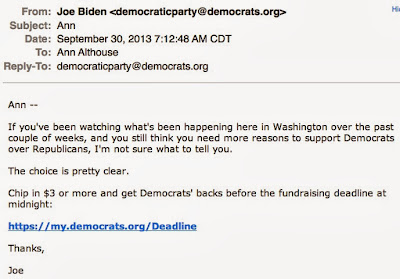
He just emailed me yesterday. Back off, Government Man!
And don't make me the bogus subject of your communication. This is not about me, but you think I'm so doggedly self-interested that I get jazzed up by email purporting to be about me?
"If you've been watching what's been happening here in Washington over the past couple of weeks..."
Well, I haven't. I've been averting my eyes.
"... and you still think you need more reasons to support Democrats over Republicans, I'm not sure what to tell you."
Yesterday's email was about how Biden "can't understand" what Republicans are doing, and today's email is about how Biden doesn't know what to say to anyone who doesn't already agree with him.
I must be on the Democratic Party's special email list of Perpetually Puzzled People, and somehow it's been decided that the best name to slap on the "From" line in email to the PPP is Joe Biden.
Friday, September 20, 2013
"In Venezuela, 17 women have died in the past 12 months as a result of liquid silicone buttock injections."
"The procedure, which according to Jesus Pereira, the president of the Veneuzelan Plastic Surgeons Association, an estimated 30 percent of Venezuelan women aged 18 to 50 have undergone, attempts to achieve a figure thought to be more attractive to Venezuelan men...."
You know, you could save yourself a lot of pain and $2,000 if you just went on a liquid diet, which you still have to do along with the pain and $2,000.
On the other hand, it's less of an intrusion and expenditure than the stomach surgery people submit to, so there's that. And how about those Venezuelan women and the things they do to be more attractive to Venezuelan men?
These injections are the latest in a long list of extreme beauty procedures in this beauty-obsessed country. Other extreme self-improvement methods include fasting pacts among friends, vomit-inducing syrup, and most recently the sewing of a plastic patch onto the tongue, which renders the consumption of solid food extremely painful....Enough about the buttocks. Let's take a look at that tongue.
Launched in 2009 by Beverly Hills plastic surgeon Nikolas Chugay, the patch is secured to the tongue with six stitches in a $2,000 procedure that takes just ten minutes.As one patient said: 'It hurt... I'm like, Christ it does work, I can't eat!"
You know, you could save yourself a lot of pain and $2,000 if you just went on a liquid diet, which you still have to do along with the pain and $2,000.
On the other hand, it's less of an intrusion and expenditure than the stomach surgery people submit to, so there's that. And how about those Venezuelan women and the things they do to be more attractive to Venezuelan men?
Wednesday, September 4, 2013
"Marijuana grower killed — and nearly decapitated — by booby trap he set to protect plants."
"Police say Daniel Rickett was drunkenly riding a quad bike when he ran into his own piano wire trap. Hikers found the 50-year-old's body lying near four large plants."
All that to protect 4 plants?!
Here's a recent segment of "This American Life" about the extent of marijuana growing in Mendocino County, California:
ADDED: Some answers to that last questions here. For the millions of acres of national forests, the federal government is regarded as a property owner:
All that to protect 4 plants?!
Here's a recent segment of "This American Life" about the extent of marijuana growing in Mendocino County, California:
A few years ago, Mendocino County Sheriff Tom Allman was trying to find a way to deal with the proliferation of marijuana in his county. Allman wanted to spend less time dealing with growers who were growing small, legal amounts, so he could focus on other problems — including criminals who run massive marijuana farms in the Mendocino National Forest....By "legal amounts," they mean not illegal under state law. The "legal amount" is 20 plants. The giant operations consume many acres of federal land (complete with irrigation systems and pesticides). Why don't the feds police their own land?
ADDED: Some answers to that last questions here. For the millions of acres of national forests, the federal government is regarded as a property owner:
When the ownership of a piece of land, government land, is considered proprietary, the government is said to have taken over none of the state's obligations for law enforcement. In other words, state and local law enforcement officers still handle calls for service as if the land were privately owned. The sheriff or city police will respond and they'll handle calls without regard to the property's ownership.But the federal government can use its legislative power to regulate this land, which isn't something private landowners can do, and it could choose to take over the law enforcement if it wanted. Given the scale of the "massive marijuana farms" — protected by armed guards who shoot at ordinary people who traipse about in the forest — you'd think the feds would take responsibility. It seems crazy for local police to handle that, and it's the federal government's marijuana policy, in conflict with what many states are trying to do, that's the foundation of the problem.
Wednesday, August 28, 2013
"They're not from here; they're tourists... They don't even speak English. They were very confused. "
"They had no idea how they wound up on the bridge," said the cop.
"I don't know how that would happen," said tourist Mike Norton to ABC. "They give you a little training before. They tell you don't take any bridges. I don't know what would possess you to take the bridge!"Meanwhile: "Lost Tourist assumes all these people are in the wrong place not the other way around."
Friday, August 23, 2013
Martin Manley's suicide website.
Yahoo took it down, his sister thinks it should be put back up — that photo at the link is not the sister, btw — and the group known as Anonymous has put the whole thing up.
So I went over there (to the link at the line) and read some of Manley's suicide website. Some. Not all. It's quite long. Multipaged. You'd think someone that chatty wouldn't be so impatient with the way life is not over yet. So why did he kill himself? I still don't know! And I skimmed a few pages, including "Why suicide?"
Some people are afraid a website like that will encourage suicide. It encouraged me to wisecrack that if I had to read this whole thing, I'd kill myself. But that's just it. You don't have to read the whole thing. And you won't be lured into Martin Manley's little world of suicide. I don't think. I predict, if you browse around over there, before you figure out what his point was, you'll get bored and click back into the real world, the world where life goes on, and you can always think of something better to do than check out early.
Monday, August 19, 2013
"'The word Messiah is a title and it's a title that has only been earned by one person and that one person is Jesus Christ,' Judge Ballew said."
"The word Judge is a title that should not apply to anyone who would ever say that in a ruling."
Yes, and also "Judge" could be a name — Judge Reinhold — and other "titles" are used as names. I think of Prince Rogers Nelson and Sargent Shriver. And Earl Butz.
It is confusing and invites jokes. A bad idea. I don't recommend it. But not everything inadvisable is a legal issue, and the Jesus-is-the-one argument is blatantly wrong.
Interestingly, the Judge in the Messiah incident changed the baby's name to Martin. I was going to add "Dean" as another title that is used as a name and is therefore confusing. But isn't it more confusing to name the kid Martin, since if he ever acquires the title Dean, he'll be Dean Martin, which was the joke of a name used for the Dean in Rodney Dangerfield's "Back to School"?
Tuesday, August 13, 2013
Young Cory Booker — groping women or appeasing women?
The Daily Caller, apparently hungry to make Cory Booker look bad, has an article with the headline "In college column, Cory Booker revealed time he groped friend, and she resisted." I think we're supposed to find it significant that when he was 15 and making out with a willing partner, on a bed, he put his hand on her breast and she rejected the move. This is nothing, of course, but it's something not because he "groped" a girl, but because he used the incident, years later, to score with women.
He was at Stanford, in peak feminist times — post-Anita Hill, pre-Monica Lewinsky — and the column was titled "So Much for Stealing Second." In the manner of the time, he told his "own personal story" to "make a point" and "make people think":
The Daily Caller writer, Charles C. Johnson, was probably a child when Booker wrote that column. Johnson doesn't seem to understand the context at all. Or maybe he understands and he's just shamelessly appropriating this material to launch the rumor that Booker is a sex offender. Is Johnson dumb or malicious? The result is malicious, but I suspect Johnson is dumb, because look at this:
I got to Johnson's nonsense via Instapundit who teased it with "Reverse the sexes and there's no story here." But there is no story here! Instapundit quotes 2 sentences of Johnson's and repeats the words "groped" and "grabbed" to refer to what the 15-year-old did to the girl's breast. But Booker writes of a very slow and gentle move of a hand toward the breast of a female who had intruded on him with "an overwhelming kiss" when he'd offered her a hug at midnight on New Year's Eve. So actually, the sexes were reversed, and Instapundit — in the midst of his sarcasm about how we overlook female sexual aggression — overlooked female sexual aggression.
If anyone was assaulted, it was Booker: "As the ball dropped, I leaned over to hug a friend and she met me instead with an overwhelming kiss." Then: "As we fumbled upon the bed, I remember debating my next 'move' as if it were a chess game." He was 15, fumbling, and thinking about chess. How old was she? How did they get to that bed? Booker was using what he had to make his feminist points to Stanford women in 1992. He had nothing, but he made something out of nothing for rhetorical purposes to lecture college men about how they ought to behave toward women.
If he did anything wrong, it's that he sought so earnestly to please women, adapting to the preferences they seemed to express, first, by trying to perform appropriately for the woman who imposed "an overwhelming kiss" on him and, then, by trying to talk the talk of the college feminists.
He was at Stanford, in peak feminist times — post-Anita Hill, pre-Monica Lewinsky — and the column was titled "So Much for Stealing Second." In the manner of the time, he told his "own personal story" to "make a point" and "make people think":
“When grandiose statements entrenched in politically correct terminology are made, many may listen but few will hear,” Booker continued. “When I hesitated in writing this column, I realized I was basking in hypocrisy. So instead I chose to write and risk.”Booker the 15-year-old may have been awkward, but Booker the college student is slick, speaking to his female peers the way they wanted. Eschew abstractions and grandiosity. Confess your male transgressions. Within the 1992 feminist environment, getting personal — "risking" — was the inroad to favor. He expresses regret about his susceptibility to "messages that sex was a game, a competition," and he'd seen getting the hand onto the breast as reaching "second base." Ironically, he was still trying to score with women, this time the college women, and admitting that he thought of sex as a game was a way to compete in the new game.
The Daily Caller writer, Charles C. Johnson, was probably a child when Booker wrote that column. Johnson doesn't seem to understand the context at all. Or maybe he understands and he's just shamelessly appropriating this material to launch the rumor that Booker is a sex offender. Is Johnson dumb or malicious? The result is malicious, but I suspect Johnson is dumb, because look at this:
"After having my hand pushed away once, I reached my ‘mark,’” Booker wrote.His "mark" was obviously the breast. The column is titled "So Much for Stealing Second." I know these kids today have relabeled the bases, but how can you not understand what "mark" means in that context? Or does Johnson understand but maliciously intend to insinuate that Booker reached some other part of the woman? Clue to Johnson: Third base was fondling the genitals, and to get the penis into the vagina was to reach home.
Booker didn’t elaborate on what his “mark” was, but whatever happened, it was enough to haunt him for years to come.
I got to Johnson's nonsense via Instapundit who teased it with "Reverse the sexes and there's no story here." But there is no story here! Instapundit quotes 2 sentences of Johnson's and repeats the words "groped" and "grabbed" to refer to what the 15-year-old did to the girl's breast. But Booker writes of a very slow and gentle move of a hand toward the breast of a female who had intruded on him with "an overwhelming kiss" when he'd offered her a hug at midnight on New Year's Eve. So actually, the sexes were reversed, and Instapundit — in the midst of his sarcasm about how we overlook female sexual aggression — overlooked female sexual aggression.
If anyone was assaulted, it was Booker: "As the ball dropped, I leaned over to hug a friend and she met me instead with an overwhelming kiss." Then: "As we fumbled upon the bed, I remember debating my next 'move' as if it were a chess game." He was 15, fumbling, and thinking about chess. How old was she? How did they get to that bed? Booker was using what he had to make his feminist points to Stanford women in 1992. He had nothing, but he made something out of nothing for rhetorical purposes to lecture college men about how they ought to behave toward women.
If he did anything wrong, it's that he sought so earnestly to please women, adapting to the preferences they seemed to express, first, by trying to perform appropriately for the woman who imposed "an overwhelming kiss" on him and, then, by trying to talk the talk of the college feminists.
Saturday, August 10, 2013
"In what will surely go down in history as one the greatest architectural blunders..."
"... the town of Benidorm in Alicante, Spain, had almost completed its 47-story skyscraper when it realized it excluded plans for elevator shafts."
And I thought the blunder was that the building looks like a giant pair of pants. No elevators, eh?
ADDED: Apparently, the blunder is only looking like a giant pair of pants.
And I thought the blunder was that the building looks like a giant pair of pants. No elevators, eh?
ADDED: Apparently, the blunder is only looking like a giant pair of pants.
Wednesday, August 7, 2013
Most Embarrassing Sentence in Major Media, 2013.
And the first nominee is:
But hanging in the air was an electrifying sense of being in the presence of an ascendant politician they believed understood the potential of the new digital world they were shaping.
Sunday, June 30, 2013
Strange ideas of the paranormal.
My Google alert on "roadside memorial" turned up this item at examiner.com:

I've already blogged about the underlying story (as another in my long series of posts about makeshift death-site memorials). This post is about the mistake of putting the story under the already stupid "astrology & paranormal" tag. Did somebody at the Examiner think actual ghosts — to the extent that makes any sense — were involved? Like, maybe it was some college town variation on the old "Ghost Riders in the Sky" legend:
But back to "Ghost Riders." Here are the lyrics. I'd love parody lyrics applicable to apparitions of college-town bike riders.

I've already blogged about the underlying story (as another in my long series of posts about makeshift death-site memorials). This post is about the mistake of putting the story under the already stupid "astrology & paranormal" tag. Did somebody at the Examiner think actual ghosts — to the extent that makes any sense — were involved? Like, maybe it was some college town variation on the old "Ghost Riders in the Sky" legend:
"(Ghost) Riders in the Sky: A Cowboy Legend" is a country and cowboy-style song [that] tells a folk tale of a cowboy who has a vision of red-eyed, steel-hooved cattle thundering across the sky, being chased by the spirits of damned cowboys. One warns him that if he does not change his ways, he will be doomed to join them, forever "trying to catch the Devil's herd across these endless skies."Here's Marty Robbins singing the song. Or if you prefer: Johnny Cash. Or here it is by the singer who possesses the voice that is the first singing voice that I ever heard and thought: This is the greatest voice ever. I must have been about 4 years old at the time, considering the year that the greatest recording ever — as I saw it — came out (1955).
But back to "Ghost Riders." Here are the lyrics. I'd love parody lyrics applicable to apparitions of college-town bike riders.
Subscribe to:
Posts (Atom)