If Republicans happen to gain six or more Senate seats in 2014, and with them a Senate majority, it’s very likely they will simply bottle up most judicial nominations in committee, not even allowing floor votes.... That’s after the 2014 elections. In 2016, in addition to another shot at Senate control, Republicans certainly could win back the White House....So... panic mode along with making it really really obvious that Supreme Court Justices are partisan ideologues? Great set-up for the 2014 elections that you're so afraid your side will lose.
Showing posts with label Supreme Court. Show all posts
Showing posts with label Supreme Court. Show all posts
Friday, November 29, 2013
At the Washington Post, pressure on Justices Ginsburg and Breyer to retire.
"There’s absolutely no question about it; if they want to secure the principles they have fought for during their careers, the best thing both of these senior liberal justices can do is to retire right now...."

Tuesday, November 26, 2013
"The Supreme Court announced today that it will hear arguments in a case challenging Obamacare's birth control coverage requirement on religious freedom grounds."
"Obamacare's employer mandates are at issue in the case, which involves whether corporations and religious institutions themselves enjoy the same First Amendment [sic] rights as individuals," says a Breaking News email from CNN.
AND: Note that the claim is based not on the Constitution, but on the Religious Freedom Restoration Act, a federal statute. Congress can change the statute. That counts heavily in my book.
Among the plaintiffs is Hobby Lobby, a nationwide chain of about 500 for-profit arts and crafts stores. David Green and his family are the owners, and say their Christian beliefs clash with parts of the law's mandates for comprehensive coverage. They say some of the drugs that would be provided prevent human embryos from being implanted in a woman's womb, which the Greens equate to abortion.ADDED: Full CNN story here.
AND: Note that the claim is based not on the Constitution, but on the Religious Freedom Restoration Act, a federal statute. Congress can change the statute. That counts heavily in my book.
Tuesday, November 19, 2013
The much-admired November 14th interview with Clarence Thomas — now on YouTube.
Discussed previously here, linking to an Above the Law item that is now titled "Justice Clarence Thomas Speaks!" but was previously titled "Justice Clarence Thomas Speaks — And Oh What A Speech!"
I'm going to guess that the "And Oh What A Speech!" part got dropped not because ATL wanted to back away from expressing enthusiasm but because it's not a speech. It's an interview. And part of what's good about it is that the interviewer 7th Circuit Judge Diane S. Sykes is excellent. The gushing over Thomas deprived Sykes of her share of the gushing.
Now, I don't like what's left of the title — "Justice Clarence Thomas Speaks!" — because it redirects our attention to a favorite liberal media meme about Thomas: He doesn't speak at oral argument. But you can easily look up his reason for that. It's been observed and discussed many times. And Clarence Thomas frequently speaks outside of the oral argument setting, so I don't like the hey-who-knew-the-guy-could-speak snark — which is what we're left with once the "And Oh What A Speech!" is lopped off.
Anyway, the fact is, this is an excellent 50 minutes of conversation, and thanks to The Federalist Society for putting it up.
Friday, November 15, 2013
"There are a lot of briefs, and people doing a lot of talking. I mean, it’s law."
Clarence Thomas said about the work of the Supreme Court.
He also said:
He also said:
Even the most boring cases are fascinating to me…. I love the cloistered life — I was in the seminary. I love my law clerks. I have this wonderful work to do.And, as summarized by David Lat:
Justice Thomas is patient enough to wait for history to catch up with him, comparing some of his jurisprudence to “a fine wine — it just needs aging.” He noted that it took the first Justice Harlan, author of the great dissent in Plessy v. Ferguson, sixty years to be vindicated.
Wednesday, October 16, 2013
When Nina Totenberg is calling affirmative action "racial preferences," affirmative action is in trouble.
Here's her report — at the NPR website — on yesterday's oral argument in a case she doesn't mention the name of but which I happen to know is Schuette v. Coalition to Defend Affirmative Action. This is the case where the people of Michigan — after the Supreme Court approved of the University of Michigan Law School's use of race in admissions — amended their constitution to require that the state "not discriminate against, or grant preferential treatment to, any individual or group on the basis of race, sex, color, ethnicity, or national origin." Another way to put that is to say: The state constitution bans affirmative action.
Under U.S. Supreme Court case law, affirmative action in university admissions does not violate the Equal Protection Clause of the U.S. Constitution when it is done in a way that is narrowly tailored to the compelling interest in the benefits of classroom diversity. In Schuette, the question is not whether the university can choose not to have a policy of affirmative action, but whether the policy against affirmative action can be put in the state constitution — where, as a political matter, it becomes difficult to change. The idea is: 1. The political process has been restructured along racial lines, and 2. That restructuring violates Equal Protection.
It's a difficult argument to make, since it sounds like choosing equality imposes inequality, but there are a couple old cases upon which to build. I just want to focus here on Totenberg's (perhaps) careless adoption of the state's characterization of affirmative action as "racial preferences." Boldface added:
If that way of thinking is lost, affirmative action is doomed.
Under U.S. Supreme Court case law, affirmative action in university admissions does not violate the Equal Protection Clause of the U.S. Constitution when it is done in a way that is narrowly tailored to the compelling interest in the benefits of classroom diversity. In Schuette, the question is not whether the university can choose not to have a policy of affirmative action, but whether the policy against affirmative action can be put in the state constitution — where, as a political matter, it becomes difficult to change. The idea is: 1. The political process has been restructured along racial lines, and 2. That restructuring violates Equal Protection.
It's a difficult argument to make, since it sounds like choosing equality imposes inequality, but there are a couple old cases upon which to build. I just want to focus here on Totenberg's (perhaps) careless adoption of the state's characterization of affirmative action as "racial preferences." Boldface added:
Students seeking to enact or get rid of other preferences can lobby the regents, [the ACLU's Mark] Rosenbaum observed. But racial minorities cannot lobby for reinstatement of consideration of race in college and university admissions decisions. Moreover, he said, to get back their preferences, minority students would have to embark on a difficult and multimillion-dollar campaign to re-amend the state constitution in a state that is more than three-quarters white.So there's Justice Breyer saying it too. Perhaps Totenberg picked up the cue from him. It seems to me, if you want affirmative action to be accepted as important, good, and — as we say in legal doctrine — compelling, you don't want to encourage the habit of thinking of it as preferences, which seem to be special benefits that some people get because of their race. You want people to think in terms of taking into account all of the many factors that play a role in the university's practicing of a subtle art of composing a student body with a marvelously fine-textured, beneficial-to-all diversity.
Also arguing against the referendum was lawyer Shanta Driver. Justice Stephen Breyer posed this hypothetical to her: Most cities have "a vast number of administrators" of all kinds of programs. Suppose an administrator of one project decides to adopt a racial preference, for a good reason, but then the city council votes to abolish that preference. Would that be unlawful?
"No," replied Driver. Breyer pressed on, asking "Where's the line?" How do you avoid giving every individual administrator the power "to decide on his own whether to use racial preferences without a possibility of a higher-up veto?"
If that way of thinking is lost, affirmative action is doomed.
Tuesday, October 15, 2013
"The affirmative-action case liberals deserve to lose."
By Emily Bazelon, who is a liberal, at Slate, which is liberal (so this isn't some conservative fakely "helping" liberals see the light, in the style of articles like "Do Yourselves a Favor, Republican/Raise the debt limit high enough that we don't have to debate it again until after your primaries," a teaser on the front page of Slate right now).
I'm very interested to hear about this morning's argument in the case Bazelon is previewing, Schuette v. Coalition to Defend Affirmative Action. The argument against the Michigan constitution's ban on affirmative action in education is so abstruse that no article aimed at laypersons can explain it. Bazelon does a creditable job — at paragraphs 4-6 at the link — but I've repeatedly read (and taught) the strange cases that the argument is based on, and I've seen year after year of law students struggling just to see what the Court was saying in those cases, which must be further extended to reject the Michigan ban. If the Supreme Court embraces that argument, people won't understand why, and it will help conservatives in 2014 and 2016.
Which is why I read Bazelon's "liberals deserve to lose" as "liberals should want to lose."
I'm very interested to hear about this morning's argument in the case Bazelon is previewing, Schuette v. Coalition to Defend Affirmative Action. The argument against the Michigan constitution's ban on affirmative action in education is so abstruse that no article aimed at laypersons can explain it. Bazelon does a creditable job — at paragraphs 4-6 at the link — but I've repeatedly read (and taught) the strange cases that the argument is based on, and I've seen year after year of law students struggling just to see what the Court was saying in those cases, which must be further extended to reject the Michigan ban. If the Supreme Court embraces that argument, people won't understand why, and it will help conservatives in 2014 and 2016.
Which is why I read Bazelon's "liberals deserve to lose" as "liberals should want to lose."
Saturday, October 12, 2013
When does someone who's selling services as a "psychic" deserve to be prosecuted for committing a crime?
In NYC, the government prosecuted a fortune teller — Sylvia Mitchell, 39 — who worked in some storefront in Greenwich Village. The jury convicted her and she could be sentenced to as much as 15 years in prison. The charges were larceny and a scheme to defraud.
Here's the classic U.S. Supreme Court case on when unbelievable beliefs can form the basis for a criminal prosecution for fraud: United States v. Ballard. The majority opinion — written by William O. Douglas — says the question needs to be whether the criminal defendant actually believed his own bullshit. (The defendants were faith healers.)
During a weeklong trial, prosecutors portrayed Ms. Mitchell as a clever swindler who preyed on distraught people, promising them that she could alleviate their troubles through prayer and meditation to remove what she called “negative energy” and rectify problems that arose from their “past lives.”In my book, this is entertainment and unconventional psychological therapy. Let the buyer beware. Who's dumb enough to actually believe this? Should the government endeavor to protect everyone who succumbs to the temptation to blow a few bucks on a fortune teller? But this was a case where there were a couple victims who somehow had enough money to make their losses nontrivial. One woman gave Mitchell $27,000 in what was portrayed as an "exercise in letting go of money." Another put $18,000 in a jar as a way to relieve herself of "negative energy."
Both women admitted on the stand under cross-examination that they were deeply skeptical of Ms. Mitchell’s techniques, but paid her anyway, suggesting that they were never tricked into thinking the psychic had the power to better their lives, [Mitchell's lawyer] said.In Stupid World, no one can hear facts screaming.
But an assistant district attorney, James Bergamo, described Ms. Mitchell as an expert at discovering people’s vulnerabilities and scaring them into handing over their cash. It mattered little, he argued in his summation, if Ms. Mitchell’s clients believed what she said about their past lives or negative spirits: the important fact was that they believed she would return their money. “The facts scream scam,” he said.
Here's the classic U.S. Supreme Court case on when unbelievable beliefs can form the basis for a criminal prosecution for fraud: United States v. Ballard. The majority opinion — written by William O. Douglas — says the question needs to be whether the criminal defendant actually believed his own bullshit. (The defendants were faith healers.)
Men may believe what they cannot prove. They may not be put to the proof of their religious doctrines or beliefs. Religious experiences which are as real as life to some may be incomprehensible to others. Yet the fact that they may be beyond the ken of mortals does not mean that they can be made suspect before the law. Many take their gospel from the New Testament. But it would hardly be supposed that they could be tried before a jury charged with the duty of determining whether those teachings contained false representations. The miracles of the New Testament, the Divinity of Christ, life after death, the power of prayer are deep in the religious convictions of many. If one could be sent to jail because a jury in a hostile environment found those teachings false, little indeed would be left of religious freedom. The Fathers of the Constitution were not unaware of the varied and extreme views of religious sects, of the violence of disagreement among them, and of the lack of any one religious creed on which all men would agree. They fashioned a charter of government which envisaged the widest possible toleration of conflicting views. Man's relation to his God was made no concern of the state. He was granted the right to worship as he pleased and to answer to no man for the verity of his religious views. The religious views espoused by respondents might seem incredible, if not preposterous, to most people. But if those doctrines are subject to trial before a jury charged with finding their truth or falsity, then the same can be done with the religious beliefs of any sect. When the triers of fact undertake that task, they enter a forbidden domain.Justice Jackson, dissenting, thought it was wrong even to ask whether the defendant believes his own purported beliefs. I'm wracking my brain for a judicial opinion I love more than what Jackson says here, and I can't think of one, so let me give you the whole thing, replete with my boldface and commentary:
I should say the defendants have done just that for which they are indicted. If I might agree to their conviction without creating a precedent, I cheerfully would do so. I can see in their teachings nothing but humbug, untainted by any trace of truth. But that does not dispose of the constitutional question whether misrepresentation of religious experience or belief is prosecutable; it rather emphasizes the danger of such prosecutions.Jackson confesses to the temptation to jump to what feels like the right outcome in this case, but he pulls back into the proper judicial role of following rules that should apply across the board.
The Ballard family claimed miraculous communication with the spirit world and supernatural power to heal the sick. They were brought to trial for mail fraud on an indictment which charged that their representations were false and that they 'well knew' they were false. The trial judge, obviously troubled, ruled that the court could not try whether the statements were untrue, but could inquire whether the defendants knew them to be untrue; and, if so, they could be convicted.The quote, the footnote says, can be found in James's "Collected Essays and Reviews," and Jackson would also like us to read James's "Varieties of Religious Experience" and "The Will to Believe" as well as Burton's (delightfully titled) "Heyday of a Wizzard." (Those last 2 links will get you to free Kindle editions.)
I find it difficult to reconcile this conclusion with our traditional religious freedoms.
In the first place, as a matter of either practice or philosophy I do not see how we can separate an issue as to what is believed from considerations as to what is believable. The most convincing proof that one believes his statements is to show that they have been true in his experience. Likewise, that one knowingly falsified is best proved by showing that what he said happened never did happen. How can the Government prove these persons knew something to be false which it cannot prove to be false? If we try religious sincerity severed from religious verity, we isolate the dispute from the very considerations which in common experience provide its most reliable answer.
In the second place, any inquiry into intellectual honesty in religion raises profound psychological problems. William James, who wrote on these matters as a scientist, reminds us that it is not theology and ceremonies which keep religion going. Its vitality is in the religious experiences of many people. 'If you ask what these experiences are, they are conversations with the unseen, voices and visions, responses to prayer, changes of heart, deliverances from fear, inflowings of help, assurances of support, whenever certain persons set their own internal attitude in certain appropriate ways.'
If religious liberty includes, as it must, the right to communicate such experiences to others, it seems to me an impossible task for juries to separate fancied ones from real ones, dreams from happenings, and hallucinations from true clairvoyance. Such experiences, like some tones and colors, have existence for one, but none at all for another. They cannot be verified to the minds of those whose field of consciousness does not include religious insight. When one comes to trial which turns on any aspect of religious belief or representation, unbelievers among his judges are likely not to understand and are almost certain not to believe him.The quote is from "The Will to Belief."
And then I do not know what degree of skepticism or disbelief in a religious representation amounts to actionable fraud. James points out that 'Faith means belief in something concerning which doubt is theoretically possible.'
Belief in what one may demonstrate to the senses is not faith. All schools of religious thought make enormous assumptions, generally on the basis of revelations authenticated by some sign or miracle. The appeal in such matters is to a very different plane of credulity than is invoked by representations of secular fact in commerce. Some who profess belief in the Bible read literally what others read as allegory or metaphor, as they read Aesop's fables. Religious symbolism is even used by some with the same mental reservations one has in teaching of Santa Claus or Uncle Sam or Easter bunnies or dispassionate judges.That's the best subtly-tucked-away little joke in all of the Supreme Court reporters: dispassionate judges.
It is hard in matters so mystical to say how literally one is bound to believe the doctrine he teaches and even more difficult to say how far it is reliance upon a teacher's literal belief which induces followers to give him money.You see what the danger is: discrimination against little-known and little-appreciated religions. If you start going after the scams, when will you stop? It is better not to start at all. Leave them all alone.
There appear to be persons—let us hope not many—who find refreshment and courage in the teachings of the 'I Am' cult. If the members of the sect get comfort from the celestial guidance of their 'Saint Germain,' however doubtful it seems to me, it is hard to say that they do not get what they pay for. Scores of sects flourish in this country by teaching what to me are queer notions. It is plain that there is wide variety in American religious taste. The Ballards are not alone in catering to it with a pretty dubious product.
The chief wrong which false prophets do to their following is not financial. The collections aggregate a tempting total, but individual payments are not ruinous. I doubt if the vigilance of the law is equal to making money stick by over-credulous people. But the real harm is on the mental and spiritual plane. There are those who hunger and thirst after higher values which they feel wanting in their humdrum lives. They live in mental confusion or moral anarchy and seek vaguely for truth and beauty and moral support. When they are deluded and then disillusioned, cynicism and confusion follow. The wrong of these things, as I see it, is not in the money the victims part with half so much as in the mental and spiritual poison they get. But that is precisely the thing the Constitution put beyond the reach of the prosecutor, for the price of freedom of religion or of speech or of the press is that we must put up with, and even pay for, a good deal of rubbish.He's right.
Prosecutions of this character easily could degenerate into religious persecution. I do not doubt that religious leaders may be convicted of fraud for making false representations on matters other than faith or experience, as for example if one represents that funds are being used to construct a church when in fact they are being used for personal purposes. But that is not this case, which reaches into wholly dangerous ground. When does less than full belief in a professed credo become actionable fraud if one is soliciting gifts or legacies? Such inquiries may discomfort orthodox as well as unconventional religious teachers, for even the most regular of them are sometimes accused of taking their orthodoxy with a grain of salt.
I would dismiss the indictment and have done with this business of judicially examining other people's faiths.
Wednesday, October 9, 2013
Hey, remember civility?
I remember when liberals were pushing civility in public discourse. I made the tag "civility bullshit" for this topic right away, because I knew it was bullshit, and this morning it seems that everywhere I look on the web, I'm seeing inflammatory rhetoric from liberals. Here are 3 things I happened to see first thing today:
1. "Right-wing nutjobs’ last stand: The debt limit endgame arrives/As the debt limit deadline approaches, conservatives are trotting out the real nonsense. The fantasy is almost over." That's a headline at Salon for an article by Brian Beutler. Apparently, at Salon, they think news analysis is just fine when it calls leaders in the political party they disapprove of "right-wing nutjobs." Does Beutler deserve that presentation? I don't know. Maybe Salon is just fighting for clicks in this crazy world.
2. And here's President Obama, the man who lectured us about civil discourse after the Tucson massacre, talking about the shutdown/debt ceiling problem, and he's using crime as a metaphor: "Think about it this way... The American people do not get to demand a ransom for doing their jobs." Why should we think about it that way? We're supposed to see the Republicans as kidnapping... I don't know... somebody. The Republicans are elected members of Congress, which makes the decisions about spending. They're having a hell of a time getting through this decision, but what makes it crime-like? The comments at that link, which goes to the NYT, pick up the President's cue. One comment — a NYT pick, highly rated by readers — begins: "President Obama is right. He should not be forced to negotiate with a rope around his neck." Suddenly, the metaphor is lynching.
3. "Will the Supreme Court Allow the Richest Donors to Corrupt American Politics Even More?" That's a front-page teaser at Slate leading to "Poor Little Rich Guys/The Supreme Court clamors to protect the right of Richie Rich, Scrooge McDuck, and the Koch brothers to further corrupt American politics." The article is by Dahlia Lithwick, who's been describing Supreme Court oral arguments for years. She's reporting on yesterday's argument in McCutcheon v. Federal Election Commission, which is a challenge to the limit on how much a person can donate to various candidates. It's not about how much you can give to any single candidate, just the ceiling on total contributions, when you're spreading money around to many candidates. (The limit is $48,600 every 2 years.) Richie Rich? Scrooge McDuck? Will Slate allow the stupidest bullshit to erode American minds even more?
You know who's also rich? In addition to those characters from comic books that Baby Boomers read when they were children? The owners of the Washington Post and the New York Times. How about a law that puts a ceiling on how much they are allowed to spend putting out their political speech? Poor little rich guys. Boo hoo. Who cares? Fuck them, she said, sarcastically.
1. "Right-wing nutjobs’ last stand: The debt limit endgame arrives/As the debt limit deadline approaches, conservatives are trotting out the real nonsense. The fantasy is almost over." That's a headline at Salon for an article by Brian Beutler. Apparently, at Salon, they think news analysis is just fine when it calls leaders in the political party they disapprove of "right-wing nutjobs." Does Beutler deserve that presentation? I don't know. Maybe Salon is just fighting for clicks in this crazy world.
2. And here's President Obama, the man who lectured us about civil discourse after the Tucson massacre, talking about the shutdown/debt ceiling problem, and he's using crime as a metaphor: "Think about it this way... The American people do not get to demand a ransom for doing their jobs." Why should we think about it that way? We're supposed to see the Republicans as kidnapping... I don't know... somebody. The Republicans are elected members of Congress, which makes the decisions about spending. They're having a hell of a time getting through this decision, but what makes it crime-like? The comments at that link, which goes to the NYT, pick up the President's cue. One comment — a NYT pick, highly rated by readers — begins: "President Obama is right. He should not be forced to negotiate with a rope around his neck." Suddenly, the metaphor is lynching.
3. "Will the Supreme Court Allow the Richest Donors to Corrupt American Politics Even More?" That's a front-page teaser at Slate leading to "Poor Little Rich Guys/The Supreme Court clamors to protect the right of Richie Rich, Scrooge McDuck, and the Koch brothers to further corrupt American politics." The article is by Dahlia Lithwick, who's been describing Supreme Court oral arguments for years. She's reporting on yesterday's argument in McCutcheon v. Federal Election Commission, which is a challenge to the limit on how much a person can donate to various candidates. It's not about how much you can give to any single candidate, just the ceiling on total contributions, when you're spreading money around to many candidates. (The limit is $48,600 every 2 years.) Richie Rich? Scrooge McDuck? Will Slate allow the stupidest bullshit to erode American minds even more?
You know who's also rich? In addition to those characters from comic books that Baby Boomers read when they were children? The owners of the Washington Post and the New York Times. How about a law that puts a ceiling on how much they are allowed to spend putting out their political speech? Poor little rich guys. Boo hoo. Who cares? Fuck them, she said, sarcastically.
Tuesday, October 8, 2013
The Supreme Court oral argument today in the federal campaign finance law limiting total contributions an individual may make to various candidates.
Adam Liptak thinks the Court is divided "along familiar ideological lines" and "prepared to strike down" the law:
UPDATE: Adam Liptak emails to say: "I meant to signal that he was saying the opposite of what he meant. The quoted words standing alone would mislead the casual reader. It also seemed to me to capture his tone." I know that was the function of the adverb, but it seems to me that the NYT is continually nudging us to view Scalia as mean/nasty... and I was having a little fun with it.
“By having these limits, you are promoting democratic participation,” Justice Ruth Bader Ginsburg said. “Then the little people will count some.”Scalia responded "sarcastically." Why an adverb for Scalia's statement and not for Ginsburg's? It seems biased not to spread the adverbs around on both sides of the "familiar ideological line." Journalism should be judged by the fairness of the distribution of adverbs.
Justice Antonin Scalia responded, sarcastically, that he assumed “a law that only prohibits the speech of 2 percent of the country is O.K.”
UPDATE: Adam Liptak emails to say: "I meant to signal that he was saying the opposite of what he meant. The quoted words standing alone would mislead the casual reader. It also seemed to me to capture his tone." I know that was the function of the adverb, but it seems to me that the NYT is continually nudging us to view Scalia as mean/nasty... and I was having a little fun with it.
Monday, October 7, 2013
What Justice Scalia really means when he says he believes in the Devil.
About halfway her wonderful interview with Justice Scalia, after some discussion of homosexuality in legal and in Catholic doctrine, Jennifer Senior pushes the old judge to worry about how history will look back on his era of the Court. The first prompt — "Justice Kennedy is now the Thurgood Marshall of gay rights" — gets merely a nod. She tries again, with another non-question: "I don’t know how, by your lights, that’s going to be regarded in 50 years." He says doesn't know and he doesn't care:
Scalia has shifted from the topic of Kennedy's legacy to his own and — declining to guess what the people of the future will think — he says: "When I’m dead and gone, I’ll either be sublimely happy or terribly unhappy."
That is, he pulls Senior back to the perhaps-more-comfortable topic of religion. She obliges, asking him if he believes in heaven and hell, which he does, and they go back and forth about who goes where, and then, as she proceeds to a new topic — "your drafting process" — he pulls her back again: "I even believe in the Devil."
Asked for evidence of the Devil lately, Scalia says:
Senior wants to know whether it's "terribly frightening to believe in the Devil." He says:
Maybe the world is spinning toward a wider acceptance of homosexual rights, and here’s Scalia, standing athwart it.Some might hear "standing athwart" homosexual rights and get an amusingly unintentionally sexual picture of Scalia straddling gay men. But I assume it's an allusion to William F. Buckley's famous 1955 mission statement for The National Review: "It stands athwart history, yelling Stop, at a time when no one is inclined to do so, or to have much patience with those who so urge it." The topic was history, you know. And who else says "standing athwart"?
Scalia has shifted from the topic of Kennedy's legacy to his own and — declining to guess what the people of the future will think — he says: "When I’m dead and gone, I’ll either be sublimely happy or terribly unhappy."
That is, he pulls Senior back to the perhaps-more-comfortable topic of religion. She obliges, asking him if he believes in heaven and hell, which he does, and they go back and forth about who goes where, and then, as she proceeds to a new topic — "your drafting process" — he pulls her back again: "I even believe in the Devil."
You do?He's already connected his Catholicism to the accession to the authority of Catholic doctrine. The devil is in the doctrine, he's Catholic, and ergo, he believes in the Devil.
Of course! Yeah, he’s a real person. Hey, c’mon, that’s standard Catholic doctrine! Every Catholic believes that.
Asked for evidence of the Devil lately, Scalia says:
You know, it is curious. In the Gospels, the Devil is doing all sorts of things. He’s making pigs run off cliffs, he’s possessing people and whatnot. And that doesn’t happen very much anymore....Later, he asks Senior if she's read "The Screwtape Letters," and not having read "The Screwtape Letters" in decades, I'm not sure if he's lifting these nifty observations from C.S. Lewis or not.
What he’s doing now is getting people not to believe in him or in God. He’s much more successful that way.
Senior wants to know whether it's "terribly frightening to believe in the Devil." He says:
You’re looking at me as though I’m weird. My God! Are you so out of touch with most of America, most of which believes in the Devil? I mean, Jesus Christ believed in the Devil! It’s in the Gospels! You travel in circles that are so, so removed from mainstream America that you are appalled that anybody would believe in the Devil! Most of mankind has believed in the Devil, for all of history. Many more intelligent people than you or me have believed in the Devil.He seems to be trying to get a reaction out of her, because she defends with: "I hope you weren’t sensing contempt from me. It wasn’t your belief that surprised me so much as how boldly you expressed it." He says:
I was offended by that. I really was.She doesn't grasp his statement or at least what she says next indicates that she didn't. She says: "I’m sorry to have offended you," as if he was an ordinary person taking offense, when in fact, he's cracking a joke. The joke is to point at her surprise at his bold expression. It was a subtle way to say: Hey, I thought I was famous for bold expression! But he's not so bold — or so bad a comedian — as to redo a joke to drive it home. Either you get it or you don't. He moves forward. Here's where he brings up "The Screwtape Letters," which she says she's read. He says:
So, there you are. That’s a great book.That suggests all the interesting things he's throwing out about the Devil are ideas in or closely tracking that book he likes.
It really is, just as a study of human nature.And there you are. He believes in the Devil not just, perhaps, because he yields to the authority of a religion of dogma and authority, but he believes in the Devil because the Devil is a literary device for exploring human nature, and how can we not believe in human nature and literature?
Which state attorneys general "were throwing away important points of law, not just for their state, but for the other 49"?
In his New York Magazine interview, Justice Scalia says that these days, when the states have cases in the Supreme Court, they send in "people who know how to conduct appellate argument." But:
Tellinghuisen was only prepared to talk about the 21st Amendment as a limit on the Spending Power. There's an argument in an amicus brief from the National Conference of State Legislatures that O'Connor pushes Tellinghuisen to use, about how related the condition needs to be to the spending, and Tellinghuisen says he's "not prepared to argue that particular fine point." His case is about a condition that relates to the sale of liquor, so he's all about the amendment that preserves state legislative power in that area, as if all that matters is winning this particular case — which he didn't — and not about the doctrine that will apply to many other cases in the future.
In the 7-to-2 opinion in Dole, written by Chief Justice Rehnquist, we see that the thrown away point in a footnote (boldface added):
In the old days, it would be the attorney general—usually an elected attorney general. And if he gets a case into the Supreme Court [pumps his fist], he’s going to argue it himself! Get the press and whatnot. Some of them were just disasters. They were throwing away important points of law, not just for their state, but for the other 49.Who, specifically, do you think he might have been talking about there? I'll tell you who I thought of when I read that: Roger A. Tellinghuisen, the Attorney General for the state of South Dakota, whose argument in South Dakota v. Dole — the key case about Congress's power to attach conditions to spending — threw away an important point of law that could have limited the spending power. For years, when I teach that case, I've urged students to listen to that argument as a lesson in what not to do.
Tellinghuisen was only prepared to talk about the 21st Amendment as a limit on the Spending Power. There's an argument in an amicus brief from the National Conference of State Legislatures that O'Connor pushes Tellinghuisen to use, about how related the condition needs to be to the spending, and Tellinghuisen says he's "not prepared to argue that particular fine point." His case is about a condition that relates to the sale of liquor, so he's all about the amendment that preserves state legislative power in that area, as if all that matters is winning this particular case — which he didn't — and not about the doctrine that will apply to many other cases in the future.
In the 7-to-2 opinion in Dole, written by Chief Justice Rehnquist, we see that the thrown away point in a footnote (boldface added):
Our cases have not required that we define the outer bounds of the "germaneness" or "relatedness" limitation on the imposition of conditions under the spending power. Amici urge that we take this occasion to establish that a condition on federal funds is legitimate only if it relates directly to the purpose of the expenditure to which it is attached. See Brief for National Conference of State Legislatures et al. as Amici Curiae 10. Because petitioner has not sought such a restriction, see Tr. of Oral Arg. 19-21, and because we find any such limitation on conditional federal grants satisfied in this case in any event, we do not address whether conditions less directly related to the particular purpose of the expenditure might be outside the bounds of the spending power.The Court found spending on highway construction sufficiently related to the age at which a person is allowed to buy alcohol. Dissenting, Justice O'Connor said:
When Congress appropriates money to build a highway, it is entitled to insist that the highway be a safe one. But it is not entitled to insist as a condition of the use of highway funds that the State impose or change regulations in other areas of the State's social and economic life because of an attenuated or tangential relationship to highway use or safety. Indeed, if the rule were otherwise, the Congress could effectively regulate almost any area of a State's social, political, or economic life on the theory that use of the interstate transportation system is somehow enhanced.What an astounding missed opportunity to limit conditional spending!
I was going to make a list titled 9 Things Justice Scalia said in his New York Magazine interview.
Most interviews with Supreme Court Justices are not even worth that. The Justices say such predictable things that I might pull out the most interesting thing or, not finding one, I skip blogging it altogether. But this interview by Jennifer Senior is so good (and long) that as I read it (before getting out of bed just now) I decided I'd pull out 9 items (the number 9 pops into my head when I'm thinking about Supreme Court Justices) and do something like:
1. He calls DVDs "CDs" (and the "CDs" in question are episodes of "Seinfeld").
2. He thinks "blurbing" on the internet is narcissistic and interferes with the process of becoming a good writer.
3. He's most proud of his opinion in Morrison v. Olson (where he's the lone dissenter in the decision that found the Independent Counsel law constitutional).
4. He thinks Congress is truly dangerous — if only it would actually use the powers it has.
5. He's not "a fan of different levels of scrutiny" in constitutional interpretation.
6. He believes in the Devil, because it's Catholic doctrine, but maybe because it's a helpful metaphor.
7. He plays poker, claims to be good at poker, but is unfamiliar with the term "tell."
8. He has friends that he knows or "very much suspect[s]" are homosexual, and doesn't like the interviewer's suggestion that — re homosexuality — he's "softened."
9. To imitate Rehnquist, he "turns his nose up theatrically, flutters his hand in dismissal."
There are more than 9 things worth treating that way...
10. You have to be very careful picking law clerks because "one dud will ruin your year."
11. His dissents have the tone they do — "breezy" and with "some thrust" — because they're written for law students and law students will read that sort of thing.
12. Back in the 80s, Supreme Court opinions were loaded with the "garbage" of legislative history (and they're not anymore, and he takes credit for that).
13. He wants the Catholic Church to be more evangelistic.
14. He blames "The Gipper" for turning the State of the Union Address into the "childish spectacle" it's become.
15. He likes Bill Bennett's radio show.
16. He won't read The Washington Post anymore because it became so "shrilly, shrilly liberal" that he can't "handle it."
17. The worst thing about the Constitution, he thinks, is that it's way too hard to amend it.
18. He "repudiate[s]" his old statement that his originalism is "fainthearted."
But I decided (at the point of finally getting out of bed) that I wanted to do a series of posts on a number of topics, taking them on individually and blogging — or blurbing — my way through and going somewhere with the idea. It's the Devil topic in particular that made me want to do that. I know there are people who are linking to this interview just to say Scalia believes in the Devil, but — is the Devil making me do this? — I feel there's a lot in his discussion of the Devil that needs to be taken apart and examined. The blog will blurb and burble.
ADDED: Here's the promised Devil post. And here's a post about a topic that isn't represented on that list of 18 things.
1. He calls DVDs "CDs" (and the "CDs" in question are episodes of "Seinfeld").
2. He thinks "blurbing" on the internet is narcissistic and interferes with the process of becoming a good writer.
3. He's most proud of his opinion in Morrison v. Olson (where he's the lone dissenter in the decision that found the Independent Counsel law constitutional).
4. He thinks Congress is truly dangerous — if only it would actually use the powers it has.
5. He's not "a fan of different levels of scrutiny" in constitutional interpretation.
6. He believes in the Devil, because it's Catholic doctrine, but maybe because it's a helpful metaphor.
7. He plays poker, claims to be good at poker, but is unfamiliar with the term "tell."
8. He has friends that he knows or "very much suspect[s]" are homosexual, and doesn't like the interviewer's suggestion that — re homosexuality — he's "softened."
9. To imitate Rehnquist, he "turns his nose up theatrically, flutters his hand in dismissal."
There are more than 9 things worth treating that way...
10. You have to be very careful picking law clerks because "one dud will ruin your year."
11. His dissents have the tone they do — "breezy" and with "some thrust" — because they're written for law students and law students will read that sort of thing.
12. Back in the 80s, Supreme Court opinions were loaded with the "garbage" of legislative history (and they're not anymore, and he takes credit for that).
13. He wants the Catholic Church to be more evangelistic.
14. He blames "The Gipper" for turning the State of the Union Address into the "childish spectacle" it's become.
15. He likes Bill Bennett's radio show.
16. He won't read The Washington Post anymore because it became so "shrilly, shrilly liberal" that he can't "handle it."
17. The worst thing about the Constitution, he thinks, is that it's way too hard to amend it.
18. He "repudiate[s]" his old statement that his originalism is "fainthearted."
But I decided (at the point of finally getting out of bed) that I wanted to do a series of posts on a number of topics, taking them on individually and blogging — or blurbing — my way through and going somewhere with the idea. It's the Devil topic in particular that made me want to do that. I know there are people who are linking to this interview just to say Scalia believes in the Devil, but — is the Devil making me do this? — I feel there's a lot in his discussion of the Devil that needs to be taken apart and examined. The blog will blurb and burble.
ADDED: Here's the promised Devil post. And here's a post about a topic that isn't represented on that list of 18 things.
Tuesday, October 1, 2013
"The Supreme Court, returning from its summer recess, on Tuesday granted review of 8 new cases..."
SCOTUSblog reports. One case is a copyright dispute over the screenplay for Raging Bull (which came out in 1980).
For a moment there, I thought I'd failed to notice that the first Monday in October had come up again. (Why were there not a bunch of Supreme Court preview stories?) But it's not Monday. It's Tuesday, and the first day in October, so the first Monday is next Monday. The court is just back, amusingly enough on the first day of the federal government shutdown, which is all very abstruse.
For a moment there, I thought I'd failed to notice that the first Monday in October had come up again. (Why were there not a bunch of Supreme Court preview stories?) But it's not Monday. It's Tuesday, and the first day in October, so the first Monday is next Monday. The court is just back, amusingly enough on the first day of the federal government shutdown, which is all very abstruse.
Sunday, September 29, 2013
"How Edith Windsor fell in love, got married, and won a landmark case for gay marriage."
A great article by Ariel Levy. Worth subscribing to The New Yorker to get access. I had The New Yorker in audio podcast form, and this article inspired me to subscribe to the print edition. It begins:
"Fuck the Supreme Court!” Edith Windsor said, one hideously hot morning in June, when she’d had just about enough. Then she sighed and mumbled, “Oh, I don’t mean that.” What she really meant was that she was hot, she was tired of waiting, and, most of all, she was tired of being told what to do. “I’m feeling very manhandled!” she said.There's some excellent material about lawyering, including getting the right plaintiff as the face of the issue. One "experienced movement attorney" explains that "Women are better than men" and "post-sexual is better than young." Windsor was not just female and presumably "aged out of carnality," but, we're told, didn't "look gay."
It was Windsor’s eighty-fourth birthday, and she was spending it staring at a laptop screen as information from scotusblog.com flashed by in a typeface too small for her to read comfortably. Four years earlier, Windsor’s partner of more than forty years, Thea Spyer, died, leaving Windsor her sole heir. The two were legally married in Canada, in 2007, but, because of the Defense of Marriage Act, Windsor was not eligible for the exemption on estate tax that applies to husbands and wives. She had to pay $363,053 in taxes to the federal government, and $275,528 to New York State, and she did not think that was fair.
Her pink lipstick and pearls would make it easier, [her lawyer Roberta] Kaplan knew, for people across the country to feel that they understood her, that she embodied values they could relate to.Some movement lawyer types thought Windsor was the wrong plaintiff because she was too rich, and her legal problem was a problem of a rich person. Who owes $600,000 in taxes? What kind of civil rights movement forefronts suffering of that kind?
"There were these calls," Kaplan said. "These people from Lambda were like, 'We really think that bankruptcy is the perfect venue to challenge DOMA,' because they had a bankruptcy case they wanted to bring. Finally, I couldn't stand it. I said, 'Really? I don't want to be disrespectful or classist, but do you really think that people who couldn't pay their personal debts are the best people to bring the claim?"...
Kaplan was convinced that Americans dislike taxes even more than they dislike the rich...
Saturday, September 28, 2013
Googling in the theater.
Remember when Pee Wee Herman got arrested for masturbating in a movie theater? That was long ago. It must have been before home video, because why go to a theater to masturbate? Exposure? The thrill of potential discovery? A need for just the right degree of intimacy with others? Because once pornography is subject only to boring disapproval from bland people, one must look for another way to feel that you're doing something titillatingly wrong?
But today, the transgression is Googling in the theater. Googling, long ago, could have been a slang term for masturbating. (Are you googling again?!) But those days are past. Googling is research, and research in the theater is a subversive activity.
From Professor Meltsner's essay about the play "Arguendo," discussed in the previous post:
While others went off to pee or to sip a glass of wine, I stayed put and read. (To be honest, I wasn't doing research on the internet. Reception was bad where we were in the woods, and I have a Shakespeare app on my iPhone.)
More from Meltsner's essay:
I'm Googling and searching in the text of "Rosencrantz and Guildenstern," looking for "meaning." Literally. I'm searching on the word "meaning" to get some snappy way to bring this post in for a landing.
Aha! Guildenstern is talking about "the meaning of order" and how if we "happened to discover, or even suspect, that our spontaneity was part of their order, we'd know we be lost." He refers to the Chinese philosopher who "dreamed he was a butterfly, and from that moment he was never quite sure that he was not a butterfly dreaming it was a Chinese philosopher." There's a pause and then Rosencrantz jumps up and shouts "Fire!"
Well, that's convenient for bringing this post in for a landing — a joke about a Supreme Court text about shouting fire in a crowded theater. Here, let me Google that for you.
Guildenstern says "Where?" and Rosencrantz says: "It's all right — I'm demonstrating the misuse of free speech. To prove it exists." He looks at us, the audience, and obviously we are sitting there, unreacting, the suspension of disbelief having secured our disbelief in the possibility of a fire. Rosencrantz says: "Not a move. They should burn to death in their shoes."
But today, the transgression is Googling in the theater. Googling, long ago, could have been a slang term for masturbating. (Are you googling again?!) But those days are past. Googling is research, and research in the theater is a subversive activity.
From Professor Meltsner's essay about the play "Arguendo," discussed in the previous post:
[The play] is replete with jargon and enough insider's free expression law that even many lawyers in the audience were grabbing smart phones to do some instant Googling.Do they Google during the performance or wait until intermission? It happens that I was using my iPhone during intermissions at a play last night. We saw "Rosencrantz and Guildenstern Are Dead" at the American Players Theatre, and since we hadn't taken the opportunity the theatre offers this summer to freshen up our knowledge of "Hamlet," there were passages of "Hamlet" I wanted to read to go along with "Rosencrantz and Guildenstern," which is a play that has 2 minor characters from "Hamlet" dealing with their situation in that larger story that they witness only in fragments.
While others went off to pee or to sip a glass of wine, I stayed put and read. (To be honest, I wasn't doing research on the internet. Reception was bad where we were in the woods, and I have a Shakespeare app on my iPhone.)
More from Meltsner's essay:
What did I expect from a play based not so much on the story of an important law case but on the particularized verbal event that is a Court argument in such a case? Plainly the Company wasn't interested in turning out teaching materials for those like me who train advocates but, then, Collins was advised by all-star legal journalist Emily Bazelon and law professor and Broadway producer Nicholas Rosenkranz...There's a name: Rosenkranz. Pure coincidence that I should trip over that this morning. No meaning.
I'm Googling and searching in the text of "Rosencrantz and Guildenstern," looking for "meaning." Literally. I'm searching on the word "meaning" to get some snappy way to bring this post in for a landing.
Aha! Guildenstern is talking about "the meaning of order" and how if we "happened to discover, or even suspect, that our spontaneity was part of their order, we'd know we be lost." He refers to the Chinese philosopher who "dreamed he was a butterfly, and from that moment he was never quite sure that he was not a butterfly dreaming it was a Chinese philosopher." There's a pause and then Rosencrantz jumps up and shouts "Fire!"
Well, that's convenient for bringing this post in for a landing — a joke about a Supreme Court text about shouting fire in a crowded theater. Here, let me Google that for you.
Guildenstern says "Where?" and Rosencrantz says: "It's all right — I'm demonstrating the misuse of free speech. To prove it exists." He looks at us, the audience, and obviously we are sitting there, unreacting, the suspension of disbelief having secured our disbelief in the possibility of a fire. Rosencrantz says: "Not a move. They should burn to death in their shoes."
"Arguendo" — a play with the text lifted from a Supreme Court oral argument about free speech and nude dancing.
At the Public Theater until the end of October. From a review in NY Magazine by Scott Brown (presumably not the political dreamboat Scott Brown)(links added by me):
From the NY Post review of the play:
HuffPo has a lawprof's cogitations. It's Michael Meltsner, who uses Barnes in his teaching of oral advocacy (and who wrote a book called "Race, Rape, and Injustice: Documenting and Challenging Death Penalty Cases in the Civil Rights Era").
I hope you like the link I did — up there in the first indented block of text — on "briefs of all sorts go flying." That was the most literally apt image from a Google search on "flying underpants." But something urges me to show you this too:

What is Sting saying via flight-themed underpants? The eloquence of his expression escapes the banks of chaos in my mind.
In 80 dizzy minutes of towering, tottering legalese, hilariously atrocious wigs and highly athletic swivel-chair-ballet, five performer-creators... do the seemingly impossible: They make the Rehnquist Court feel as intellectually rigorous as The Muppet Show. (And I mean that flatteringly, with respect to The Muppet Show.)...That review could use a rewrite. Maximum sexual innuendo or children's puppet show analogy: Pick one.
Guided by conceiver-director John Collins and aided by the endlessly creative video projections... the ensemble teases out the muffled passions and inarticulable absurdities throbbing beneath the intellectual chessmatch of [Barnes v. Glen Theatre Inc.]—is this an obscenity case? Is dance really “expression”? “Why do they call this place a ‘bookstore’?”—and crystallize the justices as characters without resorting to direct caricature.... The black-robed sages literally circle Indiana Attorney General Uhl (played by Williams and Knight) and respondent attorney Ennis (Iveson), swooping down like vultures one minute, creeping up like Skeksis the next, depending on the line of attack.... The whole nature of expression is called into question in the uninhibited finale, where briefs of all sorts go flying.... The show’s ultimate thrust is a bit of a feint, but the legal term “arguendo” translates colloquially to “for the sake of argument,” not “to conclude definitively and forcefully.”... [A]s a friend of mine used to say, “to reach a conclusion is to limit the potential of argument.”

From the NY Post review of the play:
Since the case revolves the issue of defining nude dancing as a means of communication, Collins seems to extend the discussion to the idea of theater itself. Can you turn any document into a play, even a law case? Can actors jumping and yelling seemingly randomly qualify as a show, and does nudity make that much of a difference?He takes takes off his underpants to nail the argument.
Lo and behold, [the actor playing the lawyer for the strip club] strips to a golden thong, black socks and dress shoes. Then he takes off the thong.
HuffPo has a lawprof's cogitations. It's Michael Meltsner, who uses Barnes in his teaching of oral advocacy (and who wrote a book called "Race, Rape, and Injustice: Documenting and Challenging Death Penalty Cases in the Civil Rights Era").
Alas, while the production presents the legal arguments of two knowledgeable advocates, it is replete with jargon and enough insider's free expression law that even many lawyers in the audience were grabbing smart phones to do some instant Googling. Collins has chosen neither to dignify the ideas expressed by the lawyers nor use them as a take off point for a serious exploration of a culture that debates at the highest levels the constitutional value of public nudity before consenting adults.Ooh. Ow.
That would all by perfectly ok if the result was really funny but too often the text has been saddled by distracting black robbed justices swivel chairing around the stage, enough voices overriding voices to suggest a confusing Tower of Babel in what for all its faults is a process that in the real world aims at clarity and a chaotic display of less than beautiful frontal nudity.
I hope you like the link I did — up there in the first indented block of text — on "briefs of all sorts go flying." That was the most literally apt image from a Google search on "flying underpants." But something urges me to show you this too:
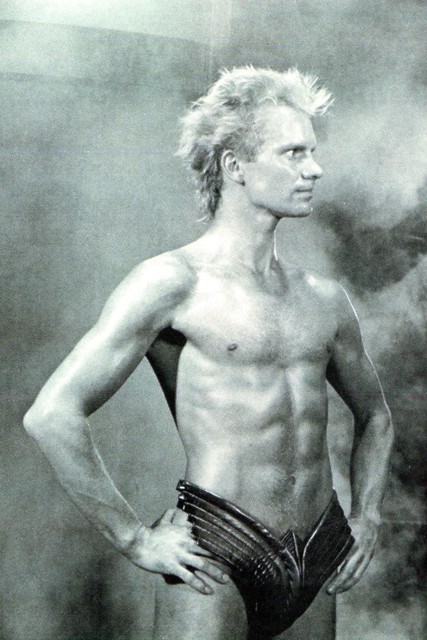
What is Sting saying via flight-themed underpants? The eloquence of his expression escapes the banks of chaos in my mind.
Poets, priests and politiciansAnd lawyers and judges...
Have words to thank for their positionsWhen words tie you up and rape you, say it with — or without — underpants. Sing a song. Sting a thong.
Words that scream for your submission
And no one's jamming their transmission
'Cos when their eloquence escapes you
Their logic ties you up and rapes you
Sunday, September 22, 2013
"It would be terrible for our democracy … if one politician could directly solicit $3.6 million from a single donor."
"That is 70 times the median income for an American family. It would mean a tiny, tiny group of donors would wield unprecedented power and influence," says an election law expert from a liberal advocacy group, quoted by David Savage in an L.A. Times piece titled "Supreme Court may strike new blow to campaign funding laws/The Supreme Court, in a new campaign funding case, may lift a lid on the total the wealthy can give to all candidates and parties."
In recent [Supreme Court] opinions, [Chief Justice John] Roberts has said the government may not try to "level the playing field" between candidates or prevent well-funded candidates from using their financial advantage to dominate the airwaves. The only justification for limiting contributions, the court has said, is to prevent "corruption or the appearance of corruption."...
"This is a limit on how many candidates you support, not on how much you give them," said James Bopp Jr., an attorney for the Republican National Committee. He cites the case of McCutcheon, an Alabama man who gave a total of $33,000 to various Republican candidates for Congress last year and wanted to give $21,000 more. He was stopped by the legal limit on total contributions to candidates, which now stands at $48,600.
McCutcheon "holds firm convictions on the proper role of government" and "opposes numerous and ill-conceived and overreaching laws," he told the court, and he wants more "federal officeholders who share his beliefs."
Sunday, August 25, 2013
Why is the NYT publishing yet another article on the fact that Justice Ginsburg is not resigning from the Supreme Court?
I was a bit surprised to see this article, with a big picture, at the top center of the NYT on-line front page today. It's utter non-news. So what's the point? She did an interview with Adam Liptak, but just last June, we'd heard the same thing, in the pages of the NYT, from Linda Greenhouse.
Let's look at Liptak's article as opposed to the front-page teaser, which says: "Amid calls from some liberals that she step down in time for President Obama to name her successor, Justice Ruth Bader Ginsburg said she was fully engaged in her work." Think about why that is the teaser. But Liptak is writing because he got an interview:
So. Onto the substance of the interview:
The article goes on to talk about the Lilly Ledbetter Fair Pay Act of 2009, which was a congressional response to Ledbetter v. Goodyear Tire and Rubber Company, in which Ginsburg dissented. She notes that there were 2 Title VII case this past term, but that Congress is unlikely to reverse them by statute, because, she says, "this Congress doesn’t seem to be able to move on anything," and: "In so many instances, the court and Congress have been having conversations with each other, particularly recently in the civil rights area.... So it isn’t good when you have a Congress that can’t react."
Do you see Liptak's sleight of hand there? He went from her characterization of the Court as activist because of its "readiness to overturn legislation," to the idea of legislation overturning a court decision, but Congress can't overturn a decision that "overturns" legislation, and Ledbetter wasn't a case that overturned legislation! Ledbetter was an interpretation of a statute, so Congress was free to amend it and did. To interpret a statute isn't to overturn it. It's to read it, and Congress can change the text if it doesn't like that reading. It's not "activist" to decline to give an expansive interpretation to a statute, which is what Ginsburg wanted in her Ledbetter dissent.
When a statute is overturned because it's inconsistent with the Constitution, you can call that "activist" or you can call that meeting a judicial duty, but you can't go to Congress to get that decision overturned. [NOTE: Congress can initiate a constitutional amendment, and there are sometimes ways to rewrite a statute to solve a constitutional problem. I don't think Ginsburg was referring to that.]
Ginsburg does display some resistance to activism with respect to constitutional rights:
In my Constitutional Law II exam last spring, written before the Supreme Court's decision in Windsor, I began a question this way (boldface added):
Let's look at Liptak's article as opposed to the front-page teaser, which says: "Amid calls from some liberals that she step down in time for President Obama to name her successor, Justice Ruth Bader Ginsburg said she was fully engaged in her work." Think about why that is the teaser. But Liptak is writing because he got an interview:
Unless they have a book to sell, Supreme Court justices rarely give interviews. Justice Ginsburg has given several this summer, perhaps in reaction to calls from some liberals that she step down in time for President Obama to name her successor.So maybe Ginsburg is talking because of political pressure about Obama's appointment opportunities, but I find that hard to believe. She's obviously not talking about that, so it's an editorial insertion, and it's therefore what the NYT editors think will pique the interest of readers. To me, a reader, it seemed really dumb, flaunting the nonnewsiness of the article. Here's another Obama-related insertion:
Were Mr. Obama to name Justice Ginsburg’s successor, it would presumably be a one-for-one liberal swap that would not alter the court’s ideological balance. But if a Republican president is elected in 2016 and gets to name her successor, the court would be fundamentally reshaped.In case you didn't know!
So. Onto the substance of the interview:
“I am now the most senior justice when we divide 5-4 with the usual suspects,” she said.What if it's measured in terms of acceptance of the duty to enforce the Constitution? That's a trick question. Answer: It's the same thing! (And that makes this post another occasion for my favorite tag: Paraphrase.)
The last two terms... were... “heady, exhausting, challenging.”
“[I]f it’s measured in terms of readiness to overturn legislation, this is one of the most activist courts in history.”
The article goes on to talk about the Lilly Ledbetter Fair Pay Act of 2009, which was a congressional response to Ledbetter v. Goodyear Tire and Rubber Company, in which Ginsburg dissented. She notes that there were 2 Title VII case this past term, but that Congress is unlikely to reverse them by statute, because, she says, "this Congress doesn’t seem to be able to move on anything," and: "In so many instances, the court and Congress have been having conversations with each other, particularly recently in the civil rights area.... So it isn’t good when you have a Congress that can’t react."
Do you see Liptak's sleight of hand there? He went from her characterization of the Court as activist because of its "readiness to overturn legislation," to the idea of legislation overturning a court decision, but Congress can't overturn a decision that "overturns" legislation, and Ledbetter wasn't a case that overturned legislation! Ledbetter was an interpretation of a statute, so Congress was free to amend it and did. To interpret a statute isn't to overturn it. It's to read it, and Congress can change the text if it doesn't like that reading. It's not "activist" to decline to give an expansive interpretation to a statute, which is what Ginsburg wanted in her Ledbetter dissent.
When a statute is overturned because it's inconsistent with the Constitution, you can call that "activist" or you can call that meeting a judicial duty, but you can't go to Congress to get that decision overturned. [NOTE: Congress can initiate a constitutional amendment, and there are sometimes ways to rewrite a statute to solve a constitutional problem. I don't think Ginsburg was referring to that.]
Ginsburg does display some resistance to activism with respect to constitutional rights:
She said that as a general matter the court would be wise to move incrementally and methodically. It had moved too fast, she said, in Roe v. Wade, the 1973 decision that established a constitutional right to abortion. The court could have struck down only the extremely restrictive Texas law before it.Hmm. Why not?! I'm guessing it's because Roe v. Wade is already decided. Nothing she can do will change that. The same-sex marriage issue is not yet completely resolved, and she will, in most likelihood, participate. That's a reason to simply refuse to talk about it, but I suspect, in addition to that, she will embrace the right with even more breadth and confidence than the Court in Roe v. Wade accepted abortion. This notion of allowing the difficult matter to be worked out in the political process... she won't make a connection.
“I think it’s inescapable that the court gave the anti-abortion forces a single target to aim at,” she said. “The unelected judges decided this question for the country, and never mind that the issue was in flux in the state legislatures.”
The question of same-sex marriage is also in flux around the nation. In June, the court declined to say whether there was a constitutional right to same-sex marriage, allowing the issue to percolate further. But Justice Ginsburg rejected the analogy to the lesson she had taken from the aftermath of the Roe decision.
“I wouldn’t make a connection,” she said.
***
In my Constitutional Law II exam last spring, written before the Supreme Court's decision in Windsor, I began a question this way (boldface added):
Here’s a section from one of the briefs in United States v. Windsor, the case in which the Supreme Court is considering whether a section of the Defense of Marriage Act is unconstitutional.Of course, Justice Ginsburg didn't agree with the side that wrote that. She showed — to use her definition of activism, above — a readiness to overturn legislation.The benefits of our federalist system resonate with especial clarity regarding the same-sex marriage debate…
Preemptively short-circuiting the democratic process by announcing only one permissible policy choice by any government under the Constitution destroys these benefits and should not occur unless the Constitution clearly mandates the legitimacy of only one outcome. The Nation's experience in the wake of Roe v. Wade bears this out. See Ruth Bader Ginsburg, Some Thoughts on Autonomy and Equality in Relation to Roe v. Wade, (remarking that Roe has "sparked public opposition and academic criticism, in part . . . because the Court ventured too far in the change it ordered and presented an incomplete justification for its action). J. Harvie Wilkinson, III, Of Guns, Abortions, and the Unraveling Rule of Law, (observing that Roe "shut down this process of legislative accommodation, polarizing the debate and making future compromise more difficult," leading "[m]any scholars" to comment on the "Roe backlash" and the intense partisan divide that has resulted).
Outrage in the wake of Roe occurred despite increasing public support for abortion and a "marked trend in state legislatures 'toward liberalization of abortion statutes."' Ruth Bader Ginsburg, Speaking in a Judicial Voice (quoting Roe v. Wade); see also Thoughts on Autonomy ("The political process was moving in the early 1970s, not swiftly enough for advocates of quick, complete change, but majoritarian institutions were listening and acting."). But the Court's "[h]eavy-handed judicial intervention was difficult to justify and appears to have provoked, not resolved, conflict." Thoughts on Autonomy, supra, at 385-86. Unlike the Court's previous decisions concerning gender classifications, Roe provoked backlash because it "invited no dialogue with legislators" and "seemed entirely to remove the ball from the legislators' court." Judicial Voice, supra, at 1205.
Not only did Roe produce conflict, it was also an ineffective engine of social change. The Court's abrupt adjustment of national policy "may have prevented state legislatures from working out long-lasting solutions based upon broad public consensus." Cass R. Sunstein, Three Civil Rights Fallacies. Professor Sunstein observed that Roe's effectiveness "has been limited, largely because of its judicial source."
Monday, July 1, 2013
"Public Approval of Supreme Court Falls to All-Time Low."
A new Rasmussen Poll.
[J]ust 28% believe the Supreme Court is doing a good or an excellent job. At the same time, 30% rate its performance as poor. That’s the highest-ever poor rating. It’s also the first time ever that the poor ratings have topped the positive assessments. Thirty-nine percent (39%) give the court middling reviews and rate its performance as fair....
Friday, June 28, 2013
"Bert and Ernie clearly love each other."
But does Ernie suck Bert’s cock? I don't think so.

IN THE COMMENTS: Rabel said: "As I understand my puppets, that's Elmo's job."
ADDED: I remember when it was considered awful for Jerry Falwell to perceive Tinky Winky as gay.
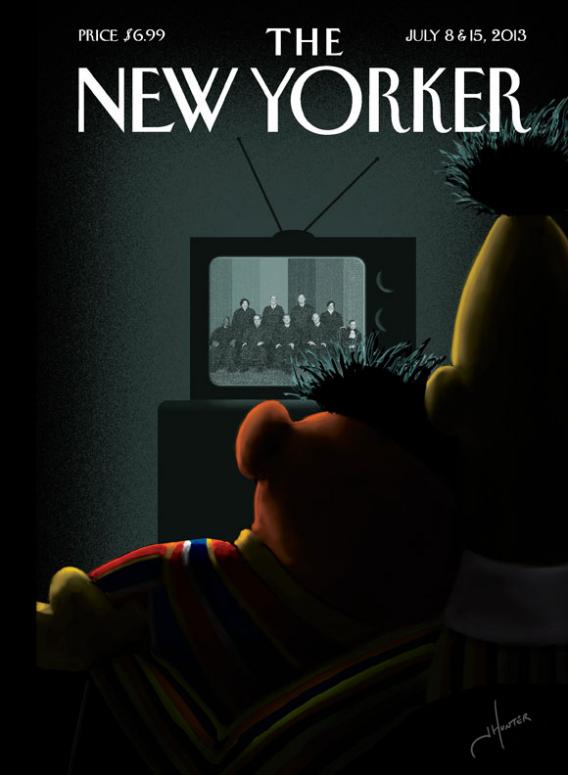
IN THE COMMENTS: Rabel said: "As I understand my puppets, that's Elmo's job."
ADDED: I remember when it was considered awful for Jerry Falwell to perceive Tinky Winky as gay.
Subscribe to:
Posts (Atom)