We're giving $5,000 to couples with the best ideas for how they'll cross state lines to tie the knot. Do you and your special someone have a great idea? Enter for your chance to win or vote for your favorite couple!
Showing posts with label same-sex marriage. Show all posts
Showing posts with label same-sex marriage. Show all posts
Tuesday, December 10, 2013
"We at the ACLU are chipping in to help 5 same-sex couples have a Big, Gay, (Il)legal Wedding..."
"...to highlight the unfair patchwork of state marriage laws and why it's so important for everyone to have the freedom to marry."

Monday, December 9, 2013
The 10 finalists for Time's Person of the Year.
I know. I hate getting suckered into this annual nonsense, but the list presents some interesting options"
Scratch Hassan Rouhani. He hassan done enough yet.
It's not going to be Barack Obama. He's already won — repeatedly — right? And he was barely there this year, never around when anything was happening. I might accept a jocular nod to The Absence of Barack Obama, because that metaphysical being has been everywhere, involved in everything.
As for Kathleen Sebelius, that's ridiculous. If they were at all thinking of giving it to her, they should have switched to one of those nameless, faceless type of "persons" like The Endangered Earth (1988) or You (2006) or The Whistleblowers (2002) and give it to The Uninsured, The Young Invincibles, The Coders, or The Bugs or something.
It's not going to be Jeff Bezos, because he already won, even if that's hard to remember because it was so last century. 1999.
An entertainer has never won, so there's zero chance that the first one will be Miley Cyrus. Popes have won, but I think it's a bit early to go with another Pope yet, unless the Time folk are itching to play Obama's recently attempted income inequality theme. I think that would be shabby, so I say no.
That leaves Edith Windsor, Ted Cruz, and Edward Snowden. I think Edith Windsor is most likely, because: 1. She gives Time a chance to pick an individual woman, something they've done — embarrassing! — only once before. (It was Corazon C. Aquino, in 1986.) 2. She's a good figurehead for same-sex marriage and gay rights, which were very big this year. 3. It lets Time vary the usual focus on politics, economics, and foreign affairs.
There's Ted. Dear sweet, crazy, everyone-hates-him Ted. If Time is smelling blood and wants to punch around a conservative, the man to pick on is definitely Ted Cruz.
Edward Snowden is an interesting choice, but I don't think it helps Obama to create an occasion for everyone to focus on the NSA problem. Yeah, it's a distraction from healthcare.gov, but does Obama want help in that form? This is a 4th reason to go with Edith Windsor: Gay marriage is a subject that casts a flattering light on Obama.
So we have a winner, don't you think? Edith Windsor.
Bashar Assad, President of SyriaIt's not going to be Assad. If we were going to do Bad Guy persons of the year, somebody more dramatically bad would have won recently, like Osama bin Laden or Saddam Hussein. It would be pathetic to reward Assad with that kind of attention. What about Vladimir Putin? He's not even on the list of finalists, probably because he's already won, back in 2007.
Jeff Bezos, Amazon Founder
Ted Cruz, Texas Senator
Miley Cyrus, Singer
Pope Francis, Leader of the Catholic Church
Barack Obama, President of the United States
Hassan Rouhani, President of Iran
Kathleen Sebelius, Secretary of Health and Human Services
Edward Snowden, N.S.A. Leaker
Edith Windsor, Gay rights activist
Scratch Hassan Rouhani. He hassan done enough yet.
It's not going to be Barack Obama. He's already won — repeatedly — right? And he was barely there this year, never around when anything was happening. I might accept a jocular nod to The Absence of Barack Obama, because that metaphysical being has been everywhere, involved in everything.
As for Kathleen Sebelius, that's ridiculous. If they were at all thinking of giving it to her, they should have switched to one of those nameless, faceless type of "persons" like The Endangered Earth (1988) or You (2006) or The Whistleblowers (2002) and give it to The Uninsured, The Young Invincibles, The Coders, or The Bugs or something.
It's not going to be Jeff Bezos, because he already won, even if that's hard to remember because it was so last century. 1999.
An entertainer has never won, so there's zero chance that the first one will be Miley Cyrus. Popes have won, but I think it's a bit early to go with another Pope yet, unless the Time folk are itching to play Obama's recently attempted income inequality theme. I think that would be shabby, so I say no.
That leaves Edith Windsor, Ted Cruz, and Edward Snowden. I think Edith Windsor is most likely, because: 1. She gives Time a chance to pick an individual woman, something they've done — embarrassing! — only once before. (It was Corazon C. Aquino, in 1986.) 2. She's a good figurehead for same-sex marriage and gay rights, which were very big this year. 3. It lets Time vary the usual focus on politics, economics, and foreign affairs.
There's Ted. Dear sweet, crazy, everyone-hates-him Ted. If Time is smelling blood and wants to punch around a conservative, the man to pick on is definitely Ted Cruz.
Edward Snowden is an interesting choice, but I don't think it helps Obama to create an occasion for everyone to focus on the NSA problem. Yeah, it's a distraction from healthcare.gov, but does Obama want help in that form? This is a 4th reason to go with Edith Windsor: Gay marriage is a subject that casts a flattering light on Obama.
So we have a winner, don't you think? Edith Windsor.
Monday, December 2, 2013
"I will vote against because I think that the referendum is not a festival of democracy, but a festival of oppression against a minority..."
... said one Croation who voted "no" on the question "Do you agree that marriage is matrimony between a man and a woman?" But 65% of Croatians voted yes on the referendum.
The referendum was called by conservative group In the Name of the Family after Croatia's centre-left government drafted a law to let gay couples register as "life partners".
The Catholic church's leaders have urged their followers to vote "yes" in the referendum. Nearly 90% of Croatians are Roman Catholics....
Croatia's liberal president Ivo Josipovic said he would vote against amending the constitution.
"We don't need this kind of a referendum," Josipovic said. "Defining marriage between a man and a woman doesn't belong to the constitution. A nation is judged by its attitude toward minorities."
Sunday, December 1, 2013
Are you one of those people who think it's so obvious: Brak = Žena + Muškarac?
"We want to show clearly that the majority of people in Croatia is convinced that marriage is only a union between a man and a woman... And that all the rights pertaining to marriage can only be part of a union between a woman and a man," said Zelja Markic, head of the citizens' group "In the Name of the Family."
The conservative bloc said it's a matter of having "a Croatia in which same-sex couples cannot adopt children," Markic said in an interview with the Catholic paper "Glas Koncila." This would go against Croatian culture, identity and values, she said....
Numerous left-wing organizations including those representing women and gays, along with peace and rights groups are alarmed by the initiative....
[T]he referendum will "open the gate wide to further constitutional changes" and that "human rights in Croatia will be threatened in the long term," Jelena Berkovic from "Citizens Vote Against" said. "We want to protect and advance human rights in Croatia. And that means above all protecting the rights of minorities."
Sunday, November 17, 2013
"No, the [Chick-fil-A] CEO did not jump out of the hidey-hole slide, point at me... and yell 'You're one of the gays!' as I had imagined."
Writes Carolyn O'Laughlin, the Director of Residence Life at Sarah Lawrence College, in The Wall Street Journal (which I'm reading because a reader emailed asking what the author's point is, whether her position as Director of Residence Life at Sarah Lawrence College is relevant to that point, and why The Wall Street Journal is publishing this sort of thing).
O'Laughlin is a member of a 4-person family consisting of 2 adult women and 2 male children, and they're on a road trip where they want to stop at the restaurant with a play area, and it happens to be a Chick-fil-A, which she put on her "list of places to avoid" when its CEO "went on record indicating his support for only families that meet the 'biblical definition of the family unit.'"
But O'Laughlin has a moderate approach to using her spending power to nudge businesses. She wanted to favor J.C. Penney, for using Ellen DeGeneres and "families like ours" in their advertising, but there was a pothole in the parking lot, so she went somewhere else, and she'd like to reward Starbucks, but it's overpriced, so she snubs it.
Noting that life is "complicated" and you've got to see the "nuance" and be "practical," she goes to the Chick-fil-A, buys the food, but hates the atmosphere — not because it's anti-gay, but it's noisy and chaotic (because of the very play area that made her overcome her political aversion to the place).
This not the point of the article, but just something I'd like to add: Picnicking at ground level in a parking lot is not a good idea. Not only is it unfair to the business that has provided tables and chairs and wants to project an image of tidiness, but it's not a clean place to eat. Grassy does not equal clean. Grass doesn't magically repel the filth from the cars, and it attracts dog poop, human sputum, and dog and human pee.
O'Laughlin is a member of a 4-person family consisting of 2 adult women and 2 male children, and they're on a road trip where they want to stop at the restaurant with a play area, and it happens to be a Chick-fil-A, which she put on her "list of places to avoid" when its CEO "went on record indicating his support for only families that meet the 'biblical definition of the family unit.'"
But O'Laughlin has a moderate approach to using her spending power to nudge businesses. She wanted to favor J.C. Penney, for using Ellen DeGeneres and "families like ours" in their advertising, but there was a pothole in the parking lot, so she went somewhere else, and she'd like to reward Starbucks, but it's overpriced, so she snubs it.
Noting that life is "complicated" and you've got to see the "nuance" and be "practical," she goes to the Chick-fil-A, buys the food, but hates the atmosphere — not because it's anti-gay, but it's noisy and chaotic (because of the very play area that made her overcome her political aversion to the place).
"Let's get out of here." I say to my boys.... Standing outside, my wife and I look around with road-trip decision paralysis. A kind Chick-fil-A employee comes toward us with four trays. "Y'all could sit on these if you'd like," she says. We smile, thank her, and set up a picnic on the grassy island between the parking lots of Chick-fil-A and Burger King. We're having it our way.So what's the point? It seems to me that the point is that life is complicated, and we make individual choices to suit our own needs and tastes, some of which include politics and morality, and part of what we get to choose is how hardcore we want to be about where we go and what we buy. Also, the lower-down employees of a company are individuals with their own lives, making their own choices, just like you, and it's good for everyone to remember that.
This not the point of the article, but just something I'd like to add: Picnicking at ground level in a parking lot is not a good idea. Not only is it unfair to the business that has provided tables and chairs and wants to project an image of tidiness, but it's not a clean place to eat. Grassy does not equal clean. Grass doesn't magically repel the filth from the cars, and it attracts dog poop, human sputum, and dog and human pee.
Tuesday, November 5, 2013
"Kids React to Gay Marriage."
This video has gone viral.
Much as I support same-sex marriage and think these children are adorable, I have a few problems:
1. Using children to get out a political message. They're too young to consent, so it's an invasion of their privacy, and they're too young really to understand the issues, even if their out-of-the-mouths-of-babes opinions charm us (especially when we agree).
2. The video is edited, so we don't hear any "wrong" answers the videographers didn't want us to hear, and we don't hear the extent of the leading questions and promptings by the adults... which takes us back to point 1: using children. When you do things with children, that particular child's interests must be placed first.
3. These children — at least most of them — have probably already been indoctrinated. We're told they are "from California." What schools have they attended? What have they been told? Do they even know what sexual feeling is? Do they understand the issue basically in terms of being nice to other people and liking what you like?
Thursday, October 24, 2013
"The Wisconsin Supreme Court raised the prospect Wednesday of striking down part — but not all — of a law that gives same-sex couples some of the rights of those who are married."
At yesterday's oral argument.
I support same-sex marriage and I opposed that 2006 amendment to the state constitution, but the amendment is what it is, and it seems as though the court is confronted with a statute that probably violates that constitutional amendment. I understand the urge to resist that unpleasant conclusion, but statutory and constitutional texts need to be taken seriously.
The people who oppose same-sex marriage are cynical enough already about whether texts are interpreted fairly and whether majoritarian preferences count against elite opinion anymore.
... Austin Nimocks, an attorney for the plaintiffs, argued domestic partnerships mirror marriages and thus aren't allowed under a 2006 amendment to the state constitution that bans gay marriage and any "legal status identical or substantially similar to marriage."....I haven't seen the transcript of the argument, and I can't tell if this was merely a device to open up the analysis or a real option under consideration, but it strikes me as profoundly anti-democratic for judges to rewrite a statute like that. It would be an interesting legislative innovation to allow domestic partnerships for any 2 co-habiting individuals who would like access to government benefits as a legally recognized couple. But that ought to be something the people have had some chance to contemplate and about which to have some representation in the legislature.
Justice Patience Roggensack noted it is rare for the court to strike down a statute in its entirety, rather than just the parts that violate the constitution. That prompted a discussion about whether the court could take out the elements of the registry law that require people to be of the same sex and not closely related.
If the court were to go that route, gays could remain in domestic partnerships, but heterosexual couples would now get the chance to form them. Family members could also enter into them, such as a woman who took care of her sick grandmother.
I support same-sex marriage and I opposed that 2006 amendment to the state constitution, but the amendment is what it is, and it seems as though the court is confronted with a statute that probably violates that constitutional amendment. I understand the urge to resist that unpleasant conclusion, but statutory and constitutional texts need to be taken seriously.
The people who oppose same-sex marriage are cynical enough already about whether texts are interpreted fairly and whether majoritarian preferences count against elite opinion anymore.
Tuesday, October 1, 2013
"While women from his own, white middle-class background, often saw him as an overawing presence, he was just another guy to African-American women and this was refreshing to him."
From a 2001 article about Bob Dylan's 6-month marriage to Carolyn Dennis, who bore him a child, his 6th child, named Desiree Gabrielle Dennis-Dylan. I got to that article after seeing this very unfairly titled Daily News article "Like a complete unknown — Unlikely that Bob Dylan will attend his daughter's wedding."
It's one of those same-sex marriages you've heard so much about. Desiree's partner is named Kayla Sampson.
Conclusion: 1. The Daily News is an idiot. (It's a wonder it can even feed itself.) 2. The fiancées and their mothers all look very happy. 3. It's sad that a family broke up long ago, but there's nothing new in this story that shows Bob Dylan mistreating anyone.
It's one of those same-sex marriages you've heard so much about. Desiree's partner is named Kayla Sampson.
Sampson’s mother, Jolene Sampson, said she expects the legendary singer-songwriter will not be there to walk his 27-year-old daughter down the aisle in Mira Loma, Calif. “Of course he’s invited, but he’s just not going to go. He didn’t say that, but that’s what we are assuming,” Jolene Sampson said.By "bride-to-be’s mom," does the Daily News means Carolyn Dennis, Dylan's ex-wife? Both Jolene Sampson and Carolyn Dennis are "bride-to-be’s moms." It might be that in some weddings of 2 women, only one chooses to be called the "bride," but there's no evidence that in this case, these 2 are saying that.
“It would be sad (if Dylan skips the nuptials), but he is really supportive and happy for her,” the bride-to-be’s mom added.
Conclusion: 1. The Daily News is an idiot. (It's a wonder it can even feed itself.) 2. The fiancées and their mothers all look very happy. 3. It's sad that a family broke up long ago, but there's nothing new in this story that shows Bob Dylan mistreating anyone.
Sunday, September 29, 2013
"How Edith Windsor fell in love, got married, and won a landmark case for gay marriage."
A great article by Ariel Levy. Worth subscribing to The New Yorker to get access. I had The New Yorker in audio podcast form, and this article inspired me to subscribe to the print edition. It begins:
"Fuck the Supreme Court!” Edith Windsor said, one hideously hot morning in June, when she’d had just about enough. Then she sighed and mumbled, “Oh, I don’t mean that.” What she really meant was that she was hot, she was tired of waiting, and, most of all, she was tired of being told what to do. “I’m feeling very manhandled!” she said.There's some excellent material about lawyering, including getting the right plaintiff as the face of the issue. One "experienced movement attorney" explains that "Women are better than men" and "post-sexual is better than young." Windsor was not just female and presumably "aged out of carnality," but, we're told, didn't "look gay."
It was Windsor’s eighty-fourth birthday, and she was spending it staring at a laptop screen as information from scotusblog.com flashed by in a typeface too small for her to read comfortably. Four years earlier, Windsor’s partner of more than forty years, Thea Spyer, died, leaving Windsor her sole heir. The two were legally married in Canada, in 2007, but, because of the Defense of Marriage Act, Windsor was not eligible for the exemption on estate tax that applies to husbands and wives. She had to pay $363,053 in taxes to the federal government, and $275,528 to New York State, and she did not think that was fair.
Her pink lipstick and pearls would make it easier, [her lawyer Roberta] Kaplan knew, for people across the country to feel that they understood her, that she embodied values they could relate to.Some movement lawyer types thought Windsor was the wrong plaintiff because she was too rich, and her legal problem was a problem of a rich person. Who owes $600,000 in taxes? What kind of civil rights movement forefronts suffering of that kind?
"There were these calls," Kaplan said. "These people from Lambda were like, 'We really think that bankruptcy is the perfect venue to challenge DOMA,' because they had a bankruptcy case they wanted to bring. Finally, I couldn't stand it. I said, 'Really? I don't want to be disrespectful or classist, but do you really think that people who couldn't pay their personal debts are the best people to bring the claim?"...
Kaplan was convinced that Americans dislike taxes even more than they dislike the rich...
Thursday, September 19, 2013
"The church’s pastoral ministry cannot be obsessed with the transmission of a disjointed multitude of doctrines to be imposed insistently."
Said Pope Francis.
We also learn that the Pope's favorite movie is “La Strada.”
The new pope’s words are likely to have repercussions in a church whose bishops and priests in many countries, including the United States, often appeared to make combating abortion, gay marriage and contraception their top public policy priorities. These teachings are “clear” to him as “a son of the church,” he said, but they have to be taught in a larger context. “The proclamation of the saving love of God comes before moral and religious imperatives."...Interesting to picture the smallness as protecting not purity but mediocrity.
In contrast to Benedict, who sometimes envisioned a smaller but purer church — a “faithful fragment” — Francis envisions the church as a big tent.
“This church with which we should be thinking is the home of all, not a small chapel that can hold only a small group of selected people,” he said. “We must not reduce the bosom of the universal church to a nest protecting our mediocrity.”
We also learn that the Pope's favorite movie is “La Strada.”
Thursday, August 29, 2013
"All Legal Same-Sex Marriages Will Be Recognized for Federal Tax Purposes."
The U.S. Department of the Treasury adopts its position in response to the Supreme Court's DOMA case. This in my view is unquestionably the correct response. It means that if a couple marries in a place that permits same-sex marriage, they'll be considered legally married regardless of where they currently reside and whether that place recognizes same-sex marriage.
“Today’s ruling provides certainty and clear, coherent tax filing guidance for all legally married same-sex couples nationwide. It provides access to benefits, responsibilities and protections under federal tax law that all Americans deserve,” said Secretary Jacob J. Lew. “This ruling also assures legally married same-sex couples that they can move freely throughout the country knowing that their federal filing status will not change.”As for past tax years that are still open under the statute of limitations, you're given an option to file an amended return and be accepted as married, but you don't have to. So, if your tax bill would be less being considered unmarried, even when you were, you get to keep that advantage you had for those years. If you'll pay less by filing as married, you should file the amended return. Going forward, if you're married, you're married for federal tax purposes. You can't move to a state that doesn't recognize your marriage as a way to reduce your tax bill.
Sunday, August 25, 2013
Why is the NYT publishing yet another article on the fact that Justice Ginsburg is not resigning from the Supreme Court?
I was a bit surprised to see this article, with a big picture, at the top center of the NYT on-line front page today. It's utter non-news. So what's the point? She did an interview with Adam Liptak, but just last June, we'd heard the same thing, in the pages of the NYT, from Linda Greenhouse.
Let's look at Liptak's article as opposed to the front-page teaser, which says: "Amid calls from some liberals that she step down in time for President Obama to name her successor, Justice Ruth Bader Ginsburg said she was fully engaged in her work." Think about why that is the teaser. But Liptak is writing because he got an interview:
So. Onto the substance of the interview:
The article goes on to talk about the Lilly Ledbetter Fair Pay Act of 2009, which was a congressional response to Ledbetter v. Goodyear Tire and Rubber Company, in which Ginsburg dissented. She notes that there were 2 Title VII case this past term, but that Congress is unlikely to reverse them by statute, because, she says, "this Congress doesn’t seem to be able to move on anything," and: "In so many instances, the court and Congress have been having conversations with each other, particularly recently in the civil rights area.... So it isn’t good when you have a Congress that can’t react."
Do you see Liptak's sleight of hand there? He went from her characterization of the Court as activist because of its "readiness to overturn legislation," to the idea of legislation overturning a court decision, but Congress can't overturn a decision that "overturns" legislation, and Ledbetter wasn't a case that overturned legislation! Ledbetter was an interpretation of a statute, so Congress was free to amend it and did. To interpret a statute isn't to overturn it. It's to read it, and Congress can change the text if it doesn't like that reading. It's not "activist" to decline to give an expansive interpretation to a statute, which is what Ginsburg wanted in her Ledbetter dissent.
When a statute is overturned because it's inconsistent with the Constitution, you can call that "activist" or you can call that meeting a judicial duty, but you can't go to Congress to get that decision overturned. [NOTE: Congress can initiate a constitutional amendment, and there are sometimes ways to rewrite a statute to solve a constitutional problem. I don't think Ginsburg was referring to that.]
Ginsburg does display some resistance to activism with respect to constitutional rights:
In my Constitutional Law II exam last spring, written before the Supreme Court's decision in Windsor, I began a question this way (boldface added):
Let's look at Liptak's article as opposed to the front-page teaser, which says: "Amid calls from some liberals that she step down in time for President Obama to name her successor, Justice Ruth Bader Ginsburg said she was fully engaged in her work." Think about why that is the teaser. But Liptak is writing because he got an interview:
Unless they have a book to sell, Supreme Court justices rarely give interviews. Justice Ginsburg has given several this summer, perhaps in reaction to calls from some liberals that she step down in time for President Obama to name her successor.So maybe Ginsburg is talking because of political pressure about Obama's appointment opportunities, but I find that hard to believe. She's obviously not talking about that, so it's an editorial insertion, and it's therefore what the NYT editors think will pique the interest of readers. To me, a reader, it seemed really dumb, flaunting the nonnewsiness of the article. Here's another Obama-related insertion:
Were Mr. Obama to name Justice Ginsburg’s successor, it would presumably be a one-for-one liberal swap that would not alter the court’s ideological balance. But if a Republican president is elected in 2016 and gets to name her successor, the court would be fundamentally reshaped.In case you didn't know!
So. Onto the substance of the interview:
“I am now the most senior justice when we divide 5-4 with the usual suspects,” she said.What if it's measured in terms of acceptance of the duty to enforce the Constitution? That's a trick question. Answer: It's the same thing! (And that makes this post another occasion for my favorite tag: Paraphrase.)
The last two terms... were... “heady, exhausting, challenging.”
“[I]f it’s measured in terms of readiness to overturn legislation, this is one of the most activist courts in history.”
The article goes on to talk about the Lilly Ledbetter Fair Pay Act of 2009, which was a congressional response to Ledbetter v. Goodyear Tire and Rubber Company, in which Ginsburg dissented. She notes that there were 2 Title VII case this past term, but that Congress is unlikely to reverse them by statute, because, she says, "this Congress doesn’t seem to be able to move on anything," and: "In so many instances, the court and Congress have been having conversations with each other, particularly recently in the civil rights area.... So it isn’t good when you have a Congress that can’t react."
Do you see Liptak's sleight of hand there? He went from her characterization of the Court as activist because of its "readiness to overturn legislation," to the idea of legislation overturning a court decision, but Congress can't overturn a decision that "overturns" legislation, and Ledbetter wasn't a case that overturned legislation! Ledbetter was an interpretation of a statute, so Congress was free to amend it and did. To interpret a statute isn't to overturn it. It's to read it, and Congress can change the text if it doesn't like that reading. It's not "activist" to decline to give an expansive interpretation to a statute, which is what Ginsburg wanted in her Ledbetter dissent.
When a statute is overturned because it's inconsistent with the Constitution, you can call that "activist" or you can call that meeting a judicial duty, but you can't go to Congress to get that decision overturned. [NOTE: Congress can initiate a constitutional amendment, and there are sometimes ways to rewrite a statute to solve a constitutional problem. I don't think Ginsburg was referring to that.]
Ginsburg does display some resistance to activism with respect to constitutional rights:
She said that as a general matter the court would be wise to move incrementally and methodically. It had moved too fast, she said, in Roe v. Wade, the 1973 decision that established a constitutional right to abortion. The court could have struck down only the extremely restrictive Texas law before it.Hmm. Why not?! I'm guessing it's because Roe v. Wade is already decided. Nothing she can do will change that. The same-sex marriage issue is not yet completely resolved, and she will, in most likelihood, participate. That's a reason to simply refuse to talk about it, but I suspect, in addition to that, she will embrace the right with even more breadth and confidence than the Court in Roe v. Wade accepted abortion. This notion of allowing the difficult matter to be worked out in the political process... she won't make a connection.
“I think it’s inescapable that the court gave the anti-abortion forces a single target to aim at,” she said. “The unelected judges decided this question for the country, and never mind that the issue was in flux in the state legislatures.”
The question of same-sex marriage is also in flux around the nation. In June, the court declined to say whether there was a constitutional right to same-sex marriage, allowing the issue to percolate further. But Justice Ginsburg rejected the analogy to the lesson she had taken from the aftermath of the Roe decision.
“I wouldn’t make a connection,” she said.
***
In my Constitutional Law II exam last spring, written before the Supreme Court's decision in Windsor, I began a question this way (boldface added):
Here’s a section from one of the briefs in United States v. Windsor, the case in which the Supreme Court is considering whether a section of the Defense of Marriage Act is unconstitutional.Of course, Justice Ginsburg didn't agree with the side that wrote that. She showed — to use her definition of activism, above — a readiness to overturn legislation.The benefits of our federalist system resonate with especial clarity regarding the same-sex marriage debate…
Preemptively short-circuiting the democratic process by announcing only one permissible policy choice by any government under the Constitution destroys these benefits and should not occur unless the Constitution clearly mandates the legitimacy of only one outcome. The Nation's experience in the wake of Roe v. Wade bears this out. See Ruth Bader Ginsburg, Some Thoughts on Autonomy and Equality in Relation to Roe v. Wade, (remarking that Roe has "sparked public opposition and academic criticism, in part . . . because the Court ventured too far in the change it ordered and presented an incomplete justification for its action). J. Harvie Wilkinson, III, Of Guns, Abortions, and the Unraveling Rule of Law, (observing that Roe "shut down this process of legislative accommodation, polarizing the debate and making future compromise more difficult," leading "[m]any scholars" to comment on the "Roe backlash" and the intense partisan divide that has resulted).
Outrage in the wake of Roe occurred despite increasing public support for abortion and a "marked trend in state legislatures 'toward liberalization of abortion statutes."' Ruth Bader Ginsburg, Speaking in a Judicial Voice (quoting Roe v. Wade); see also Thoughts on Autonomy ("The political process was moving in the early 1970s, not swiftly enough for advocates of quick, complete change, but majoritarian institutions were listening and acting."). But the Court's "[h]eavy-handed judicial intervention was difficult to justify and appears to have provoked, not resolved, conflict." Thoughts on Autonomy, supra, at 385-86. Unlike the Court's previous decisions concerning gender classifications, Roe provoked backlash because it "invited no dialogue with legislators" and "seemed entirely to remove the ball from the legislators' court." Judicial Voice, supra, at 1205.
Not only did Roe produce conflict, it was also an ineffective engine of social change. The Court's abrupt adjustment of national policy "may have prevented state legislatures from working out long-lasting solutions based upon broad public consensus." Cass R. Sunstein, Three Civil Rights Fallacies. Professor Sunstein observed that Roe's effectiveness "has been limited, largely because of its judicial source."
Monday, July 1, 2013
"Classic Linda Greenhouse awfulness."
Opines Stephen Bainbridge:
Of course, we can't really know. None of us, not even Linda Greenhouse, can divine the inner workings of anyone else's head. (Thank God! What a world this would be if we could!) But there is no more valuable inner working of your own head than to contemplate the inner workings of the heads of others. What fools we are if we take other people's words at face value! But — and here Professor Bainbridge is right — we are wrong if we present our speculation as the truth. If we posture as certain, those who don't like what we say can smack us down. You can't know that!
But I speculate that Linda Greenhouse — in the secret inner workings of the head that only she can access — knows her "The Real John Roberts Emerges" overstates what she knows about the inner workings of the mind of John Roberts. I presume that she has her reasons for writing like that. I presume, I don't know, but I could — if the inner workings of my mind cranked in this direction — write a blog post titled "The Real Linda Greenhouse Emerges." Or "The Real Stephen Bainbridge Emerges."
See if you can read my mind and tell why I don't think such cogitations need to be spelled out.
First, there's the implicit claim that she is able to divine the inner workings of [Chief Justice] Roberts' decision making processes. She knows what's in his "head" and "heart," as if she were some psychic shrink....Speculating about what's really going on behind the argle-bargle in the written opinions is something we must do to avoid falling for propaganda. I use the term "argle-bargle" to remind you of what Justice Scalia wrote in his dissenting opinion in the DOMA case, Windsor:
[T]he real rationale of today’s opinion, whatever disappearing trail of its legalistic argle-bargle one chooses to follow, is that DOMA is motivated by "'bare . . . desire to harm'" couples in same-sex marriages.And that's just what Scalia feels is acceptable within the rigors of judicial opinion-writing. We must feel impelled to pull apart the judicial verbiage that we sometimes call the "decision" to try to see The Decision, which is to say, the mental processes that actually took place in the minds of the judges.
Of course, we can't really know. None of us, not even Linda Greenhouse, can divine the inner workings of anyone else's head. (Thank God! What a world this would be if we could!) But there is no more valuable inner working of your own head than to contemplate the inner workings of the heads of others. What fools we are if we take other people's words at face value! But — and here Professor Bainbridge is right — we are wrong if we present our speculation as the truth. If we posture as certain, those who don't like what we say can smack us down. You can't know that!
But I speculate that Linda Greenhouse — in the secret inner workings of the head that only she can access — knows her "The Real John Roberts Emerges" overstates what she knows about the inner workings of the mind of John Roberts. I presume that she has her reasons for writing like that. I presume, I don't know, but I could — if the inner workings of my mind cranked in this direction — write a blog post titled "The Real Linda Greenhouse Emerges." Or "The Real Stephen Bainbridge Emerges."
See if you can read my mind and tell why I don't think such cogitations need to be spelled out.
Sunday, June 30, 2013
"High-strung right-wingers who say, for example, that the country might as well embrace polygamy if it’s going to have same-sex marriage..."
"... are not doing themselves any favors. More seriously, this would be a good time for conservatives to take supporters of SSM at their word and insist on stronger cultural as well as legal affirmations of monogamy for everyone. Somehow, though, I suspect that rather than using this as an opportunity to build new coalitions against promiscuity or divorce, we’ll just see a redoubling of resentments."
Writes Daniel McCarthy at The American Conservative.
Writes Daniel McCarthy at The American Conservative.
Saturday, June 29, 2013
"I wish that gay people would get the right to marry, and then not a-one of them would do it."
"I wish they'd say, 'Fuck you! We don't need your stupid marriage!' You need to listen to me: Nobody wants to go to your wedding. Nobody does. People will give you double gifts if you elope, I guarantee it! Your wedding is not going to be fun. It's just going to be another wedding, and nobody wants to go."
ADDED: I remember, back when the gay marriage issue first emerged, a former student of mine — a gay man — confessed to indecision over the issue. Antagonism to the conventional institution of marriage might be the better alternative. I compared it to a golf club that discriminates against women. I don't need to want to play golf to oppose the discrimination. The message of exclusion hurts even those who, given the choice, would not enter.
ADDED: I remember, back when the gay marriage issue first emerged, a former student of mine — a gay man — confessed to indecision over the issue. Antagonism to the conventional institution of marriage might be the better alternative. I compared it to a golf club that discriminates against women. I don't need to want to play golf to oppose the discrimination. The message of exclusion hurts even those who, given the choice, would not enter.
Friday, June 28, 2013
"Three judges on the 9th U.S. Circuit Court of Appeals ruled that same-sex marriages can resume 'effective immediately' in the state of California..."
... says Breaking News email from CNN.
So! I'm glad I didn't get sucked into the legalistic argle-bargle about the effect of the Supreme Court's Prop 8 case. Did you read any of that? I did, but I chose not to inflict it on you. Perhaps some local functionary will refuse to record a gay marriage and there will be more litigation, but really... get a clue. It's over.
So! I'm glad I didn't get sucked into the legalistic argle-bargle about the effect of the Supreme Court's Prop 8 case. Did you read any of that? I did, but I chose not to inflict it on you. Perhaps some local functionary will refuse to record a gay marriage and there will be more litigation, but really... get a clue. It's over.
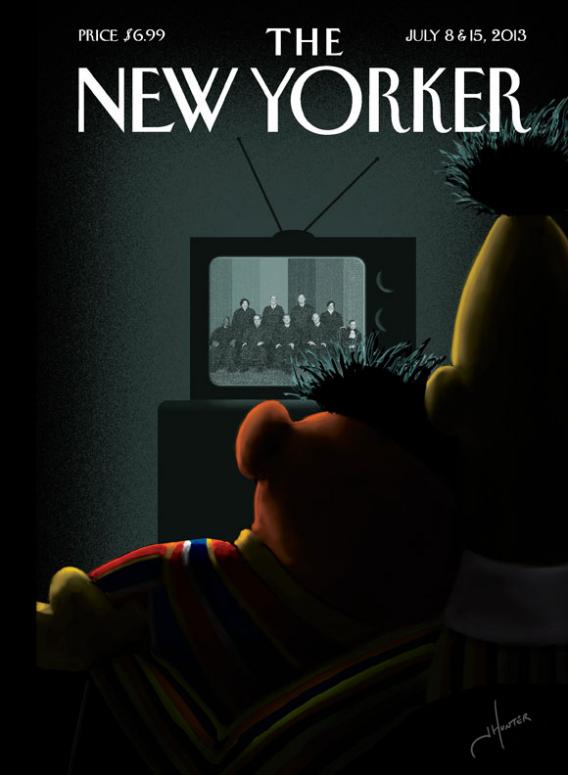
"Bert and Ernie clearly love each other."
But does Ernie suck Bert’s cock? I don't think so.

IN THE COMMENTS: Rabel said: "As I understand my puppets, that's Elmo's job."
ADDED: I remember when it was considered awful for Jerry Falwell to perceive Tinky Winky as gay.
IN THE COMMENTS: Rabel said: "As I understand my puppets, that's Elmo's job."
ADDED: I remember when it was considered awful for Jerry Falwell to perceive Tinky Winky as gay.
"Nationalized gay marriage, now inevitable."
Explains Charles Krauthammer, who's not happy about this.
If discriminating (regarding federal benefits) between a gay couple and a straight couple is prohibited in New York where gay marriage is legal, by what logic is discrimination permitted in Texas, where a gay couple is prevented from marrying in the first place?It's about timing, slowing things down a bit and giving people a chance to accommodate to things.
Which is exactly where the majority’s [Equal Protection] rationale leads — nationalizing gay marriage.... This is certainly why David Boies, the lead attorney in the companion Proposition 8 case, was so jubilant when he came out onto the courthouse steps after the ruling. He understood immediately that once the court finds it unconstitutional to discriminate between gay and straight couples, nationalizing gay marriage is just one step away.
So why didn’t Justice Anthony Kennedy, the traditional swing vote who wrote the majority opinion on DOMA with the court’s four liberals, take that step?
"John Roberts’ Openly Gay Cousin Will Now Be Getting Married."
TPM reports.
[Jean] Podrasky says she’s just as surprised that Roberts voted to uphold DOMA, as she is that he sided with the majority in throwing out the Prop 8 case on procedural grounds, which had the effect of making gay marriage legal again in California. Roberts’ split means that despite believing the federal government should continue not to recognize same-sex marriages, he helped clear the one obstacle standing in the way of his cousin and her fiancee.Whether he'll be invited to her wedding is a question she's diplomatic about not answering:
“I want to say I’m from a very, very big family — I have 12 cousins on both sides of the family,” she says. By that measure, even though he has immense power as Chief Justice, Roberts is just on the other side of a family disagreement. “I want to say that quite a bit of my family on that side are quite conservative and pretty Catholic. We have differences of opinions on many many things, but we are still family. He is about 10 years older than me, so we grew up at different times... I tend to see him at family functions. Basically weddings, funerals, celebrations things like that.”
“I actually don’t know,” she told me. “I’m certainly inviting family [but] we don’t have our guests lists yet.”
Subscribe to:
Posts (Atom)