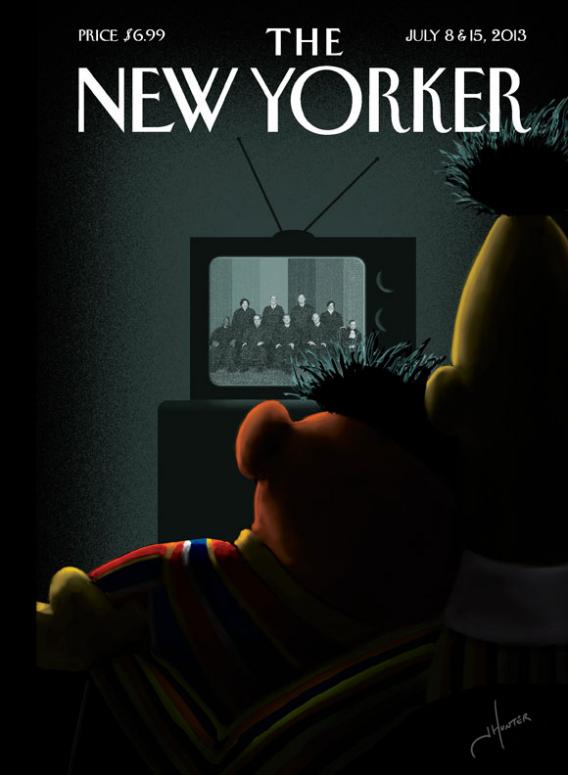
Showing posts with label The New Yorker. Show all posts

Friday, December 13, 2013

"When it comes to writing about anorexia, the only truly radical move, as far as I can tell, would be to show clearly just how profoundly boring it is..."

"... not sad or prurient or overdetermined," writes Alice Gregory in "Anorexia, the Impossible Subject," in The New Yorker (reviewing "How to Disappear Completely: On Modern Anorexia").
The very premise is an unappealing one: we’d like to believe that such unhinged myopia would have psychological roots in trauma or in some sinister personal history, but usually it doesn’t.... [A] voluntarily isolated person choosing not to eat until she’s addicted to not eating doesn’t make for a very good story....

If we really wanted to protect our supposedly susceptible youth, we’d paint anorexics as they are: slowly suicidal obsessives who avoid other people and expend ninety-five per cent of their mental energy counting the calories in green vegetables. We wouldn’t see them as worth reading about at all.
But readers choose books because they are interesting, and so whatever is written about well enough to attract readers is going to make the subject absorbing, exciting, glamorous. What things other than anorexia are actually quite boring but written about in books as if they were not boring? When else do we worry that readers will be tricked into doing things they should not do because the book failed to depict the activity as boring?

And yet... isn't Gregory is falling prey to the imitative fallacy?
Imitative fallacy is this: the mistaken notion that creating the feeling in the reader that is the same as the feeling in the character is the worthy intention of a story. That is my loose paraphrase of what is probably a lot of technical ancient Greek.  Which means, we create an imitation of life, not a story.  So, for example–if the character is bored, you bore the reader.  Or the character is confused, you confuse the reader.
The example of writing boringly to express boredom is such a typical way to explain the imitative fallacy that Christopher Lehmann-Haupt found this amusing and not boring way to talk about the imitative fallacy:
[T]he fallacy of imitative form... is the error of, say, writing chaotic prose in order to convey a mood of chaos: we were forever vigilant against this fallacy, although we often committed a variation of it, by writing boringly about interesting subjects!
What are some interesting books about boredom? I think of Kierkegaard’s "Either/Or," written about and quoted here by Roger Kimball:
He was... an unusually exuberant writer, by turns gripping, caustic, and sentimental. He could be extremely funny: “All men are bores,” he wrote in “The Rotation Method” (a key essay in Either/Or).
Surely no one will prove himself so great a bore as to contradict me in this... . The gods were bored, and so they created man. Adam was bored because he was alone, and so Eve was created. Thus boredom entered the world, and increased in proportion to the increase of population. Adam was bored alone; then Adam and Eve were bored together; then Adam and Eve and Cain and Abel were bored en famille; then the population of the world increased, and the peoples were bored en masse. To divert themselves they conceived the idea of constructing a tower high enough to reach the heavens. This idea is itself as boring as the tower was high, and constitutes a terrible proof of how boredom gained the upper hand.
If everyone is boring, then all the characters in all of the books are boring, anorexics and overeaters alike. The authors may strain to depict them as interesting, but there are exceptions, where the author clearly shows you that the characters are boring, but the book is not boring. I'm sure you can name a few. I thought of "Madame Bovary." And so, I think I've established that Gregory was wrong to call anorexia "the impossible subject." I hope you won't be so boring as to contradict me. Eat a sandwich!

Sunday, December 8, 2013

"Men, to the best of my knowledge, don’t even read."

"When’s the last time you heard a man say, 'I’ve been reading this great book, you’d really like it’? My girlfriend always tells me about these books she’s reading, and I don’t even see her reading the book! Where does this book live?"

A quote from Bryan Goldberg, the founder of the website Bustle, quoted in this New Yorker article titled "FROM MARS/A young man’s adventures in women’s publishing." I enjoyed the whole article — Goldberg raised $6.5 million to start up a website for women, though he knew he knew nothing about what women want to read. He just knew there was money to be made from advertising if he could deliver big numbers of young female readers, and he hired a whole lot of young women to work for $50 or $100 a day writing blog posts about whatever interests them (because what interests them will kinda sorta already be what interests young women). His goal is 50 million readers a month, and as of the publication of that article (last September), he'd gotten the traffic up to 14,000 a day — i.e., about half the traffic I get here, with just my own self writing, albeit not to the demographic most loved by advertisers, even though I am sure that some of you do get excited by the newest innovation in eyeliner.


But what got me thinking about that quote about reading was running acrosss this new article in Slate: "Dan Kois’ Favorite Books of 2013." Dan, a man, apparently read enough books to have 15 favorites in one year. How many books do you need to read in a year to have 15 favorites? I'd say at least 1 a week. But he's the book editor there, so he'd better do some reading. The truth is, if you put me in a room with all the books sent to the book editor in a year, I could produce a 15 favorites list in a single 8-hour workday. You just need a methodology, right? Spend less than 10 seconds on most books until you've got about 30 that seem as though you're going to like them. Maybe 30 more that you'll give a chance. Go through the first pile of 30, 5 minutes per book, and see if you get 15 you like. If not, proceed to the second pile. Put another 10 minutes into each of the chosen 15 to check that you haven't been fooled. If you find any clunkers, swap in one of the also rans from the top 60, maybe something with a colorful title or strange author name. I see Dan has on his list "There Once Lived a Girl Who Seduced Her Sister’s Husband, and He Hanged Himself: Love Stories," by Ludmilla Petrushevskaya.

Ha ha. Does my method sound like a male way to construct a top 15 list? It would amuse me.

Wednesday, December 4, 2013

"So yes, I’ll subsidize someone else’s prenatal coverage, in a more effective way than I’ve been doing by default under the current system..."

"... in which too many pregnant women show up in emergency rooms without having had such care, creating problems for themselves and their babies, and all sorts of costs for taxpayers. And I’ll remember to be relieved that my own access to health care is guaranteed. But they had better work out the problems with the A.C.A.; if they don’t, and it doesn’t fulfill its promise of insuring the uninsured, I’m really going to feel like a chump."

The last paragraph of "My Cancelled Policy, and My Values," by Margaret Talbot in The New Yorker, which I'm going to guess expresses just about exactly where liberal opinion is right now.

Saturday, November 9, 2013

"Yet women are... 'fickle, quarrelsome, suspicious, weak, and fearful'... 'tirelessly lustful.'"

"Strong men may imperil their health by trying to fulfill their sexual demands. So, in order for life to proceed calmly, women must submit to men and, above all, be chaste... Those who do not obey their husbands should be beaten," writes Joan Acocella in The New Yorker, paraphrasing something a female character says in  Boccaccio's "Decameron."
In support of that view, Boccaccio ends his book with what has become the famous story of “patient Griselda.” Gualtieri, the Marquis of Saluzzo, has no wish to marry, but his subjects pressure him. So he takes, as a wife, a peasant girl, Griselda. In time, Griselda gives birth to a daughter and a son. Both babies are taken away from her, with the strong suggestion that they will be put to death. Griselda makes no protest. So Gualtieri tightens the screw. He declares that he needs a noble wife, not a peasant. Stoically, Griselda returns to her father’s house, leaving even her dresses behind, since she feels that they belong to her husband. Soon Gualtieri calls her back, saying that he needs her to oversee the preparations for the wedding. “Gualtieri’s words pierced Griselda’s heart like so many knives,” but she agrees. On the wedding day, a boy and a girl appear whom Griselda does not know. Gualtieri introduces the girl as his bride-to-be. Griselda praises her. Finally, Gualtieri can go on no longer. He tells Griselda that the boy and the girl are her children (he had them brought up by kinfolk in Bologna), and that he is taking Griselda back, more beloved now: “I wanted to teach you how to be a wife”—that is, submissive.
Much more at the link as Acocella reviews a new translation and compares it to other translations.

Also at the top link: much feistier women and much sexier stories. Read the one about the barrel.

Friday, November 1, 2013

Another Barry Blitt New Yorker cover about Obama.


"When I heard that the troubled Obamacare Web site was built by a Canadian company, of course I felt personally responsible," says Blitt (because he's from Canada). "I’ll be happy when the glitches are all worked out and everything’s running smoothly, so I can put this all behind me."

Nice drawing. The sentiment is rather stickily sweet for the circumstances, but it's The New Yorker, shoring up support for the once-beloved President.

Wednesday, October 30, 2013

Who's giving up now? Early warning signs.

1. "The Art of Lying Down: A Guide to Horizontal Living," a book by Bernd Brunner that is an "ode to lying down... ranging from the history of the mattress to the 'slow living movement." It "makes an eloquent case for the importance of lying down in a world that values ever greater levels of activity," and presents lying down as "a protest."

2. A New Republic piece by Ben Crair about protesting against excessive activity by staying in bed. "When you’re in bed, everything seems too far away, even the other rooms of your apartment—and I live in a studio. My water intake dropped to almost zero, which I never noticed until I went outside on some errand and found myself desperately thirsty after a few minutes of leisurely walking. One evening, returning home, I planted my right foot on a step in the hallway, and lifted my left foot assuming it would follow, but nope: It went back down exactly where it had started."

3. There's this new essay in The New Yorker by Evgeny Morozov called "Only Disconnect/Two cheers for boredom," that begins with a reverie about a 1903 essay called "The Metropolis and Mental Life," that says closing the shades and "surrendering oneself to one's boredom on the sofa" is good response for people who "are pushed deeper and deeper into the hustle and bustle until eventually they no longer know where their head is." You'll need a subscription to read the whole thing, but I can tell you that Morozov is reading some new books that resonate with that old surrender-to-boredom-and-inactivity theme.

Friday, October 25, 2013

"The 50 Greatest Breakthroughs Since the Wheel."

"The Atlantic recently assembled a panel of 12 scientists, entrepreneurs, engineers, historians of technology, and others to assess the innovations that have done the most to shape the nature of modern life."

I was interested to see nitrogen fixation at #11, because it's something I've got to tell you I had never thought much about that at all until last week when I was reading this excellent New Yorker article by Elizabeth Kolbert, "Head Count, Fertilizer, fertility, and the clashes over population growth," which begins with this topic:
Early in the history of agriculture, people realized — without, obviously, understanding the chemistry behind this insight—that when usable nitrogen ran low fields turned barren. Eight thousand years ago, farmers in the Middle East were already planting legumes, whose roots harbor nitrogen-fixing bacteria, in rotation with cereal crops, such as wheat. Later, Cato the Elder recommended that Romans “save carefully goat, sheep, cattle, and all other dung.” Bird shit is an excellent source of nitrogen, and in the early nineteenth century, when Europeans learned that there were mountains of the stuff on remote islands off Peru, the discovery inspired a guano rush; by the eighteen-fifties, Britain was importing four hundred million pounds of bird poop a year, and the United States a hundred and seventy million pounds....

By [Fritz] Haber’s day, the appetite for crop-friendly nitrogen was so huge that scientists had turned their attention skyward. Nitrogen is the most common element in the earth’s atmosphere.... but almost all of it is floating around in the intractable form of N2. When... Haber showed how to bust up N2 to produce ammonia — NH3 — he basically solved the problem. No more guano would be needed. Haber had, it was said, figured out how to turn air into bread.

Sunday, October 20, 2013

"I had some dim intuitive feeling that what was wrong with all journalism is that the reporter tended to be objective and that that was one of the great lies of all time."

Said Norman Mailer, quoted in this subscribers-only article by Louis Menand in The New Yorker. As Menand puts it, Mailer "made the way in which events are reported part of what is reported."

ADDED: You could say something similar about law: I had some dim intuitive feeling that what was wrong with all judicial opinions is that the judge tended to be objective and that that was one of the great lies of all time. But what then? No judge can switch to writing the judicial equivalent of New Journalism.

(20 years ago, I tried to write about this problem, here (PDF) — with some quotes from Mailer's "Executioner's Song.")

AND: From that link, above, on New Journalism, which goes to Wikipedia:
How and when the term New Journalism began to refer to a genre is not clear....

But wherever and whenever the term arose, there is evidence of some literary experimentation in the early 1960s, as when Norman Mailer broke away from fiction to write Superman Comes to the Supermarket. A report of John F. Kennedy's nomination that year, the piece established a precedent which Mailer would later build on in his 1968 convention coverage (Miami and the Siege of Chicago) and in other nonfiction as well.
And here, you can read the full text of "Superman Comes to the Supermarket" (at the Esquire website, Esquire having once been a monumentally important magazine). It begins:
For once let us try to think about a political convention without losing ourselves in housing projects of fact and issue. Politics has its virtues, all too many of them -- it would not rank with baseball as a topic of conversation if it did not satisfy a great many things -- but one can suspect that its secret appeal is close to nicotine. Smoking cigarettes insulates one from one’s life, one does not feel as much, often happily so, and politics quarantines one from history; most of the people who nourish themselves in the political life are in the game not to make history but to be diverted from the history which is being made.
Convenient sidebar chez Esquire: 


Are we doomed? Did you go to my link and read the sentences that followed those 3 mindbendingly interesting sentences that began "Superman Comes to the Supermarket," or did you go over to click through to the explanation of why Miss Johansson in the sexiest woman alive (or what a "brutally frank" 98-year-old woman might say about sex)?

Thursday, September 26, 2013

"Quite simply, the book review is dead, and the long review essay centered on a specific book or books is staggering toward extinction."

"The future lies in a synthetic approach. Instead of books, art, theatre, and music being consigned to specialized niches, we might have a criticism that better reflects the eclecticism of our time, a criticism that takes in various arts all at once. You might have, say, a review of a novel by Rachel Kushner that is also a reflection on 'Girls,' the art of Marina Abramović, the acting style of Jessica Chastain, and the commercial, theatrical, existential provocations of Lady Gaga and Miley Cyrus. Or not. In any case, it’s worth a try."

Writes Lee Siegel in The New Yorker, longingly. Why in that example did he name 5 women and allude (via "Girls") to at least 4 more? Have women overrun culture in some anarchic way, making the single-mindedness of the stereotypical male seem old-fashioned? The future is all wildly free-associative, like the fever-swamp brain of some lady blogger.

***

"Yes, but what does sprezzatura think of it?"

Friday, September 20, 2013

The "utterly, terminally square" Jonathan Franzen called out "the cool kids" for their "vapidity and cowardice"...

... and they could "smell that kind of healthy self-doubt," and free of "the slightest fear that he will reply," attacked.
So what I think is that Franzen really ought to just come online and talk with everybody. Let some of us have it, too, if he thinks we deserve it. If he believes that Americans could be doing a better job politically, or as artists or intellectuals or students or teachers, the Internet is the place for making that case now. Yes, there are many bad things about the Internet, but serious criticism is alive and well there. Or here, rather. There are thousands upon thousands of passionate constituencies online—political, social, literary—many of them eager for the participation of as many principled, serious artists as care to come out and talk. Come on in, Mr. Franzen! The water’s fine. 
Actually, he is in. Everyone read that thing he wrote on the internet. He chose a position on the internet from which to speak. You're just saying that you want him to engage and get all interactive with the individuals who are punching up at him. That's their game. That's the position they chose.

Ironically, that come-on-join-the-internet piece I've quoted above is in The New Yorker.

I read it on the internet.

There. Or here, rather.

Friday, September 13, 2013

"I feel that at this point Krakauer has an agenda to prove that McCandless was poisoned."

"In his book ['Into the Wild'] he advances the theory that it was an alkaloid poison in a similar looking plant. Later, tests determine that the plant had no such poison. He then supposes that it was a toxic mold on the seeds, but Wiki says no mold was found his seeds."

From the discussion at Metafilter about this new New Yorker article by Jon Krakauer.

Another Metafilter comment, further down and much favorited:
I've done things a few things woefully underprepared where I drastically overexerted and overextended myself and skirted the edge of disaster before, and had the thought "fuck if I die doing this, it's going to look pretty stupid", but you know on the other hand those were some of the best times in my life....

It's kind of sad to see people here 20 years later on a silly web blog shitting on a young guy for trying to live life the way he wanted, and with a level of adventure and self-reliance few ever experience. He didn't force his story down your throat - go back to watching TV and working in an office and patting yourself on the back for living smarter and longer than he did.
By the way, it's "web log" not "web blog." Just say "blog" like a normal person and you won't need to remember this, but that commenter was going all righteous on Metafilter, which isn't a "silly" blog. It's a grand and awesome enterprise, going back to 1999.

This 99+-comment-long thread on McCandless is a testament to how unsilly it is, including this comment calling it silly.

Tuesday, September 3, 2013

"What we are watching when we watch élite sports, then, is a contest among wildly disparate groups of people..."

"... who approach the starting line with an uneven set of genetic endowments and natural advantages," writes Malcolm Gladwell in The New Yorker, which is so elite it puts an accent on the "e" in "elite." But don't let that stop you from reading this! It shifts from talking about the legs of Kenyan runners — who are genetically adapted to a particular environment and have thus lucked into an advantage — and the drug users in baseball and bicycling. That's some sleight of hand.

Tuesday, June 25, 2013

"In such situations, it is not ever an animal’s 'fault' — it is the dog-owner’s fault, of course."

"Seeing a dog-owner with a massive dog, we are likely to think that the dog-owner is enjoying his spurious power: he can cause extreme suffering, if he wishes to, and so we must be grateful that he is reining in his animal, which would love to bark and rush at us. A dog is an expression of its owner’s fantasy-self—perhaps?"

Says Joyce Carol Oates, explaining her story "Mastiff," which begins:
Earlier, on the trail, they’d seen it. The massive dog. Tugging at its master’s leash, so that the young man’s calves bulged with muscle as he fought to hold the dog back. Grunting what sounded like “Damn, Rob-roy! Damn dog!” in a tone of exasperated affection.
Mastiff... massive... master...

Rob-Roy?
Robert Roy MacGregor (Scottish Gaelic: Raibeart Ruadh MacGriogair; baptised 7 March 1671 – 28 December 1734), usually known simply as Rob Roy or alternately Red MacGregor, was a famous Scottish folk hero and outlaw of the early 18th century, who is sometimes known as the Scottish Robin Hood. Rob Roy is anglicised from the Gaelic Raibeart Ruadh, or Red Robert. (He had red hair, Ruadh being Gaelic for red-haired, though it darkened to auburn in later life.)
Names. What does it mean to name the dog Rob-Roy? Oates's scary mastiff isn't even red. He's black.

We were out on the north shore of Lake Mendota the other day with our borrowed black dog named Zeus. Along came another black Lab. "What's his name?" we ask, and the man says, "Thor."

Seeing a dog-owner with a massive dog, we are likely to think that the dog-owner is enjoying his spurious power....

I google for an image of the god Thor, and Google autocompletes to Thoreau...

"We have no relation to Mr. Snowden, his relations with the American justice or his travel around the world."

"He chooses his route himself, and we have learned about it from the media," said Russia's foreign minister Sergey Lavrov.
"We consider the attempts to accuse Russia of violation of U.S. laws and even some sort of conspiracy, which on top of all that are accompanied by threats, as absolutely ungrounded and unacceptable," Lavrov said. "There are no legal grounds for such conduct of U.S. officials, and we proceed from that."
I think back to what Michael Haz wrote in the comments to yesterday's Edward Snowden post:
Mr. Snowden, his computers and everything stored in his brain are now in possession of the KGB. He will now fully understand the meaning of the word 'disappeared'.

The press, the Department of State and Barack Obama have all been played for the rubes they are by Vladimir Putin. And there is nothing any of them can do about it. The amateurs have met the pro, and the pro won, then erased all tracks.
Meanwhile, 20 or so reporters were thrown way off the track as they happily enclosed themselves in a Snowdenless, Cuba-bound metal tube for 12 hours. What newsless meditations did they hammer out for publication? The New Yorker's John Cassidy lambasted the on-the-tube, not-in-the-tube newsmediafolk like David Gregory who, he asserts, have demonized Edward Snowden:
Snowden took classified documents from his employer, which surely broke the law. But his real crime was confirming that the intelligence agencies, despite their strenuous public denials, have been accumulating vast amounts of personal data from the American public. The puzzle is why so many media commentators continue to toe the official line. About the best explanation I’ve seen came from Josh Marshall, the founder of T.P.M., who has been one of Snowden’s critics. In a post that followed the first wave of stories, Marshall wrote, “At the end of the day, for all its faults, the U.S. military is the armed force of a political community I identify with and a government I support. I’m not a bystander to it. I’m implicated in what it does and I feel I have a responsibility and a right to a say, albeit just a minuscule one, in what it does.”
In the end, for all its faults... Marshall's going all last-paragraph-of-"1984." ("O cruel, needless misunderstanding! O stubborn, self-willed exile from the loving breast! Two gin-scented tears trickled down the sides of his nose. But it was all right, everything was all right, the struggle was finished. He had won the victory over himself. He loved Big Brother.") Except... Marshall never resisted.

Back to Cassidy:
I suspect that many Washington journalists, especially the types who go on Sunday talk shows, feel the way Marshall does, but perhaps don’t have his level of self-awareness. It’s not just a matter of defending the Obama Administration, although there’s probably a bit of that. 
Oh, just a tad. Probably! But...
It’s something deeper, which has to do with attitudes toward authority. Proud of their craft and good at what they do, successful journalists like to think of themselves as fiercely independent. 
Like to... but trapped on Aeroflot flight to Cuba, you start noticing your lack of independence. And those journalists who didn't get bamboozled into your lamentable predicament look so enragingly smug.
It’s not surprising that some of them share Marshall’s view of Snowden as “some young guy I’ve never heard of before who espouses a political philosophy I don’t agree with and is now seeking refuge abroad for breaking the law.”
A political philosophy I don’t agree with.... What is that? Resistance to big government? Cassidy — who says — he's "with Snowden" because he's "the underdog" — ends with "Which side are you on?" which is the title of an old union song. Here's Pete Seeger singing it. Bob Dylan repurposed it in "Desolation Row":
Praise be to Nero’s Neptune
The Titanic sails at dawn
And everybody’s shouting
“Which Side Are You On?”
Unlike the Titanic, the Aeroflot flight reached its destination uneventfully.
All these people that you mention
Yes, I know them, they’re quite lame
I had to rearrange their faces
And give them all another name

Thursday, June 13, 2013

"Reading Brooks’s laments about Snowden and 'the fraying of the social fabric,' I found myself thinking about Norman Rockwell..."

"... if not in the same way Brooks might. (In 2008, after what he saw as a rhetorical triumph by Sarah Palin, Brooks wrote, 'Somewhere in heaven Norman Rockwell is smiling.') The image that came to mind was one of the panels from Rockwell’s 'Four Freedoms' series: the one on freedom of speech, in which a man stands up at what looks like a town meeting. He might be about twenty-nine. He is wearing a work jacket, so maybe he’s a high-school drop-out. There are better dressed people in the hall. And they are listening to him."

Writes Amy Davidson in The New Yorker, with the sentimentality that Rockwell haters loathe about Rockwell. Here's the referenced Rockwell painting:


I was going to snark that there's no way that guy is 29, but then I asked Meade, "How old does this guy look," and he said, "29." And, "That's what guys who work on the farm look like when they're 29."

Then I tried my other idea: "How do we know he's not a communist, dressed that way to trick the naively idealistic Norman-Rockwell-loving folks of that small town? He's dressed like a folksinger. He could be Pete Seeger." And Meade said: "You can tell by that greasy dirt on his jacket. That guy does real work."

We talked about the difference between this idealized farmer — with his real dirt, in a real place, with real people — and Edward Snowden — who operated within computer networks and evanesced into Asia. But it's 2013, and maybe that Rockwell character does need to be a man detached from the American soil, floating out there in unmediated space. And yet — as Meade said — "He's Tea Party."

Tuesday, June 4, 2013

The New Yorker's George Packer takes aim at Andrew Breitbart.

Some of this is interesting, but watch out for distortion:
It was fun! Telling the truth was fun, having the American people behind him was fun, fucking with the heads of nervous journalists and helping the mainstream media commit suicide was fun. Breitbart went on Real Time With Bill Maher and stood up for himself and Rush to the politically correct hometown mob of an audience, and it was an incredibly committed moment in his life. He found himself the leader of a loose band of patriotic malcontents, and right in front of him was the same opportunity that the Founding Fathers had had—to fight a revolution against the complex.

And if he happened to get an Agriculture Department official named Shirley Sherrod fired by releasing a deceptively edited video that seemed to show her making anti-white comments when in fact she was doing just the opposite—fuck it, did the other side play fair? Anyway, Old Media’s rules about truth and objectivity were dead. What mattered was getting maximum bang from a story, changing the narrative. That was why Breitbart was winning, with ample help from his media enemies, and why he must have been at least semi-sober during his college classes on moral relativism.
Just the opposite? Packer answers the question he attributes to Breitbart: did the other side play fair? Obviously not. Packer's side is playing and is playing unfairly.

ADDED: George Packer has been unfair to me (discussed here and here).

AND: Professor Jacobson details what's so wrong about Packer's "deceptively edited video."

Via Instapundit, who says: "Sorry comrade, but what you’re offering is mere bourgeois truth, concerned with tedious facts. The higher truth is 'revolutionary truth,' which is any narrative that advances the revolution."

Saturday, June 1, 2013

Megyn Kelly dominates the males who strain to assert that the male is dominant.

They probably had to let her smack them around. Probably some uber-male at Fox News told them — Erick Erickson and Lou Dobbs — that they had to sit still for their punishment. Or maybe this is male dominance, like in those old movie melodramas where a big strong male stood still while his woman pounded her little fists on his chest until she broke down in tears and he could comfort her in his big strong arms. Except Megyn Kelly never breaks down. And Lou and Erick end up beaten to a bloody pulp.


Here's Amy Davidson in The New Yorker, quoting some of the best quotes:
Erickson had followed up with a blog post saying that “many feminist and emo lefties have their panties in a wad over my statements,” but that it was a biological truth that “kids most likely will do best in households where they have a mom at home nurturing them, while dad is out bringing home the bacon.”...

KELLY: I don’t know what it is, but I don’t think I’m an emo-liberal, and I don’t describe myself as a feminist —

ERICKSON: I don’t think you are either.

KELLY:—but I will tell you, I was offended by the piece nonetheless. I didn’t like what you wrote one bit, and I do think you are judging people. To me, you sound like somebody who’s judging but wants to come out and say, “I’m not, I’m not, I’m not, now let me judge, judge, judge. And, by the way, it’s science, science, science, it’s fact, fact, fact, fact, fact.” Well, I mean, I have a whole—this is a list of studies saying your science is wrong and your facts are wrong.
If you're going to play the science card, make sure you have a good science hand, because — unless you're just playing at home with a few lazy/dumb/weak friends, your bluff will be called.

Davidson portrays Kelly as bucking the system over there at bad old Fox News:
And, every now and then, the ideological blindness seems too much for her, and she makes it clear that she’s smarter than the men around her, rather than deftly letting them think they are.
Davidson thinks that the Fox News regulars who find themselves in the Erickson/Dobbs position "pretend, as they fall through the holes in their logic, that the ideological ground under them is still there." But I think it's more likely that the whole scene was planned that way, that it served the well-understood interests of Fox News, that Kelly had the role of dominant female delivering a beating, and Erickson and Dobbs knew that they had to receive 50 lashes of female retribution and restorative justice in order for the Fox News machine to move forward with the 2 of them as component parts.

Friday, May 24, 2013

"The Obama Administration fought to keep a search warrant for James Rosen’s private e-mail account secret..."

"... arguing to a federal judge that the government might need to monitor the account for a lengthy period of time," writes Ryan Lizza in The New Yorker.
The new details indicate that the government wanted the option to search Rosen’s e-mails repeatedly if the F.B.I. found further evidence implicating the reporter in what prosecutors argued was a conspiracy to commit espionage.

Thursday, May 16, 2013

"Look at this Boston bombing. The pictures of those two brothers. Aren’t they cute?"

Said I, as quoted in The New Yorker today in a piece by Paul Bloom called "The Dzhokar Tsarnaev Empathy Problem." I was being sarcastic and criticizing the media for using a strikingly baby-faced picture of Tsarnaev in practically every report.

Bloom concludes:
Relying on the face might be human nature—even babies prefer to look at attractive people. But, of course, judging someone based on the geometry of his features is, from a moral and legal standpoint, no better than judging him based on the color of his skin. Actually, both biases reflect the parochial and irrational nature of empathy—if Tsarnaev were black, would he evoke the same response from the mothers [Hanna Rosin described here]? When someone talks about the warm feelings she has for Tsarnaev because of his sweet face, we should treat this with the same wary understanding that we would give to someone who admits to caring more about those who have the same color skin. It’s an empathetic response, and a natural one, but hardly one to be proud of.
Bloom says nothing about the baby-faced picture of Trayvon Martin that the media tended to use. Sweet faces manipulate us emotionally even when they are black. And an individual's face isn't quite the same as his skin color, because the mind is revealed through the face (albeit incompletely and often deceptively). Bloom displays the media's favorite photo of Jared Loughner and declares that we don't feel much empathy toward that face. But the problem with that face is not inborn ugliness. It's craziness in the expression. We are properly repelled by that.

It is the true sociopath — I would suggest — whose does evil things but keeps a normal-looking face. We need to challenge ourselves to recognize the sociopaths in our midst. And let's not try to overcome our aversion to faces like Loughner's or Adam Lanza's. These people have terrible problems that we ignore at great risk.

ADDED: The post title corrects a typo that appears in The New Yorker ("bothers" for "brothers").