"... had them slaughtered and then distributed the meat to more than a dozen restaurants, all without the necessary state permits, according to records of a state investigation into his operation."
Recycling. You've got to do it the right way. No animal parts in the table scraps to be thrown to the pigs. No hamburger, no bacon bits, no chicken bones, no Italian mobsters.
Showing posts with label pigs. Show all posts
Showing posts with label pigs. Show all posts
Friday, November 29, 2013

Wednesday, October 23, 2013
"If you allow it for Mr. Davis, you allow it for Ms. Adams, Mr. Jones and everyone else."
So said the Stevenson, Alabama city attorney "adding that this was the most protracted litigation in the city since a case a few years ago involving something about pigs."
From a long NYT article about a man who buried his wife in his front yard.
From a long NYT article about a man who buried his wife in his front yard.
Monday, October 7, 2013
What Justice Scalia really means when he says he believes in the Devil.
About halfway her wonderful interview with Justice Scalia, after some discussion of homosexuality in legal and in Catholic doctrine, Jennifer Senior pushes the old judge to worry about how history will look back on his era of the Court. The first prompt — "Justice Kennedy is now the Thurgood Marshall of gay rights" — gets merely a nod. She tries again, with another non-question: "I don’t know how, by your lights, that’s going to be regarded in 50 years." He says doesn't know and he doesn't care:
Scalia has shifted from the topic of Kennedy's legacy to his own and — declining to guess what the people of the future will think — he says: "When I’m dead and gone, I’ll either be sublimely happy or terribly unhappy."
That is, he pulls Senior back to the perhaps-more-comfortable topic of religion. She obliges, asking him if he believes in heaven and hell, which he does, and they go back and forth about who goes where, and then, as she proceeds to a new topic — "your drafting process" — he pulls her back again: "I even believe in the Devil."
Asked for evidence of the Devil lately, Scalia says:
Senior wants to know whether it's "terribly frightening to believe in the Devil." He says:
Maybe the world is spinning toward a wider acceptance of homosexual rights, and here’s Scalia, standing athwart it.Some might hear "standing athwart" homosexual rights and get an amusingly unintentionally sexual picture of Scalia straddling gay men. But I assume it's an allusion to William F. Buckley's famous 1955 mission statement for The National Review: "It stands athwart history, yelling Stop, at a time when no one is inclined to do so, or to have much patience with those who so urge it." The topic was history, you know. And who else says "standing athwart"?
Scalia has shifted from the topic of Kennedy's legacy to his own and — declining to guess what the people of the future will think — he says: "When I’m dead and gone, I’ll either be sublimely happy or terribly unhappy."
That is, he pulls Senior back to the perhaps-more-comfortable topic of religion. She obliges, asking him if he believes in heaven and hell, which he does, and they go back and forth about who goes where, and then, as she proceeds to a new topic — "your drafting process" — he pulls her back again: "I even believe in the Devil."
You do?He's already connected his Catholicism to the accession to the authority of Catholic doctrine. The devil is in the doctrine, he's Catholic, and ergo, he believes in the Devil.
Of course! Yeah, he’s a real person. Hey, c’mon, that’s standard Catholic doctrine! Every Catholic believes that.
Asked for evidence of the Devil lately, Scalia says:
You know, it is curious. In the Gospels, the Devil is doing all sorts of things. He’s making pigs run off cliffs, he’s possessing people and whatnot. And that doesn’t happen very much anymore....Later, he asks Senior if she's read "The Screwtape Letters," and not having read "The Screwtape Letters" in decades, I'm not sure if he's lifting these nifty observations from C.S. Lewis or not.
What he’s doing now is getting people not to believe in him or in God. He’s much more successful that way.
Senior wants to know whether it's "terribly frightening to believe in the Devil." He says:
You’re looking at me as though I’m weird. My God! Are you so out of touch with most of America, most of which believes in the Devil? I mean, Jesus Christ believed in the Devil! It’s in the Gospels! You travel in circles that are so, so removed from mainstream America that you are appalled that anybody would believe in the Devil! Most of mankind has believed in the Devil, for all of history. Many more intelligent people than you or me have believed in the Devil.He seems to be trying to get a reaction out of her, because she defends with: "I hope you weren’t sensing contempt from me. It wasn’t your belief that surprised me so much as how boldly you expressed it." He says:
I was offended by that. I really was.She doesn't grasp his statement or at least what she says next indicates that she didn't. She says: "I’m sorry to have offended you," as if he was an ordinary person taking offense, when in fact, he's cracking a joke. The joke is to point at her surprise at his bold expression. It was a subtle way to say: Hey, I thought I was famous for bold expression! But he's not so bold — or so bad a comedian — as to redo a joke to drive it home. Either you get it or you don't. He moves forward. Here's where he brings up "The Screwtape Letters," which she says she's read. He says:
So, there you are. That’s a great book.That suggests all the interesting things he's throwing out about the Devil are ideas in or closely tracking that book he likes.
It really is, just as a study of human nature.And there you are. He believes in the Devil not just, perhaps, because he yields to the authority of a religion of dogma and authority, but he believes in the Devil because the Devil is a literary device for exploring human nature, and how can we not believe in human nature and literature?
Monday, May 6, 2013
The pig-goat personality test.
Maybe you've already seen this video, but please watch:
Your test results:
If you chose The goat was cute, you are normal. Feel free to sojourn in human society, relying on your natural instincts. Things will probably go well. Enjoy!
Now, for the rest of you. I'm just guessing on these interpretations, so feel free to offer alternatives.
The pig was tolerant. You like to take unconventional perspectives, perhaps thinking you're empathizing with the underdog, but you're not that good at identifying the underdog. [ADDED: Some take this a step further and think that the held still because he liked it, similar to the massage technique that has a woman walking on a man's back.]
I was afraid the pig might be dead. Morbid. Possibly sadistic.
I was afraid the goat might get hurt. Incapable of enjoying anything.
Too many pointless animal videos on YouTube. You're sensible, but keep it to yourself.
Human giggling/chatting interferes with aesthetics of cute animal video. You could be normal. You have the potential. But you've got a tendency to be too much like Althouse.
Your test results:
If you chose The goat was cute, you are normal. Feel free to sojourn in human society, relying on your natural instincts. Things will probably go well. Enjoy!
Now, for the rest of you. I'm just guessing on these interpretations, so feel free to offer alternatives.
The pig was tolerant. You like to take unconventional perspectives, perhaps thinking you're empathizing with the underdog, but you're not that good at identifying the underdog. [ADDED: Some take this a step further and think that the held still because he liked it, similar to the massage technique that has a woman walking on a man's back.]
I was afraid the pig might be dead. Morbid. Possibly sadistic.
I was afraid the goat might get hurt. Incapable of enjoying anything.
Too many pointless animal videos on YouTube. You're sensible, but keep it to yourself.
Human giggling/chatting interferes with aesthetics of cute animal video. You could be normal. You have the potential. But you've got a tendency to be too much like Althouse.
Sunday, April 21, 2013
Why wasn't Tamerlan Tsarnaev on the FBI's watch list when he returned after 6 months in Russia?
On Today's Fox News Sunday:
Wallace presses him: "[D]o you see any way you could have prevented these two guys?"
Don't expect the government to protect you from everything in our free society. That's a talking point. I heard it from Senator Dick Durbin this morning on "Meet the Press":


Gregory is responsible, however, for the inanity of his question. Is this a call for more money? Durbin's answer — "It is" — is as short as he can possibly make it, and Gregory doesn't stop him from gratuitously plugging in his prepared remarks about immigration. This is really shameless:
CHRIS WALLACE, host: What do you make of the fact, because of a Russian request, the FBI interrogated the older brother Tamerlan back in 2011 about his ties to radical Islam. They found out he was not a threat.... [W]hat do you make of the interrogation? And what about the fact that when he returned after six months in Russia, he apparently was not on an FBI watch list?Later in the show, Wallace interviews Philip Mudd, a terrorist expert with experience in the CIA, the National Security Council, and the FBI.
CONGRESSMAN PETER KING: ... [W]here the FBI is given information about someone as being potential terrorists, they look at them, and then they don't take action. And they go out and carry out murders after this. So, again, I'm wondering, again, is there something deficient here? What was wrong? Again, there was nothing they could find in 2011. He goes to Chechnya in 2012. He has statements up on his Web site. He's talking about radical imams. Why didn't the FBI go back and look at that?... [I]s far as getting information in advance and not seeming to take proper action, this is the fifth case I'm aware of where the FBI has failed to stop someone who ultimately became a terrorist murderer....
WALLACE: Was there any kind of a breakdown here in our national security operation, and specifically with regard to the FBI? Are you troubled by the fact that they were alerted by the Russians to the older brother, they interviewed him, decided he was not a threat, he goes to Russia, he comes back, and they don't seem to have him on a watch list?10,000 caught in the net every day? Every year? Every decade? When the FBI goes as far as it did on Tamerlan Tsarnaev, shouldn't the case be tagged in a way that would cause it to reopen when something happens that is as significant as 6 months in Russia — even if there would be 10,000 files subject to reopening? If we have to worry about "sleeper cells," why don't we monitor these characters and do something when they engage in behavior typical of planning or training? But I don't know that the FBI doesn't do these things. Mudd seems intent on deflecting our attention from past FBI failings.
PHILIP MUDD: No, I'm not troubled by this for several reasons. First, people fail to consider the implications of false positives. You look at one guy we could have gotten, but you forget the other 10,000 that would have come into the net if we look at a person like this every day. So, I look at this and say, you know, these kinds of things happen, but I suspect it wasn't a dropped ball here.
Wallace presses him: "[D]o you see any way you could have prevented these two guys?"
MUDD: Well, I mean, we're going to have to see what kind of foreign connections they have, whether the travel to Russia last year actually meant something. But what I see so far says we've got two kids who are in a closed radical circle. Breaking that circle in a state like ours that is an open society is virtually impossible.Two kids who are in a closed radical circle... An open society....
WALLACE: What is your sense -- and I understand this is speculation, but informed speculation -- were they acting alone, part of a group, and do you see any Al Qaeda fingerprints on this?
MUDD: The only fingerprint I've seen might possibly have been ideology, but not operations. Every step of the way was pretty rudimentary. For example, if you look at some of those initial photos, you've got a kid with a hoodie and a cap. If he wants to obscure himself, the hoodie goes on, and the cap goes forward. If he had operational training, I want to know who did it because they were amateurs.
Don't expect the government to protect you from everything in our free society. That's a talking point. I heard it from Senator Dick Durbin this morning on "Meet the Press":
GREGORY: Do you have questions about the FBI’s tracking of the older suspect here who is now dead and whether something was missed?I laughed at this point, because it was such knee-jerk Democratic Party response: We need to invest the resources. Spend more money. No one on their side ever fails. They were always only deprived of enough money. The FBI has been well-funded over the years, though presumably they could always hire more people and so forth. But the question is whether they did enough here and are doing enough in similar cases.
SEN. DURBIN: Of course I do. And I think we should ask those questions. That’s our responsibility. But I listened to [Chairman of the House Intelligence Committee] Mike Rogers and I thought he laid it out as a former FBI agent himself as to what we were faced with when we were asked these hard questions. We’ve got to make sure as well, let me add David, that we give to the intelligence and law enforcement agencies, federal, state, and local, the resources they need to keep America safe. We live in a dangerous world. We live also in a free and open society, which we value very much. In order to keep Americans safe at the marathon, at every other public event, we need to invest the resources that are necessary for law enforcement.
GREGORY: Is that a call in fact for re-examination of whether additional resources are needed to-- to look at homegrown terror and the potential for smaller boar attacks that can only be deterred by the strength of law enforcement and engaged citizenry?Smaller boar attacks! Gregory didn't transcribe his own question, but somebody at NBC doesn't know enough about guns.


Gregory is responsible, however, for the inanity of his question. Is this a call for more money? Durbin's answer — "It is" — is as short as he can possibly make it, and Gregory doesn't stop him from gratuitously plugging in his prepared remarks about immigration. This is really shameless:
SEN. DURBIN: It is. But let me add one other element. Let me bring it up to date with the agenda of the Senate. I’ll return tomorrow for the Senate Judiciary Committee’s second hearing on the new immigration reform bill. Let me put it in context. There are four specific provisions in this immigration reform bill that will make America safer. We are going to have a stronger border with Mexico. We are going to have 11 million people come forward and have an opportunity to register with our government, out of the shadows. We’re going to have verification of employment in the work place. And we’re finally going to have a system where we can track visa holders who visit the United States to make sure that they leave when they’re supposed to. So this is part of the ongoing conversation about a safer America and the immigration reform bill moves us closer.Does that have anything to do with terrorist attacks? Gregory gets his next question right:
GREGORY: Do you fear an impact similar to what we saw after 9/11 that derailed immigration reform. Already, you’ve heard Senator Grassley talk about, you know, loopholes in the immigration system, whether, you know, leniencies of student visas. Are there going to be concerns here related to the Boston attacks that you think impact the immigration debate?Of course, the immigration proposal, the next item on the legislative agenda, just happens to answer these questions Durbin would have us believe:
SEN. DURBIN: I’ll just put it on the line. I’ve been involved with the eight senators who have put this bill together, Democrats and Republicans. The worst thing we can do is nothing. If we do nothing, leaving 11 million people in the shadows, not making our border safer, not having the information that comes from employment and these visa holders, we will be less safe in America. Immigration reform will make us safer. And I hope that those who are critical of it will just come forward and say what their idea is. We’ve come up with a sound plan to keep this country safe.The worst thing we can do is nothing. So the best you've got is the assertion that your plan is better than nothing — is it? — and the baseless insinuation that the 11 million people in the shadows are central to the fight against terror.
Monday, February 18, 2013
"The city’s going after families who have pigs as companions."
"Meanwhile, Bloomberg’s daughter has a pig in Gracie Mansion and no one mentions it’s illegal."
The powerful think the rules don't apply to them. But that's not an argument in favor of pigs in the city. No pigs in the city!
The powerful think the rules don't apply to them. But that's not an argument in favor of pigs in the city. No pigs in the city!
Thursday, February 14, 2013
"Was the problem that had no name possibly the lack of Wi-Fi?"
Noreen Malone gets a grip on what Betty Friedan — on behalf of suburban women in general — was bellyaching about in "The Feminine Mystique." She's responding to a piece by Emily Bazelon, which we talked about in a long comments thread yesterday. Malone says:
Now, I've derailed onto the subject of the word "fussy." I just had a long conversation with Meade about his associations with the word. Knowing nothing of the context in which I'd encountered the word, he associated it with objects — specifically drawings and handmade pottery — that are inferior because they have been overworked. I prompted him to think of calling a person fussy, and he said "a baby." Time to check the Oxford English Dictionary (which I can't link to). The first meaning applies to "persons, their habits and actions": "Fond of fuss, moving and acting with fuss; habitually busy about trifles." Examples:
Who's the beast?
I grew up with a whip-smart mom who stayed at home with us, and so I always approach discussions like these with a bit of a chip on my shoulder, alert to any slights whatsoever against the choices and life mission of someone I so love and admire — even if I don’t plan to make precisely the same ones. But more of it is probably generational. For recession-scarred twentysomethings, staying at home or taking menial jobs is involuntary, but not because social mores dictate that women can’t achieve: It’s because so few of us, regardless of gender, have gotten hired at jobs Friedan might consider fulfilling...What's so wrong about paying close attention to the details of the beauty of your environment? Fussy... there's a word. When is intense, attentive work deemed fussy? This is a word that has long been used against women and against gay men. Is a person supposed to be interested in something other than what he or she finds interesting? Why? Who says what the proper foci of interest are in this world? Some people are more sensitive to the visual specifics of their environment. It's not as if the people who aren't spend their lives plumbing the meaning of the universe. Perhaps the interior decorator is closer to the core of what truly matters than the corporate lawyer.
I’m sure Betty wouldn’t be happy to see all the expensively educated young women of Brooklyn, where I live, spending their free time taking floral-arranging classes and knitting and fussily setting up their living rooms just so....
Now, I've derailed onto the subject of the word "fussy." I just had a long conversation with Meade about his associations with the word. Knowing nothing of the context in which I'd encountered the word, he associated it with objects — specifically drawings and handmade pottery — that are inferior because they have been overworked. I prompted him to think of calling a person fussy, and he said "a baby." Time to check the Oxford English Dictionary (which I can't link to). The first meaning applies to "persons, their habits and actions": "Fond of fuss, moving and acting with fuss; habitually busy about trifles." Examples:
1831 T. Moore Mem. (1854) VI. 201 Lucky for him that he is so little of an irritable or fussy nature.The third meaning relates to things: "Of dress, etc.: Full of petty details. Also, in dressmaking language, without depreciatory implication; With many flounces, puffs, pleats, etc."
1850 Fraser's Mag. 41 163 She is fussy and fidgetty (if there be such words).
1858 J. G. Holland Titcomb's Lett. i. 92 Let every garment be well fitted.. fussy in no point....Flounces, puffs... Hear the homophobic echoes. Anyway, the etymology of fussy is obvious. It's just a -y added to fuss. What's the etymology of fuss?
1896 Westm. Gaz. 7 May 3/1 The fussy sunshade is much beflounced with lace-edged chiffon.
Perhaps echoic of the sound of something sputtering or bubbling, or expressive of the action of ‘puffing and blowing’.The 2 oldest examples for fuss:
1701 G. Farquhar Sir Harry Wildair iii. i. 21 Ah! I hate these Congregation-women. There's such a fuss and such a clutter about their Devotion.And now, I am fully off track, looking for the full text of Lord Landsdowne's very cool poem "The Wild Boar's Defense," which I'm going to type out in full, because I'm only seeing images of book pages and I want to make it more available. The wild boar wants to be free:
c1730 Ld. Lansdowne Wild Boar's Def. in Wks. (1732) I. 140 With your Humanity you keep a Fuss; But are in truth worse brutes than all of us.
A boar, who had enjoy'd a happy reignMy Wi-Fi took me there, in my unfussy riffing this morning. I suppose I could tie it all up somehow. Husbands, wives... destroy each other.
For many a year, and fed on many a man,
Call'd to account, softening his savage eyes,
Thus suppliant pleads his cause before he dies:
"For what am I condemned? My crime's no more
To eat a man than yours to eat a boar.
We seek not you, but take what chance provides,
Nature and mere necessity our guides:
You murder us in sport, then dish us up
For drunken feasts, a relish for the cup.
We lengthen not our meals: but you much feast;
Gorge till your bellies burst — pray who's the beast?
With your humanity you keep a fuss,
But are in truth worse brutes than all of us.
We prey not on our kind; but you, dear brother,
Most beastly of all beasts, devour each other:
Kings worry kings, neighbour with neighbour strives,
Fathers and sons, friends, brothers, husbands, wives,
By fraud or force, by poison, sword, or gun,
Destroy each other, every mother's son!"
Who's the beast?
Tuesday, January 22, 2013
"On buffet tables, garnished with glistening hors d’œuvre, spiced baked hams crowded against salads of harlequin designs and pastry pigs and turkeys bewitched to a dark gold."
That's today's sentence from "The Great Gatsby" (in the practically inexplicable Gatsby project).
I must say this sentence almost makes me angry, and I'm going to calm myself by diagramming it...
Another calming method I use when ingesting a Gatsby sentence is: Look for the light. Or: Look for the interplay of light and darkness. (I was just explaining that yesterday.)
In today's sentence, we've got "glistening" for the light (located in the hors d’œuvre), and "bewitched to a dark gold" for the darkness. It's interestingly mysterious that the darkness gets to be gold — a metal that normally is seen as glistening, especially when compared to hors d’œuvre, which... WTF?... are they greasy? Is there a spotlight aimed at them? It's also interesting that there's some bewitching going on, but that just seems to be a goofball way of referring to cooking, the cooking of turkeys and pastry pigs. Now, you know, about 9 days ago, I got all bent out of shape over F. Scott calling pork pig. But here it's quite possible that he's not talking about some cut of pork bewitched to a dark gold, but something pastry (with pork) molded into the shape of a pig.

So I'm not going to let that get my...

Are we through yet? Or is something in this insane undertaking requiring me to help you come to terms with the "salads of harlequin designs"? I found some crazy-ass salads Googling "harlequin salad." Like:

But we're looking for salads of harlequin designs, and I'm sorry, but there's just no design there. Mom and her ilk are simply using the word "harlequin" to mean multicolored. Harlequin design has got to refer to a much more distinctive diamond shape pattern typical of the Commedia dell'Arte character. Like this:

So I'm picturing some mound of edible material with criss-crossing strips of pimento. Ah! Here: "Fancy Salads of the Big Hotels." That book is from 1921, one year before the events in "The Great Gatsby" are supposed to take place. And here's Robert Salad:
Bewitching!
I must say this sentence almost makes me angry, and I'm going to calm myself by diagramming it...
hams | crowdedOkay. That's it! That's the action in this sentence. Hams crowded. Got that?
Another calming method I use when ingesting a Gatsby sentence is: Look for the light. Or: Look for the interplay of light and darkness. (I was just explaining that yesterday.)
In today's sentence, we've got "glistening" for the light (located in the hors d’œuvre), and "bewitched to a dark gold" for the darkness. It's interestingly mysterious that the darkness gets to be gold — a metal that normally is seen as glistening, especially when compared to hors d’œuvre, which... WTF?... are they greasy? Is there a spotlight aimed at them? It's also interesting that there's some bewitching going on, but that just seems to be a goofball way of referring to cooking, the cooking of turkeys and pastry pigs. Now, you know, about 9 days ago, I got all bent out of shape over F. Scott calling pork pig. But here it's quite possible that he's not talking about some cut of pork bewitched to a dark gold, but something pastry (with pork) molded into the shape of a pig.

So I'm not going to let that get my...

Are we through yet? Or is something in this insane undertaking requiring me to help you come to terms with the "salads of harlequin designs"? I found some crazy-ass salads Googling "harlequin salad." Like:
1 can of peasAnd here's a photograph of something called "Mom Dill's Harlequin Salad":
1 can of sliced beets, diced
1/2 cup Miracle Whip
1 chopped onion (optional)
Dice beets and onions and mix all together and refrigerate until cold. I usually quadruple the recipe because it goes fast.
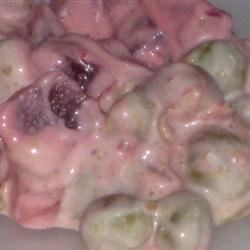
But we're looking for salads of harlequin designs, and I'm sorry, but there's just no design there. Mom and her ilk are simply using the word "harlequin" to mean multicolored. Harlequin design has got to refer to a much more distinctive diamond shape pattern typical of the Commedia dell'Arte character. Like this:

So I'm picturing some mound of edible material with criss-crossing strips of pimento. Ah! Here: "Fancy Salads of the Big Hotels." That book is from 1921, one year before the events in "The Great Gatsby" are supposed to take place. And here's Robert Salad:
Place two slices of tomato on half a heart of romaine, and on top place two rings of green pepper. Lay a slice of hard boiled eggs in each of the rings and decorate with diamond shaped dice of pimento.I know. It's really no less disgusting than Mom's concoction. But were we supposed to be licking our chops over this? It's a sentence read in isolation, but I'm guessing we were supposed to think this spread was extravagant and yet... we're happy to stay home with Mom and her ilk after the 4 buckets of Miracle Whip with canned goods have disappeared, down the various household gullets.
Bewitching!
Sunday, January 13, 2013
"I knew the other clerks and young bond-salesmen by their first names, and lunched with them in dark, crowded restaurants on little pig sausages and mashed potatoes and coffee."
It means something that F. Scott Fitzgerald wrote "pig" instead of "pork." I think about how George Harrison sang about piggies, the bigger piggies, "in their starched white shirts... stirring up the dirt" as well as "the little piggies... crawling in the dirt." (He stirred up Charles Manson to deliver "a damned good whacking.")
Life was "getting worse" for the little piggies, while, by contrast, the bigger piggies "always had clean shirts." Now, I'm not going to veer off into the topic of The Great — big pig — Gatsby's shirts. You know if you've read "The Great Gatsby" or seen the movie that a huge to-do is made at one point about how many beautiful shirts Gatsby had.
But here in this Gatsby project, we look at one sentence in isolation. That way, everyone's on the same footing. You don't have the little readers and the bigger readers. Life isn't getting worse for some of us and just fine for others. We gather here, in the daily post, to consume one sentence, so let's lunch.
Let's know each other by first names. Here we are equals. We have all read the sentence, and we can all very well speak out about it. Here, we actively exclude extrinsic evidence. About the book, I mean. We're free to drag in anything else, such as The Beatles, as betamax3000 did so well in yesterday's Gatsby thread, the one about warm human magic.
So pig, then. Pig, not pork. Which makes us think that the clerks and bond-salesmen are little piggies. The men eating humble food — all the humbler for saying pig, not pork — in a dark, crowded place. A pigsty? Our narrator is crammed in close quarters with them as he chows down. He's on familiar terms with them: He calls them by their first names. He's a member of the herd of little piggies.
Did you notice the words are right there one after the other: little pig? As a competent and tolerant reader, you can tell it's the sausages and not the pigs that are supposed to be little, and as a picky reader, you might say it's bad writing to permit that ambiguity to survive the final draft. But maybe the writer wanted you to see little pig. And the bigger question is why insert the pig at all? We'd presume that sausages were pork. Obviously, Fitzgerald wants us to think about pigs and think about the men as pigs. He wasn't as blunt as Mr. Harrison, but he was calling these guys pigs.
Another reason to throw pig in there, permitting the ambiguity, is to call the sausages little without being too aggressively Freudian about saying little sausages and making us think too quickly — before we'd noticed all these other things — of pricks.
ADDED: Meade, helping me proofread, questioned "herd" as the proper collective term for pigs. I know there are some other options, but I like it because it evokes Jesus:
Life was "getting worse" for the little piggies, while, by contrast, the bigger piggies "always had clean shirts." Now, I'm not going to veer off into the topic of The Great — big pig — Gatsby's shirts. You know if you've read "The Great Gatsby" or seen the movie that a huge to-do is made at one point about how many beautiful shirts Gatsby had.
But here in this Gatsby project, we look at one sentence in isolation. That way, everyone's on the same footing. You don't have the little readers and the bigger readers. Life isn't getting worse for some of us and just fine for others. We gather here, in the daily post, to consume one sentence, so let's lunch.
Let's know each other by first names. Here we are equals. We have all read the sentence, and we can all very well speak out about it. Here, we actively exclude extrinsic evidence. About the book, I mean. We're free to drag in anything else, such as The Beatles, as betamax3000 did so well in yesterday's Gatsby thread, the one about warm human magic.
So pig, then. Pig, not pork. Which makes us think that the clerks and bond-salesmen are little piggies. The men eating humble food — all the humbler for saying pig, not pork — in a dark, crowded place. A pigsty? Our narrator is crammed in close quarters with them as he chows down. He's on familiar terms with them: He calls them by their first names. He's a member of the herd of little piggies.
Did you notice the words are right there one after the other: little pig? As a competent and tolerant reader, you can tell it's the sausages and not the pigs that are supposed to be little, and as a picky reader, you might say it's bad writing to permit that ambiguity to survive the final draft. But maybe the writer wanted you to see little pig. And the bigger question is why insert the pig at all? We'd presume that sausages were pork. Obviously, Fitzgerald wants us to think about pigs and think about the men as pigs. He wasn't as blunt as Mr. Harrison, but he was calling these guys pigs.
Another reason to throw pig in there, permitting the ambiguity, is to call the sausages little without being too aggressively Freudian about saying little sausages and making us think too quickly — before we'd noticed all these other things — of pricks.
ADDED: Meade, helping me proofread, questioned "herd" as the proper collective term for pigs. I know there are some other options, but I like it because it evokes Jesus:
Some distance from them a large herd of pigs was feeding. The demons begged Jesus, “If you drive us out, send us into the herd of pigs.” He said to them, “Go!” So they came out and went into the pigs, and the whole herd rushed down the steep bank into the lake and died in the water. Those tending the pigs ran off, went into the town and reported all this, including what had happened to the demon-possessed men. Then the whole town went out to meet Jesus. And when they saw him, they pleaded with him to leave their region.
Wednesday, January 2, 2013
Saturday, December 8, 2012
"Court keeps alive inmate's quest for pork feast."
Headline at the National Law Journal makes the "quest" sound more absurd than it is. The prisoner, Derek Kramer, is an Odinist and he's suing in pursuit of his rights under the Free Exercise Clause and the Religious Land Use and Institutionalized Persons Act.
From the 7th Circuit court's opinion (PDF):
Kramer's loss on everything but the pork feast (which he hasn't yet won) is based on procedural matters that are probably only interesting to lawyers — unless you know how to be interested in the way procedure can operate to undermine rights.
From the 7th Circuit court's opinion (PDF):
Odinism is a polytheistic religion, which was practiced for millennia in northern Europe before the rise of Christianity and has been revived in recent decades. The practice of Odinism includes group worship ceremonies. Pork is a sacred food to Odinists....Kramer had a larger problem with the group worship at the Green Bay Correctional Institution: The Department of Corrections lumps the "Pagan" religions together for group worship purposes, and he objected to a specifically Wiccan ritual at the service. The demand for an annual pork feast was part of a larger effort to separate the Odinists from the Wiccans.
Specifically, Kramer asked for a feast on December 21st for the “High Feast of Yule” and “further requested that HAM/PORK be included in with the FEAST MEAL.”...
Kramer's loss on everything but the pork feast (which he hasn't yet won) is based on procedural matters that are probably only interesting to lawyers — unless you know how to be interested in the way procedure can operate to undermine rights.
Subscribe to:
Posts (Atom)