Showing posts with label addiction. Show all posts

Tuesday, September 24, 2013

"I haven’t had a cigarette in probably 6 years. That’s because I’m scared of my wife.”

Said Barack Obama, caught in a seemingly candid moment.

I don't believe in the truth of either statement — that he hasn't had a cigarette in about 6 years and that he's scared of his wife — but I don't hear an intent that these remarks be taken as true. I hear an off-the-record interaction with one individual that's about making a friendly connection. There's camaraderie in displaying that he knows something personal about the other man and — since what he knows is that the man has a substance addiction problem — referring to his own parallel weakness.

He doesn't scold or put down the other man, but expresses hope — hope! — that the man has quit smoking and makes the possibly untrue assertion that he hasn't smoked one cigarette in "probably 6 years." This is an encouraging remark, and I think that it was offered in the spirit of encouragement but that Obama also realized that it might sound braggadocious, so he toned it down with the self-deprecating humor about being scared of his wife.

That gives an explanation for not smoking and works as posing that he's an ordinary guy tending to the demands of his wife, even though he is the most powerful man in the world. This is humanizing and a bit silly, and it's a male-bonding moment, containing the implication that wives are demanding and require appeasement.

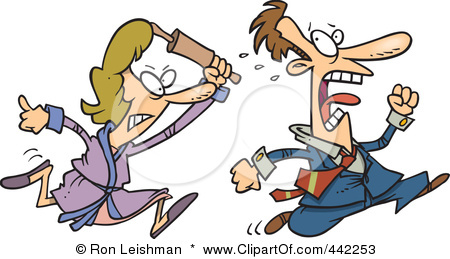
If you want to mock or criticize Obama here, I think the more sophisticated speculation not that he's revealed he's subservient and pusillanimous, but that this is misogyny or male chauvinism. Obama is using his wife — both as a stereotypical woman and as the caricature of her that we see in the media — to make points with another man. Michelle Obama is not there. It's a remark about her behind her back. She's not named, but called "my wife." And she's scary. He's not actually scared, just tapping an old sexist mindset that makes it possible to laugh at stupid cartoons like this:


And Obama is simultaneously appropriating the anti-Michelle propaganda of his political opponents. He's casually gesturing at the huge pile of mean-spirited scribblings about how she's always nagging everybody about health, all the miscellaneous things scribbled on web pages and illustrated with photos like this:


Feminists and traditionalists alike can chide the man who engages in loose, humorous talk about his wife behind her back.

***

"Honor your marriage; keep it pure by remaining true to your wife in every way."

Monday, September 16, 2013

"Chinese state television on Sunday broadcast a startling video of a famous blogger in handcuffs, renouncing his Web posts..."

"... and saying how dangerous the Internet would be if left uncontrolled by the government."
“At first, I was careful and I didn’t write many posts,” [said Charles Xue — a Chinese American businessman and one of China’s most popular bloggers]. “But later, I posted more than 80 every day. . . . In the beginning, I verified every post. But later on, I no longer did that. All of a sudden you draw so much attention...How do you describe the feeling? Gorgeous.”...

In one [blog post], he wondered whether China’s water, whose quality is always in question, contained contraceptives.

“First of all, I didn’t double-check my facts,” Xue said. “Secondly, I didn’t raise constructive suggestions to solve the problem. Instead, I just simply spread these ideas emotionally.”...

[Under China's new laws, t]hose whose posts are deemed rumors and that have been viewed by more than 5,000 Internet users or reposted more than 500 times will be subject to prosecution and face a possible three-year prison sentence.

Xue praised the new laws Sunday. “It is very necessary to release these laws and regulations today,” he said in the video. “Without regulation, there’s no punishment for spreading the rumors.”...
Xue said that as his online following grew, so did his ego. He received invitations from universities and entrepreneurs. He felt like the “emperor of the Internet.” But, he said, in what may have been his biggest mistake, he felt that even leaders of China’s ruling Communist Party were not as powerful as he was. It’s not right for [popular bloggers] to behave higher than the law,” he said in a chastened tone. “If there is no moral standard or cost for slander, you can’t manage the Internet. And there are no limits. It becomes a big problem.”
This is important not only because of the suppression of free speech in China, but because of the light it sheds on our own ideas about controlling free speech. Xue is apparently under pressure, so anyone with any sense knows not to take these statements at face value but to read between the lines.

And yet taken literally, these statements sound like things many Americans say with sincerity, even though they are under no pressure at all and live in a culture with a tradition of free speech.

Notice the idea that writing on the internet is an addiction, a mental problem that ought to be disparaged. The blogger is an egotist, who pours out verbiage to further inflate his own grandiosity. This isn't normal speech, but bad speech, and there's so much of it that what once might have been thought of as a "marketplace of ideas" is flooded with so much tainted merchandise that the government acts wisely to step in with consumer protection measures.

Pay attention to the arguments Americans make that lend themselves to the retort: You sound like Charles Xue on Chinese state television.

Tuesday, June 25, 2013

"Things I Learned in My Twenty-Four Hour Althouse Comment Withdrawal."

From betamax3000 (at 12 midnight):
• the Shakes -- they Get Real Bad;

• Twenty-Four Hours is A Long Period of Time When You Deny Yourself;

• the Baby Spiders are Real;

• I Love the Commenters: Read All the Posts, All Day, Tongue Bound, and Realized in Retrospect that -- Perhaps -- I Occasionally Suck Too Much Oxygen From the Room;

• Still Don't Quite Get Central Time;

• the Scientology "No Fear' Paradigm Crosses Neuropaths with Cruel Neutrality: when I get it Down to Four Paragraphs I Will Thrust it Sideways Into a Thread about Gabe Kaplan;

• it -- Technically -- is Not a Burning Sensation.
I do not discount the role of  El Pollo Raylan's summoning: "Beta come back!" — which took us to another dimension, a dimension not only of sight and sound, but of mind.

Lem sighed relief:
I think I can say tonight that we are in Betamax debt. From now on it will be possible to risk loosing wifi knowing that it is a survivable non-event thanks to the courage and determination of one man. and his name is Betamax.
And:
Still Don't Quite Get Central Time;

Its like Althouse politics, I think.
That's exactly right. And then betamax3000 said:
At the Metaphorical Althouse Denny's I want More hash Browns and Non-Dairy Creamer: I am building a Mountain.
And I say: This means something. This is important.


Loose the WiFi!

Saturday, June 22, 2013

"The idea that 'shame works' — that stigmatizing behaviors and shaming the people who do them are necessary and honorable tools of public policy..."

"... is a recurring theme in both conservative and more communitarian/paternalistic liberal rhetoric. It’s often based on personal experience, or home truths from one’s mom, and because people do sometimes say that shame worked for them I had a hard time articulating why I rejected this rhetoric so completely."

Writes Eve Tushnet, who figured out the answer from reading "Middlemarch."

What? You're ashamed never to have read "Middlemarch"? I'm not, because I have read it, not that I remember the part about shame.
I remember one thing about the book: Some lady was hugely supportive of her husband's writing, but then — spoiler alert! — after he dies, she gets a good look at his supposed magnum opus and it's no damned good at all. Did I get that right? I read it decades ago, and though I've seen it listed among the top books that you're supposed to read — at least if you want to be considered a reader of serious literature — I don't think you need to read it. You're off the hook — in my book — for not reading it. So no need to approach this discussion with any shame about that. And I'll just leap to what's so bad about shame that reading "Middlemarch" made Eve Tushnet capable of articulating. Then we can discuss what's so bad about shame. (You can also discuss how "Middlemarch," specifically, elucidates things, or how reading serious literature enables us to fathom complex concepts.)

Tushnet looks at "what I was like in the year or two before I quit drinking":
During that time, when I knew that I had a serious drinking problem but hadn’t yet quit, shame completely corroded my moral sense. It isolated me. I felt like there was nobody I could trust or talk to. I had no hope of change and no sense that there was any way out. I was able to imagine taking actions to hide what was going on, but stopping was completely unimaginable....
When people try to shame you, you might "just get[] angry... and totally reject[] their judgment... and decide[] to make [your] way in the world while paying them as little attention as possible."
Shame is closely allied with disgust, and we attach it to things like poverty at least as often as to actual wrongdoing. Few people feel guilty for smelling bad or getting their period in gym class; plenty of people feel ashamed for those things. This makes shame inherently a more suspect tool. It’s also inherently more tied to outside opinion than guilt is. This is part of its usefulness – like I said above, shame forces you to see yourself through other people’s eyes, which can be a powerful corrective – but shame does involve a kind of outsourced or socialized conscience.

Monday, May 27, 2013

"When you’re in public, you’re in public. What happens in public, is the very definition of it."

"I don’t want you telling me that I can’t take pictures in public without your permission."

Jeff Jarvis, quoted in an article about the intrusions of Google Glass.
Mr. Jarvis said we’ve been through a similar ruckus about cameras in public before, in the 1890s when Kodak cameras started to appear in parks and on city streets.

The New York Times addressed people’s concerns at the time in an article in August 1899, about a group of camera users, the so-called Kodak fiends, who snapped pictures of women with their new cameras.

“About the cottage colony there is a decided rebellion against the promiscuous use of photographing machines,” The Times wrote from Newport, R.I. “Threats are being made against any one who continues to use cameras as freely.” In another article, a woman pulled a knife on a man who tried to take her picture, “demolishing” the camera before going on her way.
Interesting things about that old NYT article:

1.  The word "kodak" — with a lower-case k — is used repeatedly in place of the word "camera," and the word "camera" appears once, toward the end, and only after "photographing machines." Less attention was paid back then, it seems, to the interest in preserving the trademark in brand names. (The loss of "aspirin" and "heroin" as Bayer trademarks came after WWI.)

2. The word "fiends," used repeatedly, connotes evil and addiction. From the same time period, the OED quotes: "The autograph-fiend; the cyclist-fiend; the interviewer-fiend; the newsboy-fiend; the organ-fiend" (1896), "‘A dope fiend’... A victim of the opium habit" (1896).

3. The word "promiscuous" fits with the nature of the perceived harm: women are victims. The article refers to "married men" wanting to bring lawsuits against the photographers. One man is said to have consulted a lawyer about whether "an assault could be charged" if the photograph is taken "against the will." But how sexual is the word "promiscuous"? The etymology connected it to "mixed up," and the oldest meaning is, according to the OED: "Done or applied with no regard for method, order, etc.; random, indiscriminate, unsystematic." The OED has some great quotes for the specifically sexual meaning that seems so central to us today:
1804   S. T. Coleridge Coll. Lett. (1956) II. 1119   He is..addicted to almost promiscuous Intercourse with women of all Classes.
1879   Harlequin Prince Cherrytop 29   Better frig, howe'er the mind it shocks, Than from promiscuous fucking catch the pox....
1924   C. Connolly Let. Dec. in Romantic Friendship (1975) 32,   I am not promiscuous but I can't be loyal to an icicle....
1978   S. Herzel in P. Moore Man, Woman, & Priesthood viii. 119   It is precisely because men can compartmentalize that they are more easily promiscuous than women.

Wednesday, March 27, 2013

"In Love With a Sex Addict" — oh, really?


I hadn't given much thought to the much-bruited Tiger Woods/Lindsey Vonn romance, but something about that magazine cover set off my bullshit detector. I think his PR people contacted her PR people and this couple was concocted for our consumption. I love the way they are in love... with the camera. Smiley eyes!

Here's the underlying story.
"They're a really happy couple -- not living together yet," a source explains to Us Weekly... "He confessed everything in his past to her and stuff - they're really into each other," the source tells Us.
Confessed? How do you confess — and stuff! — when everything was all already in the newspapers? And speaking of everything... did you see this new Nike ad that's been "criticized by some"?

Saturday, February 16, 2013

The Olympics have cut wrestling, and one young man grapples with disappointment.

Kyle Snyder, 17, "a 5-foot-11, 215-pound marble slab of an athlete — undefeated in his high school career, and the top-ranked prep wrestler in the country at his weight class."
“I just grew an overwhelmingly powerful love of wrestling, and it was all I could think about,” Snyder said. “I didn’t want to be out on the football field. I wanted to be getting better at wrestling. I think I have an addictive personality, and when I fall in love with something I keep thinking about it and thinking about it.”

“Wrestling is his calling,” said Snyder’s coach.... “He probably spends 80 to 90 percent of every waking hour thinking about wrestling.”
Sad that they took wrestling out of the Olympics... and it's also sad that a determined, competitive kid like this has absorbed a message from modern American culture that extraordinary concentration and dedication is a mental disorder.

I think I have an addictive personality....

How did a 17-year-old American learn to talk about himself like that? Is it a disarming faux-modesty that he's developed so that other kids don't lose their self-esteem (like they could do as well if they were weird enough to spend all their time on one thing)? Or does he genuinely think of himself as deranged and analogous to a junkie? Shouldn't a successful high school athlete be regarded as someone to be emulated by other kids (and not a bizarre outlier to be observed for entertainment's sake but disregarded as any kind of example of how to live)?

Here's some discussion of what psychiatric experts consider to be the characteristics of an addictive personality:
- Impulsive behavior, difficulty in delaying gratification, an antisocial personality and a disposition toward sensation seeking.

- A high value on nonconformity combined with a weak commitment to the goals for achievement valued by the society.

- A sense of social alienation and a general tolerance for deviance.

- A sense of heightened stress.
This isn't at all the same thing as exceptional dedication.

I'm not knocking Snyder. He's 17 and a great achiever. I'm knocking the culture that got a message through to his still-developing mind.

Sunday, December 30, 2012

"What I learned about beauty from my 56 hours in jail."

I hope you learned not to do that duck-lips thing with your mouth that you did in the "Self-portrait from the day before the incident." But no, it's stuff like:
These women were endlessly resourceful: colored pencils for eyeliner, lip liner, and eye shadow (yeah, it fucking hurts to apply). If you bend every other prong of the standard-issue comb, it becomes a makeshift brush....
The worst thing about my short time in jail? Honestly? Besides the indignity and the shitty food and the crushing boredom and the derision from the staff and the self-loathing just being there obviously inspired? Chapped lips.

OK, maybe I’m being a little facetious, but I was parched. My lips were cracked and bleeding, spoiled with a steady diet of Fresh Sugar lip treatment. Licking my lips only made it worse, but I couldn’t help it — it was Pavlovian. It sounds stupid, but I remember that agony more clearly than anything else. When my cellmate shared her makeshift chapstick (shave gel mixed with something pink that I never actually identified) with me, I practically kissed her. 
That sets up a hilarious lampooning by a commenter. Excerpt:
We broke our inkpins and blew the black ink out into our small cups of vasaline, then took a small 2 inched toothbrush to apply... some girls lined their eyes with Sharpies, meant to label our personal property. We made lip gloss with color out of red Kool-Aid or red jello and neosporin. We had clear toothpaste gel that did everything but brush your teeth, and we used this for everything from hair gel to adhesives for our pictures and calanders... We took our Gold Bond Foot Powder and dripped coffee and red Kool-Aid in our cups to try and create eyeshadow and blush....
Another commenter offers a tip she learned in school:
This sounds gross, but my 8th grade science teacher told the class that he just used his own ear wax as lip balm...

The worst part is that he wasn't even mentioning this as like a survival technique....
I love when science teachers challenge their students.

Look, don't even get started with the chapstick. It's addictive:


You'll wake up thinking about it: