"... my answer to that is that the lack of interest in the question asked in this post shows why that project doesn't fly. The Gatsby project flew. It turned on minds that accepted the turn-on and took off."
The last line of my comment explaining why I have yet to fulfill what may seem to be a promise to complete an assignment I really only gave myself.
And this post gets not only a Gatsby project tag, but also a written strangely early in the morning tag.
It's okay if you don't volunteer to sit for my outside-of-law-school exams. I have plenty of exams written by nonvolunteers that I am duty-bound to read. This post is about a duty I felt I had to write the answer to my own exam, which I only gave because I wanted to write that answer. But if the question inspired no one else, then I tend to think that my answer would only have seemed weird or annoying or — the worst — unreadable.
Or is that the worst? The devil nags me to ask. The devil says: Wouldn't it be a fascinating new project to write a blog called "Unreadable Things"?
Showing posts with label the Althouse comments community. Show all posts
Showing posts with label the Althouse comments community. Show all posts
Saturday, December 14, 2013

Thursday, October 3, 2013
At the Asphalt Chalk Café...

... you can talk about whatever you want.
(Your comment will not go up instantly. I need to approve comments, but free speech is encouraged in café posts. I would turn off the moderation function if I knew that the people I've specifically told never to comment again would refrain, but since I happen to know that they won't, this is how we must live now. Sorry to all who miss the old freedoms. I do too!)
ACTUALLY: I'm going to try non-moderation for a little while, starting now and only on today's posts. Let's see if this can work. Obviously, it's an invitation to the haters to drive this thing back into moderation, but if that happens, then the people who've been begging to get back to non-moderation will have had a chance to see what I'm dealing with here. Of course, that chance to see will be transitory, because the people I need to delete will be deleted soon enough.
Thursday, September 26, 2013
All those commenters who wanted me to read "The Fountainhead."
All I did was buy the ebook "Atlas Shrugged" so I could blog about things Ted Cruz — "Political anarchist or genius?" — said in his (not a) filibuster yesterday. Having riffed on and sniffed at some bloody metaphors in the Ayn Rand tome, I was beset with comments telling me the Ayn Rand book I really must read is "The Fountainhead."
Surfed started it:
And then Kit Carson said:
Surfed started it:
The Fountainhead was a better read, a more cogent and focused book and you get the same dose of the philosophy....
Addendum: In the movie Dirty Dancing (1987) Baby confronts Robbie to pay for Penny's abortion. Robbie refuses to take responsibility and preaches “Some people count and some people don’t” and then hands Baby a used paperback copy of The Fountainhead saying, “Read it. I think it's a book you'll enjoy, but make sure you return it; I have notes in the margin."
And then Kit Carson said:
Yes, Atlas Shrugged is great. But her earlier novel, Fountainhead, is her greatest work. Fountainhead is much shorter and she presents all her main themes and her analysis more clearly and in more entertaining fashion. The epic scene where Ellsworth Toohey explains himself and his intentions is one of the most significant pieces of writing of the modern world. Reading those few pages may well change your life.And Tank:
I too would recommend The Fountainhead instead.And the (here inaptly named) SomeoneHasToSayIt said:
Yes. Read Fountainhead before Atlas Shrugged, which would have been better served, imo, by the title Rand wanted, The Strike.And Tom began with an excellent appeal to my vanity:
Althouse, I believe you'd find The Fountainhead a more enjoyable read. In fact, I've often though of you, as a blogger, blogging in a similar manner as Howard Roark worked in architecture. To the point that I could see you destroying this blog if it was co-oped and transformed into something without your consent. What I believe that Rand was getting at - at least in my limited understanding - was a sense of personal ownership and self-accountability.Henry dumps a pitcher of cold water:
In Atlas Shrugged, she explores these concepts more. And while she always warns against the "looters" and "moochers", it is on the productive and creative that she aims her lesson - your success or failure is owned by you and is created or destroyed by your choices. What she telling the productive and creative is that there are those would will use all manner of tactics to instill in your a sense of guilt. But it is your choice to accept or reject this premise. This is not moderation in the political sense of, "should we put the road in this location or that?" -- those choices are not what Rand is getting at. Rand is asking the virtuous to understand the nature of personal ownership and self-sovereignty.
My initial reaction to both books was probably more of an adolescent "I'll take my ball and go home" reaction. Only over time did I understand that life really requires me to understand my values and to live those values based on my choices, not others. It doesn't mean I divorce myself from others - in fact, just the opposite - it means valuing who I love in the deepest sense.
Atlas Shrugged was readable as a kind of gaseous Hindenburg melodrama. I'm baffled how anyone can recommend The Fountainhead. That was as unreadable as any novel I've ever picked up. It doesn't help that Rand conflates ideology with aesthetics. Foolishness results.Mike Dini had a different approach to appealing to my vanity:
Ann -- You are normally interesting. It isn't April fools. Are intentionally trying to piss off the type of individual that tends to follow your blog? This is the sort of tripe I’d expect out of Chris Matthews.Stay away from me. Stay away from my sister, or I'll have you fired.
Don't jump into Atlas Shrugged from Anthem. Read Fountainhead first. You've decided beforehand not to like the books but at least you will be able to talk intelligently about the novels. You didn't do that here.
Sunday, September 22, 2013
Kinja, Gawker's answer to the problem of ugly, out-of-control comments sections.
"Kinja flips on its head the idea of comments and conversation below a story on Gawker Media’s Web sites...."
I blog to publish my own writing, and I include comments as a way for me to interact with readers and to amplify and get different angles on things I want to talk about. I'm not about devoting my work to maintaining a social media website for people who don't care about what I'm writing. That's the enterprise of people like Denton who are designing a mechanism for making a lot of money. As an individual expressing myself — with the long-time motto "To live freely in writing" — I am more like the commenters upon whom Gawker is leveraging its Kinja scheme.
When people sign up for Kinja, they are given their own Web address on the Gawker platform — similar to a Tumblr Web site — which becomes a collection of that person’s comments on stories. Kinja will also enable readers to write headlines and summaries — comments that have graduated from college, if you will — for stories on Gawker and even from other sites. Readers will then be able to use Kinja as a central hub for discussion on these stories, almost like their own chat room protected from the commenting maelstrom.Great. I hope the design works. Seems similar to what Metafilter has been for many years. It's good to allow people to take possession of their collected comments that are otherwise scattered about. You can take some pride in your body of comments, at least within Gawker blogs (as, on Metafilter, you have a page that collects your comments on all the various Metafilter posts you've commented on). It makes being a commenter more like being a blogger, and it lets a popular commenter drive traffic to blog posts. But it's all very intra-Gawker, just like Metafilter is intra-Metafilter. I'd like to see an overarching comments system like this. And I'd love to see Blogger provide something like this for Blogger blogs like mine.
Along with the updates to the comments service on Monday, Mr. Denton is set to unveil “a manifesto” of sorts that will outline Gawker’s plan to further blur the line between reporters and readers and explain readers’ rights. Among them, there is “the right to experience legible conversations” on the site.I've had a big struggle, peaking over the summer, with the problem of "illegible conversation," as problem commenters maliciously disrupt what might otherwise be a readable comments section. Now, I don't know that the Kinja solution will work. It might empower some of the most disruptive commenters, as they go off topic to entertain and win admirers for some agenda or style of comedy or edgy satire who'll relocate to their Kinja page. But Denton just wants you within the Gawker media empire, and not off on Twitter or Facebook, because he wants the page views in his operation, where he gets the ad revenue. The situation for a blogger is different.
I blog to publish my own writing, and I include comments as a way for me to interact with readers and to amplify and get different angles on things I want to talk about. I'm not about devoting my work to maintaining a social media website for people who don't care about what I'm writing. That's the enterprise of people like Denton who are designing a mechanism for making a lot of money. As an individual expressing myself — with the long-time motto "To live freely in writing" — I am more like the commenters upon whom Gawker is leveraging its Kinja scheme.
Friday, June 28, 2013
"So many people here, people that I otherwise respect, have written so much cloaked or naked vituperation about gay people..."
"... and our effect on civilization, that what little sympathy I had for your 'feelings' has long evaporated."
Sometimes, I get discouraged about the way people can't or won't read. It's not just the skimming and leaping to assumptions that you know what is being said, it's normal-speed reading of concision, and the failure to stop and see humor and wordplay. The post that people continued to get outraged over — which explained the extent to which the Supreme Court called gay-marriage opponents "bigots" — ended:
I said "stop acting like losers." I didn't say that you were losers in every aspect of your being. "Man up, losers," referred to losing this case, and "man up" is a sarcastic allusion to homophobia — on the off chance that some of you might think gay men are unmanly — and to the fact that we are in a turnabout in which the former losers have become the victors. There were winners and losers in that case, and the losers need to decide how they want to deal with it. I said "stop acting like losers." That implies that there is a sort of person who is an all-around loser. I didn't say you were one of them. My locution was: Don't be like them.
That was good advice, and it was intended to be a slap in the face. Wake up!
I had a premonition as soon as I wrote that line that you wouldn't snap out of it, that you would continue the crying that I find laughable. That's why I said "If you can. (I bet you can't!)"
I was right.
And I anticipate another round of crying over how terribly mean I have been to you.
At this point in my life I'm finished with the lot of you, the plantation master so-called "liberals" who are less distinguishable from Fascists every day, and the so-called small-government "conservatives", who have such little faith in their God and the eternal and sacred institution of marriage that they bray for the State to enshrine their doctrine in secular law, and scream "Apocalypse!" when it doesn't happen.Writes Palladian, in last night's café, where the whimpers of the losers of the DOMA case continued, along with slurpy wound-licking over my calling them losers — which is what they were, having lost in that case — and advising them not to whine over the more-or-less false perception that they'd been called bigots.
Sometimes, I get discouraged about the way people can't or won't read. It's not just the skimming and leaping to assumptions that you know what is being said, it's normal-speed reading of concision, and the failure to stop and see humor and wordplay. The post that people continued to get outraged over — which explained the extent to which the Supreme Court called gay-marriage opponents "bigots" — ended:
You took the opportunity to oppress when it was there, and now that it's gone, you want to say you are oppressed. Man up, losers. You lost. And you deserved to lose. Now, stop acting like losers. If you can. (I bet you can't!)The losing was the losing of the case. I gave advice not to cry about it. You're a former victor, since you won when DOMA was passed into law. Many years later, those oppressed by DOMA ousted the oppressor. You need to get some perspective on how laughable your sadness over your loss looks to those who were saddened by the oppression you enjoyed all those years. But I've interacted with you and communicated with you over this issue since 2004, when this blog started. I didn't intend to write a legal or a political blog at all, but this issue had intrigued me for a long time. I have been patient in these conversations — over 400 of them. And now, what is obviously to me the good side has won in Windsor. I refrained from gloating over this important victory. But I saw all this whining and crying about being called a "bigot," and I wanted to tell you that this did not look good, that you needed to find a way to a positive, productive future that would contain this right going forward.
I said "stop acting like losers." I didn't say that you were losers in every aspect of your being. "Man up, losers," referred to losing this case, and "man up" is a sarcastic allusion to homophobia — on the off chance that some of you might think gay men are unmanly — and to the fact that we are in a turnabout in which the former losers have become the victors. There were winners and losers in that case, and the losers need to decide how they want to deal with it. I said "stop acting like losers." That implies that there is a sort of person who is an all-around loser. I didn't say you were one of them. My locution was: Don't be like them.
That was good advice, and it was intended to be a slap in the face. Wake up!
I had a premonition as soon as I wrote that line that you wouldn't snap out of it, that you would continue the crying that I find laughable. That's why I said "If you can. (I bet you can't!)"
I was right.
And I anticipate another round of crying over how terribly mean I have been to you.
Tuesday, June 25, 2013
"Things I Learned in My Twenty-Four Hour Althouse Comment Withdrawal."
From betamax3000 (at 12 midnight):
Lem sighed relief:
Loose the WiFi!
• the Shakes -- they Get Real Bad;I do not discount the role of El Pollo Raylan's summoning: "Beta come back!" — which took us to another dimension, a dimension not only of sight and sound, but of mind.
• Twenty-Four Hours is A Long Period of Time When You Deny Yourself;
• the Baby Spiders are Real;
• I Love the Commenters: Read All the Posts, All Day, Tongue Bound, and Realized in Retrospect that -- Perhaps -- I Occasionally Suck Too Much Oxygen From the Room;
• Still Don't Quite Get Central Time;
• the Scientology "No Fear' Paradigm Crosses Neuropaths with Cruel Neutrality: when I get it Down to Four Paragraphs I Will Thrust it Sideways Into a Thread about Gabe Kaplan;
• it -- Technically -- is Not a Burning Sensation.
Lem sighed relief:
I think I can say tonight that we are in Betamax debt. From now on it will be possible to risk loosing wifi knowing that it is a survivable non-event thanks to the courage and determination of one man. and his name is Betamax.And:
Still Don't Quite Get Central Time;That's exactly right. And then betamax3000 said:
Its like Althouse politics, I think.
At the Metaphorical Althouse Denny's I want More hash Browns and Non-Dairy Creamer: I am building a Mountain.And I say: This means something. This is important.
Loose the WiFi!
Sunday, June 2, 2013
"I love when you talk dirty!"
A dialogue between 2 men in last night's open thread "At the Saturday Peony Café":
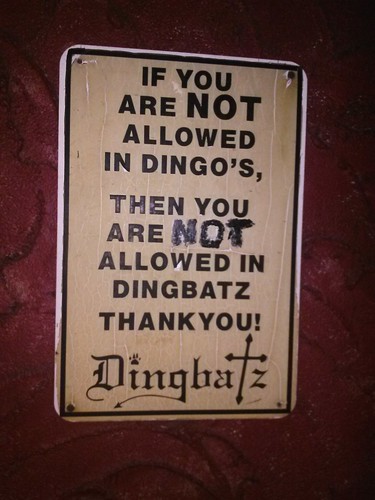
Also in the vicinity was another man, Lem. Unlike Palladian, he wasn't commenting on the music and yearning, at least not directly. He just told his own story — "We went to see a new friend perform at a local establishment and I took a picture of a sign near the entrance" — and showed us this:

Palladian: A few years ago, "peony" was a very popular note in perfumery. Many perfumes used this note, which was generally done as a big, fluorescent, loud, fruity-flower odor of no particular interest. Givaudan makes 2-cyclohexylidene-2-phenylacetonitrile, an aroma chemical they call Peonile, which I always find hilarious. Say it: Peonile.Also in the comments, a dialogue between 2 women:
El Pollo Raylan: The name is apt. I see lots of structural rigidity in the linear nitrile portion which has a nitrogenous lone pair at one end. Then there's the cyclohexylidene portion which is quasi-floppy, but made stiffer by attachment to the olefinic core. The phenyl is of course rigid except for its rotational degree of freedom.
Palladian: I love when you talk dirty!
Freeman Hunt: We had some new tile installed in our kitchen this week. One afternoon the installers washed their tools outside and left without coming back in. Because they did not come back in, they forgot to turn off their radio. The radio was across the newly laid tile that we were forbidden to walk upon. So we listened to popular, contemporary country music all that evening and for three hours the next morning. Heh. (That story is much funnier to people who know me in real life. I don't listen to anything in the background. Ever. No television. No music. Nothing. I only turn something on if I want to listen to it actively.)Intruding on this perfectly female dialogue was the aforequoted Palladian: "That's what a handgun and good aim are for."
Synova: I don't listen to "background" anything either. I can see you standing at the edge of the tile... yearning.
Freeman Hunt: "yearning"... Perfect word.
Also in the vicinity was another man, Lem. Unlike Palladian, he wasn't commenting on the music and yearning, at least not directly. He just told his own story — "We went to see a new friend perform at a local establishment and I took a picture of a sign near the entrance" — and showed us this:
Monday, May 6, 2013
Tuesday, April 30, 2013
"Imagine you're in the oven, baking."
"Some of us know and accept our sexuality right away and some need more time to cook. I should know — I baked for 33 years."
Just catching up on the metaphors in the Jason Collins "coming out" piece in Sports Illustrated that everyone was talking about yesterday. I found this story boring, but somehow the comments on my post on the subject heated up — like you were in the oven, baking — and they're up to 788 comments. What's going on in there? In my book, a 34-year-old gay guy that has gone to a lot of trouble to stay in the closet — or the oven — in this day and age is hardly a courageous hero. Yes, he's in a major American team sport, but he's at the very end of his career, and who'd heard of him before? I see nothing but a career boost for this guy. What is the big deal? Someone left the cake in the oven for 33 years, and I don't think that I can take it, 'cause it took so long to bake it, and you were about to retire from basketball anyway, oh noooooo! O-oh nooooooo!
That cake metaphor came at the end of a paragraph that began:
Just catching up on the metaphors in the Jason Collins "coming out" piece in Sports Illustrated that everyone was talking about yesterday. I found this story boring, but somehow the comments on my post on the subject heated up — like you were in the oven, baking — and they're up to 788 comments. What's going on in there? In my book, a 34-year-old gay guy that has gone to a lot of trouble to stay in the closet — or the oven — in this day and age is hardly a courageous hero. Yes, he's in a major American team sport, but he's at the very end of his career, and who'd heard of him before? I see nothing but a career boost for this guy. What is the big deal? Someone left the cake in the oven for 33 years, and I don't think that I can take it, 'cause it took so long to bake it, and you were about to retire from basketball anyway, oh noooooo! O-oh nooooooo!
That cake metaphor came at the end of a paragraph that began:
The first relative I came out to was my aunt Teri, a superior court judge in San Francisco. Her reaction surprised me. "I've known you were gay for years," she said. From that moment on I was comfortable in my own skin. In her presence I ignored my censor button for the first time. She gave me support. The relief I felt was a sweet release.Sweet release with your aunt? Having ignored your censor button — for the first time? really? — you might want to find your editor button. I love that the aunt was all "I've known you were gay for years." The first person he came out to found his announcement boring. I'm with Aunt Teri. It's boring. This cake was baked long ago. I recall the yellow polyester shorts/Foaming like a wave/On the ground around your knees/The birds like tender babies in your hands/And the old men playing checkers, by the trees....
Monday, March 18, 2013
As expected, I got some pushback for saying "I hope the Supreme Court blesses us with" a right to same-sex marriage.
That was a provocative way to say that it will be a blessing if the upcoming Supreme Court cases resolve this issue that is dogging and distorting the political discourse in our country.
Even to say "it will be a blessing" would have been provocative, since it seems to give God credit for whatever good happens. But that usage of "blessing" has constitutional text to support it:
So to say "I hope the Supreme Court blesses us" is to identify the Court as the source of the blessing, to put the Court in the place of God, and to prompt and tease those who think the Court improperly makes up rights. That was deliberate and devilish temptation. Thanks for succumbing!
Below the fold are the comments that inspired this post:
1. Gahrie:
But I don't think a right to same-sex marriage will play out politically the same way. The pro-life movement is propelled by the belief that what's going on in the zone of privacy is the murder of helpless, innocent human beings. Pro-lifers can never move on. There is no corresponding moral compulsion to continue to agonize over what's happening inside someone else's marriage. Even if you think it's terrible and sinful, you can move on. That's the political blessing I foresee.
Even to say "it will be a blessing" would have been provocative, since it seems to give God credit for whatever good happens. But that usage of "blessing" has constitutional text to support it:
We the People of the United States, in Order to form a more perfect Union, establish Justice, insure domestic Tranquillity, provide for the common defence, promote the general Welfare, and secure the Blessings of Liberty to ourselves and our Posterity, do ordain and establish this Constitution for the United States of America.Liberty is a set of blessings, our Founders told us. The human task is to secure the blessings. If the Supreme Court says it has found a liberty — let's say a right to same-sex marriage — we may say that it is securing a liberty that is already there. When someone says "bless you," that doesn't mean that the blessing emanates from the speaker. It's short for "God bless you." It's asking God to deliver a blessing. In the Constitution, what we see is that the Framers believed that God had blessed us with liberty.
So to say "I hope the Supreme Court blesses us" is to identify the Court as the source of the blessing, to put the Court in the place of God, and to prompt and tease those who think the Court improperly makes up rights. That was deliberate and devilish temptation. Thanks for succumbing!
Below the fold are the comments that inspired this post:
1. Gahrie:
This is a perfect example of our country's problems right here. You, a Constitutional law professor, our hoping that the Supreme Court will create a "right" that you favor.2. MayBee:
The Supreme Court doesn't "bless us" with rights, or create rights. It protects the ones given to us by our creator and enumerated by the people in the Constitution.
Yes, the "blessing us" idea is troubling from a constitutional law professor. Perhaps it is some of her famous humor.3. alwaysfiredup:
"I hope the Supreme Court blesses us with the requisite constitutional right"4. Chuck:
Oh dear lord...
Surely, SURELY, as a law prof you could phrase this to be less off-putting.
Prof. Althouse;5. Hagar:
Huh?
You "hope the Supreme Court blesses us with the requisite constitutional right..."?
Say what? Since when was the Supreme Court in the business of 'blessing us with constitutional rights'? I thought they were in the business of constitutional interpretation, and working on judicial review of legislation. Not "blessings."
I hope that the Supreme Court "blesses me" with a new Cadillac and a Rolex watch.
Since you are a highly intelligent person, and an expert in constitutional interpretation, I am curious what you think is a plausible basis for the Court to extend such a blessing. Given that whatever the Court decides to bestow as a "blessing," it is taking away from individual states. If the test for reviewing DOMA and California's Prop 8 is not "rational basis," what is the proper test? And if the test is rational basis, how does DOMA or Prop 8 offend?
The Supreme Court cannot "bless us" with a non-existent Constitutional right.6. ed:
It is the word "marriage" that causes the problem for people.
It is not that hard for the Federal Gov't and the States to get out of the "marriage" business. Just declare that for the future "marriage" is a religious ceremony outside their purview, but existing "marriages" will be accepted as Civil Unions for taxes and other secular purposes.
@ Gahrie "The Supreme Court doesn't "bless us" with rights, or create rights. It protects the ones given to us by our creator and enumerated by the people in the Constitution."7. Unknown:
You're forgetting the penumbra of the umbrella of the awning of the cockleshell of the reflected shadow on a latrine wall of unenumerated rights as recognized only when someone on the Supreme Court has a wet fart.
Because evidently I do not have the right to not have a federal drone hovering over my yard or a DEA SWAT team breaking down my door, shooting my dogs and handcuffing me on the say-so of a drug abusing informant looking to buy his freedom but two gay men have the right to bugger each other in privacy.
But then again if you look at the various opinions set forth by the multitude of SCOTUS decisions you can find just about any kind of idiotic retarded nonsense because it appears to be more of justifying what the justices want rather than what the Constitution actually has written.
I thought Althouse's original post was a tounge on cheek [sic] reference to how we just moved on after the Supreme Court blessed us with Roe v Wade. Her follow comment leaves me scratching my head.I think the "follow comment" of mine that he's referring to is: "The GOP will be better off if the Supreme Court trumps this political issue. Democrats will may [sic] rejoice publicly, but privately they should curse." I used the word "curse" in deliberate counterpoint to "bless." And this actually should make sense in connection with Roe v. Wade. Politically, the decision undercut the liberals who would have fought for the right and gave huge energy to those who opposed it.
But I don't think a right to same-sex marriage will play out politically the same way. The pro-life movement is propelled by the belief that what's going on in the zone of privacy is the murder of helpless, innocent human beings. Pro-lifers can never move on. There is no corresponding moral compulsion to continue to agonize over what's happening inside someone else's marriage. Even if you think it's terrible and sinful, you can move on. That's the political blessing I foresee.
Saturday, February 23, 2013
What did Jesus write in the sand? (Or: things I should have learned in church that I figured out from the Althouse comments.)
Yesterday, when many blogs were talking about the Islamist Facebook page with a cartoon showing how to stone a person who had committed adultery, I added the New Testament story, from John 8, in which Jesus said: "Let him who is without sin among you be the first to throw a stone at her." Jesus had just been teaching some people, and the scribes and the Pharisees, looking for a way to trip him up — they wanted to bring charges against him — present Jesus with a woman who had been caught in the act of adultery and remind him that the Law of Moses commanded that she should be stoned. "So what do you say?" Instead of answering, Jesus bends over and writes in the dirt. They keep pushing for an answer, and it's only then that he says: "Let him who is without sin among you be the first to throw a stone at her."
I didn't include the next few sentences, but the story was very familiar. After Jesus makes his brilliant remark — which finds a new way into the question — the crowd disperses and Jesus tells the woman to "go and... sin no more."
Some of the commenters focused on what it was that Jesus wrote on the ground. I'd always assumed that what Jesus was writing was irrelevant and that he was simply gesturing I'm not going to talk to you. He invoked his right to remain silent, as we say in the United States of America. He knew whatever he said would be used against him. Later, when he arrives at the New Testament doctrine — the higher law — he speaks up and articulates it pithily. He doesn't write it. Jesus isn't the put-it-in-writing type. The scribes are the bad guys here, and he's about talking to the people. The Word is spoken. (It's only written down later.)
But, reading the comments, I see interest in the subject of what Jesus wrote.
Sydney says: "In the movie The King of Kings, each accuser comes up to Jesus and sees written in the dirt his own sin, and turns and walks away. I love that scene." Is that the standard theory of what Jesus wrote?
And Chip Ahoy, linking here, says: "But what did he write in the sand?" At the link, we get added details from The Urantia Book (which I'd never heard of). There, the idea is that Jesus knew the woman's husband was a "troublemaker" and "perceived" that he'd forced the woman into prostitution and that the husband was now cooperating with the Pharisees to get Jesus to say something that could be used to arrest him. In this version of the story, Jesus doesn't just bend over and write in the dirt right where he is. He walks over to the troublemaker husband and writes something in front of him that makes him rush off. Jesus comes back to his original place and writes on the ground again, and the men, "one by one," leave. Last to go, is "the woman's companion in evil," who gets his own special message written in the dirt.
Kentuckyliz gives us the Old Testament quotes (the law of Moses, which is what the Pharisees threw at Jesus to trip him up):
In this scenario, Jesus acknowledges the written law of Moses by writing it. That's the Old Testament, which Jesus won't reject, even as his enemies are trying to lure him into rejecting it. He's showing that he knows the law, and in very few words, he's made it obvious to the legal experts that they are getting the law wrong and making them see their own faint-heartedness about equal justice, applying the strict law strictly on its written terms and to everyone. Then Jesus speaks, and the spoken word is the New Testament, calling us to a higher place, above the strict rules, under which we are all sinners. The New Testament demands that we look at our own sins. Go and sin no more.
That ought to keep you busy for the rest of your life. Now, leave other people alone.
ADDED: A second post includes the "King of Kings" clip and more.
I didn't include the next few sentences, but the story was very familiar. After Jesus makes his brilliant remark — which finds a new way into the question — the crowd disperses and Jesus tells the woman to "go and... sin no more."
Some of the commenters focused on what it was that Jesus wrote on the ground. I'd always assumed that what Jesus was writing was irrelevant and that he was simply gesturing I'm not going to talk to you. He invoked his right to remain silent, as we say in the United States of America. He knew whatever he said would be used against him. Later, when he arrives at the New Testament doctrine — the higher law — he speaks up and articulates it pithily. He doesn't write it. Jesus isn't the put-it-in-writing type. The scribes are the bad guys here, and he's about talking to the people. The Word is spoken. (It's only written down later.)
But, reading the comments, I see interest in the subject of what Jesus wrote.
Sydney says: "In the movie The King of Kings, each accuser comes up to Jesus and sees written in the dirt his own sin, and turns and walks away. I love that scene." Is that the standard theory of what Jesus wrote?
And Chip Ahoy, linking here, says: "But what did he write in the sand?" At the link, we get added details from The Urantia Book (which I'd never heard of). There, the idea is that Jesus knew the woman's husband was a "troublemaker" and "perceived" that he'd forced the woman into prostitution and that the husband was now cooperating with the Pharisees to get Jesus to say something that could be used to arrest him. In this version of the story, Jesus doesn't just bend over and write in the dirt right where he is. He walks over to the troublemaker husband and writes something in front of him that makes him rush off. Jesus comes back to his original place and writes on the ground again, and the men, "one by one," leave. Last to go, is "the woman's companion in evil," who gets his own special message written in the dirt.
Kentuckyliz gives us the Old Testament quotes (the law of Moses, which is what the Pharisees threw at Jesus to trip him up):
Deuteronomy 22:22 "If a man is found sleeping with another man's wife, both the man who slept with her and the woman must die."Kentuckyliz adds:
Leviticus 20:10 "If a man commits adultery with another man's wife — with the wife of his neighbor — both the adulterer and the adulteress must be put to death."
What's interesting about the Jesus scene, is that the law had become misogynistic in practice. The man is not being stoned according to the mandates of the law. In fact, I suspect he was standing in the crowd holding a stone.Note that even in the extremely concise story told in John 8, we hear that the woman was "caught in the act." Whether he was in the crowd or not, the adulterer was known. Why aren't the authorities proposing to stone both the man and the woman? Kentuckyliz doesn't refer to what Jesus wrote in the sand, but this made me imagine that Jesus wrote "the man and the woman." And if the woman was a prostitute, all of the men who had ever slept with her would deserve stoning too.
In this scenario, Jesus acknowledges the written law of Moses by writing it. That's the Old Testament, which Jesus won't reject, even as his enemies are trying to lure him into rejecting it. He's showing that he knows the law, and in very few words, he's made it obvious to the legal experts that they are getting the law wrong and making them see their own faint-heartedness about equal justice, applying the strict law strictly on its written terms and to everyone. Then Jesus speaks, and the spoken word is the New Testament, calling us to a higher place, above the strict rules, under which we are all sinners. The New Testament demands that we look at our own sins. Go and sin no more.
That ought to keep you busy for the rest of your life. Now, leave other people alone.
ADDED: A second post includes the "King of Kings" clip and more.
Wednesday, December 26, 2012
My post title "Buttons offed" made one reader picture "2 hands clasping the lapels of their own jacket and ripping them apart to reveal not a blouse but 2 voluptuous naked breasts."
"Buttons offed, pop pop, that's the image that happens" — says commenter Chip Ahoy, prompting Dr Weevil to say "Photoshop or it (your fantasy) didn't happen."
If he hadn't achieved this status yet — and I think he had — Chip Ahoy became the #1 Althouse commenter of all time — not counting Meade — by producing the Photoshop. (There's a link within that link, so nothing NSFW unless you click again.)
If he hadn't achieved this status yet — and I think he had — Chip Ahoy became the #1 Althouse commenter of all time — not counting Meade — by producing the Photoshop. (There's a link within that link, so nothing NSFW unless you click again.)
Tuesday, December 18, 2012
Why are people having so much trouble understanding rhetorical devices?
You may remember Justice Scalia the other day tweaking the kids at Princeton for not being able to handle reductio ad absurdum:
Scalia never said homosexuality is like bestiality. Here's the passage in his dissenting opinion in Lawrence v. Texas that heats up his opponents:
It's rhetoric to respond to that question — a demand for an account of Scalia's inner life — by mocking the student's inability to understand rhetoric. That was cold, intentionally cold. Hey, you Princeton guys are supposed to be smart. But Scalia could have chosen a warmer approach without selling himself out. That question could have been answered:
See? Shame on you! I am offended! Come on, think about it. Figure out the puzzle. It's an analogy, pithily phrased, and thus an occasion to pick apart the ways in which the 2 statements are/are not parallel. Many readers in my comments thread did understand the rhetoric and deal with the coherence of the analogy, but many fell into the sort of expression of outrage that's so common and so dull these days. At least show you understand the rhetoric and then tell me it's in bad taste to be humorous and challenging over topics so raw and painful.
The second post that got me started on this topic was the one that linked to this Matt K. Lewis item "The media should be ashamed of its Connecticut coverage." I'd quoted only the last few lines of that piece, where he proposed "some common sense media control." He's doing a twist on the post-Newtown gun control arguments, switching the right under threat from the 2d Amendment to the 1st Amendment. I thought that was clever and thought-provoking, but unfortunately some readers didn't get it. One said: "Professor Althouse, I'm not sure whether you got punked or if you get that this article is satire and are endorsing it's [sic] specious point." Oh, jeez, that's annoying! I like to keep things crisp around here. Are people going to be so dull that all humor will need arrows pointing at it saying it's humor?
Actually, I see that the 2 comments I've selected for quotation here are by the same person. Maybe he's simply pretending to be dull and doing the Theater of Outrage. That's rhetoric too, and I need to get it.
It's a form of argument that I thought you would have known, which is called the 'reduction to the absurd'...It can't be, of course, that the Princeton students never get argument that comes in the form of taking a principle you know your interlocutor holds dear and presenting him with other things that could fall within the principle that you know he'll object to. It's irritating to be on the receiving end. The one who wields that argument is playing with ideas, fun-loving, and challenging. The one on the receiving end doesn't want to play along. He may get super-serious and offended: How dare you talk about something I hold dear alongside those horrible things that all decent people loathe?! It's an argument with which older, calmer people needle the emotional young.
Scalia never said homosexuality is like bestiality. Here's the passage in his dissenting opinion in Lawrence v. Texas that heats up his opponents:
State laws against bigamy, same-sex marriage, adult incest, prostitution, masturbation, adultery, fornication, bestiality, and obscenity are... sustainable only in light of Bowers’ validation of laws based on moral choices. Every single one of these laws is called into question by today’s decision; the Court makes no effort to cabin the scope of its decision to exclude them from its holding.Now, it's rhetoric to act like he equated homosexuality with bestiality. It's rhetoric to say — as the Princeton student did — "Do you have any regret or shame for drawing these comparisons you did in your dissents?"
It's rhetoric to respond to that question — a demand for an account of Scalia's inner life — by mocking the student's inability to understand rhetoric. That was cold, intentionally cold. Hey, you Princeton guys are supposed to be smart. But Scalia could have chosen a warmer approach without selling himself out. That question could have been answered:
Actually, I do have feelings and I know that many of the opinions I write upset people, but what would cause me regret or shame would be to let things like that sway me from deciding the cases according to the law. I'm a judge, and when I'm doing my judge work, I have to stick to being a judge. And part of being a judge is to demand that a case express a rule that can be applied to other things that are similar. The question in Lawrence was whether moral feeling, standing alone, is enough to support a law. If the majority was saying no, then it needed to commit to that proposition across the board, and I was testing that, and a test really does need to be sharp and probing. I get that it pains you, but step up and argue with me. Tell me why bestiality is different from the other things on the morality-only list. Actually, it's pretty easy: The animal has feelings. We have feelings. Animals have feelings. Feelings matter. But as a judge, I can't do feelings. Come on, have some empathy for me in my plight!I've gone on quite long about Scalia, but Scalia wasn't the inspiration for this post. What got me started on this track was the difficulty readers had with 2 of yesterday's posts that entailed the use of rhetorical devices. One consisted of 2 quotes: "What is the gun community going to do about this tragedy?"/"I dunno. What is the gay community going to do about Penn State?" This linked to Instapundit, who provided the source of the quotes and who now has a couple updates that suggest he's getting pushback similar to some of what I see in my long comments thread, e.g., "Professor Althouse, the comparison is absurd, bigoted and offensive any way you cut it. You should be ashamed of yourself for linking to it with approval."
See? Shame on you! I am offended! Come on, think about it. Figure out the puzzle. It's an analogy, pithily phrased, and thus an occasion to pick apart the ways in which the 2 statements are/are not parallel. Many readers in my comments thread did understand the rhetoric and deal with the coherence of the analogy, but many fell into the sort of expression of outrage that's so common and so dull these days. At least show you understand the rhetoric and then tell me it's in bad taste to be humorous and challenging over topics so raw and painful.
The second post that got me started on this topic was the one that linked to this Matt K. Lewis item "The media should be ashamed of its Connecticut coverage." I'd quoted only the last few lines of that piece, where he proposed "some common sense media control." He's doing a twist on the post-Newtown gun control arguments, switching the right under threat from the 2d Amendment to the 1st Amendment. I thought that was clever and thought-provoking, but unfortunately some readers didn't get it. One said: "Professor Althouse, I'm not sure whether you got punked or if you get that this article is satire and are endorsing it's [sic] specious point." Oh, jeez, that's annoying! I like to keep things crisp around here. Are people going to be so dull that all humor will need arrows pointing at it saying it's humor?
Actually, I see that the 2 comments I've selected for quotation here are by the same person. Maybe he's simply pretending to be dull and doing the Theater of Outrage. That's rhetoric too, and I need to get it.
Subscribe to:
Posts (Atom)