"... my answer to that is that the lack of interest in the question asked in this post shows why that project doesn't fly. The Gatsby project flew. It turned on minds that accepted the turn-on and took off."
The last line of my comment explaining why I have yet to fulfill what may seem to be a promise to complete an assignment I really only gave myself.
And this post gets not only a Gatsby project tag, but also a written strangely early in the morning tag.
It's okay if you don't volunteer to sit for my outside-of-law-school exams. I have plenty of exams written by nonvolunteers that I am duty-bound to read. This post is about a duty I felt I had to write the answer to my own exam, which I only gave because I wanted to write that answer. But if the question inspired no one else, then I tend to think that my answer would only have seemed weird or annoying or — the worst — unreadable.
Or is that the worst? The devil nags me to ask. The devil says: Wouldn't it be a fascinating new project to write a blog called "Unreadable Things"?
Showing posts with label written strangely early in the morning. Show all posts
Showing posts with label written strangely early in the morning. Show all posts
Saturday, December 14, 2013

Thursday, December 12, 2013
"Why should we continue to care about Guantánamo?"
A student asked Linda Greenhouse on the last day of the law school course she taught on the sole topic of Guantánamo. She doesn't mention that the law school is Yale, which is the most difficult law school to gain admission to and therefore the one with the most elite set of students. Odd to think that someone who got into Yale and elected to take a course dealing solely with Guantánamo — it can't possibly be a required course — endured the experience to the last day and still asked why should I care?
I wasn't there, so I don't know the tone of the question. Greenhouse gives the context the student presented — "the Guantánamo population has shrunk even as urgent human rights crises that place many more people at risk have erupted in other parts of the world" — and characterizes the question as "deliberately provocative and not entirely rhetorical." Greenhouse informs us that the class was provoked to "lively" "conversation" that "quickly" produced "consensus."
Of course, the intense activity of devoting a law school semester to one legal problem needs to make sense in the end. Simple human defensiveness could explain the quick trip to consensus. Why did we take this course instead of Information Privacy Law or Law and Regulation of Banks and Other Financial Intermediaries or whatever else might have captured our hearts on Yale Law School's rich menu of course offerings?
Here's how Greenhouse, in her NYT column, phrases the consensus:
And that place is: ME! This is about ME! This is US! This is WHO. WE. ARE. Ah, relief. So I haven't been staring for months into the dismal stories of 162 shady-but-perhaps-procedurally-abused characters. I've been staring into a mirror at myself. Ah! The relief! It was about me!
That was where the elite students quickly found relief from provocation. I suspect that practically any particular legal problem can support the claim that it's really about the legitimacy and principle of the entire legal system, so the quick consensus position — to me, seen from a distance — feels more like evidence of the students' desire to free themselves from the anxiety of having paid a semester's worth of attention to something they believed they would care about, because they liked the idea of being the sort of people who do care when others do not care, but then they saw that they did not really care at least not quite that much.
And then the relief comes, and it has sufficient resonance with the original choice of what to study: I am studying myself caring about the people I wanted to believe I cared about. I've been looking into the mirror to see if I care, and I must now see that I care, or it doesn't make sense to have chosen to stare for months into a mirror to see if I care. I do care. I care about me caring.
I wasn't there, so I don't know the tone of the question. Greenhouse gives the context the student presented — "the Guantánamo population has shrunk even as urgent human rights crises that place many more people at risk have erupted in other parts of the world" — and characterizes the question as "deliberately provocative and not entirely rhetorical." Greenhouse informs us that the class was provoked to "lively" "conversation" that "quickly" produced "consensus."
Of course, the intense activity of devoting a law school semester to one legal problem needs to make sense in the end. Simple human defensiveness could explain the quick trip to consensus. Why did we take this course instead of Information Privacy Law or Law and Regulation of Banks and Other Financial Intermediaries or whatever else might have captured our hearts on Yale Law School's rich menu of course offerings?
Here's how Greenhouse, in her NYT column, phrases the consensus:
We care because the Guantánamo saga isn’t only about the 162 men still held there, or the hundreds who have come and gone. It’s about the health of our own institutions, our own commitments. We look in the mirror of Guantánamo and see ourselves.From "isn’t only about the 162 men" I gather that the students got weary of caring about those 162 men. If they are the 162 who are left, they are there for a reason. Bush put them there, but Obama has kept them there. Must we really go over and over the question of whether it all was done precisely right? And then you see it: the place of refuge from this nagging doubt about whether these 162 men deserved all this elite law study.
And that place is: ME! This is about ME! This is US! This is WHO. WE. ARE. Ah, relief. So I haven't been staring for months into the dismal stories of 162 shady-but-perhaps-procedurally-abused characters. I've been staring into a mirror at myself. Ah! The relief! It was about me!
That was where the elite students quickly found relief from provocation. I suspect that practically any particular legal problem can support the claim that it's really about the legitimacy and principle of the entire legal system, so the quick consensus position — to me, seen from a distance — feels more like evidence of the students' desire to free themselves from the anxiety of having paid a semester's worth of attention to something they believed they would care about, because they liked the idea of being the sort of people who do care when others do not care, but then they saw that they did not really care at least not quite that much.
And then the relief comes, and it has sufficient resonance with the original choice of what to study: I am studying myself caring about the people I wanted to believe I cared about. I've been looking into the mirror to see if I care, and I must now see that I care, or it doesn't make sense to have chosen to stare for months into a mirror to see if I care. I do care. I care about me caring.
"The assignment on this blog exam (written early in the morning of the day I plan to compose another law school exam) is..."
"... Using only that passage, discuss whether Mitch H. or Althouse's response accords with the ideas of the devil."
Scroll up for what Mitch H. said, then down for my response, and then the next 2 comments are a passage from "The Screwtape Letters."
Scroll up for what Mitch H. said, then down for my response, and then the next 2 comments are a passage from "The Screwtape Letters."
Wednesday, November 13, 2013
Let me explain what Richard Cohen, a person of conventional views, meant by "People with conventional views."
I gestured at the Richard Cohen vortex last evening, and I wasn't going to help silly people with their nonproblem, but I woke up feeling a little merciful, so, here, let me help.
As far as I can tell — and I'm guessing because I don't see the value of looking too long into chaos — the younger generation just doesn't read the word "conventional" the same way we oldies do. (I'm 62, and Cohen is 72.) The sentence that got him in trouble with the sensitive youths of America was:
Okay. See what I did? I used "conventional" in the pejorative way that oldies do. I happen to like to kick liberals, mostly because they think so damned well of themselves and I find that tedious and cloying.
Richard Cohen — the one we're talking about here (i.e., not my ex-husband) — is the sort of liberal who says the usual things that liberals say. It's quite dull. Why would he suddenly be anything else? To me, he is conventional, a conventional liberal, and older folks think we're sticking in the dagger when we call people "conventional."
But when Cohen (complacently, predictably liberal) said "conventional views," he didn't mean liberals, even though liberals (including, notably, him) are quite conventional. He meant those other guys — the bad guys — and he had no idea that anyone could think of him as anything other than one of the good guys — the liberals — because that's how conventional he was!
Now, I will close the door on these boring people and let them fight amongst themselves. I hope they benefit from the exercise and emerge from it with more vigor and discernment.
As far as I can tell — and I'm guessing because I don't see the value of looking too long into chaos — the younger generation just doesn't read the word "conventional" the same way we oldies do. (I'm 62, and Cohen is 72.) The sentence that got him in trouble with the sensitive youths of America was:
People with conventional views must repress a gag reflex when considering the mayor-elect of New York — a white man married to a black woman and with two biracial children.I suspect that Cohen thought he'd found a cute and clever way to kick conservatives and had zero reason to think that his readers would do anything other than assume that he was kicking conservatives, since that's what liberals always do. I have a hard time understanding why anyone would think that old Cohen would do anything other than state a... conventional view.
Okay. See what I did? I used "conventional" in the pejorative way that oldies do. I happen to like to kick liberals, mostly because they think so damned well of themselves and I find that tedious and cloying.
Richard Cohen — the one we're talking about here (i.e., not my ex-husband) — is the sort of liberal who says the usual things that liberals say. It's quite dull. Why would he suddenly be anything else? To me, he is conventional, a conventional liberal, and older folks think we're sticking in the dagger when we call people "conventional."
But when Cohen (complacently, predictably liberal) said "conventional views," he didn't mean liberals, even though liberals (including, notably, him) are quite conventional. He meant those other guys — the bad guys — and he had no idea that anyone could think of him as anything other than one of the good guys — the liberals — because that's how conventional he was!
Now, I will close the door on these boring people and let them fight amongst themselves. I hope they benefit from the exercise and emerge from it with more vigor and discernment.
Tuesday, September 24, 2013
"I haven’t had a cigarette in probably 6 years. That’s because I’m scared of my wife.”
Said Barack Obama, caught in a seemingly candid moment.
I don't believe in the truth of either statement — that he hasn't had a cigarette in about 6 years and that he's scared of his wife — but I don't hear an intent that these remarks be taken as true. I hear an off-the-record interaction with one individual that's about making a friendly connection. There's camaraderie in displaying that he knows something personal about the other man and — since what he knows is that the man has a substance addiction problem — referring to his own parallel weakness.
He doesn't scold or put down the other man, but expresses hope — hope! — that the man has quit smoking and makes the possibly untrue assertion that he hasn't smoked one cigarette in "probably 6 years." This is an encouraging remark, and I think that it was offered in the spirit of encouragement but that Obama also realized that it might sound braggadocious, so he toned it down with the self-deprecating humor about being scared of his wife.
That gives an explanation for not smoking and works as posing that he's an ordinary guy tending to the demands of his wife, even though he is the most powerful man in the world. This is humanizing and a bit silly, and it's a male-bonding moment, containing the implication that wives are demanding and require appeasement.
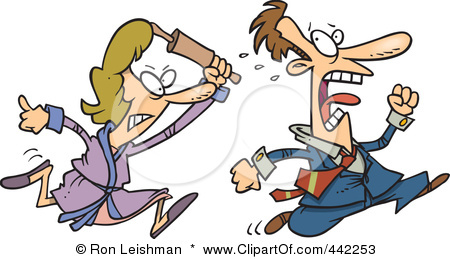
If you want to mock or criticize Obama here, I think the more sophisticated speculation not that he's revealed he's subservient and pusillanimous, but that this is misogyny or male chauvinism. Obama is using his wife — both as a stereotypical woman and as the caricature of her that we see in the media — to make points with another man. Michelle Obama is not there. It's a remark about her behind her back. She's not named, but called "my wife." And she's scary. He's not actually scared, just tapping an old sexist mindset that makes it possible to laugh at stupid cartoons like this:

And Obama is simultaneously appropriating the anti-Michelle propaganda of his political opponents. He's casually gesturing at the huge pile of mean-spirited scribblings about how she's always nagging everybody about health, all the miscellaneous things scribbled on web pages and illustrated with photos like this:

Feminists and traditionalists alike can chide the man who engages in loose, humorous talk about his wife behind her back.
"Honor your marriage; keep it pure by remaining true to your wife in every way."
I don't believe in the truth of either statement — that he hasn't had a cigarette in about 6 years and that he's scared of his wife — but I don't hear an intent that these remarks be taken as true. I hear an off-the-record interaction with one individual that's about making a friendly connection. There's camaraderie in displaying that he knows something personal about the other man and — since what he knows is that the man has a substance addiction problem — referring to his own parallel weakness.
He doesn't scold or put down the other man, but expresses hope — hope! — that the man has quit smoking and makes the possibly untrue assertion that he hasn't smoked one cigarette in "probably 6 years." This is an encouraging remark, and I think that it was offered in the spirit of encouragement but that Obama also realized that it might sound braggadocious, so he toned it down with the self-deprecating humor about being scared of his wife.

That gives an explanation for not smoking and works as posing that he's an ordinary guy tending to the demands of his wife, even though he is the most powerful man in the world. This is humanizing and a bit silly, and it's a male-bonding moment, containing the implication that wives are demanding and require appeasement.
If you want to mock or criticize Obama here, I think the more sophisticated speculation not that he's revealed he's subservient and pusillanimous, but that this is misogyny or male chauvinism. Obama is using his wife — both as a stereotypical woman and as the caricature of her that we see in the media — to make points with another man. Michelle Obama is not there. It's a remark about her behind her back. She's not named, but called "my wife." And she's scary. He's not actually scared, just tapping an old sexist mindset that makes it possible to laugh at stupid cartoons like this:
And Obama is simultaneously appropriating the anti-Michelle propaganda of his political opponents. He's casually gesturing at the huge pile of mean-spirited scribblings about how she's always nagging everybody about health, all the miscellaneous things scribbled on web pages and illustrated with photos like this:

Feminists and traditionalists alike can chide the man who engages in loose, humorous talk about his wife behind her back.
***
"Honor your marriage; keep it pure by remaining true to your wife in every way."
Saturday, September 7, 2013
"Ok, maybe your grandparents probably slept like you. And your great, great-grandparents."
"But once you go back before the 1800s, sleep starts to look a lot different. Your ancestors slept in a way that modern sleepers would find bizarre – they slept twice. And so can you."
We've talked about the subject of 2 sleeps before on this blog. (That's why a reader sent me that link.)
The new article cites a book called "Evening's Empire: A History of the Night in Early Modern Europe." From a review at that last link:
The intersleep has mission creep.
We've talked about the subject of 2 sleeps before on this blog. (That's why a reader sent me that link.)
The new article cites a book called "Evening's Empire: A History of the Night in Early Modern Europe." From a review at that last link:
[Craig] Koslofsky's epic history of the night reveals a revolution: how stage lights remade theater, how Lutheran mystics penetrated the night, how witch hunters fought the devil on his own nocturnal turf, how racism mirrored the presumed iniquity of blackness, and how street lights pacified cities....That book doesn't refer to Bob Dylan, who was not afoot in early modern Europe, but "Evening's Empire" takes me to:
Though I know that evenin’s empire has returned into sandThe thing about first and second sleep is that — here in mid-modern America — if you accept the opportunity of the wakeful time after a first sleep, you need to believe there's a second sleep in the offing. But who has that kind of confidence? Back in the 18th century, they didn't have electric lights. They didn't have computer monitors. After an hour or 2 of whatever they did in the dark — we're told they reflected, prayed, talked, had sex, and smoked — they'd be in the right condition to slip back to sleep. But reading the news of the world on a lit up screen and writing about it, I can't think of second sleep as anything more than a vague hope. What was supposed to be an interval becomes the entire next day.
Vanished from my hand
Left me blindly here to stand but still not sleeping...
The intersleep has mission creep.
"I mean really, besides my grandparents, who are both dead, who is watching the nightly news?"
Said Glenn Beck, when challenged about his boast that The Blaze would put traditional news out of business.
I've given some thought over the years — it's one of my long-time thought experiments — to the idea of an afterlife that consisted only of being able to watch the TV news, showing what was going on back in the world of the living.
And here's an article about Glenn Beck's "Man in the Moon" show:
Conservatives usually like to present themselves as appealing to the rational mind. This is not that.
I've given some thought over the years — it's one of my long-time thought experiments — to the idea of an afterlife that consisted only of being able to watch the TV news, showing what was going on back in the world of the living.
***
And here's an article about Glenn Beck's "Man in the Moon" show:
Part Tea Party rally, part Cirque du Soleil (my characterization, which Beck objected to), the show is a window into Beck’s mind — which he admits is riddled with attention-deficit disorder and a busy, buzzing energy — that is possibly more revealing than his famous chalkboard rants.Strange!
Conservatives usually like to present themselves as appealing to the rational mind. This is not that.
"It is a very strange moment for Mr. Obama..."
The NYT editorial on Obama's Syrian difficulties. It's against a military strike, I think, but in the most invisible possible way.
Let me paraphrase the 10 paragraphs:
¶1 — Obama is having trouble selling his plan to attack Syria.
¶2 — We're right to worry that the supposedly narrow attack will turn into another big war.
¶3 — The Pentagon is planning for broader war.
¶4 — The administration has asked the Pentagon to come up with more targets — more than the 50+ targets we already have.
¶5 — Obama has been vague about what these additional targets are (but they can't be the actual chemical stockpiles, because bombing them would unloose the poison).
¶6 — Talk of launching missiles from offshore has given way to reports of sending in bombers.
¶7 — Some members of Congress want to hem Obama in but McCain openly advocates taking the side of the rebels and ousting Assad.
¶8 — Obama is supposed to be the guy that gets us out of wars, and he owes us more assurance that what is planning really is narrow.
¶9 — Putin is staring Obama down.
¶10 — The whole group of foreign leaders gave Obama the cold shoulder.
¶8 is the key paragraph. It's the one with the quote I put in the post title. It's the one where the editors get as close as they are willing to answering the question posed in the headline: "Can Mr. Obama Avoid Mission Creep?" I think their secret answer is "no," but they don't want to say that. Instead, they lay out their worries and challenge him to explain how he's going to avoid a larger war. They say "the public deserves to understand more fully what 'limited' military action actually means" as if maybe it's our comprehension problem or his failure to sufficiently elaborate.
The first paragraph references Obama's planned speech on Tuesday, so maybe the editors thought, let's give him a chance to be specific about these things. Maybe the great speech-maker can explain it all next week. What's strange — if they want to talk about strange — is that Obama hasn't delivered the big explanatory speech yet. The simplest explanation is that he can't explain, and the answer to the question "Can Mr. Obama Avoid Mission Creep?" is just: no.
"Mission creep" sounds — to me, anyway — like a term from the Nixon era. (There was CREEP.) But in fact, at least according to Wikipedia's "mission creep" article, the term goes back to Somalia:
Whatever makes you happy... whatever you want....
Let me paraphrase the 10 paragraphs:
¶1 — Obama is having trouble selling his plan to attack Syria.
¶2 — We're right to worry that the supposedly narrow attack will turn into another big war.
¶3 — The Pentagon is planning for broader war.
¶4 — The administration has asked the Pentagon to come up with more targets — more than the 50+ targets we already have.
¶5 — Obama has been vague about what these additional targets are (but they can't be the actual chemical stockpiles, because bombing them would unloose the poison).
¶6 — Talk of launching missiles from offshore has given way to reports of sending in bombers.
¶7 — Some members of Congress want to hem Obama in but McCain openly advocates taking the side of the rebels and ousting Assad.
¶8 — Obama is supposed to be the guy that gets us out of wars, and he owes us more assurance that what is planning really is narrow.
¶9 — Putin is staring Obama down.
¶10 — The whole group of foreign leaders gave Obama the cold shoulder.
¶8 is the key paragraph. It's the one with the quote I put in the post title. It's the one where the editors get as close as they are willing to answering the question posed in the headline: "Can Mr. Obama Avoid Mission Creep?" I think their secret answer is "no," but they don't want to say that. Instead, they lay out their worries and challenge him to explain how he's going to avoid a larger war. They say "the public deserves to understand more fully what 'limited' military action actually means" as if maybe it's our comprehension problem or his failure to sufficiently elaborate.
The first paragraph references Obama's planned speech on Tuesday, so maybe the editors thought, let's give him a chance to be specific about these things. Maybe the great speech-maker can explain it all next week. What's strange — if they want to talk about strange — is that Obama hasn't delivered the big explanatory speech yet. The simplest explanation is that he can't explain, and the answer to the question "Can Mr. Obama Avoid Mission Creep?" is just: no.
***
"Mission creep" sounds — to me, anyway — like a term from the Nixon era. (There was CREEP.) But in fact, at least according to Wikipedia's "mission creep" article, the term goes back to Somalia:
The first two articles to use the term in the Washington Post were both by columnist Jim Hoagland ("Prepared for Non-Combat", April 15, 1993 and Beware 'mission creep' In Somalia, July 20, 1993). The New York Times used the term for the first time in an article by correspondent John H. Cushman, Jr. written after the October 4, 1993 firefight in the capital of Somalia, Mogadishu, in which 18 American military personnel were killed.Restore Hope.
The U.S. and later UN Mission in Somalia (Restore Hope) would seem to be the classic example of mission creep....
***
Whatever makes you happy... whatever you want....
Wednesday, September 4, 2013
Written strangely early in the morning...
What am I doing writing 7 posts between the hours of 1 and 3?
Maybe I should switch to blogging only in the middle of the night.
Maybe I should switch to blogging only in the middle of the night.
Tuesday, September 3, 2013
Perseverating about shoes before 7 a.m.
Woken by a phone call from the demonic "Blocked," I make coffee at 6 a.m. and sit down to approve the comments that collected in my "awaiting moderation" folder overnight. Somehow that sets me off to writing 5 comments in the thread about shoes. The coffee kicked in spiked by the false sunrise and the poetry it inspired and I got myself retracked onto the front page, where, looking back now, I feel like the blog has a theme today. It's something like: We're always only seeing things from our own point of view. (Dylan lyric: "We always did feel the same/We just saw it from a different point of view.")
So what did I say — about shoes?? — before sanity kicked in at 7? Highlights from the comments:
So what did I say — about shoes?? — before sanity kicked in at 7? Highlights from the comments:
... there are things you feel you need to do in NYC that you look almost foolish doing around here. I see some young women around campus mincing about on heels when no one else is. There isn't one man around who is dressed to go with that. It's as if she's on her way to a party that exists only in her mind....
Take a good look at yourself in the mirror when you've got your shorts on. Ask yourself if I were a woman, would I fuck me? (The question, put that way, assumes you are not a gay man. If you are a gay man, you don't need advice from me on how you look to other men.)....
I'm vulnerable to the criticism that I've promoted women's shoes that are like little girl shoes and that's inconsistent with saying shorts infantilize men. I'm treading -- in Mary Janes -- on dangerous ground!
Tuesday, June 25, 2013
"Firefighters use lid to put out kitchen pot fire in Berkeley."
Of all the headlines I have ever read, that one most exemplifies the loss of individual know-how and the instinct for self-defense in the face of dependence on government.
Wednesday, June 19, 2013
"The 35 Most Spectacular Wildlife Photos From The National Geographic Traveler Photo Contest."
#30 made me laugh. #5 is my favorite.
But don't take my word for it. I've been up since 4 a.m., woken by birds, the usual pre-dawn twittering racket having been made unusually wacky by an intermittent bass line contributed by an owl.
But don't take my word for it. I've been up since 4 a.m., woken by birds, the usual pre-dawn twittering racket having been made unusually wacky by an intermittent bass line contributed by an owl.
Subscribe to:
Posts (Atom)