Heavily.
Well, of course. You legalize it so you can tax it. To repurpose an old Obama-and-marijuana quote: That was the point.
Obama's appearance arrives at 0:57, after which a commenter (Howard Fineman) opines: "One of the reasons Barack Obama is so popular, especially among younger people, is that he seems so real, he seems to acknowledge the reality of things. It's kind of almost like a dog whistle kind of thing. Older people can't hear it. Younger people hear it. And that's one of the things that they hear. He seems to be willing to be honest."
I need some medical marijuana for my hearing. I'm old. I was old back in 2006 when that clip came out. Yes, I voted for him, but not because I believed he was a new kind of honest. And now, in 2013, watching that, what I hear — on the sound wavelengths that penetrate my old head — is the word "seems," screeching out of Fineman's word montage: He seems so real... he seems to acknowledge... He seems to be willing to be honest.
"Seems" and "willing."
Willing... like: Okay, I'll go along with this looking-honest bullshit for you folks for a while. So follow me, little puppies. I've got a new kind of reality kind of thing to kind of like show you. Can you, like, you know, hear it, kids?
And I got a big laugh out of Kathleen Parker, at the very end saying, "The thing people can't stand is the lies." I then rewatched the clip and lingered over the part where they showed Bill Clinton saying he "experimented" with marijuana and "didn't like it" and "didn't inhale." I found that very refreshing.
That's the kind of honesty I like right now. It was a lie, and you knew it was a lie when he told it. There was none of this feeling of oh, wow, look at the reality, man. What felt real was: There's a politician that will smile and lie straight to our faces. He's a liar.
Those were the days.
Showing posts with label hearing. Show all posts
Showing posts with label hearing. Show all posts
Wednesday, November 6, 2013

Wednesday, October 30, 2013
"why do i hate the sound of a dog cleaning itself?"
A search that brought someone to my blog this morning. What makes a person ask that question? You find a licking sound disgusting, but that's not the end of it. You ask why. That could be the beginning of some young person's serious intellectual exploration of human psychology. Or it could be just the next random thing that was just interesting enough to somebody who already had his fingers on the keyboard to do a little Google search.
By the way, the blog post of mine that came up in this Google search is quite helpful, giving you a key word: misphonia.
Bonus: Dog tongue pic, by Meade:

By the way, the blog post of mine that came up in this Google search is quite helpful, giving you a key word: misphonia.
Bonus: Dog tongue pic, by Meade:
Saturday, October 26, 2013
Would you want to go out to a concert of Bach Suites in a space that is kept completely dark?
I mean, wouldn't recorded music be better? And it would be a lot less trouble than going out, your chair at home is probably comfier, and there would be no one rattling a program/opening a candy wrapper/coughing. No one other than you. At home, you're free to sneeze, take you music device into the bathroom with you, eat all manner of smelly foods, and even sing along, making up your own words that don't even have to rhyme or make sense. The room was humming harder/As the ceiling flew away.... You can call out for another drink. Because you're alone and no one cares about your outbursts. Or someone else is there, but they've resigned themselves to putting up with the likes of you. You with your coughing and sneezing and nonsense lyrics. What happens when you call out for another drink? Does that long-suffering wife/husband of yours bring a tray?
But let say you do want to get up off your sofa and amble down the sidewalks of New York City to the Goethe-Institut Wyoming Building at 5 East 3rd Street. I love the combination of Goethe and Wyoming. Especially on 3rd Street. That's not 3rd Street in Brooklyn, where, you may remember, I lived back in the early 80s. That's positively 3rd Street in Manhattan, where you've got a lot of nerve to enter a concert hall in the dark:

But let say you do want to get up off your sofa and amble down the sidewalks of New York City to the Goethe-Institut Wyoming Building at 5 East 3rd Street. I love the combination of Goethe and Wyoming. Especially on 3rd Street. That's not 3rd Street in Brooklyn, where, you may remember, I lived back in the early 80s. That's positively 3rd Street in Manhattan, where you've got a lot of nerve to enter a concert hall in the dark:
After of years of investigation, the Suites are removed from the concert hall and placed in an unilluminated space, in which the cellist repeatedly plays them over a period of ten days. Through the extended timeframe and the elimination of any visual input, the listener and the playing musician are unified within the same visual and musical space.Scurry over there — would you? — if you're within scurrying distance, and let me know if you became unified with the musician by virtue of your presence in "the same visual and musical space." The "visual space" is nothingness. You can close your eyes while listening to your iPod, and imagine the cellist playing with his eyes shut. But he's not there, and it's not happening now, so unification requires more imagination. Still, this mystic state might be more achievable in the absence of the distraction of finding your way around in the dark.
Uncertainty about the original creative intentions of the Suites invites perpetual debate and allows imaginative free reign for redefining the environment in which they are played.I'm distracted reining in my imagination and reigning over my imagination about the old rein/reign pedantry. But proceed:
Bach Suites in the Dark removes the Suites from the concert hall [and] explores their malleability and the notion of practice in which they are rooted.Most people know the Suites from recordings — like this — so the notion of removing them from the place where you never needed to go invites us into the even-more-imaginary place in the past when people had no recorded music.
.jpeg)
Tuesday, September 17, 2013
"Slamming doors, banging walls, bellowing strangers and whistling neighbors were the bane of the philosopher Arthur Schopenhauer’s existence."
"But it was only in later middle age, after he had moved with his beloved poodle to the commercial hub of Frankfurt, that his sense of being tortured by loud, often superfluous blasts of sound ripened into a philosophical diatribe. Then, around 1850, Schopenhauer pronounced noise to be the supreme archenemy of any serious thinker."
Yeah, that poodle needs to simmer down.
Yeah, that poodle needs to simmer down.
Thursday, August 15, 2013
"The Passive House: Sealed for Freshness."
Quite aside from the environmentalism and the long-term cost savings, I love the promise of quiet:
Look out the living room windows and you can see a gardener wielding one of those ear-piercing leaf blowers in the yard, but you would never know it inside.
There is no furnace or air-conditioner clicking on or off, no whir of forced air, and yet the climate is a perfect 72 degrees, despite the chilly air outside....In one of the most humid cities in the country, you aren’t sticky or irritable....
Sunday, June 2, 2013
"I love when you talk dirty!"
A dialogue between 2 men in last night's open thread "At the Saturday Peony Café":
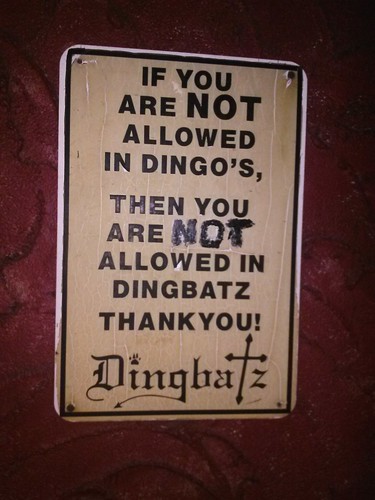
Also in the vicinity was another man, Lem. Unlike Palladian, he wasn't commenting on the music and yearning, at least not directly. He just told his own story — "We went to see a new friend perform at a local establishment and I took a picture of a sign near the entrance" — and showed us this:

Palladian: A few years ago, "peony" was a very popular note in perfumery. Many perfumes used this note, which was generally done as a big, fluorescent, loud, fruity-flower odor of no particular interest. Givaudan makes 2-cyclohexylidene-2-phenylacetonitrile, an aroma chemical they call Peonile, which I always find hilarious. Say it: Peonile.Also in the comments, a dialogue between 2 women:
El Pollo Raylan: The name is apt. I see lots of structural rigidity in the linear nitrile portion which has a nitrogenous lone pair at one end. Then there's the cyclohexylidene portion which is quasi-floppy, but made stiffer by attachment to the olefinic core. The phenyl is of course rigid except for its rotational degree of freedom.
Palladian: I love when you talk dirty!
Freeman Hunt: We had some new tile installed in our kitchen this week. One afternoon the installers washed their tools outside and left without coming back in. Because they did not come back in, they forgot to turn off their radio. The radio was across the newly laid tile that we were forbidden to walk upon. So we listened to popular, contemporary country music all that evening and for three hours the next morning. Heh. (That story is much funnier to people who know me in real life. I don't listen to anything in the background. Ever. No television. No music. Nothing. I only turn something on if I want to listen to it actively.)Intruding on this perfectly female dialogue was the aforequoted Palladian: "That's what a handgun and good aim are for."
Synova: I don't listen to "background" anything either. I can see you standing at the edge of the tile... yearning.
Freeman Hunt: "yearning"... Perfect word.
Also in the vicinity was another man, Lem. Unlike Palladian, he wasn't commenting on the music and yearning, at least not directly. He just told his own story — "We went to see a new friend perform at a local establishment and I took a picture of a sign near the entrance" — and showed us this:
Friday, April 12, 2013
"Did Recording the McConnell Meeting Violate State Law?"
Orin Kerr takes a look at the Kentucky eavesdropping statute and this relevant commentary:
But what would you say about writing down quotes? Many times, I've sat in cafés and heard people talking, and I've jotted down quotes I've found interesting. And here's a specific example: Once we sat in a café at a table where we could not help overhearing a conversation. We recognized one participant as a famous professor and he was saying some extraordinarily foolish things. There's a certain word, that — if you knew how to pronounced it the way this professor did — you could say and crack me up in one second. I could have written down a lot of quotes that day and blogged them. Decency constrained me. But, surely, that could not be made into a crime in the United States.
ADDED: I'm musing about what we might consider morally wrong because it relates to what the statute might mean and also what the government may — if it chooses — criminalize.
AND: It seems to me that putting your ear against the wall/door is wrong in a way that pausing to listen when you hear talking through a wall/door is not. Here's a passage from David Rakoff's book "Half Empty":
A conversation which is loud enough to be heard through the wall or through the heating system without the use of any device is not protected by KRS 526.020. A person who desires privacy of communication has the responsibility to take the steps necessary to insure that his conversation cannot be overheard by the ordinary ear.Kerr comments:
This is arguably quite relevant: the McConnell campaign discussion apparently was loud enough to be overheard from outside the door; from what we can tell, it was recorded from a phone or video camera without audio amplification. So that language makes me think that the recording was probably not a crime. At the same time, the commentary is ambiguous. It could be read as merely making the obvious point that eavesdropping requires a device. That is, listening with your ears is different from recording with a microphone.Obviously, you don't want to make a crime out of happening to hear a conversation on the other side of a door or wall. Perhaps there's something a little more wrong about stopping to listen, once you realize you can hear people talking. If you can hear through the wall when your neighbors talk, should you have an obligation not to pay attention or is it their responsibility to make sure you can't hear? Yet to record them seems to cross a moral line, I would think.
But what would you say about writing down quotes? Many times, I've sat in cafés and heard people talking, and I've jotted down quotes I've found interesting. And here's a specific example: Once we sat in a café at a table where we could not help overhearing a conversation. We recognized one participant as a famous professor and he was saying some extraordinarily foolish things. There's a certain word, that — if you knew how to pronounced it the way this professor did — you could say and crack me up in one second. I could have written down a lot of quotes that day and blogged them. Decency constrained me. But, surely, that could not be made into a crime in the United States.
ADDED: I'm musing about what we might consider morally wrong because it relates to what the statute might mean and also what the government may — if it chooses — criminalize.
AND: It seems to me that putting your ear against the wall/door is wrong in a way that pausing to listen when you hear talking through a wall/door is not. Here's a passage from David Rakoff's book "Half Empty":
Once during the day... I could hear Raul Rivas having sex in the office downstairs. I skittered around the apartment like a cockroach on a frying pan, trying not to make noise while desperately looking for a knothole in the crappy floorboards. Eventually I just lay down flat against the tile of the kitchen floor, listening. Lying flat against the tile of the kitchen floor listening to someone else have sex is essentially my early twenties in a nutshell.Morally wrong, but how morally wrong?
Tuesday, January 15, 2013
Belgian doctors give suicide injections to 45-year-twins who were going blind.
Marc and Eddy Verbessem, who were deaf, decided they didn't want to live anymore, and the doctors fulfilled their death wish.
Where was the "unbearable pain"? There was no physical pain, only mental anguish, accepted as pain. And the anguish seems to have been premised on a fear of institutionalization. Why were they threatened by that? If their fear was reasonable, something is wrong with the treatment of the disabled in Belgium. If their fear was unreasonable, their decision should not have been enough even in a system that authorizes physician assisted suicide.
IN THE COMMENTS: Pogo (who is a doctor) offers a passage from Robert Jay Lifton's book "The Nazi Doctors: Medical Killing And The Psychology Of Genocide."
Euthanasia is legal under Belgian law if those making the decision can make their wishes clear and are suffering unbearable pain, according to a doctor's judgement....This is a shocking story. We're told the men were "terrified" of being institutionalized once they went blind. But they hadn't gone blind yet, and they hadn't attempted to learn how to live independently while blind and deaf. Why not at least wait until they actually became blind? Why advance-euthanize? And what kind of a society facilitates death for the disabled while scaring them with the loss of their freedom? When are the blind institutionalized?
Mr Dufour, the doctor who presided over the euthanasia, told RTL television news that the twins had taken the decision in 'full conscience.' He said they were 'very happy' and it had was a 'relief' to see the end of their suffering.
'They had a cup of coffee in the hall, it went well and a rich conversation,' Mr Dufour said. 'Then the separation from their parents and brother was very serene and beautiful. At the last there was a little wave of their hands and then they were gone.'
Where was the "unbearable pain"? There was no physical pain, only mental anguish, accepted as pain. And the anguish seems to have been premised on a fear of institutionalization. Why were they threatened by that? If their fear was reasonable, something is wrong with the treatment of the disabled in Belgium. If their fear was unreasonable, their decision should not have been enough even in a system that authorizes physician assisted suicide.
IN THE COMMENTS: Pogo (who is a doctor) offers a passage from Robert Jay Lifton's book "The Nazi Doctors: Medical Killing And The Psychology Of Genocide."
Sunday, December 16, 2012
Subscribe to:
Posts (Atom)