In planning a new neighborhood, a developer includes some form of food production — a farm, community garden, orchard, livestock operation, edible park — that is meant to draw in new buyers, increase values and stitch neighbors together.What about the noises and the smell?!
Showing posts with label smelly. Show all posts
Showing posts with label smelly. Show all posts
Tuesday, December 17, 2013
"Farms — complete with livestock, vegetables and fruit trees — are serving as the latest suburban amenity."
"It's called development-supported agriculture, a more intimate version of community-supported agriculture — a farm-share program commonly known as CSA."

Saturday, November 16, 2013
Marijuana may be legal(ish) in Denver, but the neighbors can still call the cops over violations of the odor ordinance.
If the olfactometer says you're over the stink limit, the fine is $2,000.
And, by the way, there's a great article about the difficulties of legalizing marijuana in the new issue of The New Yorker: "BUZZKILL/Washington State discovers that it’s not so easy to create a legal marijuana economy." But you'll need to subscribe to read it. Odor ordinances are the least of it. There are big problems with trying to eliminate the black market. Just one is: Young people under 21 aren't going to be allowed to buy legally, and these are a huge part of the marijuana market. Life isn't going to change for them. Another is that the state is seeing legalization in tax terms, which means it's tempted to overprice — which sends folks back to the black market — and it's getting addicted to a cash flow based on heavy users (because it's probably true that something like 20% of the users will by 90% of the product).
And, by the way, there's a great article about the difficulties of legalizing marijuana in the new issue of The New Yorker: "BUZZKILL/Washington State discovers that it’s not so easy to create a legal marijuana economy." But you'll need to subscribe to read it. Odor ordinances are the least of it. There are big problems with trying to eliminate the black market. Just one is: Young people under 21 aren't going to be allowed to buy legally, and these are a huge part of the marijuana market. Life isn't going to change for them. Another is that the state is seeing legalization in tax terms, which means it's tempted to overprice — which sends folks back to the black market — and it's getting addicted to a cash flow based on heavy users (because it's probably true that something like 20% of the users will by 90% of the product).
Wednesday, October 30, 2013
Those Dell laptops that smell like cat urine? Don't worry.
"The smell is not related to cat urine or any other type of biological contaminant, nor is it a health hazard."
Link goes to a BBC news item that ends "News of the issue spread after a link to the thread was posted to discussion site Reddit," which links to a Reddit thread where the top-rated comment refers to the BBC link to the comments thread and comments like "Clearly BBC journalists like to keep their fingers on the pulse of what's happening. Commendable attitude" and "Or they're desperately scrabbling for a source that isn't 'Marge from St. Ives said so' and don't think people will look too carefully..."
Link goes to a BBC news item that ends "News of the issue spread after a link to the thread was posted to discussion site Reddit," which links to a Reddit thread where the top-rated comment refers to the BBC link to the comments thread and comments like "Clearly BBC journalists like to keep their fingers on the pulse of what's happening. Commendable attitude" and "Or they're desperately scrabbling for a source that isn't 'Marge from St. Ives said so' and don't think people will look too carefully..."
Thursday, September 19, 2013
"In the morning I grab the clothes that smell cleanest out of the pile of 'clean' clothes on my floor to wear that day…"
"Would you say this is an acceptable way to approach fashion?"
Question asked in a Reddit "Ask Me Anything" of fashion critic Robin Givhan. I consider it a rhetorical question, but she did answer it. No, of course, is the obviously right answer, but it's also obviously wrong, since to answer it is to misinterpret it. And yet, if you submit to "Ask Me Anything," aren't you implicitly offering to answer everything? A clever way out would be to say: I said you can ask me anything, but I don't believe you are asking me anything.
"The rhetorical question is... any question asked for a purpose other than to obtain the information the question asks."
Here's a nonrhetorical question: For what purpose did the above-quoted man ask his question?
Question asked in a Reddit "Ask Me Anything" of fashion critic Robin Givhan. I consider it a rhetorical question, but she did answer it. No, of course, is the obviously right answer, but it's also obviously wrong, since to answer it is to misinterpret it. And yet, if you submit to "Ask Me Anything," aren't you implicitly offering to answer everything? A clever way out would be to say: I said you can ask me anything, but I don't believe you are asking me anything.
"The rhetorical question is... any question asked for a purpose other than to obtain the information the question asks."
Here's a nonrhetorical question: For what purpose did the above-quoted man ask his question?
Saturday, June 22, 2013
"The idea that 'shame works' — that stigmatizing behaviors and shaming the people who do them are necessary and honorable tools of public policy..."
"... is a recurring theme in both conservative and more communitarian/paternalistic liberal rhetoric. It’s often based on personal experience, or home truths from one’s mom, and because people do sometimes say that shame worked for them I had a hard time articulating why I rejected this rhetoric so completely."
Writes Eve Tushnet, who figured out the answer from reading "Middlemarch."
What? You're ashamed never to have read "Middlemarch"? I'm not, because I have read it, not that I remember the part about shame.
I remember one thing about the book: Some lady was hugely supportive of her husband's writing, but then — spoiler alert! — after he dies, she gets a good look at his supposed magnum opus and it's no damned good at all. Did I get that right? I read it decades ago, and though I've seen it listed among the top books that you're supposed to read — at least if you want to be considered a reader of serious literature — I don't think you need to read it. You're off the hook — in my book — for not reading it. So no need to approach this discussion with any shame about that. And I'll just leap to what's so bad about shame that reading "Middlemarch" made Eve Tushnet capable of articulating. Then we can discuss what's so bad about shame. (You can also discuss how "Middlemarch," specifically, elucidates things, or how reading serious literature enables us to fathom complex concepts.)
Tushnet looks at "what I was like in the year or two before I quit drinking":
Writes Eve Tushnet, who figured out the answer from reading "Middlemarch."
What? You're ashamed never to have read "Middlemarch"? I'm not, because I have read it, not that I remember the part about shame.
I remember one thing about the book: Some lady was hugely supportive of her husband's writing, but then — spoiler alert! — after he dies, she gets a good look at his supposed magnum opus and it's no damned good at all. Did I get that right? I read it decades ago, and though I've seen it listed among the top books that you're supposed to read — at least if you want to be considered a reader of serious literature — I don't think you need to read it. You're off the hook — in my book — for not reading it. So no need to approach this discussion with any shame about that. And I'll just leap to what's so bad about shame that reading "Middlemarch" made Eve Tushnet capable of articulating. Then we can discuss what's so bad about shame. (You can also discuss how "Middlemarch," specifically, elucidates things, or how reading serious literature enables us to fathom complex concepts.)
Tushnet looks at "what I was like in the year or two before I quit drinking":
During that time, when I knew that I had a serious drinking problem but hadn’t yet quit, shame completely corroded my moral sense. It isolated me. I felt like there was nobody I could trust or talk to. I had no hope of change and no sense that there was any way out. I was able to imagine taking actions to hide what was going on, but stopping was completely unimaginable....When people try to shame you, you might "just get[] angry... and totally reject[] their judgment... and decide[] to make [your] way in the world while paying them as little attention as possible."
Shame is closely allied with disgust, and we attach it to things like poverty at least as often as to actual wrongdoing. Few people feel guilty for smelling bad or getting their period in gym class; plenty of people feel ashamed for those things. This makes shame inherently a more suspect tool. It’s also inherently more tied to outside opinion than guilt is. This is part of its usefulness – like I said above, shame forces you to see yourself through other people’s eyes, which can be a powerful corrective – but shame does involve a kind of outsourced or socialized conscience.
Tuesday, June 4, 2013
"If DNA sampling was actually like fingerprinting, [the Supreme Court's] argument might be convincing."
"But of course it isn’t. Fingerprints are a phenotype that reveals nothing except a random pattern that no two individuals share. DNA, however, is your genotype: the blueprint for your entire physical person. If the government has my fingerprints, it’s like they have my randomly assigned Social Security number. If it has my DNA, it’s like they have the entire operating system."
Harvard lawprof Noah Feldman says in "Court’s DNA Ruling Brings U.S. a Step Closer to 'Gattaca.'"
Like many, Feldman bestows admiration on the oft-scorned Scalia, who dissented. Feldman — despite the admiration — refers to the Scalia opinion as "his pungent dissent." I guess he wanted a less-common adjective to tack onto the word "dissent." What are the usual words? Stinging, sharp, pointed, biting...
But "pungent"? Doesn't that mean smelly? Feldman doesn't intend an insult, so, did he — shunning the trite — pick the wrong word? Actually, no. The (unlinkable) Oxford English Dictionary gives 6 meanings for the adjective "pungent," and they justify it as a compliment paid to a strong and well-written dissenting opinion:
In addition to troublesome words like "pungent," we're expected to get "Gattaca." That's a movie I put on my "watchlist" at Amazon after I saw that it was one of "The Top 5 Underrated Sci-Fi Movie Masterpieces."
Harvard lawprof Noah Feldman says in "Court’s DNA Ruling Brings U.S. a Step Closer to 'Gattaca.'"
Like many, Feldman bestows admiration on the oft-scorned Scalia, who dissented. Feldman — despite the admiration — refers to the Scalia opinion as "his pungent dissent." I guess he wanted a less-common adjective to tack onto the word "dissent." What are the usual words? Stinging, sharp, pointed, biting...
But "pungent"? Doesn't that mean smelly? Feldman doesn't intend an insult, so, did he — shunning the trite — pick the wrong word? Actually, no. The (unlinkable) Oxford English Dictionary gives 6 meanings for the adjective "pungent," and they justify it as a compliment paid to a strong and well-written dissenting opinion:
1. Of pain: as if caused by a sharp point; piercing, stabbing; pricking....I think the "smelly" connotation arose — a rose! — over the years as people used the word as a humorous euphemism, causing it to sound — at least to me — like a insult. I will reassign it to my mental list of noninsults.
2. Sharp; piercing; that has sharp points....
3. Forcefully or incisively expressed; (of argument, opinion, etc.) convincing, persuasive; sharply critical; (of censure) trenchant, biting....1747 J. Edwards True Saints vi, He expressed himself with that exact propriety and pertinency, in such significant, weighty, pungent expressions, with that decent appearance of sincerity.4. a. Affecting the sense organs, esp. those of smell or taste, with a sharp, penetrating sensation; acrid, irritant; intensely flavoured, piquant....
1761 tr. C. Batteux Course Belles Lettres III. ii. v. 195 This poet is author of two satires universally esteemed the most pungent and best written in our language....
1876 Atlantic Monthly Aug. 202/2 He forced the unwilling esteem of men by his inflexible probity, his pungent logic, and his untiring industry.
1953 E. Jones Sigmund Freud I. viii. 168 She had a pungent tongue that contributed to a store of family epigrams....
5. Strongly or painfully affecting the feelings; intense, keen; painful, poignant. Now rare and literary....
6. Mentally stimulating or exciting; fascinating. Now rare....
In addition to troublesome words like "pungent," we're expected to get "Gattaca." That's a movie I put on my "watchlist" at Amazon after I saw that it was one of "The Top 5 Underrated Sci-Fi Movie Masterpieces."
Sunday, June 2, 2013
"I love when you talk dirty!"
A dialogue between 2 men in last night's open thread "At the Saturday Peony Café":
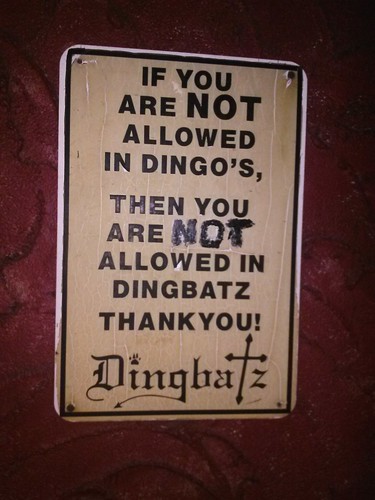
Also in the vicinity was another man, Lem. Unlike Palladian, he wasn't commenting on the music and yearning, at least not directly. He just told his own story — "We went to see a new friend perform at a local establishment and I took a picture of a sign near the entrance" — and showed us this:

Palladian: A few years ago, "peony" was a very popular note in perfumery. Many perfumes used this note, which was generally done as a big, fluorescent, loud, fruity-flower odor of no particular interest. Givaudan makes 2-cyclohexylidene-2-phenylacetonitrile, an aroma chemical they call Peonile, which I always find hilarious. Say it: Peonile.Also in the comments, a dialogue between 2 women:
El Pollo Raylan: The name is apt. I see lots of structural rigidity in the linear nitrile portion which has a nitrogenous lone pair at one end. Then there's the cyclohexylidene portion which is quasi-floppy, but made stiffer by attachment to the olefinic core. The phenyl is of course rigid except for its rotational degree of freedom.
Palladian: I love when you talk dirty!
Freeman Hunt: We had some new tile installed in our kitchen this week. One afternoon the installers washed their tools outside and left without coming back in. Because they did not come back in, they forgot to turn off their radio. The radio was across the newly laid tile that we were forbidden to walk upon. So we listened to popular, contemporary country music all that evening and for three hours the next morning. Heh. (That story is much funnier to people who know me in real life. I don't listen to anything in the background. Ever. No television. No music. Nothing. I only turn something on if I want to listen to it actively.)Intruding on this perfectly female dialogue was the aforequoted Palladian: "That's what a handgun and good aim are for."
Synova: I don't listen to "background" anything either. I can see you standing at the edge of the tile... yearning.
Freeman Hunt: "yearning"... Perfect word.
Also in the vicinity was another man, Lem. Unlike Palladian, he wasn't commenting on the music and yearning, at least not directly. He just told his own story — "We went to see a new friend perform at a local establishment and I took a picture of a sign near the entrance" — and showed us this:
Tuesday, May 28, 2013
Tuesday, May 21, 2013
"Why is Facebook blue?... It’s because Mark Zuckerberg is red-green color blind..."
"... blue is the color Mark can see the best."
That factoid begins an article about the use of color in branding, which does not otherwise involve the topic of designing color images with knowledge of how it looks to people who see some but not all colors. The article gets into assertions about what women like and what men like. Both respond to blue and green and are repelled by orange and brown, but women go for purple, which men don't like, and men like black while women dislike gray. That's sort of interesting, but it's much softer information than the hardcore physical reality of red-green color blindness.
Is there software that lets you check what your design looks like to someone who's red-green color blind? One answer, I guess, is stick to blue. But it seems to me that there are many blues, including blues that lean toward red (before you'd say purple) and blues that lean to yellow (before you'd start calling it green). A person who's not red-green color blind might think that's a really lovely blue at the very point where it might look ugly to a person with red-green color blindness.
I've been thinking about this topic a lot because I've been losing my sense of smell, to the point where I'm smell-blind — anosmic — in some sectors of the sense of smell. It would be one thing to have no sense of smell at all, like complete color blindness. But when you have partial perception, you care about the part that you have, but you'd like a good experience with it, but other people, who may be providing the experience, don't know what it's like for you.
That factoid begins an article about the use of color in branding, which does not otherwise involve the topic of designing color images with knowledge of how it looks to people who see some but not all colors. The article gets into assertions about what women like and what men like. Both respond to blue and green and are repelled by orange and brown, but women go for purple, which men don't like, and men like black while women dislike gray. That's sort of interesting, but it's much softer information than the hardcore physical reality of red-green color blindness.
Is there software that lets you check what your design looks like to someone who's red-green color blind? One answer, I guess, is stick to blue. But it seems to me that there are many blues, including blues that lean toward red (before you'd say purple) and blues that lean to yellow (before you'd start calling it green). A person who's not red-green color blind might think that's a really lovely blue at the very point where it might look ugly to a person with red-green color blindness.
I've been thinking about this topic a lot because I've been losing my sense of smell, to the point where I'm smell-blind — anosmic — in some sectors of the sense of smell. It would be one thing to have no sense of smell at all, like complete color blindness. But when you have partial perception, you care about the part that you have, but you'd like a good experience with it, but other people, who may be providing the experience, don't know what it's like for you.
Tuesday, March 26, 2013
"The government’s use of trained police dogs to investigate the home and its immediate surroundings is a 'search' within the meaning of the Fourth Amendment."
Justice Scalia writes in a new Supreme Court opinion. This is one of those 5-4 cases where Scalia and Thomas join the liberal Justices. It's not 6-3 because Justice Breyer joins the conservatives.
Here's the PDF of the case.
Justice Kagan (with Sotomayor and Ginsburg) joins Scalia's opinion "in full" and riffs on Scalia's "keeps easy cases easy" by quipping that adding the expectation of privacy analysis would "make 'an easy cas[e] easy” twice over.'"
Alito writes the dissenting opinion. The police came onto the property, but only on "the customary path," during the daytime, and for "less than a minute or two." As for privacy:
Here's the PDF of the case.
[W]e need not decide whether the officers’ investigation of Jardines’ home violated his expectation of privacy under Katz. One virtue of the Fourth Amendment’s property-rights baseline is that it keeps easy cases easy. That the officers learned what they learned only by physically intruding on Jardines’ property to gather evidence is enough to establish that a search occurred.The dog had gone up onto the porch — that is, the curtilage: "The front porch is the classic exemplar of an area 'to which the activity of home life extends.'"
Justice Kagan (with Sotomayor and Ginsburg) joins Scalia's opinion "in full" and riffs on Scalia's "keeps easy cases easy" by quipping that adding the expectation of privacy analysis would "make 'an easy cas[e] easy” twice over.'"
Alito writes the dissenting opinion. The police came onto the property, but only on "the customary path," during the daytime, and for "less than a minute or two." As for privacy:
A reasonable person understands that odors emanating from a house may be detected from locations that are open to the public, and a reasonable person will not count on the strength of those odors remaining within the range that, while detectible by a dog, cannot be smelled by a human.Alito's opinion is much more dog-positive than Scalia's or Kagan's. Scalia and Kagan refer to "the dog" — it's basically a tool of the police to them. Kagan compares the dog's nose to the "thermal imaging device" in Kyllo. Alito calls the dog by name: Franky. Alito's got footnotes to things like "A Dog's History of America: How Our Best Friend Explored, Conquered, and Settled a Continent."
Friday, February 15, 2013
About those 4,200 cruise ship passengers...
Do they all imagine they are media stars now? Do we have to hear from each and every one about what they did with their precious bodily fluids?
Unless you have a distinctive and grisly detail or a truly idiosyncratic way to describe the mundane, I don't want to hear about it. I don't want to hear how it feels good to be back on dry land, how you care about your family with whom you are at long last reunited, how stressful it all was, and the crushingly obvious fact that shit stinks.
You are all people who went on a cruise in the first place. That's where you made your mistake.
“It just feels so good to be on land again and to feel like I have options,” said Tracey Farmer of Tulsa, Okla. “I’m just ready to see my family. It’s been harder on them than us I think because they’ve been so worried about us. It’s been extremely stressful for them.”Tracey Farmer — if that really is your name — please go home to Tulsa, Oklahoma. All of you 4,200 people, please melt back into your normal lives in your respective hometowns.
Unless you have a distinctive and grisly detail or a truly idiosyncratic way to describe the mundane, I don't want to hear about it. I don't want to hear how it feels good to be back on dry land, how you care about your family with whom you are at long last reunited, how stressful it all was, and the crushingly obvious fact that shit stinks.
You are all people who went on a cruise in the first place. That's where you made your mistake.
Tuesday, February 12, 2013
Purchase of the day.
February 11, 2013. Stink Free Hardfloor Pet Stain & Odor Remover by Stink Free (Earnings to the Althouse blog = $0.97)
Honorable mentions:
Sugarlips Seamless Rib Tank Top 409 (Earnings to the Althouse blog = $1.05)
InSinkErator CRD-00 Power Cord Kit (Earnings to the Althouse blog = $0.66)
InSinkErator DWC-00 Dishwasher Connector Kit (Earnings to the Althouse blog = $0.52)
Odor-Free Countertop Compost Keeper by Norpro (Earnings to the Althouse blog = $1.84)
...and 60 other purchases at no additional cost to the purchaser that say, "hey Althouse, thanks for blogging!"
Thank YOU, all you sugarlipped insink composting stinkards!
Honorable mentions:
Sugarlips Seamless Rib Tank Top 409 (Earnings to the Althouse blog = $1.05)
InSinkErator CRD-00 Power Cord Kit (Earnings to the Althouse blog = $0.66)
InSinkErator DWC-00 Dishwasher Connector Kit (Earnings to the Althouse blog = $0.52)
Odor-Free Countertop Compost Keeper by Norpro (Earnings to the Althouse blog = $1.84)
...and 60 other purchases at no additional cost to the purchaser that say, "hey Althouse, thanks for blogging!"
Thank YOU, all you sugarlipped insink composting stinkards!
Monday, January 28, 2013
Monday, January 7, 2013
"There was a ripe mystery about it, a hint of bedrooms up-stairs more beautiful and cool than other bedrooms..."
"... of gay and radiant activities taking place through its corridors, and of romances that were not musty and laid away already in lavender but fresh and breathing and redolent of this year’s shining motor-cars and of dances whose flowers were scarcely withered."
Ripe, beautiful, cool, gay, radiant, (not) musty, fresh, breathing, redolent, shining, (scarcely) withered. What I'm seeing in today's Gatsby sentence are a lot of adjectives, adjectives all about a house, a house that we're told is a mystery. The adjectives tantalize us about the nature of the mystery. Every adjective says sex. If only we could get upstairs to the bedrooms or into those corridors. Those places are alive! They are breathing.
But within that sex and life there is a hint of death. What does it mean to be "laid away already in lavender." I'm picturing the lavender in a sachet, put in a drawer to impart a semblance of freshness. How do you put musty romances away like that? Those are your memories (or maybe old love letters). But don't worry about that. The point here is that these romances are alive, fresh and breathing. I mean, they are alive somewhere in this house, this mysterious house you've just entered, if only you could find your way into the bedrooms and corridors.
Here at the entry point, we just have a hint. There's a smell. It's ripe. It's redolent. It's not musty. It's not that lavender you use on old things. It's like shining motor-cars and dances where there are flowers. Shining motor cars? It's the famous new car smell people are always raving about, and I guess they loved it back in the 1920s when F. Scott Fitzgerald was writing "The Great Gatsby." So there's this wonderful spell of fresh romance and it smells like new cars and dance flowers.
We've already encountered dance flowers in our little sentence-a-day Gatsby project. My self-imposed rule is to stay within the boundaries of one sentence. But it's so strange to me that a sentence that names one flower goes on to say "flowers" without saying what kind. I guess you could say those flowers are like the women in the romances that are happening now. They aren't memories, which are specific and can thus (in some poetic logic) be laid away with specific flowers. These women could be anybody. Maybe their namelessness is part of the adventure that goes with those unseen rooms and corridors.
But I can't help thinking back to that sentence we looked at on January 2d, which had Daisy — a named woman, named after a specific flower — drowsing at dawn with the shreds of her evening dress "tangled among dying orchids on the floor beside her bed." It seems that when the romance is over and laid away into memories, the flowers can be specified. In the January 2d sentence, the flowers, orchids, were dying (as Daisy was drowsing). The flowers we see today are not dying. They are part of romance that is happening right now.
And yet, here it is again, that hint of death: The flowers are withered. Scarcely withered, yes, but withered. And withered is our last adjective. This is another sentence with a narrative trajectory: We went from ripe to withered, in a sentence full of life — hints of life, life just out of reach, with a whiff of death. A mystery!
Ripe, beautiful, cool, gay, radiant, (not) musty, fresh, breathing, redolent, shining, (scarcely) withered. What I'm seeing in today's Gatsby sentence are a lot of adjectives, adjectives all about a house, a house that we're told is a mystery. The adjectives tantalize us about the nature of the mystery. Every adjective says sex. If only we could get upstairs to the bedrooms or into those corridors. Those places are alive! They are breathing.
But within that sex and life there is a hint of death. What does it mean to be "laid away already in lavender." I'm picturing the lavender in a sachet, put in a drawer to impart a semblance of freshness. How do you put musty romances away like that? Those are your memories (or maybe old love letters). But don't worry about that. The point here is that these romances are alive, fresh and breathing. I mean, they are alive somewhere in this house, this mysterious house you've just entered, if only you could find your way into the bedrooms and corridors.
Here at the entry point, we just have a hint. There's a smell. It's ripe. It's redolent. It's not musty. It's not that lavender you use on old things. It's like shining motor-cars and dances where there are flowers. Shining motor cars? It's the famous new car smell people are always raving about, and I guess they loved it back in the 1920s when F. Scott Fitzgerald was writing "The Great Gatsby." So there's this wonderful spell of fresh romance and it smells like new cars and dance flowers.
We've already encountered dance flowers in our little sentence-a-day Gatsby project. My self-imposed rule is to stay within the boundaries of one sentence. But it's so strange to me that a sentence that names one flower goes on to say "flowers" without saying what kind. I guess you could say those flowers are like the women in the romances that are happening now. They aren't memories, which are specific and can thus (in some poetic logic) be laid away with specific flowers. These women could be anybody. Maybe their namelessness is part of the adventure that goes with those unseen rooms and corridors.
But I can't help thinking back to that sentence we looked at on January 2d, which had Daisy — a named woman, named after a specific flower — drowsing at dawn with the shreds of her evening dress "tangled among dying orchids on the floor beside her bed." It seems that when the romance is over and laid away into memories, the flowers can be specified. In the January 2d sentence, the flowers, orchids, were dying (as Daisy was drowsing). The flowers we see today are not dying. They are part of romance that is happening right now.
And yet, here it is again, that hint of death: The flowers are withered. Scarcely withered, yes, but withered. And withered is our last adjective. This is another sentence with a narrative trajectory: We went from ripe to withered, in a sentence full of life — hints of life, life just out of reach, with a whiff of death. A mystery!
Subscribe to:
Posts (Atom)