Showing posts with label money. Show all posts

Friday, September 20, 2013

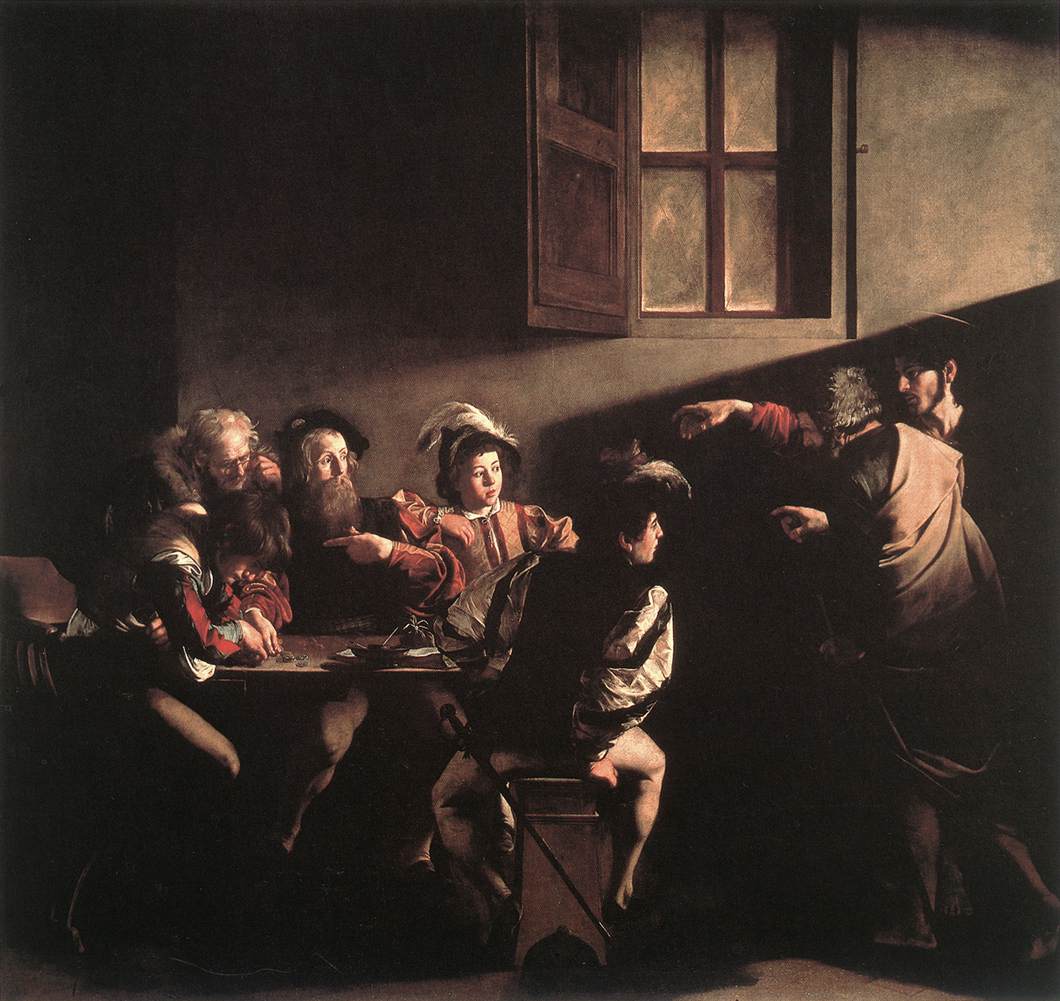
"The Calling of St. Matthew" — the Caravaggio painting often contemplated by Pope Francis.


"That finger of Jesus, pointing at Matthew. That’s me. I feel like him. Like Matthew."

"It is the gesture of Matthew that strikes me: he holds on to his money as if to say, ‘No, not me! No, this money is mine.’ Here, this is me, a sinner on whom the Lord has turned his gaze. And this is what I said when they asked me if I would accept my election as pontiff." Then the pope whispers in Latin: "I am a sinner, but I trust in the infinite mercy and patience of our Lord Jesus Christ, and I accept in a spirit of penance."

Friday, September 13, 2013

Please take my Establishment Clause test.

The Freedom From Religion Foundation sued to have the motto "In God We Trust" taken off U.S. money. The federal judge, applying a familiar old doctrine, dismissed the suit, saying "the Supreme Court has repeatedly assumed the motto's secular purpose and effect."

Here's my test: You have 30 seconds. Don't read the article and don't look anything up. Write one sentence articulating a secular purpose for having "In God We Trust" on the money. Do the best you can — that is, be on against the Freedom From Religion side for the purposes of this exercise.

ADDED: I will read all the comments later today and pick some winners, but after reading a few, I feel like saying that the requirement that a law have a secular purpose can be diminished to nothing if you accept the proposition that there is a secular purpose for religion. Government can always say it is using religion to mollify/control/improve people for worldly ends. The argument would be that as long as religion is the means and not the end, it's a secular purpose. Note that complete atheists could embrace this kind of religion (and I assume they have throughout history all over the world).

CORRECTION:  The original post said "on" where it should have said "against." That was confusing, and I'm very sorry. It makes no sense — perhaps you noticed — to articulate the FFR side, which is there is NO secular purpose. The idea is to come up with a secular purpose, and I wanted you to do your best at that, even if you'd prefer to see FFR win this.

Thursday, September 5, 2013

The "quasi-Christian" sect — the Twelve Tribes — that proselytizes at Dylan concerts.

Are Dylan disciples ripe picking for a group that "requires forsaking all material goods, living communally, and working without pay in one of the group’s cafés, stores, farms, or construction companies scattered across the United States"?

They travel around in a cute "two-tone, double-decker bus called the Peacemaker" and hand out a brochure titled "Dylan: What Are You Thinking?" which leverages lyrics from old Dylan songs to make a pitch that I would think close attention to Dylan lyrics would inoculate you against.

You’re gonna have to serve somebody... so why not serve lattes at our café?

Monday, May 20, 2013

"How to buy happiness."

"The new science of spending points to a surprising conclusion: How we use our money may matter as much or more than how much of it we've got."

I don't know why that is "surprising," but the details are perhaps worth noting. For one thing, buying a house or moving to a better house is found unlikely to bring more happiness.
And dozens of studies show that people get more happiness from buying experiences than from buying material things. Experiential purchases — such as trips, concerts and special meals — are more deeply connected to our sense of self, making us who we are....
Some meal you ate is more deeply connected to your sense of self than your home? I find that hard to believe. I think it's more that the meal is over and done with, so the happiness was consumed on the spot and remembered. The house continues and you enjoy it sometimes but are burdened by it too. You have mixed feelings over a long period of time. It's not a memory.
And experiences come with one more benefit: They tend to bring us closer to other people, whereas material things are more often enjoyed alone. (We tend to watch our new television alone on the couch, but we rarely head to a wonderful restaurant or jet off to Thailand solo.) 
That's why you might want to bring loved ones into that house of yours. And why is there no mention of the nonwonderful restaurants and nonwonderful flights overseas?
So, doing things with other people makes a difference for happiness, and our research suggests that doing things for other people can provide an additional boost. 
That's obvious and not about how you spend your money. Dropping dollars on restaurant meals and travel won't necessarily get you better social connections.
In experiments we've conducted around the world, including in Canada, the United States, Uganda and South Africa, we find that people are happier if they spend money on others. And we've found that spending even just a few dollars on someone else provides more happiness than using the cash to treat yourself.
This is why we love to pay taxes, no?

Saturday, April 13, 2013

Dinga DINga!... who rings the doorbell like that?

Sounds all friendly. Jaunty.

Meade answers. It's the spit-in-the-tube government guy again.

He's back. On a Saturday morning. Maybe he was hoping somebody else would answer the door. But it's Meade again. Still refusing to succumb to the $90 bribe. The man inquires, Mind if I ask why? Meade says that the spit-in-a-tube part is a little over-the-top, plus he's read the brochure, and he's not convinced of the value of the mission. The man shifts to sympathy mode: I know how I'd feel if someone came to my door. And Meade says: Well, there you have it. Hearing Meade's account of the colloquy, I say: I guess their argument is, we want to give you $90. If $90 doesn't overcome your resistance, they've got nothing.

Wednesday, March 20, 2013

Bowl bought for $3 at a garage sale is sold for $2.2 million.

It was a Ding bowl from the Northern Song dynasty — a thousand years old.
Sotheby’s would not identify the lucky bowl sellers, only to say that they were a family from somewhere in New York state.
I can see why they don't want to be known. It's best that the people who sold it to them never realize what happened.

Saturday, February 23, 2013

Purchase of the day.

From the February 22, 2013 Amazon Associates Earnings Report:

"If Democrats Had Any Brains, They'd Be Republicans" [Hardcover] Ann Coulter (Author) (Earnings to the Althouse blog = $0.00)

Honorable mention:

Educational Products - SET Zimbabawe 10, 50, 100 Trillions Collection / Hyperinflation Money - (Earnings to the Althouse blog = $0.96)

... and 52 other items purchased — at no additional cost to the buyers — through the Althouse Amazon portal.

Althouse portal users: brainy, frugal, value-smart.

Thank you all who support this blog.

Wednesday, February 20, 2013

"The Silicon Valley aristocrats Mark Zuckerberg, Sergey Brin and Yuri Milner have jointly established the most lucrative annual prize in the history of science..."

"... to reward research into curing diseases and extending human life. The newly created Breakthrough Prize in Life Sciences Foundation on Wednesday announces the first 11 winners of an award intended to inject excitement into the sometimes lonely, underfunded quests to understand and combat cancer, diabetes, Parkinson's disease and other maladies. Zuckerberg, who founded Facebook; Brin, who co-founded Google; and Milner, a venture capitalist, have dipped into their fortunes to sponsor awards worth $3m each, compared with a Nobel prize's monetary value of $1.1m."
"I had to sit down on the floor for a while. I thought it must be a practical joke or a Nigerian scam," said Cornelia Bargmann, 51, who has pioneered work on neural circuits and behaviour at the Rockefeller University. "The scale of this is so outsized I think it will have a huge impact on the life sciences." Asked how she would spend the money she hesitated. "It's so far outside my normal planning I don't know. Get the car fixed?"...
Titia de Lange, 57, who researches cell biology, genetics and cancer at Rockefeller university, said the award felt surreal. "I'm not used to having a lot of money. I don't really have possessions." Two women from a list of 11 fairly reflected the percentage of women working at that level, she said. "One would like it to be higher of course."
Young women! Enter the sciences. Silicon Valley aristocrats are dying to give you $3 million. The gender balance must be achieved. No sooner is this wonderful, generous prize announced than the criticism rolls in, gently at first, but you know there is a problem. The aristocrats want the honor of handing out honor and they must comply with the ethical structure of the Silicon Valley culture where they reign. There must be women recipients. 11 prizes? 6 should go to women!

So, ladies, get on it. There's big money here! And yet, women are apparently not so motivated by money. Oh, I don't know, get the car fixed. Gotta sit down on the floor. I don't really have possessions....

So funny. It's men who are offering big money as an incentive. But what if monetary incentives are a male thing, working mostly on men? And yet you have to include the women, equally, because even if women don't care so much about actually getting the money, they care immensely about equality and fairness. And everyone's watching. The symbolism counts, not just the effect of motivating improvements in life for the rest of us. What do you want more — cures for diseases or the appearance of gender equity?

Wednesday, February 6, 2013

Signs that people are tired of thinking about politics.

Here are the "most popular" stories in The Washington Post right now:


#1 is Michelle Obama's ass. #4 is a bird laid an egg. And both of these are stories that I blogged yesterday. The First Lady's ass attracted 197 commenters here on the blog. I blogged the bird story too. In the comments, Inga made fun of the WaPo headline saying that the bird had given birth, and I note this morning that the headline has been rewritten, and now it's producing a chick. But there we were, talking about whether it's silly to say a bird gave birth.

Give birth is an interesting expression, even as applied to mammals. Which is my point: What is interesting this morning? Something tells me it's not politics.

Meanwhile, even politicians seem to know we're tired of dreary politics. Apparently, Republicans want to win us over with "happy talk" — #3 on that list:
At a retreat for Republican leaders last month, former House speaker Newt Gingrich told them to “learn to be a happy party” and a “cheerful” one, and Republican National Committee Chairman Reince Priebus said they should be a party “that smiles.”...

House Majority Leader Eric Cantor took this don’t­worry-be-happy strategy seriously, and in a heavily promoted “major” speech to the American Enterprise Institute [that]... began with an uplifting anecdote about the Wright brothers and quoted the inspirational words of Emma Lazarus. He spoke from a lectern decorated with a foam board carrying the slogan “Making life work for more people”....
Decorated with a foam board... That's like a bird giving birth. The WaPo is bumping up the rhetoric inanely. Even when mocking the GOP for its strained cheeriness, they're goosing us with inappropriate but exciting words.

And then there's that coin. It's moving closer to reality.  Here I am over here in Reality. And there... somewhere out there.... a coin... it approaches!

Words, words, words... What kind of words do you have an appetite for this morning?
Wednesday, January 23, 2013

Purchase of the day...

... and by day I mean yesterday: Starbucks VIA Ready Brew Coffee (Amazon Associates earnings to the blog: $1.00).

Many thanks to everyone — in every language except Yanomamö since there is no word for "thank you" in Yanomamö, the language of the fierce people — who showed their support by shopping through the Althouse Amazon portal.

Wednesday, January 16, 2013

"[S]he noticed there were more bills, lots of bills, in the snow near the sidewalk, and she figured she had better call police...."

If you would call the police in this situation, would it be because that's the sort of honest, upright person you are or would it be because it was broad daylight and the bills weren't in a neat little bundle but spread out on the snow, in which case the activity of picking them up risks: 1. making you look suspicious (and somebody might call the cops on you), and 2. other people showing up and competing with you in the pickup (in which case, you might need police protection and you want to be the one to get your name on the found-money claim)?

Friday, January 11, 2013

"The Charmin corporate Twitter account got in on it with a surprisingly trenchant commentary on the disposability of American currency."

That's the way Slate — displaying the winners of its design-a-$1-trillion-coin contest — refers to the symbolism here:


"Surprisingly trenchant commentary." Come on! I like delicate toilet paper, but why the delicacy talking about toilet paper? What, exactly, is the commentary? I assumed it was: American currency is something you may as well wipe your ass with. But then I thought the idea was: Uh, oh, we just pooped ourselves.

Maybe you're wracking your brain for a way to use the old "Don't Squeeze the Charmin" slogan, but that was the 1960s. The current slogans — if I am to believe the Charmin Wikipedia page — are: "Enjoy the Charmin experience" and "Enjoy The Go." Enjoy the go?! Put that on the coin. Hell, make that the national motto. "In God We Trust" is getting old. It's divisive. And, frankly, it's unfair to God.

"Enjoy the Go"... I looked it up to see how they were playing this slogan in the commercials:


The relief. The calm. The clean. The comfort.

See? That's the way you'll feel after that $1-trillion is deposited in the toilet bank. This image evokes Sigmund Freud:
Freud suggested that children in the anal stage of development regard the release of their feces as a gift to the parent — a gift that can be given or withheld. Children will release the feces if given sufficient love and withhold them if not. In Freudian thought, fecal matter becomes a type of currency in the parent-child relationship, which can be withheld or dispensed, thus giving the child a sense of control. The word currency is appropriate in this context; Freud assumed that the human unconscious makes a symbolic equation between feces and money. In a 1911 paper on dreams in folklore, he noted that according to ancient Eastern mythology, “gold is the excrement of hell” (Freud & Oppenheim, 1911/1958, p. 157).
Hell!

(I'm riffing on the toilet paper topic topic Meade introduced late last night. That was Meade — did you notice? — not me.)

Monday, January 7, 2013

"Should President Obama be willing to print a $1 trillion platinum coin if Republicans try to force America into default?"

"Yes, absolutely. He will, after all, be faced with a choice between two alternatives: one that’s silly but benign, the other that’s equally silly but both vile and disastrous. The decision should be obvious."

Says Paul Krugman.

It's strange that it's come to this, but I don't believe the President of the United States would choose to do something that will strike the people as so bizarre, even if he feels capable of articulating the legal theory with a straight face. The President must maintain the people's trust and confidence. He must be comprehensible as normal, sound, and sane to ordinary folks.

ADDED: