After last night's VMA performance, this old video is charting on Reddit (where the top comment is "When can we start using The Onion as a credible source?"):
We were talking about the VMA performance in a post earlier this morning, and you can see it here. I was going to watch it closely and opine on the race-and-gender politics and the symbolism of teddy bears, but then I didn't. Let's just watch the old Bjork video, directed by Michael Gondry, for "Human Behavior." That had some strange bears around a puzzling young woman:
If you ever get close to a human/And human behavior/You'd better be ready to get confused....
Showing posts with label symbols. Show all posts
Showing posts with label symbols. Show all posts
Monday, August 26, 2013

Sunday, August 18, 2013
"'Westward'... a symbolical presentation of the Pioneers led by the spirits of Civilization and Enlightenment to the conquest by cultivation of the Great West."
The painter Edwin H. Blashfield explains his painting, which holds a place of honor in the Grand Stairway of the Iowa state capitol building, which we visited yesterday. I'm amazed at the celestial delicacy of females...

That's not the way I'd pictured pioneers, and these lovely ladies seem mismatched to the more stereotypically pioneer males:

But this is "a symbolical presentation," and so these women represent the ideals that animated the pioneers — as imagined by an artist in 1905. The male figures seem more like the fleshly people who traveled westward, while the female figures are the lofty spirits that propelled them. And then there are the canine spirits. No one could think pioneers had dogs like that. We squinted at this painting for some time, looking for the third dog, some white puffbull of a Bichon Frise or some such thing. It must be there, in those whitish daubings at the end of the lady's leash...
"They had their dogs on a leash?" Meade asks sarcastically.

But no, that's not a leash. She's carrying a stick. I read more of Blashfield's quote (PDF) and it forces me to disengage from the center of the painting where the refined/enervated females and their dogs had held my eyes:

That's not the way I'd pictured pioneers, and these lovely ladies seem mismatched to the more stereotypically pioneer males:
But this is "a symbolical presentation," and so these women represent the ideals that animated the pioneers — as imagined by an artist in 1905. The male figures seem more like the fleshly people who traveled westward, while the female figures are the lofty spirits that propelled them. And then there are the canine spirits. No one could think pioneers had dogs like that. We squinted at this painting for some time, looking for the third dog, some white puffbull of a Bichon Frise or some such thing. It must be there, in those whitish daubings at the end of the lady's leash...
"They had their dogs on a leash?" Meade asks sarcastically.
But no, that's not a leash. She's carrying a stick. I read more of Blashfield's quote (PDF) and it forces me to disengage from the center of the painting where the refined/enervated females and their dogs had held my eyes:
"Considered pictorially, the canvass shows a ‘Prairie Schooner’ drawn by oxen across the prairie. The family ride upon the wagon or walk at its side. Behind them, and seen through the growth of stalks at the right, come crowding the other pioneers and ‘later men.’ In the air and before the wagon, are floating four female figures; one holds the shield with the arms of the state of Iowa upon it; one holds a book symbolizing Enlightenment; two others carry a basket and scatter the seeds which are symbolical of the change from wilderness to ploughed fields and gardens that shall come over the prairie. Behind the wagon, and also floating in the air, two female figures hold, respectively, a model of a stationary steam engine and of an electric dynamo to suggest the forces which come with the ‘later men.’”Ah! What later men we all are!
Wednesday, August 14, 2013
"Let’s begin with a working (and provable) premise: Women, if allowed to be fully equal to men, will bring peace to the planet."
WaPo's Kathleen Parker says, arguing that the Hillary for President message should be: "She can save the world."
Even assuming women's equality is the key to world peace, what's the big connection between a female U.S. President and the condition of women around the world? Parker notices that gap in her argument:
She became recognized because of the achievements of her husband. That has nothing to do with advancing women's rights. She's revered? Has that been established?! But let's assume she's revered. What does that have to do with advancing women's rights? Like being the wife of a powerful man, a woman's being revered isn't an aspect of female empowerment. The most traditional societies embrace the idea of a woman who inspires reverence, someone who's good and worthy of respect. The Virgin Mary is revered.
Parker continues:
Parker ends with the assertion that "the world’s women are watching" the American 2016 election "closely." Parker is big on assertions!
Remember when The Washington Post made its reputation through investigative reporting, when it worked hard at uncovering what powerful people were trying to hide?
Even assuming women's equality is the key to world peace, what's the big connection between a female U.S. President and the condition of women around the world? Parker notices that gap in her argument:
What does this have to do with Hillary? Quite a bit.So she read a line in a speech that was an utterly standard proposition of feminism, and she did that because she was the wife of a political leader, and... voila!... recognized and revered... therefore... ????
Rewinding the tape to 1995 at the U.N.’s Fourth World Conference on Women in Beijing, then-first lady Hillary Clinton empowered women as never before with just a few words: “Human rights are women’s rights and women’s rights are human rights, once and for all.”...
At the time, it was a revolutionary statement and helps explain why Hillary is one of the most recognized and revered individuals in the world.
She became recognized because of the achievements of her husband. That has nothing to do with advancing women's rights. She's revered? Has that been established?! But let's assume she's revered. What does that have to do with advancing women's rights? Like being the wife of a powerful man, a woman's being revered isn't an aspect of female empowerment. The most traditional societies embrace the idea of a woman who inspires reverence, someone who's good and worthy of respect. The Virgin Mary is revered.
Parker continues:
While Americans obsess about Hillary’s hair and married life, others have been studying her for inspiration. To millions, she is a role model and a warrior for women’s right to self-determination.She's applying for the job of leading Americans, and we tend to take her married life into account when deciding whether to find her inspiring or not. But Parker tells us there are "millions," apparently not American millions, who would like to model themselves on her, who are inspired in some way that doesn't have to do with achieving prominence through marriage and enduring a husband's infidelity.
As secretary of state, she continued the work of predecessors Condoleezza Rice and Madeleine Albright, who first insisted that women’s rights be part of our foreign policy, and then pushed further. Under Hillary’s watch, Obama made permanent the Office of Global Women’s Issues and appointed longtime Hillary colleague Melanne Verveer as ambassador-at-large.So women's rights have been part of the work of the State Department for a long time, and Hillary was the third female Secretary of State.
Whether one likes or dislikes Hillary, few dispute that she has matured in her public role. Her résumé can be topped by few and the symbolic power of electing a woman president — especially this woman — can’t be overestimated.We just did the symbolic power of electing a black President. Did we overestimate that? I think we did. Isn't it time for substance and not mere symbolism? We've OD'd on symbolism. What are Hillary's achievements? Lines on a résumé aren't the same as accomplishments. In fact, when you've had powerful positions, the lack of specific achievements is the opposite of inspiring.
Many doubtless shudder at the prospect of Hillary Clinton as the most powerful person in the world, but we’ve done worse.Parker's argument has gone from "She can save the world" to "We could do worse." I can't believe how bad this column is! Why can't The Washington Post do better? Perhaps millions are inspired that a Woman has written a column in The Washington Post. The symbolic power cannot be overestimated!
Parker ends with the assertion that "the world’s women are watching" the American 2016 election "closely." Parker is big on assertions!
In 2007 when I traveled through the Middle East with then-first lady Laura Bush, every woman I met was riveted by the U.S. presidential election and wanted to talk about only this question: Will Hillary win?Every woman was riveted by the question whether Hillary would win?
In 2008, it seemed possible. In 2016, barring a Benghazi surprise, it seems probable.Oh, wouldn't it be terrible, wouldn't hope for the world collapse, if Hillary doesn't win, which would be undermined if there were a "Benghazi surprise"? You mean if we actually found out what happened in Benghazi?!
Remember when The Washington Post made its reputation through investigative reporting, when it worked hard at uncovering what powerful people were trying to hide?
Saturday, May 18, 2013
"Heh, great stuff, Althouse. Cf. Derrida on Nietzsche's umbrella."
Says Yashu, in the comments on "The word 'umbrella' appears exactly once in Obama's 'Dreams From My Father.'" And that was after I'd read rhhardin, commenting on "Sigmund Freud on the meaning of the umbrella": "Derrida in Spurs on the umbrella that Nietzsche wrote he had forgotten."
I'm spurred to read "Spurs," but "Spurs" is not an ebook, so I'm off the hook. Still, here's some text visible in Google books. Derrida is playing with the the possible meaning(s) of "I have forgotten my umbrella," found (in quotation marks) in Nietzche's unpublished manuscripts. Excerpt:
"Apotropaic" is also unusual. The OED says it's "Having or reputed to have the power of averting evil influence or ill luck" and gives this earliest example from the 1883 Encyclopedia Brittanica:
We law folk know "umbra" from the "penumbras" in "specific guarantees in the Bill of Rights [that] have penumbras, formed by emanations from those guarantees that help give them life and substance," a very glaring phrase written by Justice William O. Douglas, trying to explain how in the lamp-lit street he dimly saw the right of privacy.
But it was really Oliver Wendell Holmes, Jr. who got that word started in its U.S. law usage, the OED tells us: "The use of the penumbra metaphor in American jurisprudence appears to date from the late 19th cent. and is associated with Oliver Wendell Holmes (1841–1935), legal scholar and Associate Justice of the U.S. Supreme Court."
"Are you ready for me to read it?" Meade asks, and I say, "It needs one more thing, and I don't know what it is."
I'm spurred to read "Spurs," but "Spurs" is not an ebook, so I'm off the hook. Still, here's some text visible in Google books. Derrida is playing with the the possible meaning(s) of "I have forgotten my umbrella," found (in quotation marks) in Nietzche's unpublished manuscripts. Excerpt:
The umbrella's symbolic figure is well-known, or supposedly so. Take, for example, the hermaphroditic spur of a phallus which is modestly enfolded in its veils, an organ which is at once aggressive and apotropaic, threatening and/or threatened. One doesn't just happen onto an unwonted object of this sort in a sewing-machine on a castration table."Unwonted" is not a typo. Unlike "unwanted," it's not commonly heard/seen. It means: "not commonly heard, seen, practised." So says the OED, which tells us that Charlotte Brontë used "unwonted" in "Jane Eyre": "Difficulties in habituating myself to new rules and unwonted tasks." Are there umbrellas in "Jane Eyre"?
I jumped up, took my muff and umbrella, and hastened into the inn-passage: a man was standing by the open door, and in the lamp-lit street I dimly saw a one-horse conveyance....The Freudian symbolism is too blatant to need pointing out. The umbrella, the man, and the horse. And the muff, the inn-passage, and the open door. That's more than dimly seen.
"Apotropaic" is also unusual. The OED says it's "Having or reputed to have the power of averting evil influence or ill luck" and gives this earliest example from the 1883 Encyclopedia Brittanica:
The sacrifice of the ‘October horse’ in the Campus Martius..had also a naturalistic and apotropaic character.Wikipedia says the "October horse was an animal sacrifice to Mars carried out on October 15, coinciding with the end of the agricultural and military campaigning season." There were chariot races and "the right-hand horse of the winning team was transfixed by a spear, then sacrificed." So did the ancient Romans have umbrellas? Yes. They were used by women and "effeminate men." Used against the sun, of course. How much Latin do you need to see the "umbra" in "umbrella" and to know we're talking about shade.
We law folk know "umbra" from the "penumbras" in "specific guarantees in the Bill of Rights [that] have penumbras, formed by emanations from those guarantees that help give them life and substance," a very glaring phrase written by Justice William O. Douglas, trying to explain how in the lamp-lit street he dimly saw the right of privacy.
But it was really Oliver Wendell Holmes, Jr. who got that word started in its U.S. law usage, the OED tells us: "The use of the penumbra metaphor in American jurisprudence appears to date from the late 19th cent. and is associated with Oliver Wendell Holmes (1841–1935), legal scholar and Associate Justice of the U.S. Supreme Court."
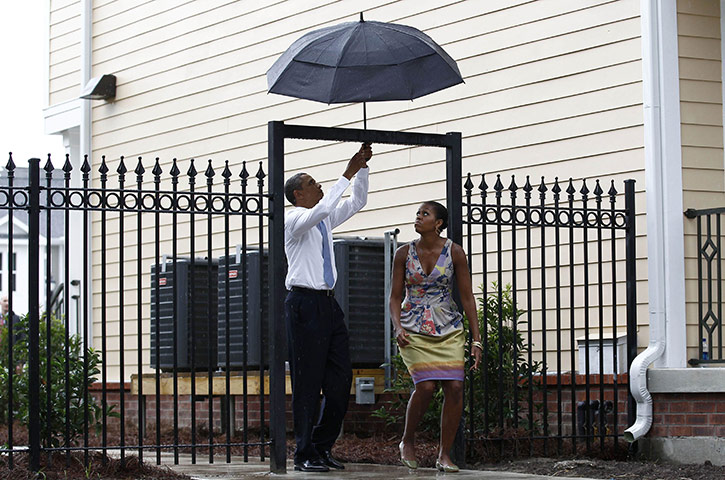
1873 O. W. Holmes in Amer. Law. Rev. 7 654 It is better to have a line drawn somewhere in the penumbra between darkness and light, than to remain in uncertainty.I suspect no one will ever Heh-great-stuff-Althouse-Cf. me again. Here I am, writing expectantly, hoping for the circle to finally close, as it did for young Obama, crying over his father's grave, when he realized that the masculine needed to be leavened with femininity and that who he was, what he cared about, was no longer just a matter of intellect or obligation, no longer a construct of words, and then it started to rain and suddenly his brother Bernard was squatting beside him, sheltering him with a bent-up old umbrella.
"Are you ready for me to read it?" Meade asks, and I say, "It needs one more thing, and I don't know what it is."
Sigmund Freud on the meaning of the umbrella.
We've been talking about Obama and umbrellas this morning — here, here, and here — and, as noted, I bought the Kindle version of Freud's "Interpretation of Dreams" so I could search for "umbrella," which I remembered as a famous Freudian symbol.
And what would Freud say about the scene that has seized the public imagination — #1 on The Washington Post's most popular list — "Obama puts Marines on umbrella duty, irking conservatives"?

To ask the question is to see the answer! Indeed, to ask the question is to see innumerable phallic symbols in the photograph. Here, inspect this huge enlargement. Oh, my! It's a world of wonder. The shape of those windowed doors! Obama's 2-thumbs-up gesture. The lectern stands. The microphones. The medals. The arrows in the claws of the eagles on the seals. The umbrellas, one more erect than the other.
According to the WaPo article, the U.S. military might believe that umbrellas are effeminate. Dr. Freud says no, no absolutely not. They are quite masculine, especially when erect. Getting a rigidly erect male to hold erect umbrella over you and another rigidly erect male to hold another albeit slightly less erect umbrella over a world leader? It's the most masculine image ever seen!
It's no wonder the President's detractors are irked. In the Freudian analysis, we know the source of the anxiety that motivates them to drag him down with assertions that umbrellas are not manly.
All elongated objects, sticks, tree-trunks, umbrellas (on account of the opening, which might be likened to an erection), all sharp and elongated weapons, knives, daggers, and pikes, represent the male member...What then would Freud say about Obama's writing a book called "Dreams From My Father" in which he depicts a scene (perhaps concocted for dramatic effect) in which he is crying in the rain between the small boxes that are the graves of his father and grandfather and his brother is suddenly there holding an opened umbrella? To ask that question is already to see the answer.
Small boxes, chests, cupboards, and ovens correspond to the female organ; also cavities, ships, and all kinds of vessels.
And what would Freud say about the scene that has seized the public imagination — #1 on The Washington Post's most popular list — "Obama puts Marines on umbrella duty, irking conservatives"?
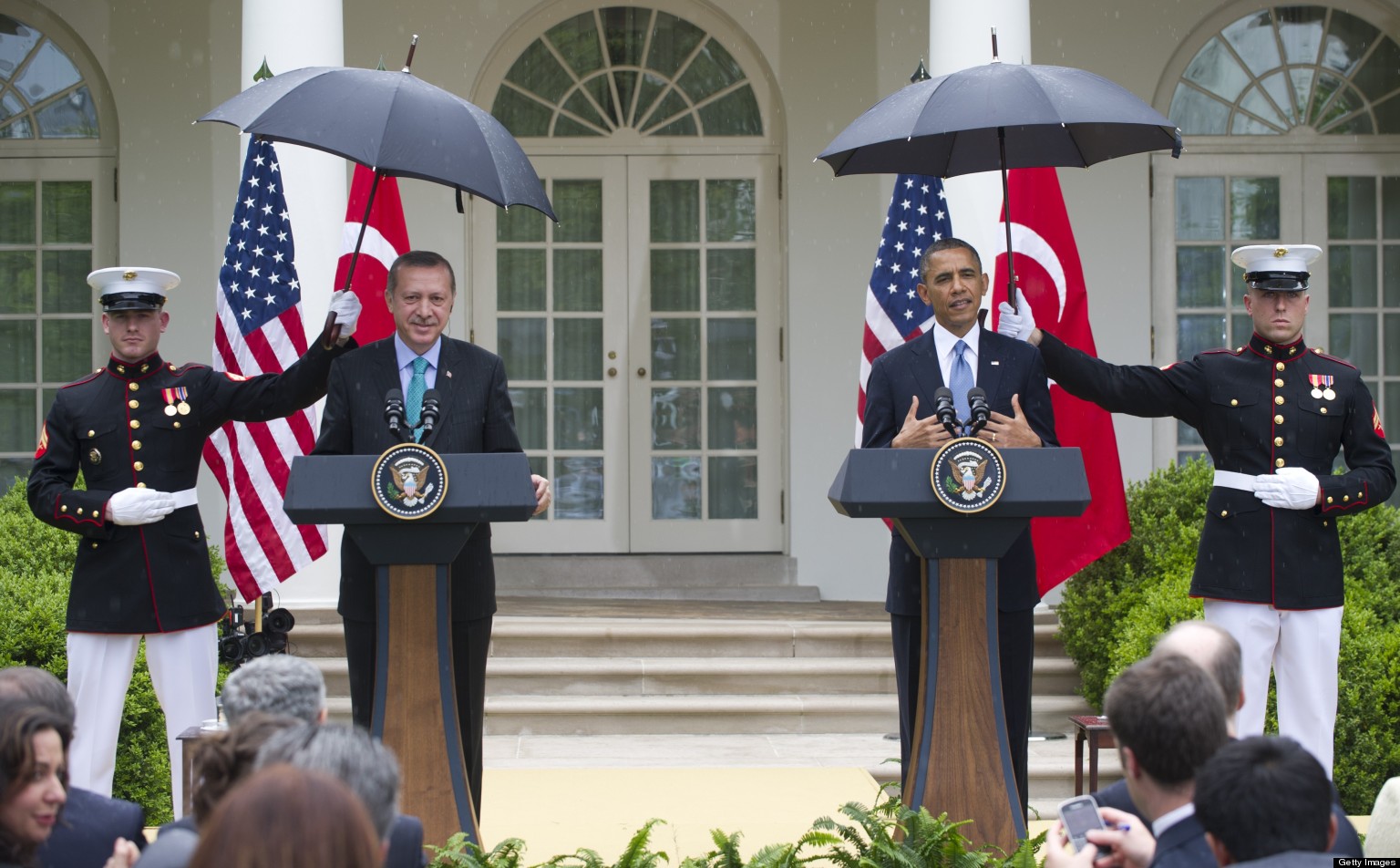
To ask the question is to see the answer! Indeed, to ask the question is to see innumerable phallic symbols in the photograph. Here, inspect this huge enlargement. Oh, my! It's a world of wonder. The shape of those windowed doors! Obama's 2-thumbs-up gesture. The lectern stands. The microphones. The medals. The arrows in the claws of the eagles on the seals. The umbrellas, one more erect than the other.
According to the WaPo article, the U.S. military might believe that umbrellas are effeminate. Dr. Freud says no, no absolutely not. They are quite masculine, especially when erect. Getting a rigidly erect male to hold erect umbrella over you and another rigidly erect male to hold another albeit slightly less erect umbrella over a world leader? It's the most masculine image ever seen!
It's no wonder the President's detractors are irked. In the Freudian analysis, we know the source of the anxiety that motivates them to drag him down with assertions that umbrellas are not manly.
"It was a lighthearted moment in the midst of a grim few days for the White House..."
But Obama's comical stylings didn't play as well this week as they have in the past. I'm reading "Obama puts Marines on umbrella duty, irking conservatives" only because I'm interested in figuring out why it's #1 on the "most popular" list in the sidebar at The Washington Post. Something cute about the headline, I thought. But reading it — and looking at that photograph of Obama intentionally clowning with the white-gloved Marine — I'm seeing something tragic. The old ways — that made us love him — don't work anymore. The gentle, slow-talking, stalling with "uhs" for Woody Allen-like timing:
There's something so sad about that picture. The gloved Marine answering the call of duty from the Commander in Chief, performing the duty with crisp precision, even as Obama's outstretched hand adjusted his elbow position, even as he knows it violates Marine Corps uniform regulation for a male Marine to carry an umbrella. I know that regulation from reading the WaPo's #1 most popular article. The same rule applies in all branches of the military, and always only for males, not for females:
If umbrella-holding conveys a message of unmanliness, it is a vivid image of impotence. It's a symbol.

"Uh I am going to go ahead and ask, folks, why don’t we get a couple of Marines — they’re going to look good next to us — just 'cause uh uh — I wanna — I’ve got a change of suits but I don’t know about uh uh uh our prime uh our prime minister. Uh there we go. That’s good. [To the reporters:] You guys, I’m sorry about but but let let let uh uh mmm uh let me uh uh uuuuhhh make sure that I answer a specific question...."We see the rain failing on his dark suit, and maybe we think about how, yes, that's the White House in back of him and he does have his closets in there, full of suits... empty suits... skeletons in the uh uh uh... But he cares about Recep Tayyip Erdogan, who came all the way from Turkey, probably not to hear Obama grilled with uh uh uh specific questions. He's probably got another suit or 2 in his uh uh suitcase. Heh ha... suitcase... suits in suitcases... it's like gloves in the glove compartment... do you put gloves in the glove compartment... heh heh... Who puts gloves in the glove compartment? I mean... really... Gloves in the glove compartment! What an idea, am I right? Come on! That's funny, people, come on, but but let let let uh uh mmm uh let me uh uh uuuuhhh make sure that I answer a specific question....
There's something so sad about that picture. The gloved Marine answering the call of duty from the Commander in Chief, performing the duty with crisp precision, even as Obama's outstretched hand adjusted his elbow position, even as he knows it violates Marine Corps uniform regulation for a male Marine to carry an umbrella. I know that regulation from reading the WaPo's #1 most popular article. The same rule applies in all branches of the military, and always only for males, not for females:
An attempt to change the policy in the 1990s failed, with some suggesting that there was something effeminate about umbrellas.Isn't it unmanly to be very nervous, especially about being unmanly? But who were these "some" who suggested carrying an umbrella is "effeminate"? And who were these "irked conservatives"? WaPo only cites an email from the conservative Move America Forward PAC, but that's not so much expressing irritation at misuse of the Marines for umbrella duty as it is using that umbrella-holding duty as a symbol of the failure to act during the Benghazi attack. The email read — we're told — "Rain: 'Hold My Umbrella.' Benghazi: 'Stand Down.'"
“They seem to be very nervous what constitutes unmanly behavior,” said Cynthia Enloe, a professor at Clark University who researched military uniform codes in the book “Maneuvers: The International Politics of Militarizing Women’s Lives.”
If umbrella-holding conveys a message of unmanliness, it is a vivid image of impotence. It's a symbol.
Friday, January 11, 2013
"The Charmin corporate Twitter account got in on it with a surprisingly trenchant commentary on the disposability of American currency."
That's the way Slate — displaying the winners of its design-a-$1-trillion-coin contest — refers to the symbolism here:

"Surprisingly trenchant commentary." Come on! I like delicate toilet paper, but why the delicacy talking about toilet paper? What, exactly, is the commentary? I assumed it was: American currency is something you may as well wipe your ass with. But then I thought the idea was: Uh, oh, we just pooped ourselves.
Maybe you're wracking your brain for a way to use the old "Don't Squeeze the Charmin" slogan, but that was the 1960s. The current slogans — if I am to believe the Charmin Wikipedia page — are: "Enjoy the Charmin experience" and "Enjoy The Go." Enjoy the go?! Put that on the coin. Hell, make that the national motto. "In God We Trust" is getting old. It's divisive. And, frankly, it's unfair to God.
"Enjoy the Go"... I looked it up to see how they were playing this slogan in the commercials:
The relief. The calm. The clean. The comfort.
See? That's the way you'll feel after that $1-trillion is deposited in thetoilet bank. This image evokes Sigmund Freud:
(I'm riffing on the toilet paper topic topic Meade introduced late last night. That was Meade — did you notice? — not me.)

"Surprisingly trenchant commentary." Come on! I like delicate toilet paper, but why the delicacy talking about toilet paper? What, exactly, is the commentary? I assumed it was: American currency is something you may as well wipe your ass with. But then I thought the idea was: Uh, oh, we just pooped ourselves.
Maybe you're wracking your brain for a way to use the old "Don't Squeeze the Charmin" slogan, but that was the 1960s. The current slogans — if I am to believe the Charmin Wikipedia page — are: "Enjoy the Charmin experience" and "Enjoy The Go." Enjoy the go?! Put that on the coin. Hell, make that the national motto. "In God We Trust" is getting old. It's divisive. And, frankly, it's unfair to God.
"Enjoy the Go"... I looked it up to see how they were playing this slogan in the commercials:
The relief. The calm. The clean. The comfort.
See? That's the way you'll feel after that $1-trillion is deposited in the
Freud suggested that children in the anal stage of development regard the release of their feces as a gift to the parent — a gift that can be given or withheld. Children will release the feces if given sufficient love and withhold them if not. In Freudian thought, fecal matter becomes a type of currency in the parent-child relationship, which can be withheld or dispensed, thus giving the child a sense of control. The word currency is appropriate in this context; Freud assumed that the human unconscious makes a symbolic equation between feces and money. In a 1911 paper on dreams in folklore, he noted that according to ancient Eastern mythology, “gold is the excrement of hell” (Freud & Oppenheim, 1911/1958, p. 157).Hell!
(I'm riffing on the toilet paper topic topic Meade introduced late last night. That was Meade — did you notice? — not me.)
Subscribe to:
Posts (Atom)