"It was a birthday present, and is one of a few clues to her interior decor; the others being that she keeps fish and cockroaches ("Why u do not [sic] have any pet at home?")...."
#4 on a list of 10 things learned about Madonna via her "Ask Me Anything" stint on Reddit.
Showing posts with label phallic symbol. Show all posts
Showing posts with label phallic symbol. Show all posts
Tuesday, September 17, 2013

Sunday, June 2, 2013
"I love when you talk dirty!"
A dialogue between 2 men in last night's open thread "At the Saturday Peony Café":
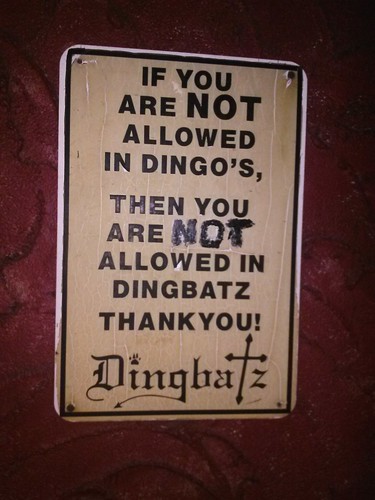
Also in the vicinity was another man, Lem. Unlike Palladian, he wasn't commenting on the music and yearning, at least not directly. He just told his own story — "We went to see a new friend perform at a local establishment and I took a picture of a sign near the entrance" — and showed us this:

Palladian: A few years ago, "peony" was a very popular note in perfumery. Many perfumes used this note, which was generally done as a big, fluorescent, loud, fruity-flower odor of no particular interest. Givaudan makes 2-cyclohexylidene-2-phenylacetonitrile, an aroma chemical they call Peonile, which I always find hilarious. Say it: Peonile.Also in the comments, a dialogue between 2 women:
El Pollo Raylan: The name is apt. I see lots of structural rigidity in the linear nitrile portion which has a nitrogenous lone pair at one end. Then there's the cyclohexylidene portion which is quasi-floppy, but made stiffer by attachment to the olefinic core. The phenyl is of course rigid except for its rotational degree of freedom.
Palladian: I love when you talk dirty!
Freeman Hunt: We had some new tile installed in our kitchen this week. One afternoon the installers washed their tools outside and left without coming back in. Because they did not come back in, they forgot to turn off their radio. The radio was across the newly laid tile that we were forbidden to walk upon. So we listened to popular, contemporary country music all that evening and for three hours the next morning. Heh. (That story is much funnier to people who know me in real life. I don't listen to anything in the background. Ever. No television. No music. Nothing. I only turn something on if I want to listen to it actively.)Intruding on this perfectly female dialogue was the aforequoted Palladian: "That's what a handgun and good aim are for."
Synova: I don't listen to "background" anything either. I can see you standing at the edge of the tile... yearning.
Freeman Hunt: "yearning"... Perfect word.
Also in the vicinity was another man, Lem. Unlike Palladian, he wasn't commenting on the music and yearning, at least not directly. He just told his own story — "We went to see a new friend perform at a local establishment and I took a picture of a sign near the entrance" — and showed us this:
Saturday, May 18, 2013
"Heh, great stuff, Althouse. Cf. Derrida on Nietzsche's umbrella."
Says Yashu, in the comments on "The word 'umbrella' appears exactly once in Obama's 'Dreams From My Father.'" And that was after I'd read rhhardin, commenting on "Sigmund Freud on the meaning of the umbrella": "Derrida in Spurs on the umbrella that Nietzsche wrote he had forgotten."
I'm spurred to read "Spurs," but "Spurs" is not an ebook, so I'm off the hook. Still, here's some text visible in Google books. Derrida is playing with the the possible meaning(s) of "I have forgotten my umbrella," found (in quotation marks) in Nietzche's unpublished manuscripts. Excerpt:
"Apotropaic" is also unusual. The OED says it's "Having or reputed to have the power of averting evil influence or ill luck" and gives this earliest example from the 1883 Encyclopedia Brittanica:
We law folk know "umbra" from the "penumbras" in "specific guarantees in the Bill of Rights [that] have penumbras, formed by emanations from those guarantees that help give them life and substance," a very glaring phrase written by Justice William O. Douglas, trying to explain how in the lamp-lit street he dimly saw the right of privacy.
But it was really Oliver Wendell Holmes, Jr. who got that word started in its U.S. law usage, the OED tells us: "The use of the penumbra metaphor in American jurisprudence appears to date from the late 19th cent. and is associated with Oliver Wendell Holmes (1841–1935), legal scholar and Associate Justice of the U.S. Supreme Court."
"Are you ready for me to read it?" Meade asks, and I say, "It needs one more thing, and I don't know what it is."
I'm spurred to read "Spurs," but "Spurs" is not an ebook, so I'm off the hook. Still, here's some text visible in Google books. Derrida is playing with the the possible meaning(s) of "I have forgotten my umbrella," found (in quotation marks) in Nietzche's unpublished manuscripts. Excerpt:
The umbrella's symbolic figure is well-known, or supposedly so. Take, for example, the hermaphroditic spur of a phallus which is modestly enfolded in its veils, an organ which is at once aggressive and apotropaic, threatening and/or threatened. One doesn't just happen onto an unwonted object of this sort in a sewing-machine on a castration table."Unwonted" is not a typo. Unlike "unwanted," it's not commonly heard/seen. It means: "not commonly heard, seen, practised." So says the OED, which tells us that Charlotte Brontë used "unwonted" in "Jane Eyre": "Difficulties in habituating myself to new rules and unwonted tasks." Are there umbrellas in "Jane Eyre"?
I jumped up, took my muff and umbrella, and hastened into the inn-passage: a man was standing by the open door, and in the lamp-lit street I dimly saw a one-horse conveyance....The Freudian symbolism is too blatant to need pointing out. The umbrella, the man, and the horse. And the muff, the inn-passage, and the open door. That's more than dimly seen.
"Apotropaic" is also unusual. The OED says it's "Having or reputed to have the power of averting evil influence or ill luck" and gives this earliest example from the 1883 Encyclopedia Brittanica:
The sacrifice of the ‘October horse’ in the Campus Martius..had also a naturalistic and apotropaic character.Wikipedia says the "October horse was an animal sacrifice to Mars carried out on October 15, coinciding with the end of the agricultural and military campaigning season." There were chariot races and "the right-hand horse of the winning team was transfixed by a spear, then sacrificed." So did the ancient Romans have umbrellas? Yes. They were used by women and "effeminate men." Used against the sun, of course. How much Latin do you need to see the "umbra" in "umbrella" and to know we're talking about shade.
We law folk know "umbra" from the "penumbras" in "specific guarantees in the Bill of Rights [that] have penumbras, formed by emanations from those guarantees that help give them life and substance," a very glaring phrase written by Justice William O. Douglas, trying to explain how in the lamp-lit street he dimly saw the right of privacy.
But it was really Oliver Wendell Holmes, Jr. who got that word started in its U.S. law usage, the OED tells us: "The use of the penumbra metaphor in American jurisprudence appears to date from the late 19th cent. and is associated with Oliver Wendell Holmes (1841–1935), legal scholar and Associate Justice of the U.S. Supreme Court."
1873 O. W. Holmes in Amer. Law. Rev. 7 654 It is better to have a line drawn somewhere in the penumbra between darkness and light, than to remain in uncertainty.I suspect no one will ever Heh-great-stuff-Althouse-Cf. me again. Here I am, writing expectantly, hoping for the circle to finally close, as it did for young Obama, crying over his father's grave, when he realized that the masculine needed to be leavened with femininity and that who he was, what he cared about, was no longer just a matter of intellect or obligation, no longer a construct of words, and then it started to rain and suddenly his brother Bernard was squatting beside him, sheltering him with a bent-up old umbrella.
"Are you ready for me to read it?" Meade asks, and I say, "It needs one more thing, and I don't know what it is."
Sigmund Freud on the meaning of the umbrella.
We've been talking about Obama and umbrellas this morning — here, here, and here — and, as noted, I bought the Kindle version of Freud's "Interpretation of Dreams" so I could search for "umbrella," which I remembered as a famous Freudian symbol.
And what would Freud say about the scene that has seized the public imagination — #1 on The Washington Post's most popular list — "Obama puts Marines on umbrella duty, irking conservatives"?

To ask the question is to see the answer! Indeed, to ask the question is to see innumerable phallic symbols in the photograph. Here, inspect this huge enlargement. Oh, my! It's a world of wonder. The shape of those windowed doors! Obama's 2-thumbs-up gesture. The lectern stands. The microphones. The medals. The arrows in the claws of the eagles on the seals. The umbrellas, one more erect than the other.
According to the WaPo article, the U.S. military might believe that umbrellas are effeminate. Dr. Freud says no, no absolutely not. They are quite masculine, especially when erect. Getting a rigidly erect male to hold erect umbrella over you and another rigidly erect male to hold another albeit slightly less erect umbrella over a world leader? It's the most masculine image ever seen!
It's no wonder the President's detractors are irked. In the Freudian analysis, we know the source of the anxiety that motivates them to drag him down with assertions that umbrellas are not manly.
All elongated objects, sticks, tree-trunks, umbrellas (on account of the opening, which might be likened to an erection), all sharp and elongated weapons, knives, daggers, and pikes, represent the male member...What then would Freud say about Obama's writing a book called "Dreams From My Father" in which he depicts a scene (perhaps concocted for dramatic effect) in which he is crying in the rain between the small boxes that are the graves of his father and grandfather and his brother is suddenly there holding an opened umbrella? To ask that question is already to see the answer.
Small boxes, chests, cupboards, and ovens correspond to the female organ; also cavities, ships, and all kinds of vessels.
And what would Freud say about the scene that has seized the public imagination — #1 on The Washington Post's most popular list — "Obama puts Marines on umbrella duty, irking conservatives"?
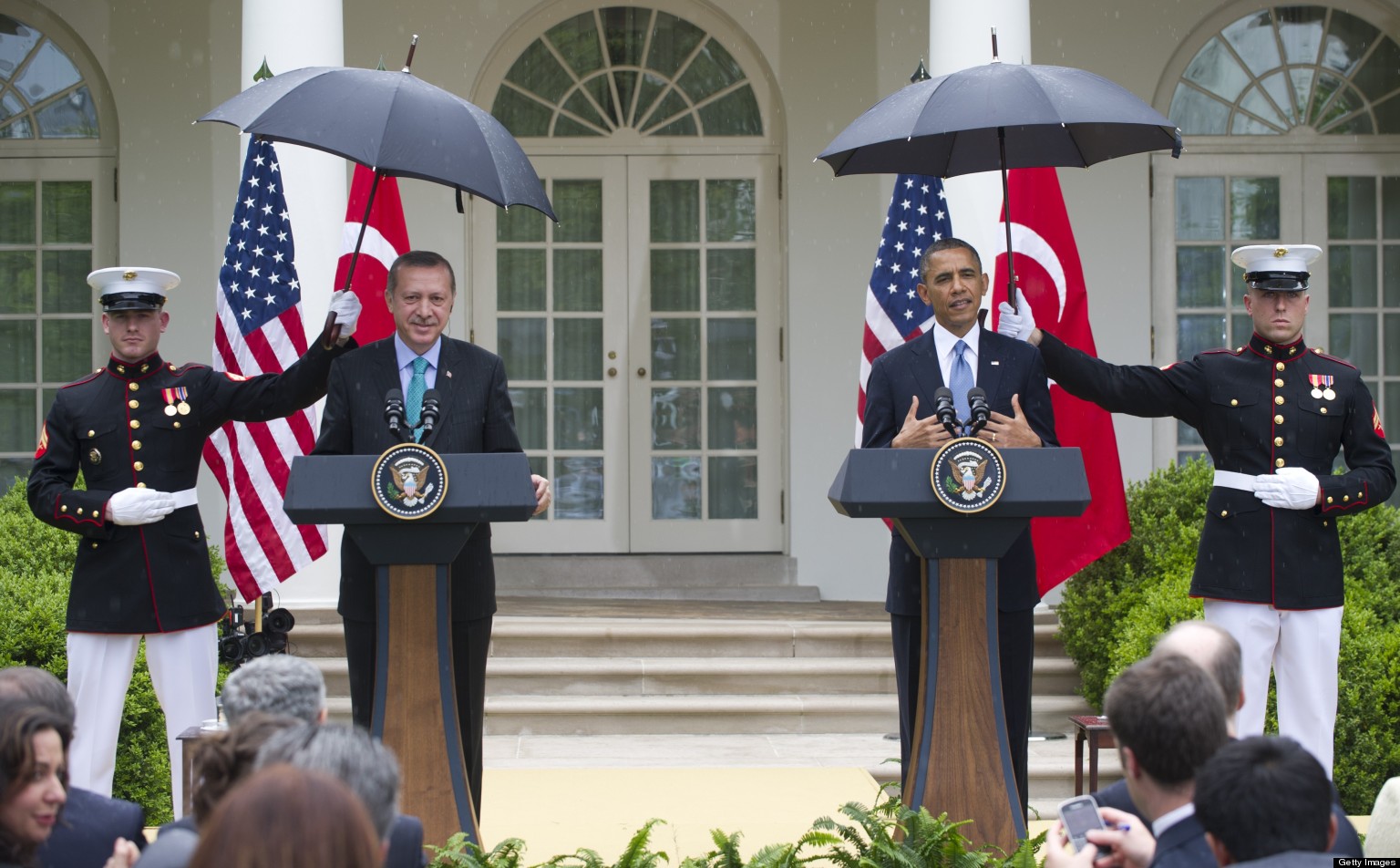
To ask the question is to see the answer! Indeed, to ask the question is to see innumerable phallic symbols in the photograph. Here, inspect this huge enlargement. Oh, my! It's a world of wonder. The shape of those windowed doors! Obama's 2-thumbs-up gesture. The lectern stands. The microphones. The medals. The arrows in the claws of the eagles on the seals. The umbrellas, one more erect than the other.
According to the WaPo article, the U.S. military might believe that umbrellas are effeminate. Dr. Freud says no, no absolutely not. They are quite masculine, especially when erect. Getting a rigidly erect male to hold erect umbrella over you and another rigidly erect male to hold another albeit slightly less erect umbrella over a world leader? It's the most masculine image ever seen!
It's no wonder the President's detractors are irked. In the Freudian analysis, we know the source of the anxiety that motivates them to drag him down with assertions that umbrellas are not manly.
The word "umbrella" appears exactly once in Obama's "Dreams From My Father."
I'm searching the text, because I've been thinking, this morning, about the fascination with Obama's interaction with the Marine and the umbrella, and that set me looking into umbrellas as a famously Freudian symbol, and I was struck by the meaningfulness — in that Freudian context — of Obama's book title "Dreams From My Father."
Now, I'm astounded to see that the umbrella figures importantly in the book — and it is even an umbrella held over him by another man (his younger brother Bernard). This happens at the end of what is the most dramatic scene in the book, on the last page of the final chapter. Obama, in Africa, falls to the ground between the graves of his father and his grandfather and cries. He's crying about a lack of "a faith that wasn’t new, that wasn’t black or white or Christian or Muslim but that pulsed in the heart of the first African village and the first Kansas homestead—a faith in other people."
Flash forward, and he's President. He is in the Rose Garden. It starts to rain. No man suddenly appears with an umbrella. He is getting wet and he is President — with plenty of airplanes and rifles and all of the world's greatest military at hand — but he is still getting wet. He has to order the Marine to shelter him. It isn't Bernard squatting with a bent-up old umbrella. It's a Marine in full-dress uniform, with a fine unbent umbrella, which is nevertheless not correct under the official — male, rigid — Marine Corps regulations. Where are the words of encouragement, the embraces, the strong, true love? You could never forge yourself into a whole man by leaving those things behind!
Now, here is the whole world gathered around him. Was there ever anything more unlike the time when he was alone between 2 graves? And yet, back then, the moment a light rain began to fall, his brother was there, sent by others who loved to see if he was okay. And here he is, the center of the whole world's attention, and he had to call for the umbrella. He is not okay.
Now, I'm astounded to see that the umbrella figures importantly in the book — and it is even an umbrella held over him by another man (his younger brother Bernard). This happens at the end of what is the most dramatic scene in the book, on the last page of the final chapter. Obama, in Africa, falls to the ground between the graves of his father and his grandfather and cries. He's crying about a lack of "a faith that wasn’t new, that wasn’t black or white or Christian or Muslim but that pulsed in the heart of the first African village and the first Kansas homestead—a faith in other people."
And for lack of faith you clung to both too much and too little of your past. Too much of its rigidness, its suspicions, its male cruelties.He expresses the idea that their "male cruelties" should have been moderated by more of "the laughter in Granny’s voice, the pleasures of company while herding the goats, the murmur of the market, the stories around the fire... Words of encouragement. An embrace. A strong, true love." That is, the over-masculinity should have been mixed with more feminine things, things that "could make up for a lack of airplanes or rifles." There's a theory of gender here: "you could never forge yourself into a whole man by leaving those things behind."
For a long time I sat between the two graves and wept. When my tears were finally spent, I felt a calmness wash over me. I felt the circle finally close. I realized that who I was, what I cared about, was no longer just a matter of intellect or obligation, no longer a construct of words. I saw that my life in America—the black life, the white life, the sense of abandonment I’d felt as a boy, the frustration and hope I’d witnessed in Chicago.... all of it was connected with this small plot of earth an ocean away, connected by more than the accident of a name or the color of my skin. The pain I felt was my father’s pain. My questions were my brothers’ questions. Their struggle, my birthright.So — as he dramatizes it —it is at the moment when he finds out who he really is that another man suddenly appears and is sheltering him with an umbrella. He's been crying, but now it all makes sense, and — with the prompting of the younger man — he sees that he is okay.
A light rain began to fall, the drops tapping on the leaves above. I was about to light a cigarette when I felt a hand on my arm. I turned to find Bernard squatting beside me, trying to fit the two of us under a bent-up old umbrella.
“They wanted me to see if you were okay,” he said.
I smiled. “Yeah. I’m okay.”
Flash forward, and he's President. He is in the Rose Garden. It starts to rain. No man suddenly appears with an umbrella. He is getting wet and he is President — with plenty of airplanes and rifles and all of the world's greatest military at hand — but he is still getting wet. He has to order the Marine to shelter him. It isn't Bernard squatting with a bent-up old umbrella. It's a Marine in full-dress uniform, with a fine unbent umbrella, which is nevertheless not correct under the official — male, rigid — Marine Corps regulations. Where are the words of encouragement, the embraces, the strong, true love? You could never forge yourself into a whole man by leaving those things behind!
Now, here is the whole world gathered around him. Was there ever anything more unlike the time when he was alone between 2 graves? And yet, back then, the moment a light rain began to fall, his brother was there, sent by others who loved to see if he was okay. And here he is, the center of the whole world's attention, and he had to call for the umbrella. He is not okay.
"I think he's crude, I think he's medieval, and I don't want an elderly gentleman from Vienna with an umbrella inflicting his dreams upon me."
"I don't have the dreams that he discusses in his books. I don't see umbrellas in my dreams. Or balloons."
So said Vladimir Nabokov, in 1966, answering the question "Mr. Nabokov, would you tell us why it is that you detest Dr. Freud?" I'm reading this now after writing the last post, about the symbolism of Obama and the Marine-held umbrella. The post ends:
Interestingly, Nabokov is also talking about something else that was a topic in the Obama-and-the-umbrella post:
Nevertheless, I am downloading Freud's "Interpretation of Dreams." I want it in my Kindle, alongside, among other things, Obama's — ahem — "Dreams From My Father."
So said Vladimir Nabokov, in 1966, answering the question "Mr. Nabokov, would you tell us why it is that you detest Dr. Freud?" I'm reading this now after writing the last post, about the symbolism of Obama and the Marine-held umbrella. The post ends:
If umbrella-holding conveys a message of unmanliness, it is a vivid image of impotence. It's a symbol.Umbrellas are a famously Freudian symbol, and I was going to embellish that last post with some stray erudition. But the post was already too long. (Too long!!) And here was Nabokov, taking a swipe at the elderly gentleman from Vienna way back in 1966.
Interestingly, Nabokov is also talking about something else that was a topic in the Obama-and-the-umbrella post:
I'm not a good speaker, you see. When I start to speak, I have immediately four or five lines of thought — sort of roads, you know, trails going various ways. And I have to decide which trail I'm going to follow, and while I decide this, hawing and hemming begins, and it may be very upsetting because I hear it myself. I can never understand those limpid, fluid speakers, as my father was, who just deliver perfect phrases, beautifully built, with an aphorism here, you know, and a metaphor there. I can't do it. I have to think it out; I have to take a pencil; I have to write it down laboriously; have it before me. I do things like that. It's probably psychological. I can imagine what old Freud would have said, whom I heartily detest, as my readers know by now.Ah! What would Freud have said about Obama's endless uh-ing?
Nevertheless, I am downloading Freud's "Interpretation of Dreams." I want it in my Kindle, alongside, among other things, Obama's — ahem — "Dreams From My Father."
Saturday, May 4, 2013
Wednesday, April 10, 2013
"Anthony Weiner eyeing run for mayor of New York City."
Count the phallic symbols in the photo illustrating this headline.
AND: Compare this puff piece in the NYT Magazine: "Anthony Weiner and Huma Abedin’s Post-Scandal Playbook." It begins:
IN THE COMMENTS: CatherineM said: "Wow, so I guess he moved out of Forest Hills. No need since he's not representing a district anymore. So, I guess he's loaded if he's in Gramercy." Yeah. Good point. Where did all that money come from? Maybe the answer is in that NYT article, but the one bite of that cream puff was too much for me.
ADDED: To try to answer my question "Where did all that money come from?" without slogging through the whole thing, I searched the entire article text for various words: money, income, wealth, salary. Nothing. I resorted to "pay." "Pay" came up twice. Here:
AND: Compare this puff piece in the NYT Magazine: "Anthony Weiner and Huma Abedin’s Post-Scandal Playbook." It begins:
One day in early February, I met Anthony Weiner and Huma Abedin for breakfast at the Gramercy Park Hotel, one of their regular joints, just a few blocks from their apartment on Park Avenue South. The first thing Weiner said when I sat down was that their 13-month-old son, Jordan, had just moments ago taken his first step. They were both giddy, kvelling with baby-pride, especially Weiner, who, with all his free time, has become his son’s primary caretaker....They're kvelling. I'm gagging.
IN THE COMMENTS: CatherineM said: "Wow, so I guess he moved out of Forest Hills. No need since he's not representing a district anymore. So, I guess he's loaded if he's in Gramercy." Yeah. Good point. Where did all that money come from? Maybe the answer is in that NYT article, but the one bite of that cream puff was too much for me.
ADDED: To try to answer my question "Where did all that money come from?" without slogging through the whole thing, I searched the entire article text for various words: money, income, wealth, salary. Nothing. I resorted to "pay." "Pay" came up twice. Here:
"'You’re not paying enough attention to me'... And, I would then maybe play out, you know, if they told someone else that I was not paying attention to them anymore...."Ha. That's just Weiner talking about his idiotic scandal that we're supposedly "post."
Saturday, February 16, 2013
"In 1959 Fred Astaire hired renowned makeup artist John Chambers to work on his television special, Another Evening with Fred Astaire."
"The assignment? Turn Fred Astaire into Alfred E. Neuman. The results were predictably strange."
As they say... The past is a foreign country: they do things differently there.
I can't imagine such a long dance routine on network TV, even with a visual gag. I can't imagine a visual gag going on and on like that. People must have been so much more patient back then. Or much more in love with the idea of themselves as appreciating elevated culture. And yet it was not so elevated, what with the Alfred E. Neuman gag.
And that deadly modern dance. The woman swanning around while men in tuxedos behaved as if they were a single entity and that entity was a pulsating sexual organ. And all in such exquisite taste! Then Neuman/Astaire performs alone, lasts longer than all the rest of them, but in the end, he too loses his erection.
Moral: The ugliest guy might be the best performer.
Did I get that right?
As they say... The past is a foreign country: they do things differently there.
I can't imagine such a long dance routine on network TV, even with a visual gag. I can't imagine a visual gag going on and on like that. People must have been so much more patient back then. Or much more in love with the idea of themselves as appreciating elevated culture. And yet it was not so elevated, what with the Alfred E. Neuman gag.
And that deadly modern dance. The woman swanning around while men in tuxedos behaved as if they were a single entity and that entity was a pulsating sexual organ. And all in such exquisite taste! Then Neuman/Astaire performs alone, lasts longer than all the rest of them, but in the end, he too loses his erection.
Moral: The ugliest guy might be the best performer.
Did I get that right?
Wednesday, January 2, 2013
"Through this twilight universe Daisy began to move again with the season..."
"... suddenly she was again keeping half a dozen dates a day with half a dozen men, and drowsing asleep at dawn with the beads and chiffon of an evening dress tangled among dying orchids on the floor beside her bed."
We're sticking to sentences, here in our "Gatsby" project. I won't pretend not to know that Daisy is the main female character in the book, but for the purposes of this project, I'm disregarding what we know about her and where she might be in the plot line when this sentence appears. I'd like to follow a rule that excludes all extrinsic evidence, but the phrase "this twilight universe" shows why that rule may be too severe. Nevertheless, I'm going to stick with the no-extrinsic-evidence rule, and accept "this twilight universe" as a mystery. Daisy has been up to something in what is now being referred to as "this twilight universe," and there's something poignant about encountering someone — a flower-named woman — in a mysterious place where she has moved before and is beginning to move again.
That Daisy's renewed movement comes with the season makes us think of the plants that come and go seasonally. One third of the way through the sentence, we are thinking about the annual cycle of the seasons as well as the daily cycle of light and dark that contains twilight. A flower that is a woman moves within the inexorable movements of the universe.
This lone female is suddenly joined by numerous men. Though the unnamed men never get definition as individuals, they presumably get one-on-one dates with her, since the numbers match up: half a dozen dates a day with half a dozen men. This is the kind of "dating" one associates with a prostitute. The "twilight universe" feels more sinister, and the next thing we see is Daisy in bed: drowsing asleep at dawn. The daily sun cycle has turned from twilight to dawn, the 6 dates have somehow been cranked through and (suddenly) there is our wilted flower on her bed, but there is a string of words — like a string of men — that we must experience before we get to to "bed" (the last word of the sentence (she and we must get to bed)).
The words are the things on the floor beside her bed: "the beads and chiffon of an evening dress tangled among dying orchids." Orchids! There is Daisy — the flower we associate with freshness and simplicity — and there, next to her, on the way to the bed, are the complicated flowers whose name, literally, means testicles. So the 6 men were unnamed, but there is a name that bespeaks male sexuality. And there are those testicles, dying (as Daisy is drowsing), dying and all tangled up the pretty tatters — beads and chiffon — of what once was a dress.
Note carefully that it is not a dress that is tangled up with the orchids, it is the beads and chiffon, suggesting that the delicate dress has lost all integrity. And yet our Daisy has disentangled herself from the spewings of sex that lie on the floor. And she's not passed out, dead drunk. She's drowsing, in her presumably pretty nakedness.
It's dawn, and she will emerge again, with the cycle of the new day, fresh and daisy-like again. Remember, she was only beginning to move through this twilight universe, and with the new day, the movement will continue, with 6 more men and another dress to move through. She's not caught in this twilight universe. She moves through it. She gets through the men and through the dresses, and sleeps lightly as the detritus dies on the floor.
We're sticking to sentences, here in our "Gatsby" project. I won't pretend not to know that Daisy is the main female character in the book, but for the purposes of this project, I'm disregarding what we know about her and where she might be in the plot line when this sentence appears. I'd like to follow a rule that excludes all extrinsic evidence, but the phrase "this twilight universe" shows why that rule may be too severe. Nevertheless, I'm going to stick with the no-extrinsic-evidence rule, and accept "this twilight universe" as a mystery. Daisy has been up to something in what is now being referred to as "this twilight universe," and there's something poignant about encountering someone — a flower-named woman — in a mysterious place where she has moved before and is beginning to move again.
That Daisy's renewed movement comes with the season makes us think of the plants that come and go seasonally. One third of the way through the sentence, we are thinking about the annual cycle of the seasons as well as the daily cycle of light and dark that contains twilight. A flower that is a woman moves within the inexorable movements of the universe.
This lone female is suddenly joined by numerous men. Though the unnamed men never get definition as individuals, they presumably get one-on-one dates with her, since the numbers match up: half a dozen dates a day with half a dozen men. This is the kind of "dating" one associates with a prostitute. The "twilight universe" feels more sinister, and the next thing we see is Daisy in bed: drowsing asleep at dawn. The daily sun cycle has turned from twilight to dawn, the 6 dates have somehow been cranked through and (suddenly) there is our wilted flower on her bed, but there is a string of words — like a string of men — that we must experience before we get to to "bed" (the last word of the sentence (she and we must get to bed)).
The words are the things on the floor beside her bed: "the beads and chiffon of an evening dress tangled among dying orchids." Orchids! There is Daisy — the flower we associate with freshness and simplicity — and there, next to her, on the way to the bed, are the complicated flowers whose name, literally, means testicles. So the 6 men were unnamed, but there is a name that bespeaks male sexuality. And there are those testicles, dying (as Daisy is drowsing), dying and all tangled up the pretty tatters — beads and chiffon — of what once was a dress.
Note carefully that it is not a dress that is tangled up with the orchids, it is the beads and chiffon, suggesting that the delicate dress has lost all integrity. And yet our Daisy has disentangled herself from the spewings of sex that lie on the floor. And she's not passed out, dead drunk. She's drowsing, in her presumably pretty nakedness.
It's dawn, and she will emerge again, with the cycle of the new day, fresh and daisy-like again. Remember, she was only beginning to move through this twilight universe, and with the new day, the movement will continue, with 6 more men and another dress to move through. She's not caught in this twilight universe. She moves through it. She gets through the men and through the dresses, and sleeps lightly as the detritus dies on the floor.
Monday, December 31, 2012
How to read a book a day for a year.
Choose short/easy/audio books.
Actually, I read a book a day and have for years — but it's an audiobook, and most of this reading is done while asleep.
Do you have an reading-related New Year's resolutions? Let's think up some reading projects for the new year. We don't necessarily have to do them. Let's just contemplate them. I've already thought of 2, one of which I plan to do. First:
Actually, I read a book a day and have for years — but it's an audiobook, and most of this reading is done while asleep.
Do you have an reading-related New Year's resolutions? Let's think up some reading projects for the new year. We don't necessarily have to do them. Let's just contemplate them. I've already thought of 2, one of which I plan to do. First:
Maybe a good project would be those "History of..." pages, not just for their most common words — WAR! — but to have had it run through your head, at least once, what happened in all of those places. Do you know how many pages we are talking about? The number of members in the United Nations is not the right answer, but do you know that number? It's 193. Wikipedia lists 206 sovereign states (including those with disputed sovereignty).That will start on New Year's day. Don't worry, I'll make it amusing. Second:
Let's make a New Year's resolution: Each day, read one Wikipedia "History of..." page. Will you join me? We'll go in alphabetical order, and I'll prompt you with blog posts.
What I like [about "The Great Gatsby"] is that each sentence is good, on its own. Seriously. Test it out. "As my train emerged from the tunnel into sunlight, only the hot whistles of the National Biscuit Company broke the simmering hush at noon." Every sentence is a writer's inspiration....With commentary, of course. For example, here's my commentary on the hot-whistle-simmering-hush sentence (responding to a commenter who complained that "trains do not 'emerge' from tunnels. They blast, speed, rip, explode, hurtle. E.B. White and Orwell would have hated the verb 'emerge'):
I feel like starting a blog devoted to individual sentences in "The Great Gatsby," chosen randomly, and continuing until all the sentences have been used up.
Now, one reason the train can't "blast" or "explode" from the tunnel — and by the way, oh, you men, with your cocks — is that the "only" sound was the "hot whistle." Otherwise, there was a "hush." That's all very surreal, no? Why didn't the train make any noise? It emerged, because it wasn't a screaming cock blasting through a vagina tunnel, as happens in your (presumably) E.B. White-approved works of fiction. Why was the train silent, why were the whistles hot, why was the hush simmering, why was it noon, why were the whistles biscuit whistles, and why wasn't it the biscuit, rather than the whistle, that was hot?
Tuesday, December 18, 2012
"In the olden days, when leftists wished to argue against gun owners, they claimed that guns were phallic symbols..."
"... and that the excessive love of guns demonstrated latent homosexuality," says William (the commenter), tapping his own memory as "I'm an old man and a living link with the past."
Keep oiling and loading that pisstool, big boy. We know what you're really doing....
Can we not now claim that excessive fear of gun ownership indicates a streak of homophobia? They don't want to ban guns. We know what they really want to ban.
Subscribe to:
Posts (Atom)