Showing posts with label Freud. Show all posts

Friday, June 14, 2013

"Women have fabricated a way of talking about the conflict between women who hope to find most of their self-fulfillment in the home..."

"... and those for whom being a homemaker and childrearer is not enough — and not only that, but believe it should not be enough for most women. This is the enlightened, productive side of what are commonly called the Mommy Wars. My question... is: Where are the Daddy Wars?"

Asks Marc Tracy, perhaps only because the annual nonsense of producing an article about Father's Day was nagging at whoever's running The New Republic these days.
In a smart response on New York’s The Cut blog, Kurt Soller noted that men will probably have to take their cues from ladyblogs and the like as they navigate this issue, and offered several smart thoughts....
So Kurt of The Cut has a smart response that offered smart thoughts. All I can say is: ouch. (In the old days — before feminists destroyed Freud — one could have wisecracked about castration anxiety.)

Monday, June 3, 2013

"We’ve been a pretty youth-oriented generation."

"We haven’t idealized growing up and getting mature in the same way that other cohorts have."

Efforts to explain why Baby Boomers are killing themselves at what is supposedly "an alarming rate."
“There was an illusion of choice — where people thought they’d be able to re-create themselves again and again,” [said Barry Jacobs, director of behavioral sciences at the Crozer-Keystone Family Medicine Residency Program in Pennsylvania]. “These people feel a greater sense of disappointment because their expectations of leading glorious lives didn’t come to fruition.”...

Baby boomers... have struggled more with existential questions of purpose and meaning. Growing up in a post-Freudian society, they were raised with a new vocabulary of emotional awareness and an emphasis on self-actualization. But that did not necessarily translate into an increased ability to cope with difficult emotions — especially among men.

Saturday, May 18, 2013

Sigmund Freud on the meaning of the umbrella.

We've been talking about Obama and umbrellas this morning — here, here, and here — and, as noted, I bought the Kindle version of Freud's "Interpretation of Dreams" so I could search for "umbrella," which I remembered as a famous Freudian symbol.
All elongated objects, sticks, tree-trunks, umbrellas (on account of the opening, which might be likened to an erection), all sharp and elongated weapons, knives, daggers, and pikes, represent the male member...

Small boxes, chests, cupboards, and ovens correspond to the female organ; also cavities, ships, and all kinds of vessels.
What then would Freud say about Obama's writing a book called "Dreams From My Father" in which he depicts a scene (perhaps concocted for dramatic effect) in which he is crying in the rain between the small boxes that are the graves of his father and grandfather and his brother is suddenly there holding an opened umbrella? To ask that question is already to see the answer.

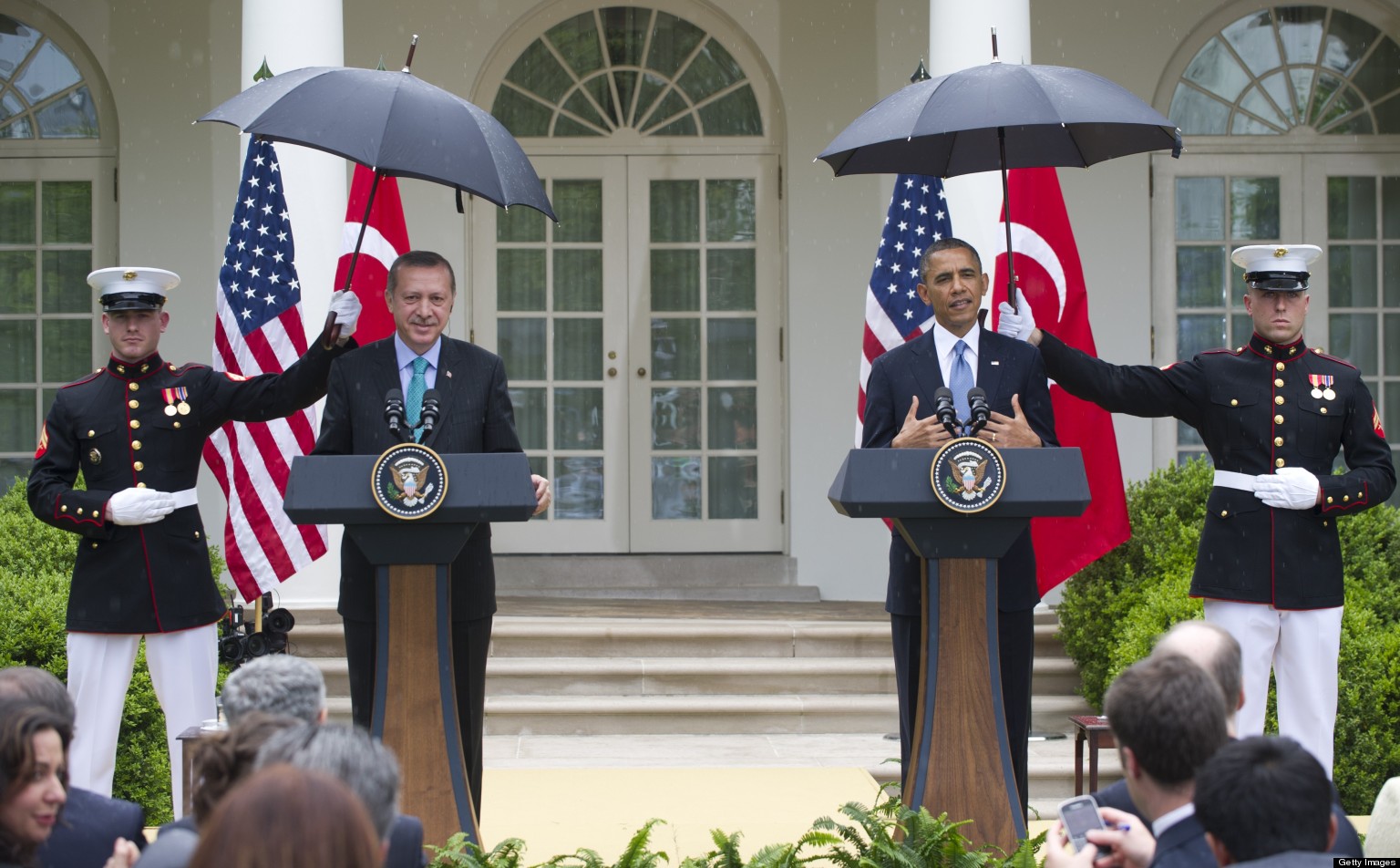
And what would Freud say about the scene that has seized the public imagination — #1 on The Washington Post's most popular list — "Obama puts Marines on umbrella duty, irking conservatives"?


To ask the question is to see the answer! Indeed, to ask the question is to see innumerable phallic symbols in the photograph. Here, inspect this huge enlargement. Oh, my! It's a world of wonder. The shape of those windowed doors! Obama's 2-thumbs-up gesture. The lectern stands. The microphones. The medals. The arrows in the claws of the eagles on the seals. The umbrellas, one more erect than the other.

According to the WaPo article, the U.S. military might believe that umbrellas are effeminate. Dr. Freud says no, no absolutely not. They are quite masculine, especially when erect. Getting a rigidly erect male to hold erect umbrella over you and another rigidly erect male to hold another albeit slightly less erect umbrella over a world leader? It's the most masculine image ever seen!

It's no wonder the President's detractors are irked. In the Freudian analysis, we know the source of the anxiety that motivates them to drag him down with assertions that umbrellas are not manly.

The word "umbrella" appears exactly once in Obama's "Dreams From My Father."

I'm searching the text, because I've been thinking, this morning, about the fascination with Obama's interaction with the Marine and the umbrella, and that set me looking into umbrellas as a famously Freudian symbol, and I was struck by the meaningfulness — in that Freudian context — of Obama's book title "Dreams From My Father."

Now, I'm astounded to see that the umbrella figures importantly in the book — and it is even an umbrella held over him by another man (his younger brother Bernard). This happens at the end of what is the most dramatic scene in the book, on the last page of the final chapter. Obama, in Africa, falls to the ground between the graves of his father and his grandfather and cries.  He's crying about a lack of "a faith that wasn’t new, that wasn’t black or white or Christian or Muslim but that pulsed in the heart of the first African village and the first Kansas homestead—a faith in other people."
And for lack of faith you clung to both too much and too little of your past. Too much of its rigidness, its suspicions, its male cruelties
He expresses the idea that their "male cruelties" should have been moderated by more of "the laughter in Granny’s voice, the pleasures of company while herding the goats, the murmur of the market, the stories around the fire... Words of encouragement. An embrace. A strong, true love." That is, the over-masculinity should have been mixed with more feminine things, things that "could make up for a lack of airplanes or rifles." There's a theory of gender here: "you could never forge yourself into a whole man by leaving those things behind."

For a long time I sat between the two graves and wept. When my tears were finally spent, I felt a calmness wash over me. I felt the circle finally close. I realized that who I was, what I cared about, was no longer just a matter of intellect or obligation, no longer a construct of words. I saw that my life in America—the black life, the white life, the sense of abandonment I’d felt as a boy, the frustration and hope I’d witnessed in Chicago.... all of it was connected with this small plot of earth an ocean away, connected by more than the accident of a name or the color of my skin. The pain I felt was my father’s pain. My questions were my brothers’ questions. Their struggle, my birthright.

A light rain began to fall, the drops tapping on the leaves above. I was about to light a cigarette when I felt a hand on my arm. I turned to find Bernard squatting beside me, trying to fit the two of us under a bent-up old umbrella. 

“They wanted me to see if you were okay,” he said.

I smiled. “Yeah. I’m okay.” 
So — as he dramatizes it —it is at the moment when he finds out who he really is that another man suddenly appears and is sheltering him with an umbrella. He's been crying, but now it all makes sense, and — with the prompting of the younger man — he sees that he is okay.

Flash forward, and he's President. He is in the Rose Garden. It starts to rain. No man suddenly appears with an umbrella. He is getting wet and he is President — with plenty of airplanes and rifles and all of the world's greatest military at hand — but he is still getting wet. He has to order the Marine to shelter him. It isn't Bernard squatting with a bent-up old umbrella. It's a Marine in full-dress uniform, with a fine unbent umbrella, which is nevertheless not correct under the official — male, rigid — Marine Corps regulations. Where are the words of encouragement, the embraces, the strong, true love? You could never forge yourself into a whole man by leaving those things behind!

Now, here is the whole world gathered around him. Was there ever anything more unlike the time when he was alone between 2 graves? And yet, back then, the moment a light rain began to fall, his brother was there, sent by others who loved to see if he was okay. And here he is, the center of the whole world's attention, and he had to call for the umbrella.  He is not okay.

"I think he's crude, I think he's medieval, and I don't want an elderly gentleman from Vienna with an umbrella inflicting his dreams upon me."

"I don't have the dreams that he discusses in his books. I don't see umbrellas in my dreams. Or balloons."

So said Vladimir Nabokov, in 1966, answering the question "Mr. Nabokov, would you tell us why it is that you detest Dr. Freud?" I'm reading this now after writing the last post, about the symbolism of Obama and the Marine-held umbrella. The post ends:
If umbrella-holding conveys a message of unmanliness, it is a vivid image of impotence. It's a symbol.
Umbrellas are a famously Freudian symbol, and I was going to embellish that last post with some stray erudition. But the post was already too long. (Too long!!) And here was Nabokov, taking a swipe at the elderly gentleman from Vienna way back in 1966.

Interestingly, Nabokov is also talking about something else that was a topic in the Obama-and-the-umbrella post:
I'm not a good speaker, you see. When I start to speak, I have immediately four or five lines of thought — sort of roads, you know, trails going various ways. And I have to decide which trail I'm going to follow, and while I decide this, hawing and hemming begins, and it may be very upsetting because I hear it myself. I can never understand those limpid, fluid speakers, as my father was, who just deliver perfect phrases, beautifully built, with an aphorism here, you know, and a metaphor there. I can't do it. I have to think it out; I have to take a pencil; I have to write it down laboriously; have it before me. I do things like that. It's probably psychological. I can imagine what old Freud would have said, whom I heartily detest, as my readers know by now.
Ah! What would Freud have said about Obama's endless uh-ing?

Nevertheless, I am downloading Freud's "Interpretation of Dreams." I want it in my Kindle, alongside, among other things, Obama's — ahem — "Dreams From My Father."

Monday, February 18, 2013

The answer to Freud's famous question "What does woman want?"

Give women what they ask for and when the demands end, the answer will be known.

ADDED: And then there's the less famous question: Why does this post have no link? If you really need a link for Freud's having said "What does woman want?" (or the alternate translations, "What do women want?"/"What does a woman want?"), feel free to Google it and get millions of search results. If you want a link for the statement, "Give women what they ask for and when the demands end, the answer will be known," that would be a link to this very post. It's my aphorism. If you want a link to what made me think about this, that's not how things work around here, where the conversation goes on and on, which is one of the many things women want. 

Wednesday, February 13, 2013

"Trypophobia... is an irrational fear of holes, pods or cracks — specifically, clusters of them."

"On Instagram and Reddit, people share photographs of clusters that make them anxious, obsessed and even nauseated."
Many images show holey foods or clusters of seeds, like aerated chocolates, the innards of a red bell pepper, and bubbles rising up in pancakes while they cook.

"I don't like the holes in crumpets or sponges or Swiss cheese," @CourtneySGray said on Twitter. "They all make me shudder and panic."

The trypophobia Facebook page touts nearly 7,000 followers, who commiserate on their "condition" and triggers. "When macaroni noodles stand up straight when I'm boiling them, I wanna cry," Kelcey Piper remarked on Facebook. "Anyone else experienced this?"
The amazing thing is, the link goes to NPR, where there's no mention whatsoever of Sigmund Freud. How radically our culture has changed in the last 30 years!

Friday, January 11, 2013

"The Charmin corporate Twitter account got in on it with a surprisingly trenchant commentary on the disposability of American currency."

That's the way Slate — displaying the winners of its design-a-$1-trillion-coin contest — refers to the symbolism here:


"Surprisingly trenchant commentary." Come on! I like delicate toilet paper, but why the delicacy talking about toilet paper? What, exactly, is the commentary? I assumed it was: American currency is something you may as well wipe your ass with. But then I thought the idea was: Uh, oh, we just pooped ourselves.

Maybe you're wracking your brain for a way to use the old "Don't Squeeze the Charmin" slogan, but that was the 1960s. The current slogans — if I am to believe the Charmin Wikipedia page — are: "Enjoy the Charmin experience" and "Enjoy The Go." Enjoy the go?! Put that on the coin. Hell, make that the national motto. "In God We Trust" is getting old. It's divisive. And, frankly, it's unfair to God.

"Enjoy the Go"... I looked it up to see how they were playing this slogan in the commercials:


The relief. The calm. The clean. The comfort.

See? That's the way you'll feel after that $1-trillion is deposited in the toilet bank. This image evokes Sigmund Freud:
Freud suggested that children in the anal stage of development regard the release of their feces as a gift to the parent — a gift that can be given or withheld. Children will release the feces if given sufficient love and withhold them if not. In Freudian thought, fecal matter becomes a type of currency in the parent-child relationship, which can be withheld or dispensed, thus giving the child a sense of control. The word currency is appropriate in this context; Freud assumed that the human unconscious makes a symbolic equation between feces and money. In a 1911 paper on dreams in folklore, he noted that according to ancient Eastern mythology, “gold is the excrement of hell” (Freud & Oppenheim, 1911/1958, p. 157).
Hell!

(I'm riffing on the toilet paper topic topic Meade introduced late last night. That was Meade — did you notice? — not me.)

Friday, December 7, 2012

Katie Roiphe tries to fathom the depths of why she's buying really expensive shoes.

She writes about herself in the second person saying things like: 
You have read Adorno. You are able to think critically about your desire for the shoes. Furthermore, you have a healthy class-hatred for people who dress habitually in clothes from this store...
And:
If you do walk out with the shoes...  they work like a drug—the anxieties that were plaguing you before you enter the store have lifted. As you step out into traffic, the still and stagnant city is suddenly charged with possibility

The parties you have scribbled in your calendar seem more glittery or interesting or fun, and you in the shoes, more daunting, more sylphlike, more free, more invulnerable....

Do you want to be the kind of person who sacrifices, overreaches, for a pair of shoes, who imbues them with a romantic overlay that a material object cannot possibly sustain?
That's where the internal argument ends up, and obviously she buys the shoes. Obviously, there's a huge mental element to consumerism, both before and after the purchase. Note that anxieties must be stirred up to provide an additional argument: I need to dispel these anxieties! She gets off on the purchase.

My question: Why shoes? There's some discussion of how shoes "will transform you into someone else" — special shoe magic. (See "The Wizard of Oz.") There's oddly little reference to sex. Roiphe ignores Freud, who famously saw shoes as vagina symbols. Roiphe wants — or wants "you" — to be daunting, sylphlike, free, and invulnerable.

A sylph is a female fairy. In Alexander Pope's "The Rape of the Lock," "women who are full of spleen and vanity turn into sylphs when they die because their spirits are too full of dark vapors to ascend to the skies." (Here is "The Rape of the Lock," with the illustrations by Aubry Beardsley, for only 99¢ on Kindle!)

So, maybe, why shoes? Why not dresses, jackets, jewelry, sweaters? I think it's that you've got to specialize — unless you're actually rich — if you're going to shop in the really expensive places. You can trick yourself into thinking you've been indulged. Still, why specialize in shoes?