Showing posts with label 2008 campaign. Show all posts

Wednesday, December 18, 2013

NYT/CBS poll finds only 1/3 of Americans think the ACA will improve the health care system.

The full numbers won't come out until later today, so there aren't specific percentages at the squib just published at the NYT, and there isn't even a rough fraction to suggest how many of the rest thought things would get worse and how many took the neutral middle position. The headline is "Broad Skepticism on Health Care Law," and I'm just going to guess that the negative group is more than 1/3. Here's some teasing text:
Among all adults, nearly half think the law will not affect them at all, while among uninsured adults, just over one-quarter say that. And while a nearly 4 in 10 plurality of uninsured Americans think the health care law will hurt them personally, they are twice as likely as the general public to say the law will help them.
You can't figure out from that what either group said about thinking that the law would help them. I'll be interested to see how low those numbers are. It could be as high as 6 out of 10 and 3 out of 10 or much lower — 2 out of 10 and 1 out of 10 or worse. [ADDED: If 4 in 10 is indeed a "plurality," then 3 out of 10 for the uninsured think the law will help. You can figure that out. And that would mean that 1.5 out of 10 in the "general public" think it will help them. I guess the "general public" includes this uninsured, so the numbers of already-insured who think it will help them must be less that 1.5. I am relying on precision in the NYT language.]

The promise was that vast majorities of Americans would be helped, including nearly everyone with inadequate or no insurance, and that nearly all of the rest would remain [at worst] in a neutral position, keeping what they had if they liked it. So we are experiencing a monumental reversal of expectations. It's hard to fathom how crushed people feel, both in having the huge promise so badly broken and in having so much upheaval with such an effect on one's personal finances and physical well-being.

This is so different from other huge events in American politics. One political party chose to cause this great disruption. It's not like a terrorist attack or a war that demands that we change. It was chosen, and it was chosen with no decent understanding of how difficult a disruption it would be.

I think back to something Michelle Obama said in early 2008, which seemed ominous to some even then:
Barack Obama... is going to demand that you shed your cynicism. That you put down your divisions. That you come out of your isolation, that you move out of your comfort zones. That you push yourselves to be better. And that you engage. Barack will never allow you to go back to your lives as usual, uninvolved, uninformed.
Maybe it's true that Barack has successfully prevented us from getting back to our lives as usual, our lives that many of us liked and wanted to keep. And it's true that he demanded that we shed our cynicism, and that was only the most ironic of the many way that he inspired our cynicism.

Monday, November 25, 2013

"I may have missed something, I cannot help but wonder, Professor..."

"... given your many recent blistering critiques of Obama, if you now regret voting for him."

Asks St. George in the comments thread to yesterday's post "Juan Williams reveals that the White House is calling the Republicans' opposition to Obamacare "the original sin.'"

I expressed whatever regret I have in the form of voting against Obama's reelection, but I have never said I think it was a mistake to have voted for him the first time. For the voter, the decision-making point arrived in November 2008 and the choice was between Obama and John McCain. I stand by my contemporaneous post "How McCain lost me." How can you compare what Obama actually did to imagined scenarios about McCain? If McCain had won in 2008, we'd have heard about the amazing brilliant alternative path into history we might have taken with Barack Obama.

Wednesday, November 6, 2013

Having voted to legalize marijuana, Coloradans now vote to tax it.

Heavily.

Well, of course. You legalize it so you can tax it. To repurpose an old Obama-and-marijuana quote: That was the point.


Obama's appearance arrives at 0:57, after which a commenter (Howard Fineman) opines: "One of the reasons Barack Obama is so popular, especially among younger people, is that he seems so real, he seems to acknowledge the reality of things. It's kind of almost like a dog whistle kind of thing. Older people can't hear it. Younger people hear it. And that's one of the things that they hear. He seems to be willing to be honest."

I need some medical marijuana for my hearing. I'm old. I was old back in 2006 when that clip came out. Yes, I voted for him, but not because I believed he was a new kind of honest. And now, in 2013, watching that, what I hear — on the sound wavelengths that penetrate my old head — is the word "seems," screeching out of Fineman's word montage: He seems so real... he seems to acknowledge... He seems to be willing to be honest.

"Seems" and "willing."

Willing... like: Okay, I'll go along with this looking-honest bullshit for you folks for a while. So follow me, little puppies. I've got a new kind of reality kind of thing to kind of like show you. Can you, like, you know, hear it, kids?

And I got a big laugh out of Kathleen Parker, at the very end saying, "The thing people can't stand is the lies." I then rewatched the clip and lingered over the part where they showed Bill Clinton saying he "experimented" with marijuana and "didn't like it" and "didn't inhale." I found that very refreshing.

That's the kind of honesty I like right now. It was a lie, and you knew it was a lie when he told it. There was none of this feeling of oh, wow, look at the reality, man. What felt real was: There's a politician that will smile and lie straight to our faces. He's a liar.

Those were the days.

Monday, November 4, 2013

"Obama unable to govern like he campaigns"... a painfully funny front-page teaser at the L.A. Times...

... takes us to a more-painful-because-they're-serious headline: "Why can't Obama run the government as smoothly as his campaign?" Subhead: "The president increasingly seems to be battling top-level management failures as much as policy or political problems, observers say."

Remember when Obama, running for President in 2008, was asked what executive experience he had and he said running his campaign was executive experience?
Well, you know, my understanding is, is that Governor Palin's town of Wasilla has, I think, 50 employees. We have got 2,500 in this campaign. I think their budget is maybe $12 million a year. You know, we have a budget of about three times that just for the month. So, I think that our ability to manage large systems and to execute, I think, has been made clear over the last couple of years. And, certainly, in terms of the legislation that I passed just dealing with this issue post-Katrina of how we handle emergency management, the fact that many of my recommendations were adopted and are being put in place as we speak, I think, indicates the degree to which we can provide the kinds of support and good service that the American people expect.
Manage large systems... provide the kinds of support and good service that the American people expect.... 

Back to the L.A. Times:
As a candidate, he vowed to restore government competence to earn back trust, and to make a case for expanding the government's role in people's lives.

"We simply cannot afford to perpetuate a system in Washington where politicians and bureaucrats make decisions behind closed doors, with little accountability for the consequences … and where outdated technology and information systems undermine efficiency, threaten our security and fail to serve an engaged citizenry," Obama said in 2009...

"It seems to be that this White House has no chain to the top, even just the conventional 'protect the boss' standard that ought to be in place everywhere," [said Bob Stone, project director of the Clinton-era government reform effort]. "When something is about to burst, you warn the boss. That's both a management issue and a political issue.... It's hard to see that the president has really had any interest in actually managing the government."

Saturday, November 2, 2013

Goodbye to Ruth Garland-Dewson, the San Francisco milliner.

"Mrs. Dewson owned a celebrated shop on upper Fillmore Street called Mrs. Dewson's Hats for more than 37 years. Among her customers were former Mayor Willie Brown, Bruce Springsteen, Samuel L. Jackson, B.B. King and Sharon Stone. Brown called her "the milliner to high society." Mrs. Dewson designed a hat for him, which she called the Willie Brown Snap Brim. 'It fit my personality,' Brown wrote in his autobiography, 'Basic Brown."

When I was in San Francisco back in 2007, I had a chance encounter with her. I blogged this:
I was traipsing about San Francisco yesterday, and, snapping dozens of pictures, I made my way over to Fillmore Street for a little window shopping. I saw this...

DSC06281.JPG

.. and was struggling against the glare and reflections to frame my shot — and also, idiotically, talking on my iPhone — when a woman — who I now understand to be Ruth Garland-Dewson — swept out of the store and flung herself between me and the picture of Barack Obama.

"Are you trying to take a picture of my man?" she said dramatically.

But she wasn't what I for a second thought she was: one of those shopkeepers who are touchy about having their place photographed. She wanted to come out and talk — about Barack Obama and other things as well. I got off my phone conversation and complimented her on the great shop and asked if she had extra large hats. I love women's hats, but since I need a men's extra-large size, I can never find a woman's hat — aside from something stretchy — that fits. She found me what might have been her largest hat, and it almost fit. You know, I should have bought it! It was ocher-colored with a dark purple spiral — a felt hat with a large brim. I think I would have bought it if she'd tried to talk me into it (as so many sales people have nudged me beyond my initial resistance — it's not very hard).

But she wanted to talk about Barack Obama. Do I like him? Yes! I think he's a good man, and that he would be able to do a lot of good. I added, "But I kind of like Giuliani." That was okay with her, it seemed — so long as I don't like Hillary.
I'm sad to read that she's died, and I'm sorry I didn't buy that hat. She was so sociable and nice to me that day. She seemed like she was ready to launch into a conversation with me just because I was the one person who happened to be around just then.

Can you see the printed text in my photograph, above? That's her line, "I would say, 'Go, Obama, you're black enough for me,'" which ended a letter that she had printed in the San Francisco Chronicle on March 1, 2007, reacting to what was then a hot dispute: whether Obama was "black enough."

Wednesday, October 23, 2013

"In December 2007, candidate Obama was asked: "If you could... enact one piece of legislation — one thing, that’s all you’re going to get through in your presidency — what would it be?"

It was a question asked by one of 6 New Hampshire independents meeting with Senator Obama at the Loaf and Ladle restaurant, and "it seemed to stump him for a moment." What was the answer?
“I would enact a bold energy policy because I think that we could save so much money, engineer such a resurgence in our economy and solve climate change all at one time. And it would improve our national security posture. So you get a three-fer. It helps our environment, our economy and our national security and it would free up resources over time to deal with what I think is the most important domestic issue which is health care, and I think it would help us strategically on the international stage.”
Health care is in there, but only after the economy booms, freeing up money over time to make it workable to deal with health care.

Were we warned that leading from behind his party's majority in Congress, he would push through a massive health-care reform — without persuading the majority of Americans, without gaining support from the minority party, without prior economic recovery, and while plummeting hopelessly and incomprehensibly deeply into debt?

Was he stumped by that Loaf-and-Ladle question, or did he pause to carefully frame a bizarre lie? Notice that he claims his energy policy will be a "three-fer" and health care isn't one of the 3 things. The 3 things are a resurgent economy, the solution to climate change, and stronger national security. Health care is tossed in as an afterthought, and he's calling it an "important issue," not saying how he will solve it, only implying that money needs to be amassed before the issue can be approached.

As an independent who voted for Obama in 2008, looking back at that crafty answer, I feel defrauded. Maybe back then those thoughtful, elaborate answers inflated us with hope, but pulling that one apart this morning, I feel anger and disgust. What a horrible squandering of 2 terms of presidency!

"Nobody's madder than me," Obama says now. That can't be true.

Monday, June 24, 2013

Wake up to what Drudge is saying about Hillary.


The link on "921 days to go..." goes to the cheerful Washington Post headline "Welcome to the Hillary Rodham Clinton presidential speculation sweepstakes," which is full of babble like "It’s a double-edged sword. Early hype can deter viable challenges, but it also invites the kind of scrutiny that can deflate a bubble very quickly."

"921 days to go" seems like a fair enough teaser, but subliminally, what is Drudge doing? I suspect he's saying she's got a long, long way to go, and — look — she's already 65. She'll be 69 by Election Day 2016. I think he's working the too old message.

My suspicion arises before I read the next line:


So connect that photo of Hillary to the big, old dead body of James Gandolfini. And also worry about whether the Clintons give special preference to Hollywood celebrities... and it's okay with Drudge if you merge Gandolfini with a Mafia crime boss.

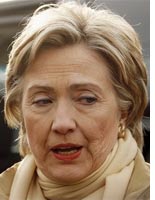
If you think I'm overeager to attribute meaning to the photos and juxtapositions at The Drudge Report, remember that Drudge actively and obviously played the Hillary is too old game in December 2007. Here's the notorious photograph:


... under the headline "The Toll of a Campaign."

Is she up for another campaign, 6 years later, with 3 years of running, trying to convince us that she can labor on for 4 years after that? I don't know but I fully expect Drudge to inject those doubts into us. He'll try to do it subliminally, so listen to me, and you'll at least be able to be conscious as Dr. Matt approaches with his syringe full of doubt.

Wednesday, June 12, 2013

"[I]t’s time to move beyond the political style of the baby boom generation."

"This is a style... that is highly moralistic and personal, dividing people between who is good and who is bad."

That's David Brooks on October 19, 2006, paraphrasing Obama and encouraging him to run for President. It's a paraphrase of what Obama wrote in the then-just-out "Audacity of Hope" and something he'd said to Brooks in an interview.

Look at the contradiction even in those 2 sentences that Brooks put together to promote Obama. Obama would like to "move beyond" the politics that divides people into good and bad, even as he draws a line of division and portrays the Baby Boomers as bad.

I'm searching the text of "The Audacity of Hope" to see what Obama wrote about Baby Boomers. There are 2 mentions. First, at page 50:

Despite a forty-year remove, the tumult of the sixties and the subsequent backlash continues to drive our political discourse. Partly it underscores how deeply felt the conflicts of the sixties must have been for the men and women who came of age at that time, and the degree to which the arguments of the era were understood not simply as political disputes but as individual choices that defined personal identity and moral standing.

The fury of the counterculture may have dissipated into consumerism, lifestyle choices, and musical preferences rather than political commitments, but the problems of race, war, poverty, and relations between the sexes did not go away.

And maybe it just has to do with the sheer size of the Baby Boom generation, a demographic force that exerts the same gravitational pull in politics that it exerts on everything else, from the market for Viagra to the number of cup holders automakers put in their cars.

Whatever the explanation, after Reagan the lines between Republican and Democrat, liberal and conservative, would be drawn in more sharply ideological terms. This was true, of course, for the hot-button issues of affirmative action, crime, welfare, abortion, and school prayer, all of which were extensions of earlier battles. But it was also now true for every other issue, large or small, domestic or foreign, all of which were reduced to a menu of either-or, for-or-against, sound-bite-ready choices. No longer was economic policy a matter of weighing trade-offs between competing goals of productivity and distributional justice, of growing the pie and slicing the pie. You were for either tax cuts or tax hikes, small government or big government.  No longer was environmental policy a matter of balancing sound stewardship of our natural resources with the demands of a modern economy; you either supported unchecked development, drilling, strip-mining, and the like, or you supported stifling bureaucracy and red tape that choked off growth. In politics, if not in policy, simplicity was a virtue.

Sometimes I suspect that even the Republican leaders who immediately followed Reagan weren’t entirely comfortable with the direction politics had taken. In the mouths of men like George H. W. Bush and Bob Dole, the polarizing rhetoric and the politics of resentment always seemed forced, a way of peeling off voters from the Democratic base and not necessarily a recipe for governing.

But for a younger generation of conservative But for a younger generation of conservative operatives who would soon rise to power, for Newt Gingrich and Karl Rove and Grover Norquist and Ralph Reed, the fiery rhetoric was more than a matter of campaign strategy. They were true believers who meant what they said, whether it was “No new taxes” or “We are a Christian nation.” In fact, with their rigid doctrines, slash-and-burn style, and exaggerated sense of having been aggrieved, this new conservative leadership was eerily reminiscent of some of the New Left’s leaders during the sixties. As with their left-wing counterparts, this new vanguard of the right viewed politics as a contest not just between competing policy visions, but between good and evil. Activists in both parties began developing litmus tests, checklists of orthodoxy, leaving a Democrat who questioned abortion increasingly lonely, any Republican who championed gun control effectively marooned. In this Manichean struggle, compromise came to look like weakness, to be punished or purged. You were with us or against us. You had to choose sides.

It was Bill Clinton’s singular contribution that he tried to transcend this ideological deadlock...
And a few pages later:
In the back-and-forth between Clinton and Gingrich, and in the elections of 2000 and 2004, I sometimes felt as if I were watching the psychodrama of the Baby Boom generation—a tale rooted in old grudges and revenge plots hatched on a handful of college campuses long ago—played out on the national stage. The victories that the sixties generation brought about—the admission of minorities and women into full citizenship, the strengthening of individual liberties and the healthy willingness to question authority—have made America a far better place for all its citizens. But what has been lost in the process, and has yet to be replaced, are those shared assumptions—that quality of trust and fellow feeling—that bring us together as Americans. 
So that's what we were supposed to be saved from by the next generation, unburdened by the 60s psychodrama. Brooks said Obama should run not in spite of his young age but  "because of his age." Brooks seemed to worry that Obama was too indecisive, with his "compulsive tendency to see both sides of any issue." ("He seems like the guy who spends his first 15 minutes at a restaurant debating the relative merits of fish versus meat.") But he liked "this style" as "surely the antidote to the politics of the past several years."And "the times will never again so completely require the gifts that he possesses."

Tuesday, February 12, 2013

"Shushing the Baby Boomers."

I linked to this January 2007 NYT piece in the previous post, and I've linked to it before — here and here. Is Obama a Baby Boomer or not? If Obama the solution to the Baby Boomer problem or part of the problem? Obama's ambiguous generationality. Much to say there.

But I've just got to make a separate post to call attention to the historical artifact that is Robert Grossman's illustration depicting Barack Obama leaping over 6 little figures who represent the Baby Boomers: