Showing posts with label Chip Ahoy. Show all posts

Monday, June 17, 2013

Monday, June 10, 2013

Ready to make some waves?

Last night's "Fluffy Cloud Café," reacted to by Chip Ahoy, who said:
Para bailar la bomba se necesita un poca de gracia, pero agitar la mar se necesita un chuchara de madera muy grande.

You can stir things up all you want over an dover but it just keeps returning to normal.

And did:

Sunday, April 21, 2013

Chip's dog GIFs.

First, "At the Yellower Café," Chip — opining about Zeus — says "He's a bit of a modeling primadona."


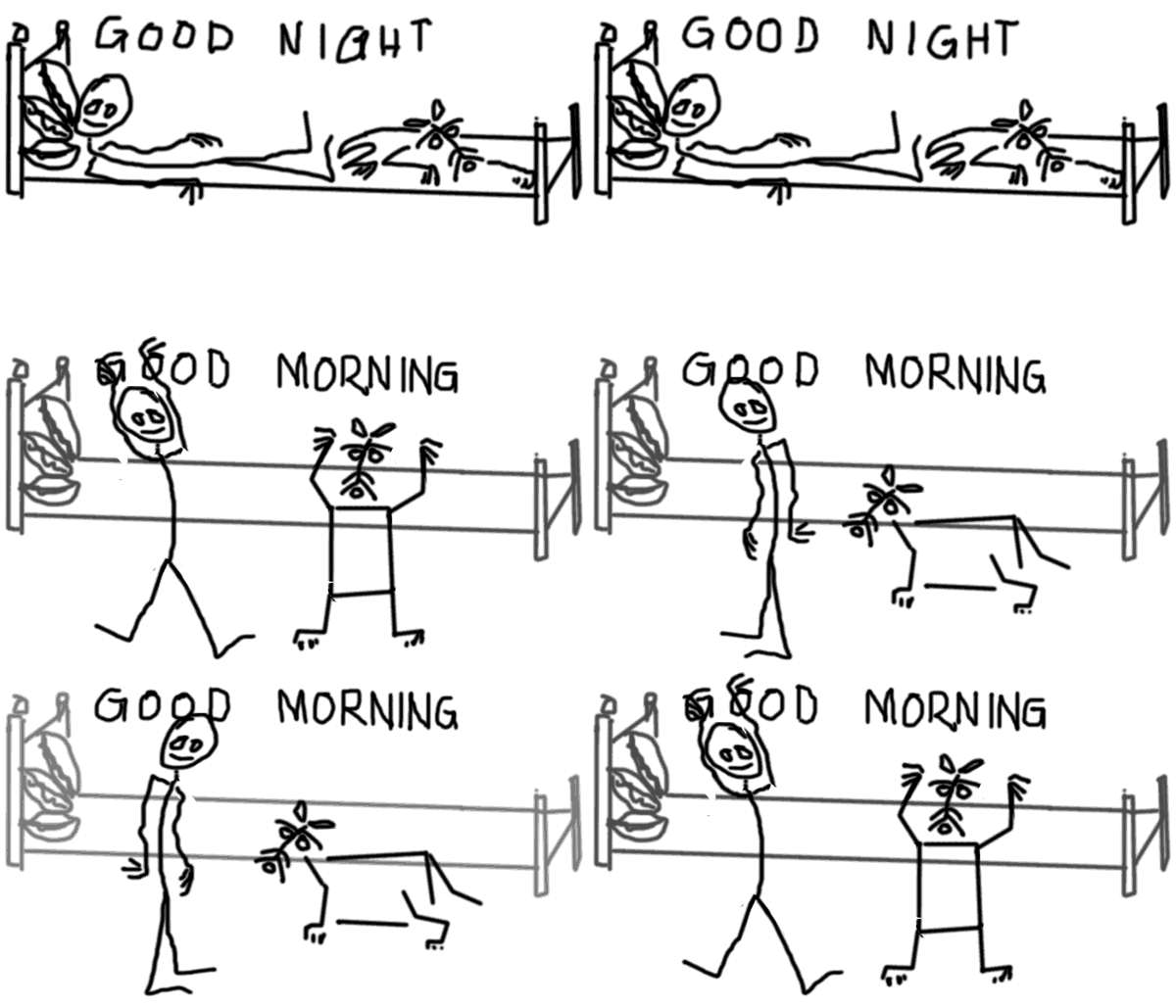
Second, on the subject of George Bush sending Laura stick figure drawings. ("At the same time, George had gotten an app on his iPad where he could draw pictures. And he communicated with me if I was on the road, or with Barbara and Jenna, with these very funny stick figure drawings of him in bed with Barney: 'Good night.' Then, the active stick figure in the morning: 'Good morning.'")

Chip says "What? Like this?


"Yo no lo comprendo. Well find me an art instructor."

Friday, March 29, 2013

"As the viewer is struck with eggs spilling out in all directions twisting like an egg tornado and wondering how all that was packed into a flat card..."

"... and further how in the world will all that mess ever close back, depicted in black and white and in a smaller scale behind all of that, Jesus of Nazareth ascends in triumphant pose presiding over all, but his astonishing Earth-shattering demonstration of survival of the death experience goes unnoticed because attention is misdirected to the movement of colorful eggs."

Saturday, March 23, 2013

"I know what you're up to. This is the strange Lutheran thing, isn't it?"

"Stranger even than what the Mormons get up to. It's why you guys are oddly so cool and taciturn about this time of year, the most joyous of all for the promise it holds and for its demonstration of life eternal."

That's Chip Ahoy, in last night's Glacier Café, the one with this picture:

Untitled

Chip's riff:


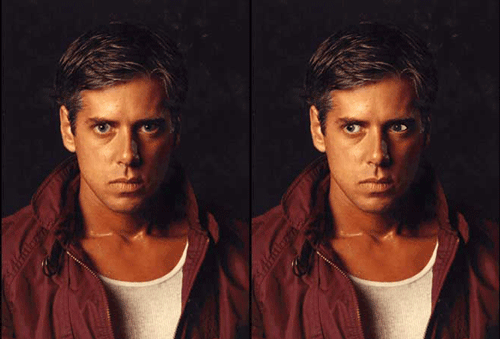
If you don't recognize the image within the image, it's from yesterday's "What does Jesus look like?" post, the one that began with a discussion of a leaflet illustration of (supposedly) Jesus, the one where Meade said "If Chip Ahoy had a son, he'd look like Jesus." Because Chip Ahoy really does look that Jesus. Not the guy-that-got-thrown-out-of-the-darts-tournament Jesus, the Jehovah's-Witnesses-leaflet Jesus.


Especially this pic (nicked from the sidebar at Chip's here):

Saturday, February 23, 2013

What did Jesus write in the sand? (Or: things I should have learned in church that I figured out from the Althouse comments.)

Yesterday, when many blogs were talking about the Islamist Facebook page with a cartoon showing how to stone a person who had committed adultery, I added the New Testament story, from John 8, in which Jesus said: "Let him who is without sin among you be the first to throw a stone at her." Jesus had just been teaching some people, and the scribes and the Pharisees, looking for a way to trip him up — they wanted to bring charges against him — present Jesus with a woman who had been caught in the act of adultery and remind him that the Law of Moses commanded that she should be stoned. "So what do you say?" Instead of answering, Jesus bends over and writes in the dirt. They keep pushing for an answer, and it's only then that he says: "Let him who is without sin among you be the first to throw a stone at her."

I didn't include the next few sentences, but the story was very familiar. After Jesus makes his brilliant remark — which finds a new way into the question — the crowd disperses and Jesus tells the woman to "go and... sin no more."

Some of the commenters focused on what it was that Jesus wrote on the ground. I'd always assumed that what Jesus was writing was irrelevant and that he was simply gesturing I'm not going to talk to you. He invoked his right to remain silent, as we say in the United States of America. He knew whatever he said would be used against him. Later, when he arrives at the New Testament doctrine — the higher law — he speaks up and articulates it pithily. He doesn't write it. Jesus isn't the put-it-in-writing type. The scribes are the bad guys here, and he's about talking to the people. The Word is spoken. (It's only written down later.)

But, reading the comments, I see interest in the subject of what Jesus wrote.

Sydney says: "In the movie The King of Kings, each accuser comes up to Jesus and sees written in the dirt his own sin, and turns and walks away. I love that scene." Is that the standard theory of what Jesus wrote?

And Chip Ahoy, linking here, says: "But what did he write in the sand?" At the link, we get added details from The Urantia Book (which I'd never heard of). There, the idea is that Jesus knew the woman's husband was a "troublemaker" and "perceived" that he'd forced the woman into prostitution and that the husband was now cooperating with the Pharisees to get Jesus to say something that could be used to arrest him. In this version of the story, Jesus doesn't just bend over and write in the dirt right where he is. He walks over to the troublemaker husband and writes something in front of him that makes him rush off. Jesus comes back to his original place and writes on the ground again, and the men, "one by one," leave. Last to go, is "the woman's companion in evil," who gets his own special message written in the dirt.

Kentuckyliz gives us the Old Testament quotes (the law of Moses, which is what the Pharisees threw at Jesus to trip him up):
Deuteronomy 22:22 "If a man is found sleeping with another man's wife, both the man who slept with her and the woman must die."

Leviticus 20:10 "If a man commits adultery with another man's wife — with the wife of his neighbor — both the adulterer and the adulteress must be put to death."
Kentuckyliz adds:
What's interesting about the Jesus scene, is that the law had become misogynistic in practice. The man is not being stoned according to the mandates of the law. In fact, I suspect he was standing in the crowd holding a stone.
Note that even in the extremely concise story told in John 8, we hear that the woman was "caught in the act." Whether he was in the crowd or not, the adulterer was known. Why aren't the authorities proposing to stone both the man and the woman? Kentuckyliz doesn't refer to what Jesus wrote in the sand, but this made me imagine that Jesus wrote "the man and the woman." And if the woman was a prostitute, all of the men who had ever slept with her would deserve stoning too.

In this scenario, Jesus acknowledges the written law of Moses by writing it. That's the Old Testament, which Jesus won't reject, even as his enemies are trying to lure him into rejecting it. He's showing that he knows the law, and in very few words, he's made it obvious to the legal experts that they are getting the law wrong and making them see their own faint-heartedness about equal justice, applying the strict law strictly on its written terms and to everyone. Then Jesus speaks, and the spoken word is the New Testament, calling us to a higher place, above the strict rules, under which we are all sinners. The New Testament demands that we look at our own sins. Go and sin no more.

That ought to keep you busy for the rest of your life. Now, leave other people alone.

ADDED: A second post includes the "King of Kings" clip and more.

Saturday, February 9, 2013

"I have completed the task the Lord hath assignedeth me of creating the templates and instructions for a simple Valentine's Day pop-up card."

"So now I am released of my duty to humankind," says Chip Ahoy in yesterday's café, The Faithful Dog:
The templates are so simple it's embarrassing.

Nevertheless, here are some 30 or so photos that show a step by step process any child can follow. The 3 little files are png files to drag and drop. They fit an 8.5 X 11 sheet of card stock, to print, but you will not need the templates, just use the idea instead. They are put there for your human comfort.

And I tell you what, if you were to take a moment and fashion such a card for your sweetie, it will be the best card they ever receive and I'm not kidding. It will be treasured, I learned, and saved. Forever. When the person dies their survivors will go through their things, and go, "no wait, what? what? this person got Valentines cards like this when they were alive? That's awesome! Man, I wish I had friends who gave me cards like this."
And it's a simple one too. Part 2 Doubles the awesomeness of this card, and Part 3 intensifies that!
The super-clear photo instructions are entertaining even for those of us who would never hand-make a card, even for those who don't send cards of any kind, and even those who have a Valentine's-equivalent-of-Scrooge-like attitude about Valentine's Day.

Tuesday, February 5, 2013

"He knew that when he kissed this girl, and forever wed his unutterable visions to her perishable breath..."

"... his mind would never romp again like the mind of God."

That's a challenging one, today's sentence in the "Gatsby" project (wherein we examine, each day, one sentence, out of context, from "The Great Gatsby").

I'm seriously intimidated, because I can't bust out of the sentence to get a grasp of how it can be that his mind is, pre-kiss, romping like the mind of God. Oh, but suddenly it's clear! If he kisses her, he enters the concrete word, where one specific thing after another will happen. But before he takes that action, he exists within imagination — his unutterable visions. There's so much to gain and so much to lose. Within imagination, he is like God, fully free. Anything — everything — can happen. You throw that all away if you kiss her. To kiss her is not to marry her, but there is a wedding: of the mind to the body, the perishable breath.

And quite aside from the man and the resisted kiss, there's an assertion about God. God has a romping mind.

ADDED: Chip Ahoy animates the sentence:

Monday, February 4, 2013

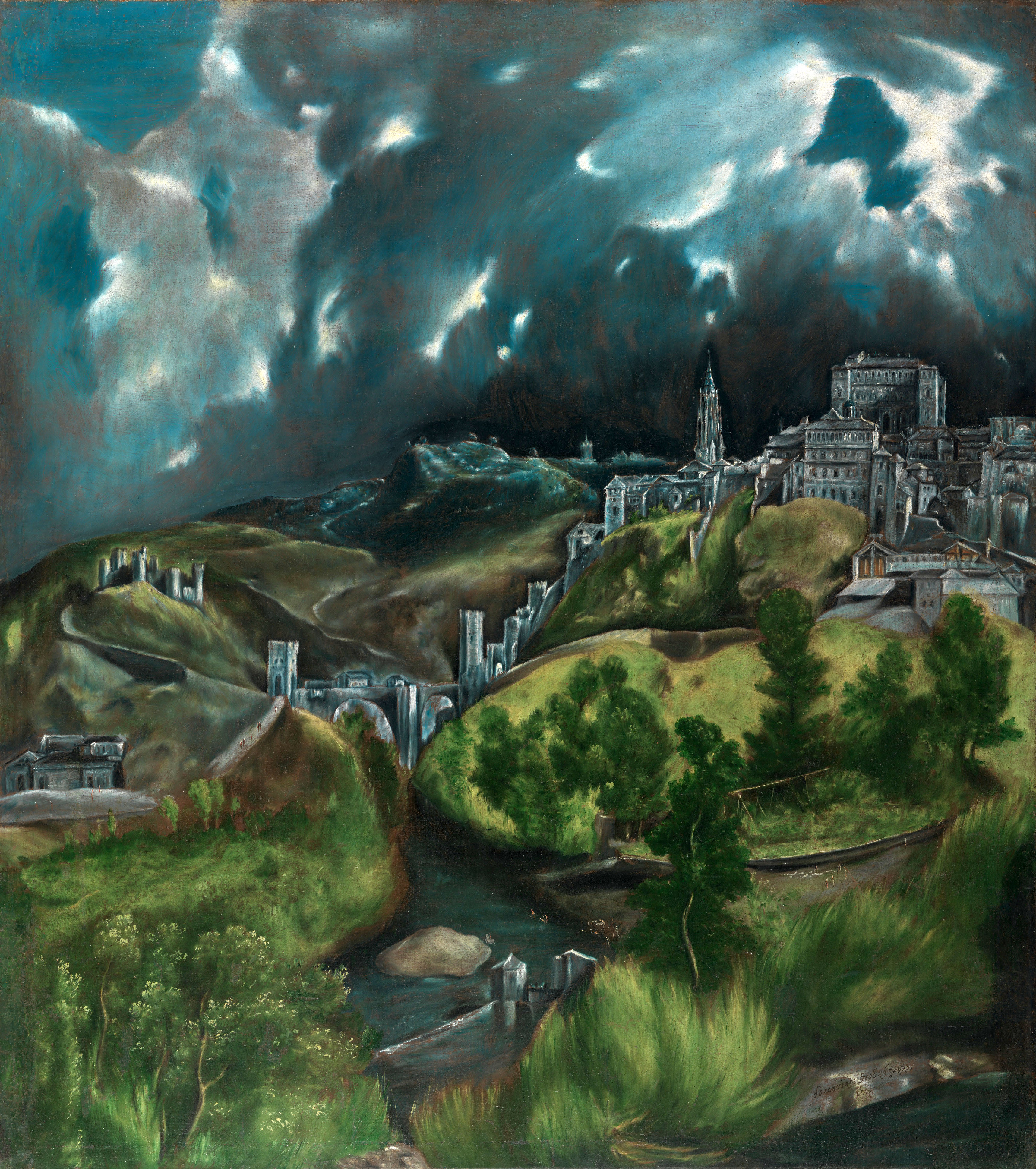
"I see it as a night scene by El Greco: a hundred houses, at once conventional and grotesque, crouching under a sullen, overhanging sky and a lustreless moon.

This is the picture  — I assume — that F. Scott Fitzgerald had in his head...


... when he wrote that sentence, which is today's sentence from "The Great Gatsby." (Every day we isolate and talk about one sentence from "The Great Gatsby.")

El Greco painted that "View of Toledo" circa 1600. That seems too long ago for a man to have been painting like that. It's hard to understand how that could have happened. But maybe you are thinking: Toledo!? Was that part of the Ohio Inquisition we were just talking about?

I'll remind you once again of the look for the light question that almost always works in "Gatsby" sentences. Here we've got the absence of light. After last night, when Gatsby was his own light source...


(GIF by Chip Ahoy.)

.... tonight we have the moon and it is lustreless.

Lustre is a lovely word, evoking lust, though its lineage is different. Lust comes from the Germanic, and lustre comes from the Latin and is all about illumination. "The quality or condition of shining by reflected light; sheen, refulgence; gloss," says the OED. But here there is no light to the moon. Lustreless. It's a night scene. There are houses, here in America, not off in Spain, but you get the picture. It's like that El Greco. And in case you don't see it clearly — F. Scott Fitzgerald has a bunch of adjectives to make the point: conventional,  grotesque, crouching, sullen, overhanging, and — as noted — lustreless.

Even as there is contradiction in depriving the moon of its light, we've got contradiction in conventional and grotesque. It's an ordinary scene, houses on a landscape at night. But see it as grotesque. Put your El Greco distortion glasses on. Did you know that the etymology of the word grotesque has to do with painting and that, like El Greco's painting, it goes back to 1600?
c.1600s, originally a noun (1560s), from Middle French crotesque (16c., Modern French grotesque), from Italian grottesco, literally "of a cave," from grotta (see grotto). The usual explanation is that the word first was used of paintings found on the walls of basements of Roman ruins (Italian pittura grottesca), which OED finds "intrinsically plausible." Originally "fanciful, fantastic," sense became pejorative after mid-18c.
Grotesque was a happier concept 300 years ago. Who knows what happened in grottoes back then?
Saturday, January 26, 2013

"When we pulled out into the winter night and the real snow, our snow, began to stretch out beside us..."

"... and twinkle against the windows, and the dim lights of small Wisconsin stations moved by, a sharp wild brace came suddenly into the air."

To diagram that sentence — today's sentence from "The Great Gatsby" — begin with: brace | came. The subject of the sentence is brace, and the predicate is came. You've got a long clause beginning the sentence which has 3 parts to it — one with a we | pulled subject and verb, one with snow as a subject and the verb began tied to stretch and twinkle, and one with lights and moved. There is also a pair of "into" phrases — "into the winter night" and "into the air" — near the beginning and at the very end of the sentence.

You could easily get on the wrong track reading this sentence and think the real snow is part of what we pulled out into, especially with no comma after night, but the real snow, our snow is the subject of the next phrase. We don't pull out into the snow, only into the night. The snow then takes over the action, stretching out beside us. That's a little sexy, like the snow is in bed with us. But then we see that we must be on a train and the snow is out there in the night, on the other side of the windows. The snow twinkles against the window. It's a kind of light, twinkling. It's tiny lights that mingle with dim lights, the tiny lights of small Wisconsin stations. The stations move by — that's the illusion as we move forward on this train into Wisconsin, into the real snow, our snow, the snow that's like a lover in bed with us, with tiny twinkly lights all around.

Did you get that thrill? It was a sharp wild brace that came suddenly into the air. Orgasmic!

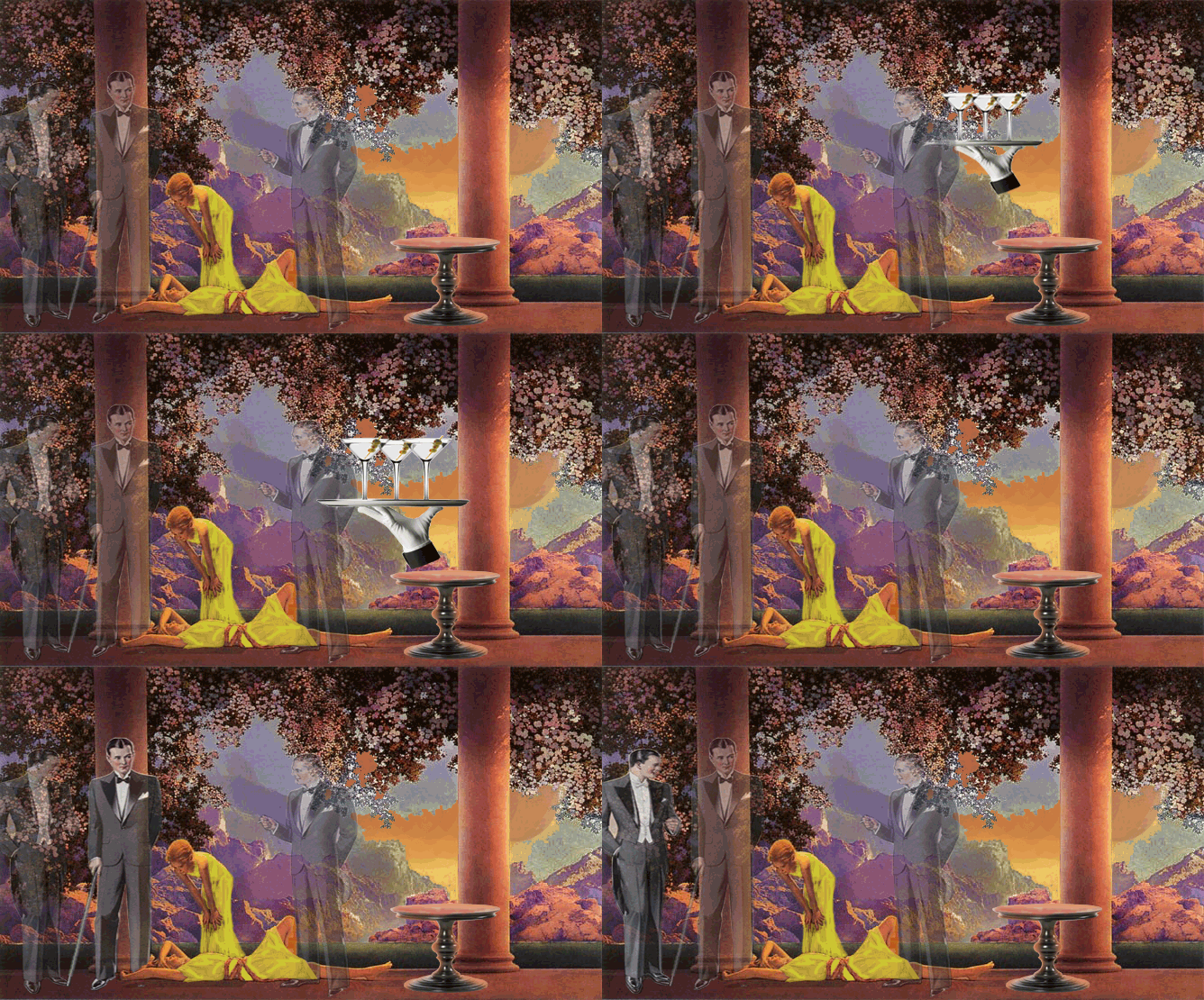
ADDED: Speaking of thrills, here's Chip Ahoy's animation of the "Gatsby" sentence I revealed to be my favorite, 3 days ago:


"A tray of cocktails floated at us through the twilight, and we sat down at a table with the two girls in yellow and three men, each one introduced to us as Mr. Mumble."

Sunday, January 13, 2013

"That's how you laughed in the middle of the night."

Said Meade, and I said: "Then Chip Ahoy must have been in my dream."

Because I was just reading his comment: "Melody and Rose broke up the Sweedish contractors and threw change in the tip jar and put on her warm magic apron."

And I laughed not because that is nonsense, but because it's a quite brilliant contribution to a conversation that was pretty far along at that point, including betamax3000's extended interpretation of "The White Album." Beta had said:
Like the White Album perhaps Althouse is telling us there are secret messages to be found, backwards.

"Sweetly up broke voice, her rose melody."

"Upon magic human warm her of little."

"Out tipped change."
It all began with a sentence from "The Great Gatsby," which was about — not a woman laughing — a woman singing. But women laugh all the time in "The Great Gatsby." For example: "She looked at me and laughed pointlessly."

"These 'Gatsby' posts are becoming the new café around here" — "café" posts are open threads  — I say as I drink my coffee and contemplate today's Gatsby sentence, which I'd said will be "I knew the other clerks and young bond-salesmen by their first names, and lunched with them in dark, crowded restaurants on little pig sausages and mashed potatoes and coffee."

I picked that sentence after searching my Kindle copy of "Gatsby" for "potato" after betamax3000 said:
Yesterday was "gulp down the incomparable milk of wonder," today is "tipped out a little of her warm human magic." Is it getting hot in here or is it just me?
And that was funny, because — before getting out of bed this morning — I'd been toying with the idea of saying: In that "Melody rose" sentence, Fitzgerald intended us to think of semen when we read about "warm human magic" that tipped out of the vessel that is the woman.
 

And betamax added:
My God: if we get to the sentence involving Daisy, the potato and the gardener I just don't know what is going to happen.
Which is what had me looking for "potato" in "Gatsby," not finding it, and suspecting that betamax was making a canny reference to "Lady Chatterly's Lover." I buy "Lady Chatterly's Lover" in Kindle just so I can search for "potato"! My literary pursuits are a tad — a tot — bizarre. I find:
"No; my heart's as numb as a potato, my penis droops and never lifts its head up, I dare rather cut him clean off than say 'shit!' in front of my mother or my aunt... they are real ladies, mind you; and I'm not really intelligent, I'm only a 'mental-lifer.'"
And:
"I don't want to fuck you at all. My heart's as cold as cold potatoes just now."

Friday, December 28, 2012

I finally figured out what David Gregory displaying that prop reminds me of.

Yesterday, I was asking: Why was that prop so important to David Gregory? If possession of that high-capacity magazine was a crime, and the NBC folk knew it and had even contacted the police and thus even knew they'd created rock-hard evidence that they knew it, why did they go ahead and have Gregory flaunt that illegal possession on television? They had to have thought it was a devastatingly powerful prop. My first guess was that they imagined that viewers — some viewers, at least — would find the object itself scary.

Now, I've got to show you another one of Chip Ahoy's little riffs, because it's what jogged my thinking on the subject for some reason. Here's Chip in the comments thread to that other post, the one where I showed those David Gregory masks (designed by Chip). This is a little dialogue:
"No. It doesn't look that threatening to me. If that's what you were thinking. No. It just doesn't."

"What do you mean? Are you insane? This magazine holds thirty rounds."

"So."

"So? So? So? Is that all you got? It holds thirty!"

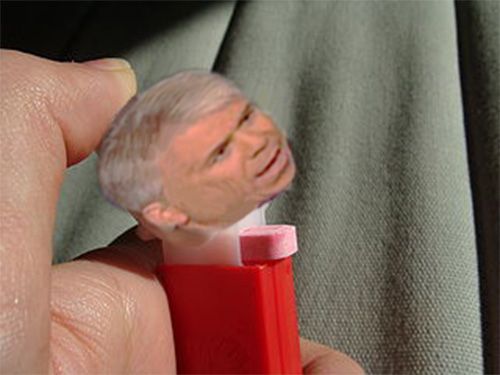
"So. It's small. Looks like a PEZ dispenser to me."

"WHAT? So, this is amusing to you? You find this amusing."



Caption: "It holds 30." I'm not sure exactly why that jogged my thinking, but suddenly I understand the drama Gregory (and his people) were trying to enact. It's a deep psychic memory of childhood. Gregory sought dominance over his interlocutor, NRA CEO Wayne LaPierre, and the idea — in the act of picking up that magazine and beginning an interrogation about it — was that Gregory would become (subliminally) a parent figure who would push LaPierre into the subordinate role of the little boy, the cowering child confronted with undeniable evidence of his wrongdoing. What's THIS I found in your room?

The plan was for LaPierre to babble lamely, scrambling to explain it away, like the kid trying to concoct some cockamamie reason why that (whatever) got into his room. He'd look foolish and guilty, as Dad continues to hold up the item which the kid knows will be the defeat of every idea that flashes through his stupid, stupid brain.

The scenario didn't play out as scripted. LaPierre is a stolid veteran of many a confrontational interview. He's not going to let the interviewer get the upper hand that easily. Somebody needs to tell Gregory: We all want the hand. Hand is tough to get.

Thursday, December 27, 2012

"Tired of being stopped at airports? Can you do without all the hassles of unreasonable arrests?"

"Had it up to here )) skeet (( *cut at the neck* with all those intolerable fines and inconsistently applied regulations and restrictions?" asks Chip Ahoy, offering these Official Washington, D.C. Gun Passes in sturdy laminate/sun proof colors/long lasting bands/Large holes for clear vision/slip proof:


Wednesday, December 26, 2012

My post title "Buttons offed" made one reader picture "2 hands clasping the lapels of their own jacket and ripping them apart to reveal not a blouse but 2 voluptuous naked breasts."

"Buttons offed, pop pop, that's the image that happens" — says commenter Chip Ahoy, prompting Dr Weevil to say "Photoshop or it (your fantasy) didn't happen."

If he hadn't achieved this status yet — and I think he had — Chip Ahoy became the #1 Althouse commenter of all time — not counting Meade — by producing the Photoshop. (There's a link within that link, so nothing NSFW unless you click again.)