Showing posts with label landscapes. Show all posts

Monday, October 7, 2013

At the Wetlands Café...

Untitled

... you can talk all night.

"Learn to Love our Natural World." [UPDATED with a list of 9 annoying things.]

Seen yesterday:

Untitled

Untitled

Meade points to the signage — orders from The State:

Untitled
(Click photo to enlarge.)

IN THE COMMENTS: Peter says:
Those photos show a world that's "natural" in the same same sense that downtown Chicago is "natural"- that is, they show the natural world as it's been shaped by humans and their activities for many, many centuries.

The landscapes shown in these photos surely look far different then they would without the presence of humans and the various human activities that have shaped and altered them.
Yes, and the least natural thing is the government imposing signs, and this sign is especially ridiculous, telling people who are already out walking in the nature preserve that they must learn to love nature. Quite apart from the annoying inference that we do not already love nature, I was annoyed by:

1. The presence of any signage infringing on the direct experience.

2. A sign that provides no specific information (such as the names of plants and the history of the restoration).

3. Government seeing our emotions as within its domain of command.

4. The selection of "love" as the specific emotion that should be dictated.

5. Presenting the sublime emotion of "love" as something that is achieved through a process of education.

6. Stimulating an anti-authoritarian impulse that drives me away from love.

7. Stimulating an anti-education impulse that makes me resist learning. (If you want me to learn, give me some information to learn here, not instruction to love.)

8. A subtle state-sponsored atheism.

9. Stimulating a list-making response in me that provokes me to write an item — that last one — that makes me annoying and proud of being so annoying.

Sunday, October 6, 2013

Basking on the Wisconsin River beach.

Untitled

I walked all the way around to the other side to show you this alternate perspective on this river beachscape:

Untitled

Click to enlarge to see the hearty beach lovers. And feel free to talk about anything you want in the comments.

Saturday, October 5, 2013

At the River Sunset Café...

Untitled

... talk all you want as the night falls.


Untitled

(Photos taken this evening on the Wisconsin River, near Spring Green.)

Friday, September 13, 2013

"If this video doesn't inspire you to plan a trip, nothing will."

Buzzfeed offers this "Facts That Will Make You Want To Travel." Since questioning traveling is a big theme on this blog, I'm going to embed this before watching it. I'll get back to you on whether it consigns me to the category Buzzfeed considers uninspirable.


UPDATE: Second-by-second reaction.

0:02 I realize I have seen this video before.

0:12 I've seen reports of those "studies" and am skeptical. People misjudge how much buying, say, clothing will make them happy, but they also may misjudge how much happiness they got from a trip. The strains of traveling are over, and they are now nurturing the memory they made. What's really being compared are 1. material objects that you have in your possession and come to view as not such a big deal anymore and 2. past events that are only in memory and can therefore be massaged into a form you enjoy. This is testament to the power of the mind and the value of the intangible possession that is the past.

0:16 That music thinks it can juice me up. Instead it makes me more aware that I am watching propaganda. And this is propaganda for the travel industry. It must convince me to drop money into things that won't last — like the $300 shoes that I'll "eventually forget about." Yeah, but meanwhile, I'm always going to need some shoes. They're not just for the purpose of memory-making. And: 1. Money saved not buying expensive shoes doesn't have to be thrown into travel. 2. For $300, I could buy, instead of expensive shoes, a pair of shoes, a skirt, and 2 tops or some other combination of useful wearable things that will make daily life comfortable and nice. 3. I actually do have some happy memories of specific shoes, in fact, only yesterday I was contemplating a particular kind of shoe that we wore circa 1960 that I'd love to find today.

0:21 I don't need to spend $300 to gaze at a sunset over a beautiful landscape. I can walk or bike to many beautiful vantage points, and I can drive an hour or less and get to really scenic places. If I'd spent money and time getting to somewhere farther away, would I be more likely or less likely to arrive at the elated expression seen on that woman's face? I think a less planned and more subtle experience might produce greater joy. But the contrast made in the video is to $300 sneakers. That's not the relevant comparison.

0:31 "A short trip will make you feel just as happy." Yeah, that's the argument against travel! Go for a walk in your own town or to the nearby state parks. You don't have to make a big deal about it.

0:33 Those people look like they could be enjoying sitting out on Union Terrace, having a drink while the sun sets over Lake Mendota. We love to walk there.

0:39 This shows that what is important are relationships with other people. Travel is presented as a means to that end, but there are obviously many other means. And there's a correlation-is-not-causation problem with "Regular travellers get along with people better." Maybe people who avoid travel do so because they don't get along with other people. Those who love interacting with other people may go in for travel because one of the stresses of travel isn't so stressful for them. You can't necessarily infer that traveling will improve your ability to get along with other people. I'm picturing a crowded plane with the usual annoyances.

0:46 Here we see how nice it is to have an intimate partner in life. What's the connection to travel? I see they are in a car. Meade and I are often in a car together. It's always nice, around town or off on some longer trip. But the surtitle is trying to nudge us to think couples have sex more if they go on a trip. Sex — or some other "intimacy" — is the end. Travel is offered as the means. That strikes me as a bit pathetic.

0:51 Another argument in favor of having someone to love. This is classic advertising propaganda. Put the product with something else that's good.

1:05 Oh, great. Che Guevara. I should travel because Che Guevara. Blech. He "found himself." Do you seriously think your self is out there somewhere you need to travel to find?

1:11 Monet didn't travel to Argenteuil. He lived there. Relocating your home isn't travel.

1:16 "The ticket is usually the only big cost." Oh! The money we have spent in hotels and restaurants. That's where you hemorrhage money.

1:19 "A massage in Bali is $6." Why the hell would you spent all that money and time going to Bali and then lie around with your eyes closed and have a passive experience that you can get at home? Yeah, it's more than $6 at home, but why'd you go to Bali? And do you really want to extract the pleasure of a massage from someone you are exploiting economically? The argument the video is making here is that you should give a lot of your money to the airlines because they can take you to places where the people will sell themselves super-cheap. How about avoiding the (terrible) airlines and spending the money in your hometown, on people who are your neighbors, who contribute to your community, and are asking a fair price for their work?

1:32 Eh. I'm smart enough.

1:37 "It's time to plan a trip." Planning. I don't like planning. I like spontaneous. Make an equivalent video about living spontaneously in the present. Won't that bring more happiness and intimacy, and won't you be more likely to find yourself and to get along without spending too much money? I think so.

Tuesday, September 10, 2013

Wisconsin, September.

Untitled

A photograph from Sunday — when it was overcast and cool — that I was motivated to pull out of the camera by my own comment, dropped in the post about the man who fell or was pushed off a cliff in Glacier National Park:
When we went to Glacier, I was too afraid to hike there. You have these fantastic views, but then you can't enjoy them.

One more reason not to travel: The gentler landscapes of Wisconsin are more beautiful, because they don't force you to think about dying.
There's a human scale to Wisconsin. It feels humane. The West is dramatic, and I have enjoyed many trips though those landscapes, including Death Valley, the national park named to confront you with its hostility.

Why do we seek extreme experiences, when the subtleties of our normal lives are so close by? Why would we ever want to leave their sweet embrace? Ultimately, death will drag us away from the places we love, but why do we torment ourselves with those experiments in exile we call travel?

Monday, February 4, 2013

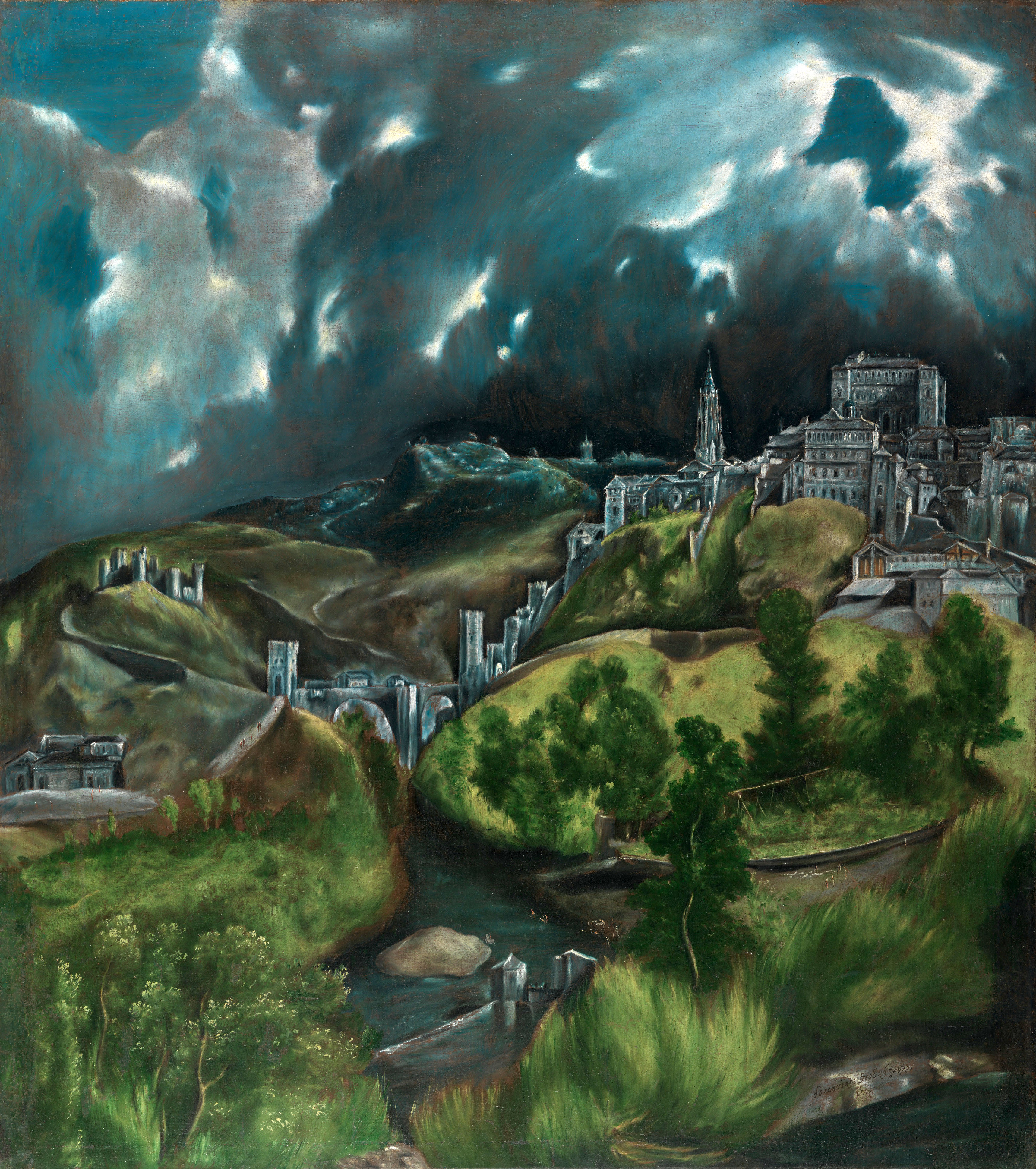
"I see it as a night scene by El Greco: a hundred houses, at once conventional and grotesque, crouching under a sullen, overhanging sky and a lustreless moon.

This is the picture  — I assume — that F. Scott Fitzgerald had in his head...


... when he wrote that sentence, which is today's sentence from "The Great Gatsby." (Every day we isolate and talk about one sentence from "The Great Gatsby.")

El Greco painted that "View of Toledo" circa 1600. That seems too long ago for a man to have been painting like that. It's hard to understand how that could have happened. But maybe you are thinking: Toledo!? Was that part of the Ohio Inquisition we were just talking about?

I'll remind you once again of the look for the light question that almost always works in "Gatsby" sentences. Here we've got the absence of light. After last night, when Gatsby was his own light source...


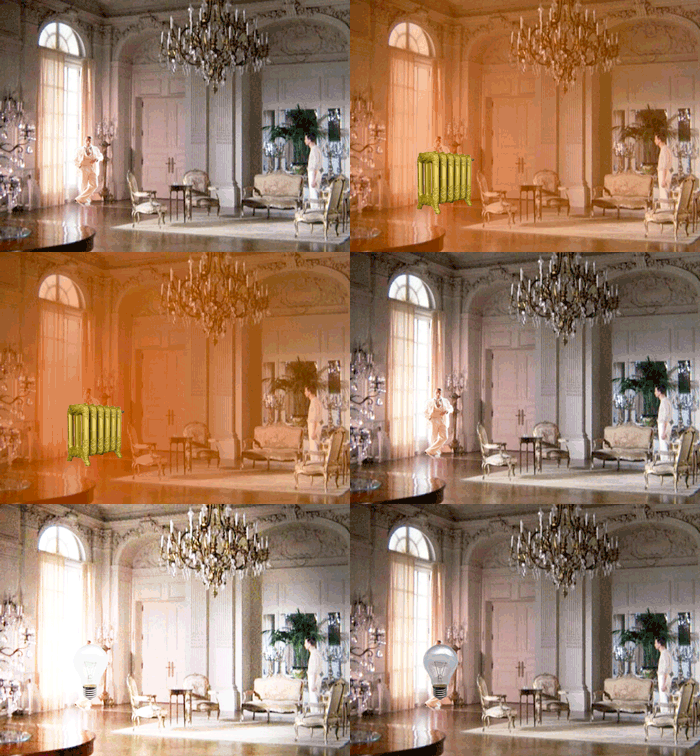
(GIF by Chip Ahoy.)

.... tonight we have the moon and it is lustreless.

Lustre is a lovely word, evoking lust, though its lineage is different. Lust comes from the Germanic, and lustre comes from the Latin and is all about illumination. "The quality or condition of shining by reflected light; sheen, refulgence; gloss," says the OED. But here there is no light to the moon. Lustreless. It's a night scene. There are houses, here in America, not off in Spain, but you get the picture. It's like that El Greco. And in case you don't see it clearly — F. Scott Fitzgerald has a bunch of adjectives to make the point: conventional,  grotesque, crouching, sullen, overhanging, and — as noted — lustreless.

Even as there is contradiction in depriving the moon of its light, we've got contradiction in conventional and grotesque. It's an ordinary scene, houses on a landscape at night. But see it as grotesque. Put your El Greco distortion glasses on. Did you know that the etymology of the word grotesque has to do with painting and that, like El Greco's painting, it goes back to 1600?
c.1600s, originally a noun (1560s), from Middle French crotesque (16c., Modern French grotesque), from Italian grottesco, literally "of a cave," from grotta (see grotto). The usual explanation is that the word first was used of paintings found on the walls of basements of Roman ruins (Italian pittura grottesca), which OED finds "intrinsically plausible." Originally "fanciful, fantastic," sense became pejorative after mid-18c.
Grotesque was a happier concept 300 years ago. Who knows what happened in grottoes back then?

Sunday, December 2, 2012

Riding the Capital City Trail.

It was amazing to be able to go on a 20+-mile bike ride on the 2d of December in Madison, Wisconsin, but we did it, and it was easy. About 50°. Meade had the GoPro HD HERO2: Outdoor Edition strapped to his helmet, and he edited the trip down to 15 minutes. It's a silent movie, so I recommend playing some music of your own. This is the trail we ride over and over throughout the year, and the video shows what it's like: