Showing posts with label blood. Show all posts

Monday, November 25, 2013

Council of Croatian Community in France files suit against Bob Dylan in a Paris court, accuses him of racism.

"He was without any doubt inciting hatred against Croatians," according to the Council of Croatian Community in France. What did Bob do? In an interview with Rolling Stone, he said (as quoted at the link): "Black people can sense Klan blood, Jews can sense Nazi blood and Serbs can sense Croat blood."

What does that mean "sensing blood"? Talking in terms of blood does have a racist feeling to it. He's a poet though, so there's that tendency to use vivid metaphor. Blood is one of the great metaphors — used in 49 Dylan songs — but it's complicated, a refers to many different things. The word "sense" is vague, unlike say "smell" or "taste," and tied to "blood," it can cause too much confusion, and I don't recommend judicial relief.

Here's the Rolling Stone interview (which came out last year). Check the context and the actual verbatim quote:
Do you see any parallels between the 1860s and present-day America?

Mmm, I don't know how to put it. It's like . . . the United States burned and destroyed itself for the sake of slavery. The USA wouldn't give it up. It had to be grinded out. The whole system had to be ripped out with force. A lot of killing. What, like, 500,000 people? A lot of destruction to end slavery. And that's what it really was all about.

This country is just too fucked up about color. It's a distraction. People at each other's throats just because they are of a different color. It's the height of insanity, and it will hold any nation back – or any neighborhood back. Or any anything back. Blacks know that some whites didn't want to give up slavery – that if they had their way, they would still be under the yoke, and they can't pretend they don't know that. If you got a slave master or Klan in your blood, blacks can sense that. That stuff lingers to this day. Just like Jews can sense Nazi blood and the Serbs can sense Croatian blood.

It's doubtful that America's ever going to get rid of that stigmatization. It's a country founded on the backs of slaves. You know what I mean? Because it goes way back. It's the root cause. If slavery had been given up in a more peaceful way, America would be far ahead today. Whoever invented the idea "lost cause . . . ." There's nothing heroic about any lost cause. No such thing, though there are people who still believe it.
The statement "He was without any doubt inciting hatred against Croatians" incites... negative opinions against... the person who makes that statement... in that I'm left thinking he's not too good at reading. But reading's an emotional thing. I'm continually amazed at what happens to words when they're swirled around with the readers' emotions.

Monday, November 11, 2013

"Sanguinary."

Writing the previous post, quoting the original Armistice Day proclamation, fixing on the word "sanguinary," I noticed that I had not looked a word up in the Oxford English Dictionary in a long time. Of course, I know that "sanguinary" means bloody, but what would motivate anyone to use the word "sanguinary," instead of "bloody"?

One reason is that "bloody" "has long had taboo status, and for many speakers constituted the strongest expletive available... Following the original use in England, Scotland, and Ireland, the sense spread to most other parts of the English-speaking world, with the notable exception of the United States, where it has apparently only ever achieved limited currency, e.g. among sailors during the 19th cent." (I'm quoting the OED, which I cannot link.)

So, "sanguinary" is a useful word for avoiding offense to those who take offense, and the OED even officially defines "sanguinary" — at definition #4, slang — as "a jocular euphemism for bloody adj., n., and adv., in reports of vulgar speech." Examples:
1800   S. T. Coleridge Coll. Lett. (1956) I. 564   This Extract breathed the spirit of the most foul & sanguinary Aristocracy—& depend upon it, Sheridan is a thorough-paced bad man!
1890   R. Kipling in Macmillan's Mag. LXI. 155/1   This is sanguinary. This is unusual sanguinary. Sort o' mad country....
1910   G. B. Shaw Lett. to Granville Barker (1956) 168   The inhabitants raise up their voices and call one another sanguinary liars.
I'm not suggesting that Woodrow Wilson, in his original Armistice Day proclamation, intended to attach the suggestion of an obscenity to "war" — the noun modified by "sanguinary" — though it is common enough to call war an obscenity.

The first meaning for "sanguinary" is "Attended by bloodshed; characterized by slaughter; bloody," and the second is "Bloodthirsty; delighting in carnage." The first meaning for "bloody" is "Containing blood; composed or consisting of blood; resembling blood," which, interestingly, is less emotive than the original meaning of "sanguinary." So "sanguinary" can be considered more apt — quite aside from any desire to avoid a frisson of obscenity.

Wednesday, September 25, 2013

I've never read "Atlas Shrugged," but after all these years, I'm adding it to my Kindle.

I'll explain this to you, but could you please, if you need a Kindle, use this linkto check out the spiffy new Kindle Fire? Or go in through the Althouse Amazon portal and buy whatever you want, including a copy of "Atlas Shrugged," if you, like me, have some use for it. Or do you already have it on your shelf? I know at least one of my readers kept 2 copies of "Atlas Shrugged" on his shelf, and perhaps he systematically handed off copies of it to people who wandered into his lair and said, "Why do you have 2 copies of 'Atlas Shrugged'?"

I hope you enjoyed the quality of my commercial effort, above, and feel inclined to show your appreciation by using those links, or just by continuing to read this. You've wandered into my lair, and maybe you're saying "Yeah, why would anyone after resisting 'Atlas Shrugged' all those years finally relent?"

And it is many years. I'm quite old! I don't need any philosophical-ideological mental nourishment to power me forth in this life. It's not breakfast time chez Althouse. When I was young, a classmate — this was high school — chided me for not reading anything that wasn't assigned by teachers. That wasn't quite true — though I did apply myself assiduously to consuming whatever the government indoctrinators put on my plate — but I was quite sensitive to insinuations that I was in any way not a good person. And I read the book this teenage boy insisted on giving me: "Anthem." Sorry, old man who was once that boy, but it didn't change my life, it's still the only Ayn Rand book I ever read, and I don't remember anything about it, other than that it might have been science fiction.

The reason I'm downloading "Atlas Shrugged" into my Kindle this morning is the reason I buy most of the ebooks I buy: I want to be able to do searches, find the context of quotes, and cut and paste text into this blog. I happen to need "Atlas Shrugged" right now, because Ted Cruz — the filibustering Ted Cruz — was quoting from "Atlas Shrugged," and I was using a quote on the blog, in the previous post, and I have a lot more to say about the quote, and I can't do it without the context.

Having written that long post, I found myself going into my own comments section to say something more. Quoting the first line of the passage Cruz had quoted  — "There are two sides to every issue: one side is right and the other is wrong..." — I said:
That's already wrong!

2 sides to every issue?!

Ridiculous.
I was about to add:
I guess she may mean, there's what's right and however many other things people might think, all those other things are wrong. All those other things constitute one side, the wrong side.

Who thinks like that?! I don't believe that anyone who thinks like that can ever get elected to public office (unless they lie to people along the way).

I've never read "Atlas Shrugged," but I know it's a novel. If Ayn Rand is so dedicated to the truth, why did she write fiction? I assume it's so she could say drastic things with deniability. Those quoted lines are said by some fictional character, right?
And that's when I needed the text.  I do a search on the word "poison," the most distinctive word in the passage that springs to mind. (From: "In any compromise between food and poison, it is only death that can win.") Actually, there are other distinctive words, more likely than "poison" to pinpoint the text I want. "Knave" and "transfusion" would have been better bets. "Poison" appears 9 times in "Atlas Shrugged." (Boldface added.)
Without us, they are corpses and their sole product is poison, not wealth or food, the poison of disintegration that turns men into hordes of scavengers. p. 620.
Okaaay.
Somewhere, he thought, there was this boy’s mother.... Had she fed him tainted refuse, he thought, had she mixed poison into his food, it would have been more kind and less fatal. p. 994. 
We're closing in on page 1000, and still, I've not reached the "poison" I'm seeking.
"Then I saw what was wrong with the world.... Just as the parasites around me were proclaiming their helpless dependence on my mind and were expecting me voluntarily to accept a slavery they had no power to enforce.... so throughout the world and throughout men’s history, in every version and form, from the extortions of loafing relatives to the atrocities of collective countries, it is the good, the able, the men of reason, who act as their own destroyers, who transfuse to evil the blood of their virtue and let evil transmit to them the poison of destruction, thus gaining for evil the power of survival, and for their own values— the impotence of death. I saw that there comes a point, in the defeat of any man of virtue, when his own consent is needed for evil to win— and that no manner of injury done to him by others can succeed if he chooses to withhold his consent. I saw that I could put an end to your outrages by pronouncing a single word in my mind. I pronounced it. The word was ‘No.’" p. 1048
No, that not it. But we seem to be getting warm, because the transfusions are there now too. It's the image of the tube that has good lifeblood coming from the able people who are getting poison back. And here's the quote I'm looking for, on page 1054, and we're deep into a long peroration, too long and too late in the story to put me in a position to call Rand out for taking cover within fiction.
“The man who refuses to judge, who neither agrees nor disagrees, who declares that there are no absolutes and believes that he escapes responsibility, is the man responsible for all the blood that is now spilled in the world....

“There are two sides to every issue: one side is right and the other is wrong, but the middle is always evil. The man who is wrong still retains some respect for truth, if only by accepting the responsibility of choice. But the man in the middle is the knave who blanks out the truth in order to pretend that no choice or values exist, who is willing to sit out the course of any battle, willing to cash in on the blood of the innocent or to crawl on his belly to the guilty, who dispenses justice by condemning both the robber and the robbed to jail, who solves conflicts by ordering the thinker and the fool to meet each other halfway. In any compromise between food and poison, it is only death that can win. In any compromise between good and evil, it is only evil that can profit. In that transfusion of blood which drains the good to feed the evil, the compromiser is the transmitting rubber tube.

“You, who are half-rational, half-coward, have been playing a con game with reality, but the victim you have conned is yourself. When men reduce their virtues to the approximate, then evil acquires the force of an absolute, when loyalty to an unyielding purpose is dropped by the virtuous, it’s picked up by scoundrels— and you get the indecent spectacle of a cringing, bargaining, traitorous good and a self-righteously uncompromising evil."
Is this cranking you up? It doesn't work on me. I think moderation is a virtue, but in this imagery, virtue is blood, evil is poison, and moderation is a tube. You're supposed to feel this as a flashy display of reason, but it's full of emotional bluster and heavily reliant on metaphor. I'm being asked to regard myself as a rubber tube.  No.

I'm blogging, so I can just say: No, I am not a rubber tube. But if I were a writer of 1000-page novels, I would see that I could pronounce a single word in my mind. I would pronounce it. The word would be "No."

I'm not accepting this picture of life in terms of people with good blood and people with bad blood and everyone else as a bunch of tubes conducting a big old transfusion that's just got to stop, so this ongoing peroration — a filibuster of sorts — feels nightmarish. It contains enough reason and coherence to pull listeners along, to make them feel smart and energized. That's the most dangerous sort of irrationality. Completely irrational speakers repel all listeners. But this sort of material draws people in. The way to draw an audience is with a transfusion of irrationality and rationality — to be the rubber tube.

Saturday, May 25, 2013

Blood and grammar.

1. Questionable sentence in yesterday's Daily News: "But a bride-to-be who stabbed her fiancé in the heart just hours before they walked down the aisle has now been convicted of his murder."

2. I've read about a murder that happened long ago in which a woman was stabbed in the heart with a long pin, and because she neither felt it — perhaps because of a tight corset — or saw the blood — which oozed slowly into her dark-colored dress — she went about her activities for many hours before succumbing.

Wednesday, April 17, 2013

A fractured opinion about when the police can draw blood for a warrant after a drunk-driving arrest.

It's hard to know where to start in this new opinion, Missouri v. McNeely:
Sotomayor, J., announced the judgment of the Court and delivered the opinion of the Court with respect to Parts I, II–A, II–B, and IV, in which Scalia, Kennedy, Ginsburg, and Kagan, JJ., joined, and an opinion with respect to Parts II–C and III, in which Scalia, Ginsburg, and Kagan, JJ., joined. Kennedy, J., filed an opinion concurring in part. Roberts, C. J., filed an opinion concurring in part and dissenting in part, in which Breyer and Alito, JJ., joined. Thomas, J., filed a dissenting opinion.
I start with Justice Thomas, who says the natural dissipation of alcohol in the blood is always the "exigent circumstance" that avoids the warrant requirement.  He gives a clear rule.


The Chief Justice writes:
I have no quarrel with the Court’s “totality of the circumstances” approach as a general matter; that is what our cases require. But the circumstances in drunk driving cases are often typical, and the Court should be able to offer guidance on how police should handle cases like the one before us.
He would say that the natural dissipation of alcohol in the blood is an exigent circumstance unless there is time to get a warrant. He wants something closer to a rule.  Kennedy, who is the one who deprives Sotomayor of a majority in some parts of her opinion, wants less of a rule from the Court, so that states and local governments can work out their own rules.

And here's Sotomayor:
The State’s proposed per se rule... fails to account for advances in the 47 years since Schmerber was decided that allow for the more expeditious processing of warrant applications, particularly in contexts like drunk-driving investigations where the evidence offered to establish probable cause is simple....
Basically, using the telephone, it can be made very easy to get these warrants. You wouldn't want to remove the incentive on the police to set up these procedures and to make them efficient and thus to avoid the destruction-of-evidence problem.

Monday, April 1, 2013

"Prosecutors said today they will seek the death penalty for Colorado movie theater shooting suspect James Holmes."

"Holmes had offered to plead guilty and spend the rest of his life behind bars in exchange for avoiding the death penalty."
Holmes is accused of opening fire in an Aurora, Colorado, movie theater on July 20, 2012, killing 12 people and injuring 58. By the time he had finished, a police officer has testified, there was so much blood the theater floor had become slippery. Bodies were left with horrific injuries and there was the eerie sound of cell phones ringing, over and over again....
Breaking news email from CNN.

Monday, March 18, 2013

The original meaning of the word "bless" is about blood.

"Bless" is the word of the day, blogged already here. Now, I'm looking in the Oxford English Dictionary (which, unfortunately, I don't have a way to link to) to see whether it is only God that blesses, and I see that in the original meaning, it is human beings who do the blessing and they do it with blood.
Orig. meaning (prob.), To make 'sacred' or 'holy' with blood; to consecrate by some sacrificial rite which was held to render a thing inviolable from profane use of men and evil influence of men or demons. (The streaking of the lintel and doorposts with blood, Exodus xii. 23, to mark them as holy to the Lord and inviolable by the destroying angel, was apparently the kind of idea expressed by blóedsian in pre-christian times. Cf. also the history of the Latin words consecrāre and sacrificium.)
Note that the etymology is about blood:

Old English blóedsian , blédsian , blétsian : not found elsewhere in Germanic, but formed on the Germanic type *blôdisôjan , < *blôdo-m (Old English blód ) blood... The etymological meaning was thus ‘to mark (or affect in some way) with blood (or sacrifice); to consecrate’. But the sense-development of the word was greatly influenced by its having been chosen at the English conversion to render Latin benedīcere , and Greek εὐλογεῖν , which started from a primitive sense of ‘speak well of or to, eulogize, praise,’ but were themselves influenced by being chosen to translate Hebrew brk , primarily ‘to bend,’ hence ‘to bend the knee, worship, praise, bless God, invoke blessings on, bless as a deity.’ Hence, a long and varied series of associations, heathen, Jewish, and Christian, blend in the English uses of bless and blessing.... At a very early date the popular etymological consciousness began to associate this verb with bliss n. ‘benignity, blitheness, joy, happiness,’ which affected the use of both words...
Ah! That connects nicely with yesterday's discussion of the necessary connection between religion and happiness.

Sunday, February 10, 2013

How many calories in a pint of blood?

I see Instapundit is encouraging people to give blood. He mentions that "the blood folks are always calling me saying they’re desperately short of blood, I wonder if the standards are too strict." The blood folks. Not everyone is purely altruistic! How many calories in a pint of blood? "Can I donate blood to lose weight?"
"Perhaps blood donation could be promoted as one way to lose a bit of unwanted weight. Taking into account the composition and energy in each component . . . I estimated that one unit of blood reflects about 600 cal of food intake. Hence, a single donation can off-set either 2 hamburgers, 3 donuts, or 5 granola bars. Awareness of these statistics might increase the appeal of blood donation, particularly among healthy adults who are concerned about obesity."

Tuesday, January 29, 2013

Blood donor dogs and cats.

At the University of Wisconsin-Madison School of Veterinary Medicine’s Veterinary Medical Teaching Hospital:
To do that, the hospital has its own Animal Blood Bank with a dedicated core [sic] of 12 dogs and 11 cats who serve as regular donors, many of them the animal companions of students or staff members at the UW-Madison School of Veterinary Medicine. “We actually have a waiting list of pets to become new donors,” notes Bach.

The typical canine blood donor is a healthy, larger dog — more than 50 pounds — that has been screened for blood borne parasites and diseases that affect the qualities of blood. Importantly, the dog donor possesses a good nature.

“We don’t sedate the dogs,” explains Bach, who says a typical blood draw from a dog takes about 7 to 10 minutes. “Cats are certainly different than dogs. Cats are a little more reclusive and sometimes have a little higher stress level in the hospital. They are sedated.”
Cats also need a more compatible blood-type cross match when they are getting transfusion.

They also do horse and cow transfusions.
Their most recent resident donor horse, Drive Thru, retired this fall after seven years of donating blood and serving as a calming presence and companion for any skittish equine patients at the hospital. In the hospital’s large animal practice, Drive Thru was a star, getting presents and mail from the children of clients and visitors and occasionally popping his head into the waiting room for peppermint candy, his favorite.
The resident cow donors are Maxine and Natalie, "beautiful and pampered Holsteins." How much blood goes into a cow getting a transfusion? 6 to 12 liters.

Sunday, January 13, 2013

"I'm amused that right after 'potato, my penis droops' up pops Quayle."

I say, in the laughing-in-bed first-post-of-the-morning. 

Quayle is a regular commenter here, but — who knows, on the internet? — it might be Dan Quayle.


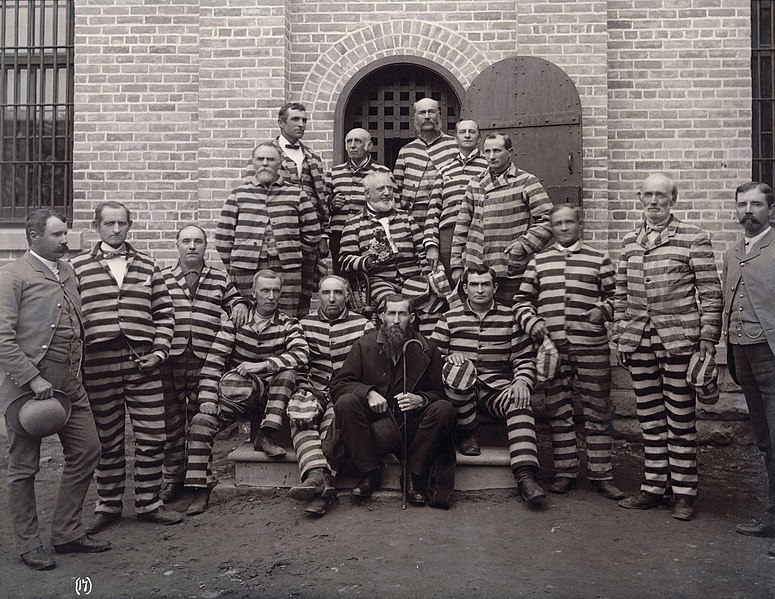
Quayle responds: "I carry the blood of polygamists in my veins. So one should expect that sort of thing, I guess." He adds: "I took the name from my great grandfather, pictured here surrounded by some new friends."


That's a photograph of taken at the Utah Penitentiary in 1889, showing men arrested under the Edmunds-Tucker Act, explained here. Included in the photo is John C. Bennett, who "taught a doctrine of 'spiritual wifery'":
He and associates sought to have illicit sexual relationships with women by telling them that they were married "spiritually," even if they had never been married formally, and that the Prophet approved the arrangement.
That wasn't the correct doctrine, and Bennett got excommunicated, and then he "toured the country speaking against the Latter-day Saints and published a bitter anti-Mormon exposé charging the Saints with licentiousness."

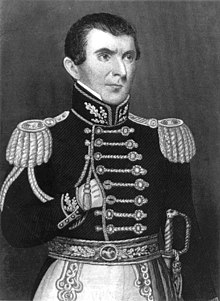
Here's John C. Bennett in happier days...


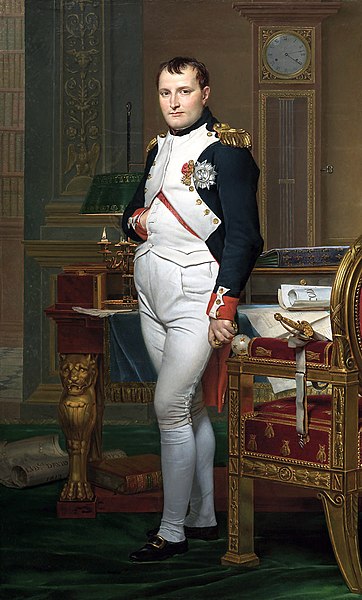
... posing like Napoleon: